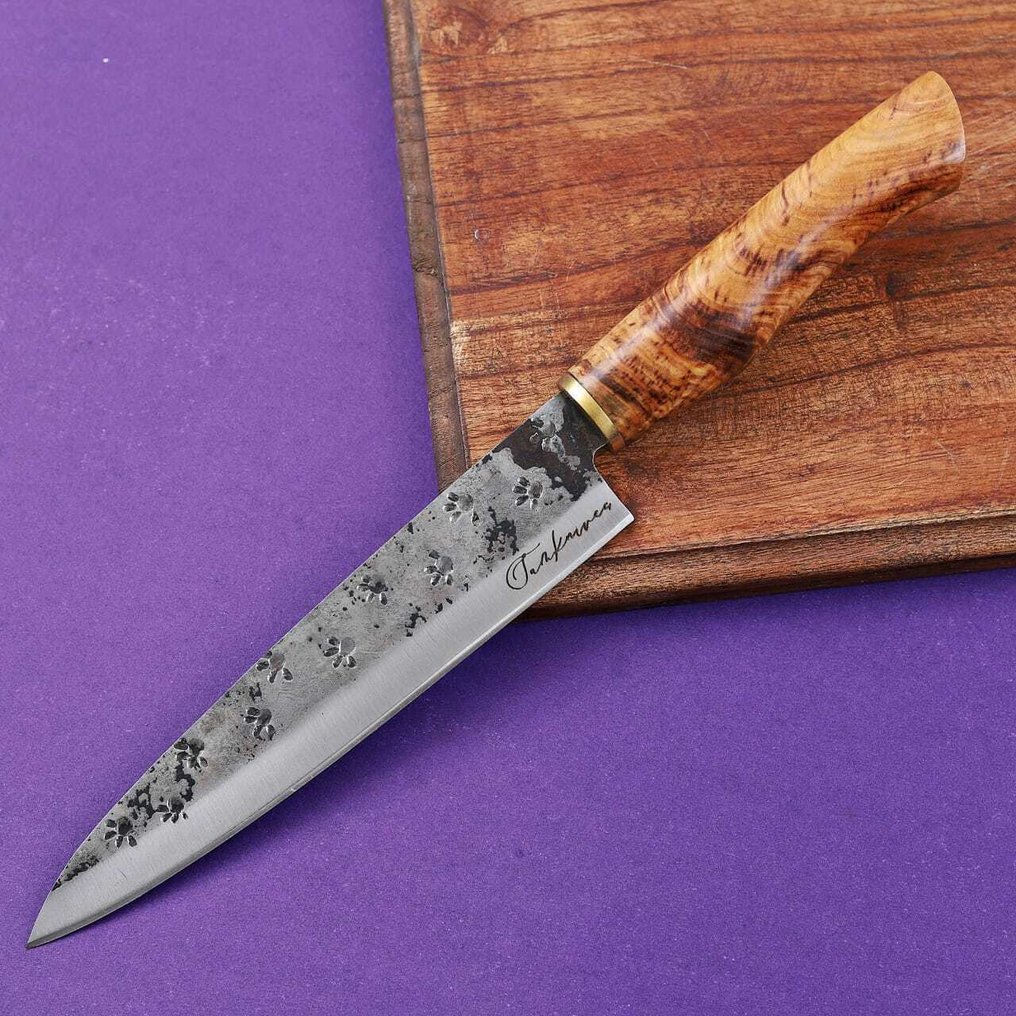
Kitchen knife - R603 - Walnut - Italy - Etched Chef’s Knife


Opens 01 January 2026
Starting bid
€ 1
Add to your favourites to get an alert when the auction starts.

Expert
Selected by Ger van Oers
Owned an antiques and curio shop with a large international network.
Estimate € 150 - € 220
Catawiki Buyer Protection
Your payment’s safe with us until you receive your object.View details
Trustpilot 4.4 | 123294 reviews
Rated Excellent on Trustpilot.
Description from the seller
Size Description
Based on proportions and standard chef knife dimensions:
Blade Length: ~8–10 inches (20–25 cm)
Blade Width: ~1.5–2 inches (4–5 cm)
Handle Length: ~5 inches (12–13 cm)
Overall Length: ~13–15 inches (33–38 cm)
This classifies it as a chef’s knife (Gyuto style) — a multi-purpose kitchen knife.
Description
Blade:
Forged carbon steel or high-carbon stainless steel with a kurouchi (black forge) finish on the upper part — this adds rustic character and some corrosion resistance.
Polished lower edge for a razor-sharp cutting surface.
The tapering point allows for precise slicing and detail work.
Handle:
Made from natural wood (appears to be rosewood or a stabilized hardwood), with a warm brown grain pattern.
Fitted with a brass bolster and end cap, offering durability and balance.
Design Style:
Japanese-inspired with a Western grip, suitable for both home cooks and professionals.
Usage
This knife is versatile for:
Chopping, dicing, and slicing vegetables, fruits, and herbs.
Trimming and portioning meats, fish, or poultry (especially boneless).
Fine prep work such as mincing garlic, herbs, or onions.
Its sharp tip and curved belly make it suitable for both rock chopping and push cutting techniques.
Precautions & Care
Handling:
Use on a stable, soft cutting board (wood or plastic, not glass or marble).
Always cut away from your body and keep your fingers tucked in.
Avoid chopping through bone or frozen food, as it can chip the edge.
Cleaning:
Hand wash immediately after use with warm, mild soapy water.
Dry thoroughly to prevent rust, especially since the blade shows carbon steel characteristics.
Do not put in the dishwasher — heat, moisture, and detergents can damage the handle and blade.
Maintenance:
Hone regularly with a honing rod and sharpen periodically on a whetstone.
Apply a thin coat of food-safe mineral oil to the blade and handle occasionally to prevent corrosion and dryness.
Store in a knife block, magnetic strip, or sheath to protect the edge and ensure safety.
Seller's Story
The Legacy of Hikari : Crafting Perfection in Steel
Founded in the early 1900s in Seki City, Japan, Hikari has been dedicated to the art of knife-making for over a century. Inspired by the craftsmanship of ancient swordsmiths, Hikari established the company with a vision to create knives that combine beauty, sharpness, and durability.
Today, under the guidance of his grandson, Hikari, the company is known worldwide for its high-quality Damascus steel knives, including the popular Signature Series. Each blade is meticulously hand-forged, blending traditional techniques with modern innovation. From the professional kitchen to the home cook, Hikari knives are celebrated for their precision, balance, and timeless design.
Owning a Hikari knife is owning a piece of Japan’s rich heritage, where every blade carries the legacy of over 100 years of craftsmanship and passion.
Size Description
Based on proportions and standard chef knife dimensions:
Blade Length: ~8–10 inches (20–25 cm)
Blade Width: ~1.5–2 inches (4–5 cm)
Handle Length: ~5 inches (12–13 cm)
Overall Length: ~13–15 inches (33–38 cm)
This classifies it as a chef’s knife (Gyuto style) — a multi-purpose kitchen knife.
Description
Blade:
Forged carbon steel or high-carbon stainless steel with a kurouchi (black forge) finish on the upper part — this adds rustic character and some corrosion resistance.
Polished lower edge for a razor-sharp cutting surface.
The tapering point allows for precise slicing and detail work.
Handle:
Made from natural wood (appears to be rosewood or a stabilized hardwood), with a warm brown grain pattern.
Fitted with a brass bolster and end cap, offering durability and balance.
Design Style:
Japanese-inspired with a Western grip, suitable for both home cooks and professionals.
Usage
This knife is versatile for:
Chopping, dicing, and slicing vegetables, fruits, and herbs.
Trimming and portioning meats, fish, or poultry (especially boneless).
Fine prep work such as mincing garlic, herbs, or onions.
Its sharp tip and curved belly make it suitable for both rock chopping and push cutting techniques.
Precautions & Care
Handling:
Use on a stable, soft cutting board (wood or plastic, not glass or marble).
Always cut away from your body and keep your fingers tucked in.
Avoid chopping through bone or frozen food, as it can chip the edge.
Cleaning:
Hand wash immediately after use with warm, mild soapy water.
Dry thoroughly to prevent rust, especially since the blade shows carbon steel characteristics.
Do not put in the dishwasher — heat, moisture, and detergents can damage the handle and blade.
Maintenance:
Hone regularly with a honing rod and sharpen periodically on a whetstone.
Apply a thin coat of food-safe mineral oil to the blade and handle occasionally to prevent corrosion and dryness.
Store in a knife block, magnetic strip, or sheath to protect the edge and ensure safety.
Seller's Story
The Legacy of Hikari : Crafting Perfection in Steel
Founded in the early 1900s in Seki City, Japan, Hikari has been dedicated to the art of knife-making for over a century. Inspired by the craftsmanship of ancient swordsmiths, Hikari established the company with a vision to create knives that combine beauty, sharpness, and durability.
Today, under the guidance of his grandson, Hikari, the company is known worldwide for its high-quality Damascus steel knives, including the popular Signature Series. Each blade is meticulously hand-forged, blending traditional techniques with modern innovation. From the professional kitchen to the home cook, Hikari knives are celebrated for their precision, balance, and timeless design.
Owning a Hikari knife is owning a piece of Japan’s rich heritage, where every blade carries the legacy of over 100 years of craftsmanship and passion.
Details
Era
After 2000
Kitchen knife type
R603
Wood type
Walnut
Title additional information
Etched Chef’s Knife
No. of items
1
Country of Origin
Italy
Material
Steel, Wood
Condition
Excellent condition: barely used with minimal signs of wear
Height
13 in
Width
4.5 in
Depth
2 in
Estimated Period
2020+
Sold by