Whale - Fossil tooth - Basilosaurus - 6 cm (No reserve price)


05
days
19
hours
52
minutes
36
seconds

No bids placed
Catawiki Buyer Protection
Your payment’s safe with us until you receive your object.View details
Trustpilot 4.4 | 122910 reviews
Rated Excellent on Trustpilot.
Description from the seller
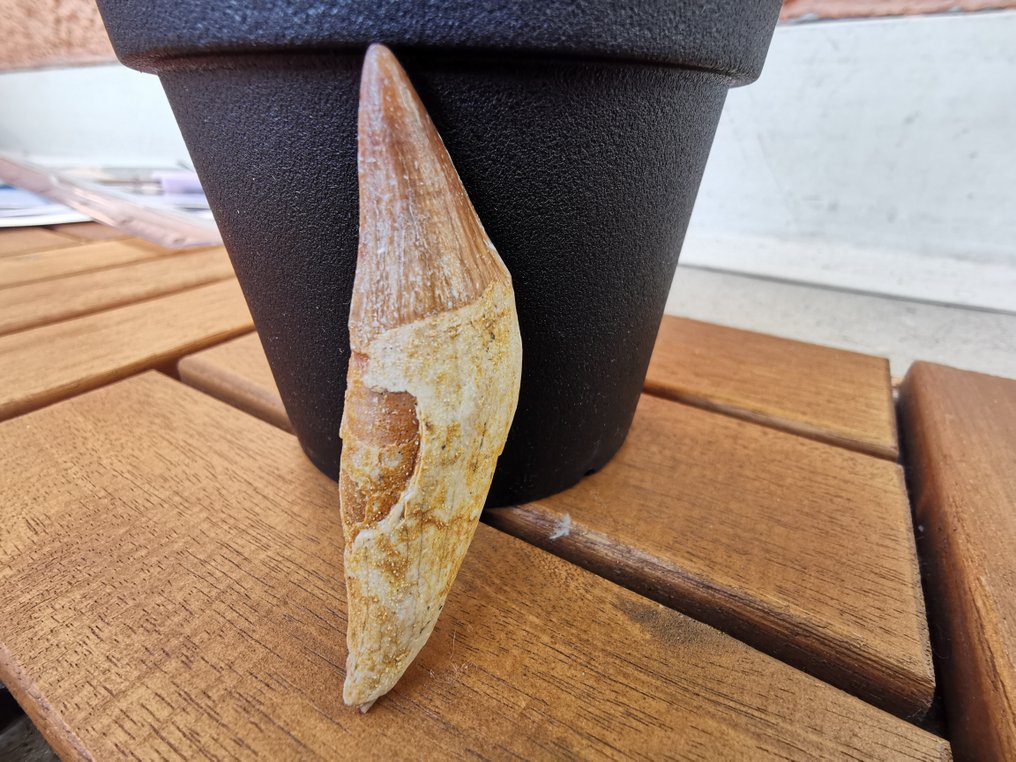
→ 6cm long Basilosaurus canine teeth
It is a very beautiful conical shaped fossil of a Basilosaurus canine teeth which gives a good feeling to hold and look at it reminding of the top preadator of the Late Eocene shallow seas around 38 to 33.9 million years ago. The canines of Basilosaurus are just behind the two front incisors and infront of the molar. Basilosaurus had very prominent heterodont dentition which means a lot of variation in the jaw amongst the teeth. The canine is less curved and more pointed and conical with the purpose of firmly holding the prey and puncturing it and helping to strongly hold onto prey.
This teeth is in excellent shape with no restoration or repair. It has undergone brown colored fossilization at teeth crown and whitish colored fossilization at the root. Interestingly enough, some part of root is exposed which reveals the similar brownish color as that of tooth crown.
Adult Basilosaurus teeth with the root can be more than 12 cm long. Since, this teeth is just 6 cm, its is surely a young Basilosaurus teeth. Basilosaurus was a mammal and mammals shed their teeth in early childhood. So that's also one possibility its a milk teeth of young Basilosaurus. In addition, this teeth could also belong toa young Durodon, which was a smaller member of Basilosauridae family and a favourite prey of Basilosaurus. By no means adult Durodon was small either as it could reach length of 5 meters while Basilosaurus could grow as long as as 20 meters.
The teeth has been professionally conserved to make it long lasting.
Please refer to photos for reference.
→ 6cm long Basilosaurus canine teeth
It is a very beautiful conical shaped fossil of a Basilosaurus canine teeth which gives a good feeling to hold and look at it reminding of the top preadator of the Late Eocene shallow seas around 38 to 33.9 million years ago. The canines of Basilosaurus are just behind the two front incisors and infront of the molar. Basilosaurus had very prominent heterodont dentition which means a lot of variation in the jaw amongst the teeth. The canine is less curved and more pointed and conical with the purpose of firmly holding the prey and puncturing it and helping to strongly hold onto prey.
This teeth is in excellent shape with no restoration or repair. It has undergone brown colored fossilization at teeth crown and whitish colored fossilization at the root. Interestingly enough, some part of root is exposed which reveals the similar brownish color as that of tooth crown.
Adult Basilosaurus teeth with the root can be more than 12 cm long. Since, this teeth is just 6 cm, its is surely a young Basilosaurus teeth. Basilosaurus was a mammal and mammals shed their teeth in early childhood. So that's also one possibility its a milk teeth of young Basilosaurus. In addition, this teeth could also belong toa young Durodon, which was a smaller member of Basilosauridae family and a favourite prey of Basilosaurus. By no means adult Durodon was small either as it could reach length of 5 meters while Basilosaurus could grow as long as as 20 meters.
The teeth has been professionally conserved to make it long lasting.
Please refer to photos for reference.
Details
Number of items
1
Specimen
Whale
Scientific name
Basilosaurus
Country of Origin
Morocco
Geological Period
Paleogene, Eocene (56 - 33.9 million years)
Condition
Natural
Treatment
Conserved
Height
6 cm
Sold by