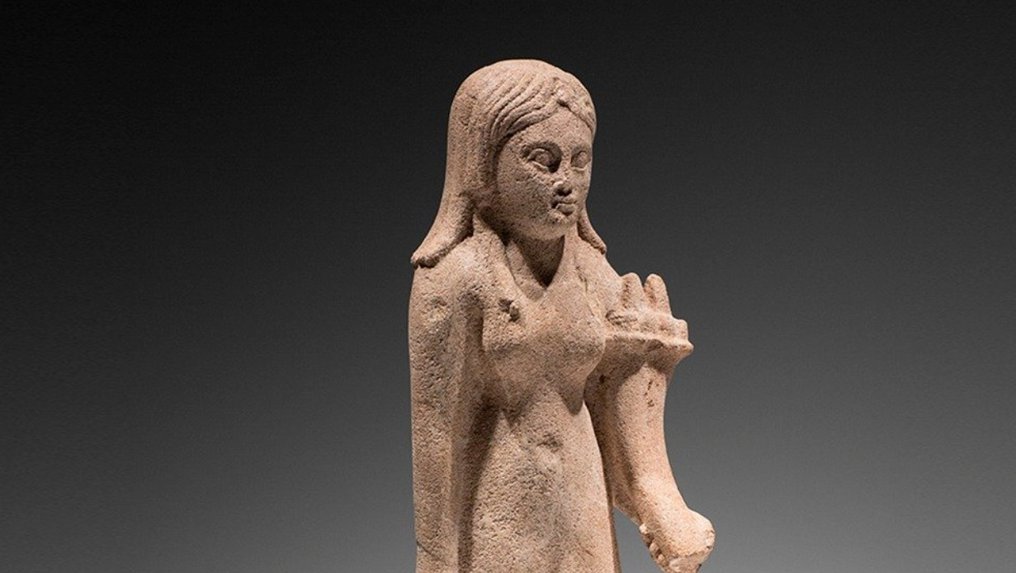
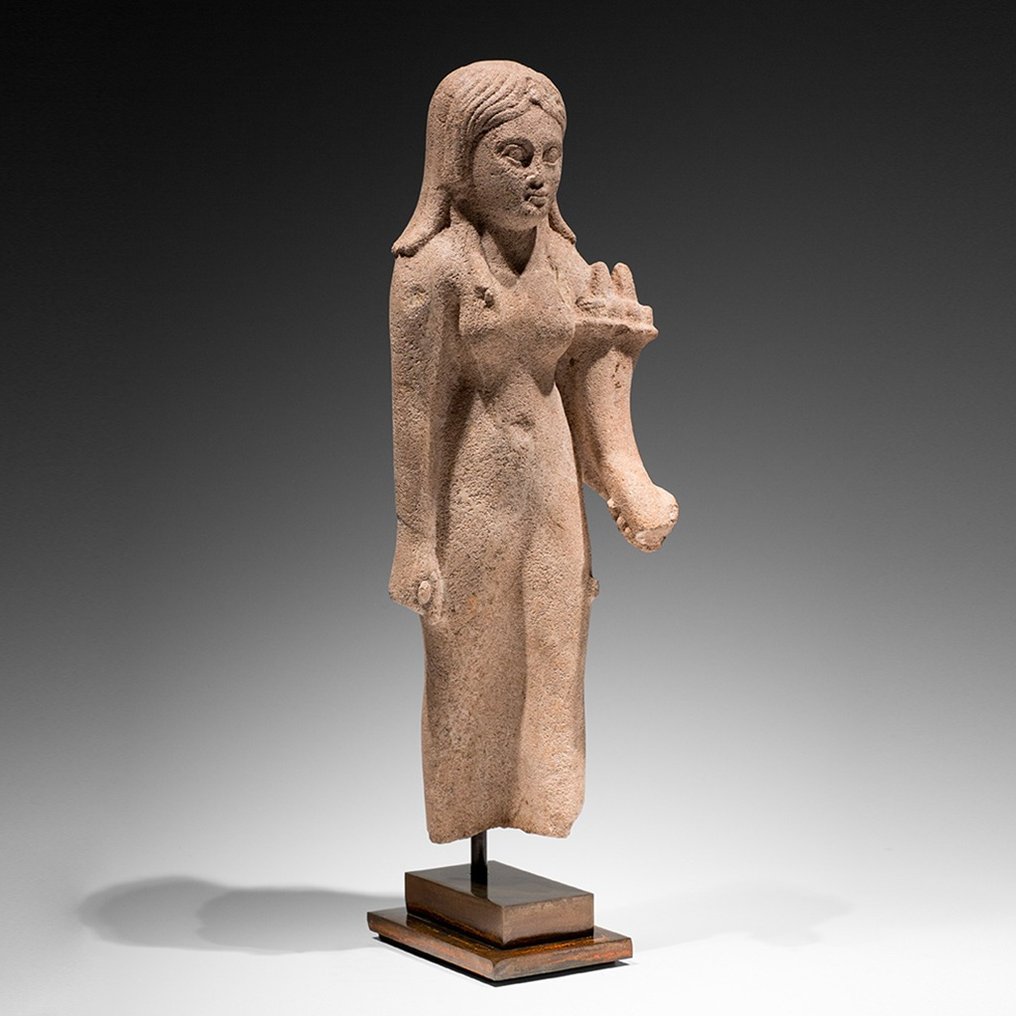
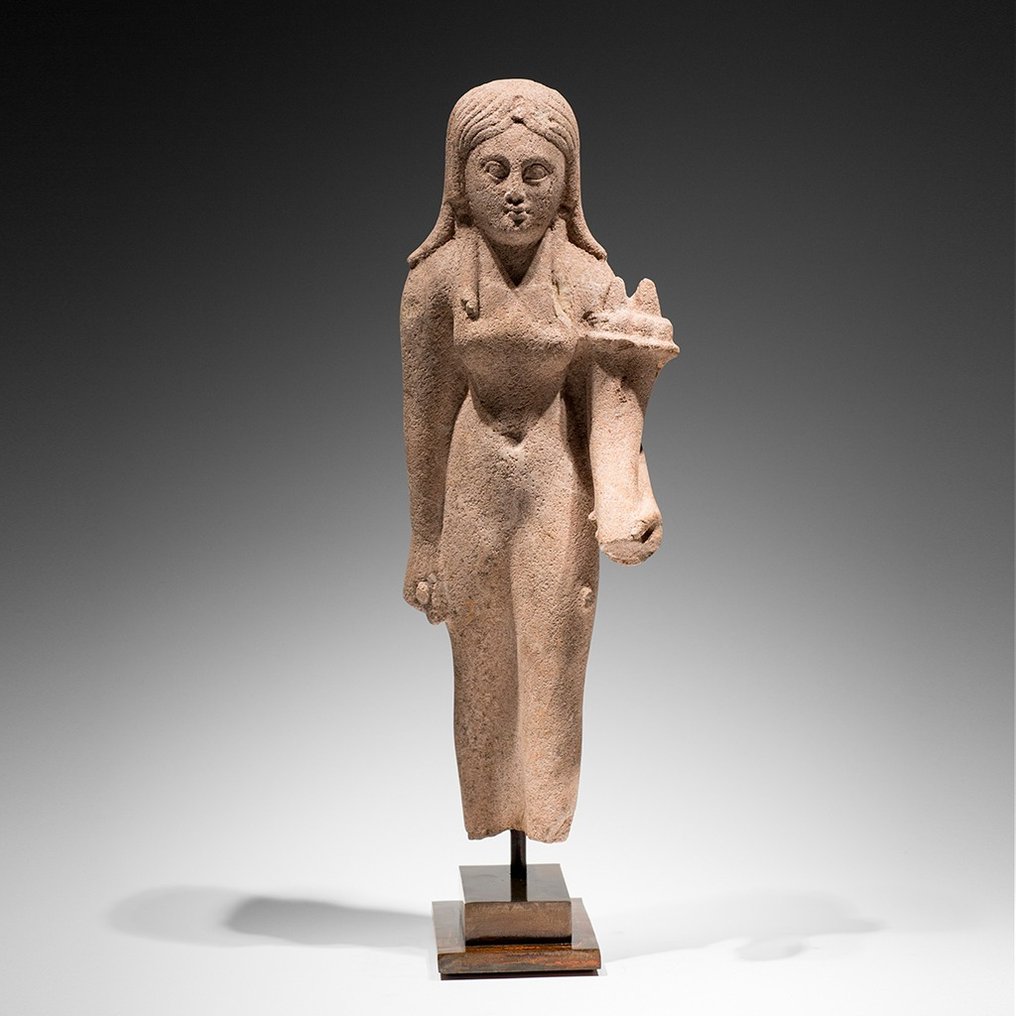
Ancient Egyptian Hardened limestone Sculpture of a Queen. Ptolemaic Period 332-30 BC. 36.5 cm H. Spanish Export License.
07
days
15
hours
10
minutes
47
seconds
Current bid
€ 100
Reserve price not met

Expert
Selected by Ruth Garrido Vila
Directed the Ifergan Collection Museum, specialising in Phoenician and Mediterranean archaeology.
Estimate € 23,000 - € 26,000
8 other people are watching this object
 Bidder 8570 Bidder 8570 | €100 |
|---|
Catawiki Buyer Protection
Your payment’s safe with us until you receive your object.View details
Trustpilot 4.4 | 123077 reviews
Rated Excellent on Trustpilot.
Ancient Egyptian sculpture of a queen from the Ptolemaic Period (332–30 BC), carved in hardened limestone, about 36.5 cm tall, in good condition with a chip on the right plait and missing end of the cornucopia, feet and base.
AI-assisted summary
Description from the seller
Sculpture of a Queen.
- Very Fine Piece -
Ptolemaic Period 332-30 BC.
Hardened limestone.
36.5 cm height.
PROVENANCE:
- Private collection, Belgium, acquired in the 1980s.
- Private collection, François Antonovich, Paris, France.
- Sold by judicial auction in 2022.
CONDITION: In a good general state of preservation, without restoration. There is a chip on the right plait and the end of the cornucopia is missing, as are the feet and the base of the sculpture.
DESCRIPTION:
A sculpture representing a queen of the Greek dynasty of the Ptolemies. During the domination of Egypt by the descendants of Alexander the Great, art underwent a period of change, incorporating classic elements of Egyptian iconography, while it still retained its roots and most essential elements intact.
The hieratic stance of the figure can be clearly appreciated, with the left leg forward as if in movement. The queen would have been positioned on a rectangular base from which a pillar would have risen to support the back of the figure. This was a typical element giving stability to Egyptian representations.
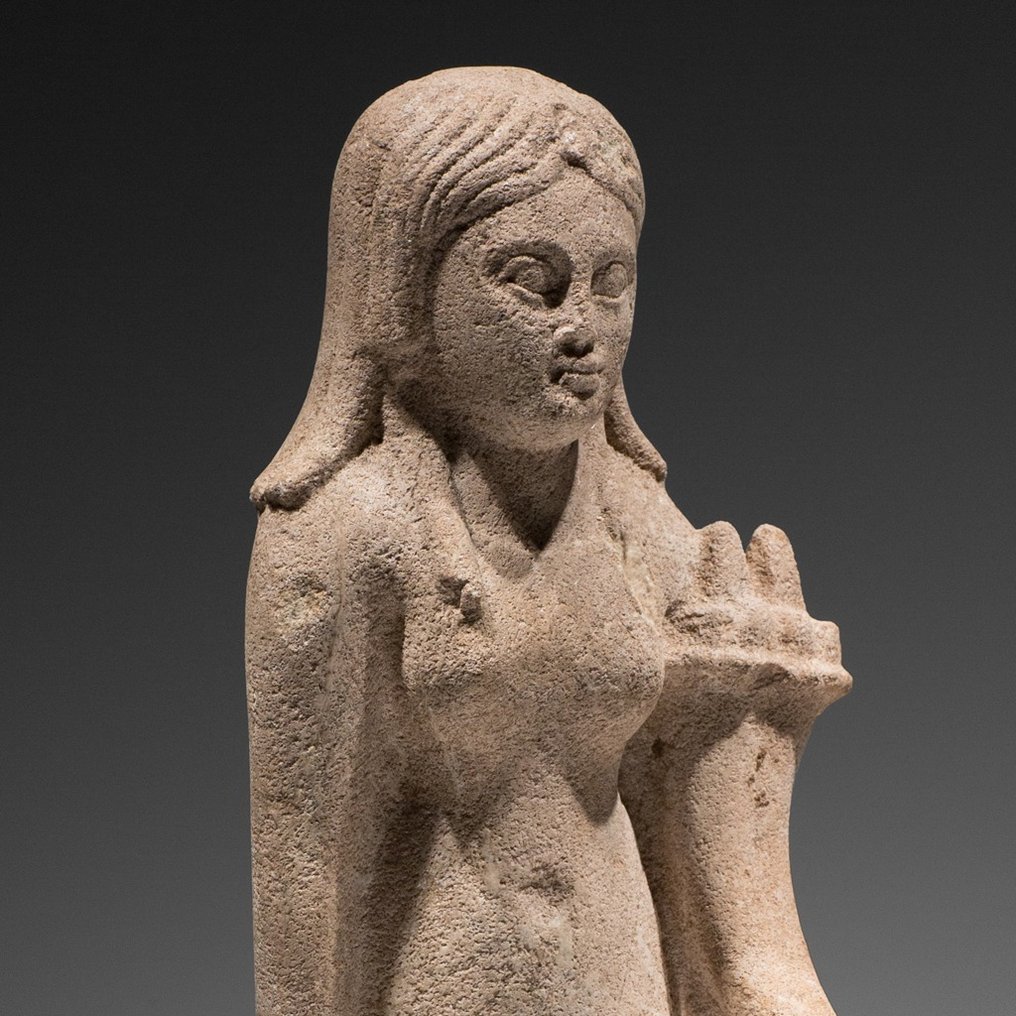
Her body, although without any decoration, is covered by a long-sleeved tunic closely fitting her body from the neck to the ankles. The technique of “panneggio bagnato”, wet drapery, has been used so that the clothing clings so closely that the outlines and details of female anatomy, such as the navel, can be seen to perfection.
The right arm hangs down by the side of the body with the fist closed, holding a ribbon, an Egyptian characteristic seen again and again since the Old Kingdom. The left arm, in contrast, is slightly bent and extended forward, holding a classical emblem, a cornucopia. This is decorated with floral and vegetal elements.
Her rather idealized face has almost spherical, wide-open eyes, a narrow nose with a wide bridge and small lips. Some similar pieces, like those conserved in the Metropolitan Museum of Art in New York, show a name inscribed in a cartouche. Others have faces which, while not definitive depictions of a real queen, bear a close relationship to coins of the period, thus making it possible to attribute a piece as a depiction of a certain person.
The hair or wig is styled in locks of different thicknesses and height which fall vertically.
Sculptures which represent queens of the period have enough specific character for them to be considered to form a class of its own within Ptolemaic art. They were destined to be placed in temples as offerings to the gods, but so that they could be seen by the public. Many examples of these have been found, and they have been rendered in a variety of materials such as marble, faience, granite, basalt and other dark stones. All of them are characterised by the same iconographic elements as can be seen here, with more or less variety in the details.
PUBLICATION: Lord of Truth. J. Bagot Arqueología. Barcelona. 2017. Fig 26.
PARALLELS:
Fig. 1 Statue of a Ptolemaic queen, possibly Cleopatra VII. Metropolitan Museum of Art, New York. Accession Number: 89.2.660
Fig. 2 Statue of Arsione II. Metropolitan Museum of Art, New York. Accession Number: 20.2.21.
Notes:
- The piece includes authenticity certificate.
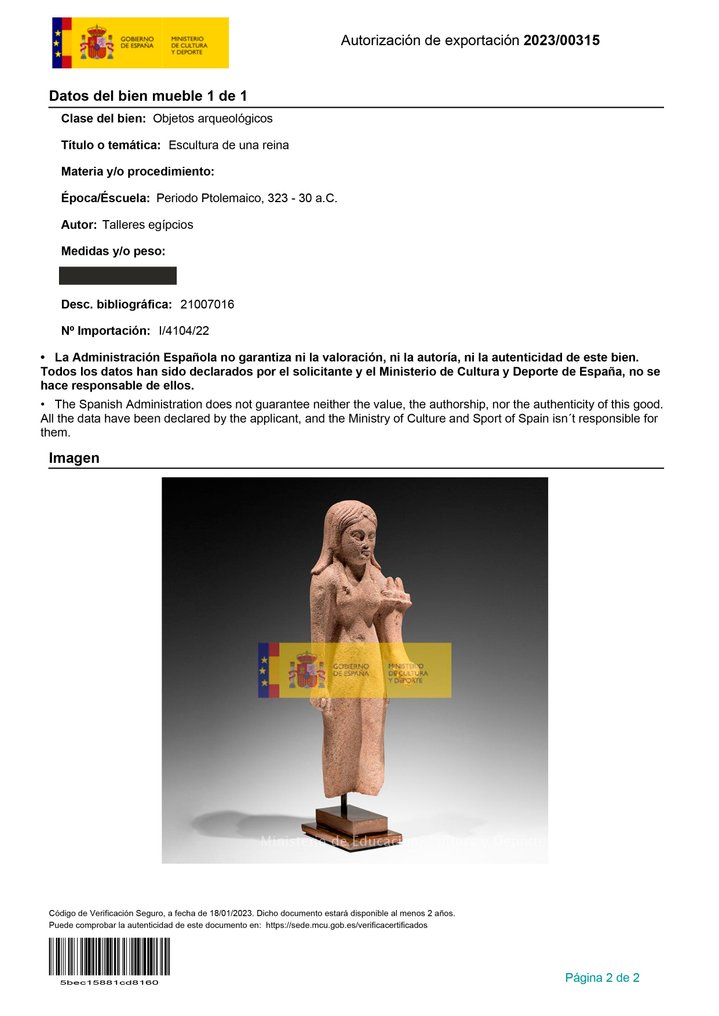
- The piece includes Spanish Export License.
- The seller guarantees that he acquired this piece according to all national and international laws related to the ownership of cultural property. Provenance statement seen by Catawiki.
#ExclusiveCabinetofCuriosities
Seller's Story
Gallery of Ancient Art - Archeology based in Barcelona with more than fifteen years of experience. Specialized in classical art, Egyptian art, Asian art and pre-Columbian art. It guarantees the authenticity of all its pieces. It participates in the most important art fairs in Spain, such as Feriarte, as well as in fairs abroad, BRAFA, Parcours des Mondes, Cultures Brussels.
All the pieces are sent with an Export Permit issued by the Spanish Ministry of Culture.
We are quick to ship via DHL Express or Direct Art Transport.
Translated by Google TranslateSculpture of a Queen.
- Very Fine Piece -
Ptolemaic Period 332-30 BC.
Hardened limestone.
36.5 cm height.
PROVENANCE:
- Private collection, Belgium, acquired in the 1980s.
- Private collection, François Antonovich, Paris, France.
- Sold by judicial auction in 2022.
CONDITION: In a good general state of preservation, without restoration. There is a chip on the right plait and the end of the cornucopia is missing, as are the feet and the base of the sculpture.
DESCRIPTION:
A sculpture representing a queen of the Greek dynasty of the Ptolemies. During the domination of Egypt by the descendants of Alexander the Great, art underwent a period of change, incorporating classic elements of Egyptian iconography, while it still retained its roots and most essential elements intact.
The hieratic stance of the figure can be clearly appreciated, with the left leg forward as if in movement. The queen would have been positioned on a rectangular base from which a pillar would have risen to support the back of the figure. This was a typical element giving stability to Egyptian representations.
Her body, although without any decoration, is covered by a long-sleeved tunic closely fitting her body from the neck to the ankles. The technique of “panneggio bagnato”, wet drapery, has been used so that the clothing clings so closely that the outlines and details of female anatomy, such as the navel, can be seen to perfection.
The right arm hangs down by the side of the body with the fist closed, holding a ribbon, an Egyptian characteristic seen again and again since the Old Kingdom. The left arm, in contrast, is slightly bent and extended forward, holding a classical emblem, a cornucopia. This is decorated with floral and vegetal elements.
Her rather idealized face has almost spherical, wide-open eyes, a narrow nose with a wide bridge and small lips. Some similar pieces, like those conserved in the Metropolitan Museum of Art in New York, show a name inscribed in a cartouche. Others have faces which, while not definitive depictions of a real queen, bear a close relationship to coins of the period, thus making it possible to attribute a piece as a depiction of a certain person.
The hair or wig is styled in locks of different thicknesses and height which fall vertically.
Sculptures which represent queens of the period have enough specific character for them to be considered to form a class of its own within Ptolemaic art. They were destined to be placed in temples as offerings to the gods, but so that they could be seen by the public. Many examples of these have been found, and they have been rendered in a variety of materials such as marble, faience, granite, basalt and other dark stones. All of them are characterised by the same iconographic elements as can be seen here, with more or less variety in the details.
PUBLICATION: Lord of Truth. J. Bagot Arqueología. Barcelona. 2017. Fig 26.
PARALLELS:
Fig. 1 Statue of a Ptolemaic queen, possibly Cleopatra VII. Metropolitan Museum of Art, New York. Accession Number: 89.2.660
Fig. 2 Statue of Arsione II. Metropolitan Museum of Art, New York. Accession Number: 20.2.21.
Notes:
- The piece includes authenticity certificate.
- The piece includes Spanish Export License.
- The seller guarantees that he acquired this piece according to all national and international laws related to the ownership of cultural property. Provenance statement seen by Catawiki.
#ExclusiveCabinetofCuriosities
Seller's Story
Gallery of Ancient Art - Archeology based in Barcelona with more than fifteen years of experience. Specialized in classical art, Egyptian art, Asian art and pre-Columbian art. It guarantees the authenticity of all its pieces. It participates in the most important art fairs in Spain, such as Feriarte, as well as in fairs abroad, BRAFA, Parcours des Mondes, Cultures Brussels.
All the pieces are sent with an Export Permit issued by the Spanish Ministry of Culture.
We are quick to ship via DHL Express or Direct Art Transport.
Translated by Google TranslateDetails
Culture
Ancient Egyptian
Century/ Timeframe
Ptolemaic Period 323-30 BC
Name of object
Sculpture of a Queen. Ptolemaic Period 332-30 BC. 36.5 cm H. Spanish Export License.
Acquired from
Private collection
Material
Hardened limestone
Condition
Good
Disclaimer
The seller was informed by Catawiki about documentation requirements and guarantees the following: - the object was legally obtained, - the seller has the right to sell and/or export the object, as relevant, - the seller will provide the necessary provenance information and arrange required documentation and permits/licenses, as applicable and as per local laws, - the seller will notify the buyer of any delays in obtaining permits/licenses. By bidding, you acknowledge that import documentation may be required depending on your country of residence and that obtaining permits/licenses may cause delays in the delivery of your object.
The seller was informed by Catawiki about documentation requirements and guarantees the following: - the object was legally obtained, - the seller has the right to sell and/or export the object, as relevant, - the seller will provide the necessary provenance information and arrange required documentation and permits/licenses, as applicable and as per local laws, - the seller will notify the buyer of any delays in obtaining permits/licenses. By bidding, you acknowledge that import documentation may be required depending on your country of residence and that obtaining permits/licenses may cause delays in the delivery of your object.
