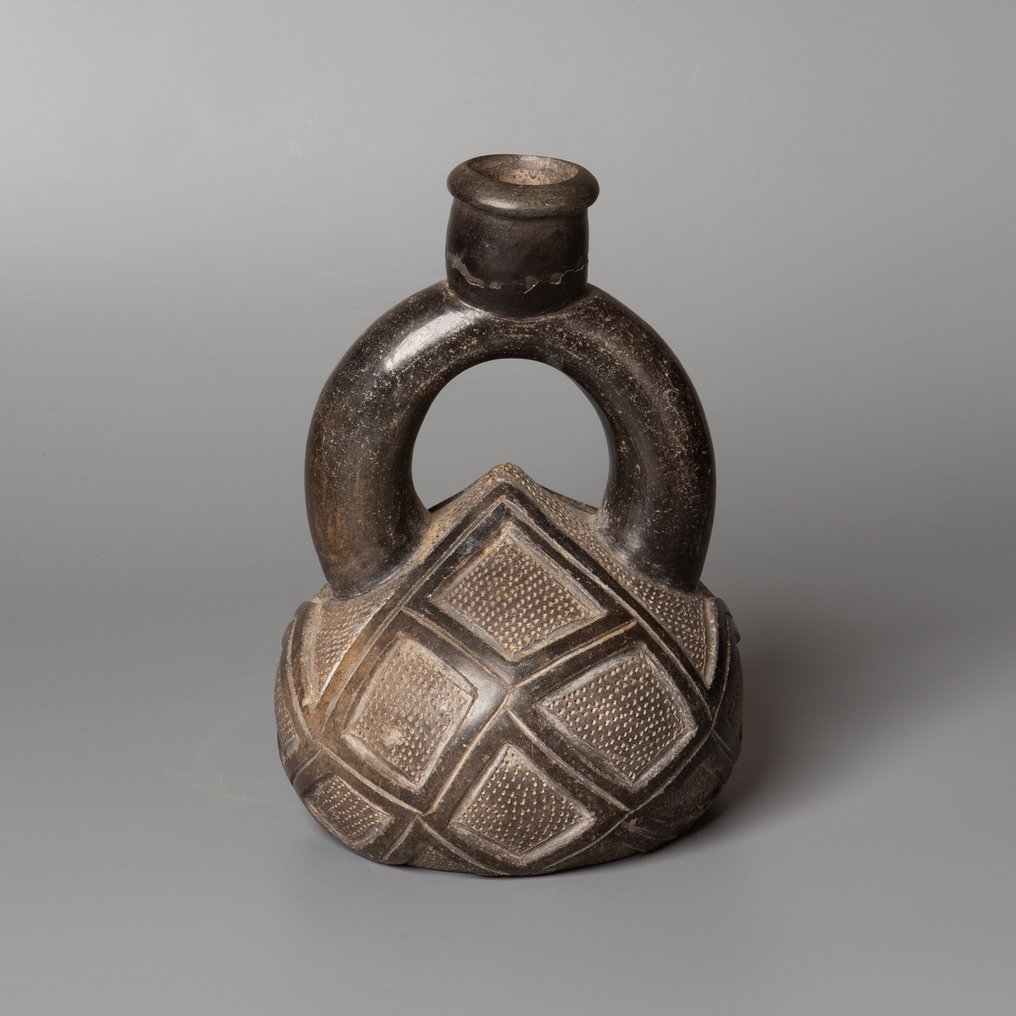
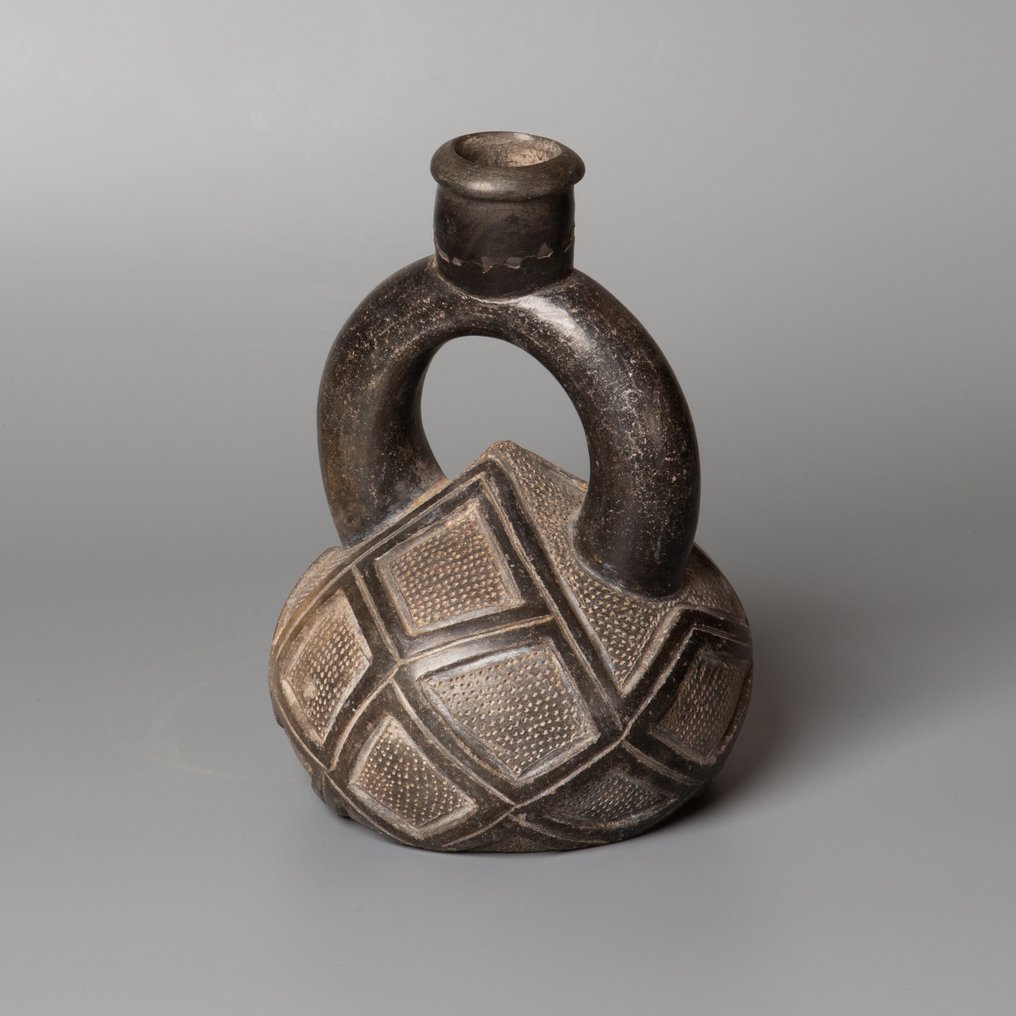
Cupisnique - Chavin, Peru Terracotta Huaco with stirrup handle 1200 - 500 BC. 17.5 cm height. TL TEST. Spanish Export License.


06
days
17
hours
45
minutes
37
seconds
Starting bid
€ 1
Reserve price not met

Expert
Selected by Ruth Garrido Vila
Directed the Ifergan Collection Museum, specialising in Phoenician and Mediterranean archaeology.
Estimate € 2,800 - € 3,100
No bids placed
Catawiki Buyer Protection
Your payment’s safe with us until you receive your object.View details
Trustpilot 4.4 | 123077 reviews
Rated Excellent on Trustpilot.
Cupisnique–Chavin terracotta huaco with a smooth black slip and a stirrup-shaped handle, 17.5 cm high, dated to ca. 1200–500 BC, in very good condition with private collection provenance and including an authenticity certificate and a Spanish export license.
AI-assisted summary
Description from the seller
Huaco with stirrup handle.
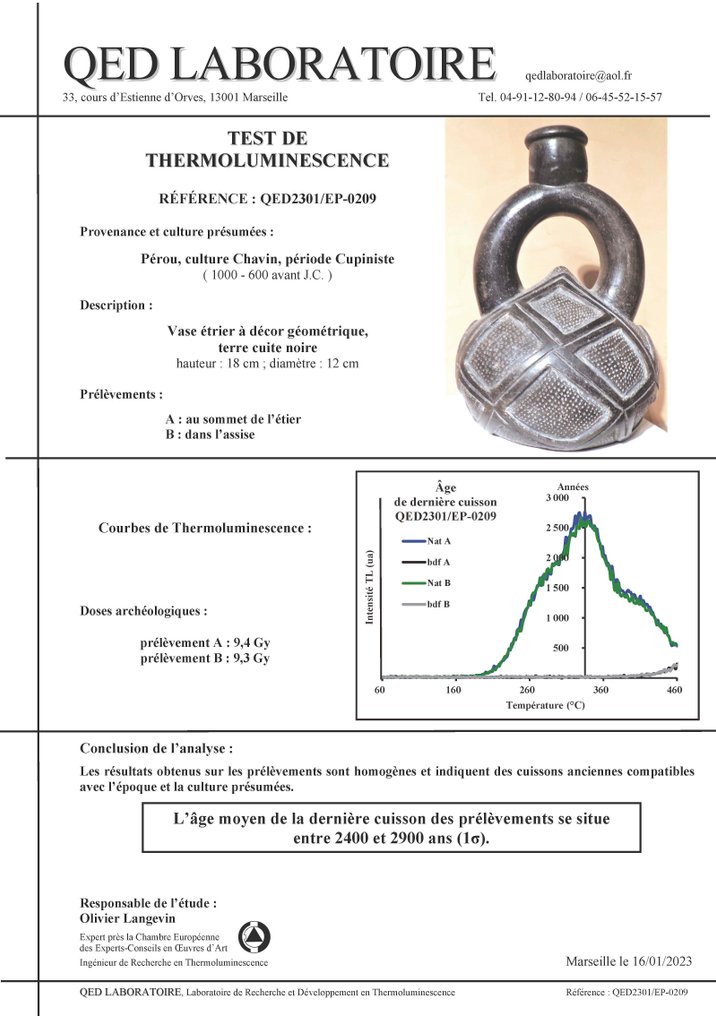
- With thermoluminescence test -
Cupisnique - Chavin, Peru, 1200 - 1551 AD.
Terracotta.
17.5 cm height.
CONDITION: Good condition. Intact.
PROVENANCE:
Private collection of Dr. and Mrs. N. William Wawro, United States of America, 1950 – 1970. Collection numbering incised on the base.
DESCRIPTION:
Periform huaco with smooth circular stirrup handle in black slip. The surface is covered by a decoration of two parallel bands forming diamonds that cover the vase, the interior part is decorated by means of incisions made with a pointed tool.
The huacos are closed vessels, with a globular or sculptural body, a flat base and a tubular stirrup-shaped handle. They have been and are one of the essential elements to know not only the characteristics of this pre-Hispanic culture, but also its society, the natural environment in which it developed and the different stages of its cultural evolution. Its name derives from huaca, the name by which the tombs were designated, since they were plastic vessels for funerary equipment.
The Cupisnique culture, discovered by Rafael Larco in 1930, developed during the Formative Age, three thousand years ago. At this time the temples arise. The artisans make objects loaded with religious content, which will be used in ceremonies, and as funeral offerings.
The Cupisnique modeled their pottery, which they then fired in kilns using wood that produced a lot of smoke, thus obtaining a dark color. The decoration was mainly achieved by incisions. The most characteristic element is the stirrup-shaped handle. They produced sculptural vessels in the shape of animals, fruits, human heads, and houses.
Notes:
- The piece includes authenticity certificate.
- The piece includes Spanish Export License (Passport for European Union) - If the piece is destined outside the European Union a substitution of the export permit should be requested, can take between 1-2 weeks maximum.
- The seller guarantees that he acquired this piece according to all national and international laws related to the ownership of cultural property. Provenance statement seen by Catawiki.
Seller's Story
Gallery of Ancient Art - Archeology based in Barcelona with more than fifteen years of experience. Specialized in classical art, Egyptian art, Asian art and pre-Columbian art. It guarantees the authenticity of all its pieces. It participates in the most important art fairs in Spain, such as Feriarte, as well as in fairs abroad, BRAFA, Parcours des Mondes, Cultures Brussels.
All the pieces are sent with an Export Permit issued by the Spanish Ministry of Culture.
We are quick to ship via DHL Express or Direct Art Transport.
Translated by Google TranslateHuaco with stirrup handle.
- With thermoluminescence test -
Cupisnique - Chavin, Peru, 1200 - 1551 AD.
Terracotta.
17.5 cm height.
CONDITION: Good condition. Intact.
PROVENANCE:
Private collection of Dr. and Mrs. N. William Wawro, United States of America, 1950 – 1970. Collection numbering incised on the base.
DESCRIPTION:
Periform huaco with smooth circular stirrup handle in black slip. The surface is covered by a decoration of two parallel bands forming diamonds that cover the vase, the interior part is decorated by means of incisions made with a pointed tool.
The huacos are closed vessels, with a globular or sculptural body, a flat base and a tubular stirrup-shaped handle. They have been and are one of the essential elements to know not only the characteristics of this pre-Hispanic culture, but also its society, the natural environment in which it developed and the different stages of its cultural evolution. Its name derives from huaca, the name by which the tombs were designated, since they were plastic vessels for funerary equipment.
The Cupisnique culture, discovered by Rafael Larco in 1930, developed during the Formative Age, three thousand years ago. At this time the temples arise. The artisans make objects loaded with religious content, which will be used in ceremonies, and as funeral offerings.
The Cupisnique modeled their pottery, which they then fired in kilns using wood that produced a lot of smoke, thus obtaining a dark color. The decoration was mainly achieved by incisions. The most characteristic element is the stirrup-shaped handle. They produced sculptural vessels in the shape of animals, fruits, human heads, and houses.
Notes:
- The piece includes authenticity certificate.
- The piece includes Spanish Export License (Passport for European Union) - If the piece is destined outside the European Union a substitution of the export permit should be requested, can take between 1-2 weeks maximum.
- The seller guarantees that he acquired this piece according to all national and international laws related to the ownership of cultural property. Provenance statement seen by Catawiki.
Seller's Story
Gallery of Ancient Art - Archeology based in Barcelona with more than fifteen years of experience. Specialized in classical art, Egyptian art, Asian art and pre-Columbian art. It guarantees the authenticity of all its pieces. It participates in the most important art fairs in Spain, such as Feriarte, as well as in fairs abroad, BRAFA, Parcours des Mondes, Cultures Brussels.
All the pieces are sent with an Export Permit issued by the Spanish Ministry of Culture.
We are quick to ship via DHL Express or Direct Art Transport.
Translated by Google TranslateDetails
Culture
Cupisnique - Chavin, Peru
Century/ Timeframe
1200 - 500 BC.
Name of object
Huaco with stirrup handle 1200 - 500 BC. 17.5 cm height. TL TEST. Spanish Export License.
Acquired from
Private collection
Material
Terracotta
Condition
Very good
Disclaimer
The seller was informed by Catawiki about documentation requirements and guarantees the following: - the object was legally obtained, - the seller has the right to sell and/or export the object, as relevant, - the seller will provide the necessary provenance information and arrange required documentation and permits/licenses, as applicable and as per local laws, - the seller will notify the buyer of any delays in obtaining permits/licenses. By bidding, you acknowledge that import documentation may be required depending on your country of residence and that obtaining permits/licenses may cause delays in the delivery of your object.
The seller was informed by Catawiki about documentation requirements and guarantees the following: - the object was legally obtained, - the seller has the right to sell and/or export the object, as relevant, - the seller will provide the necessary provenance information and arrange required documentation and permits/licenses, as applicable and as per local laws, - the seller will notify the buyer of any delays in obtaining permits/licenses. By bidding, you acknowledge that import documentation may be required depending on your country of residence and that obtaining permits/licenses may cause delays in the delivery of your object.
