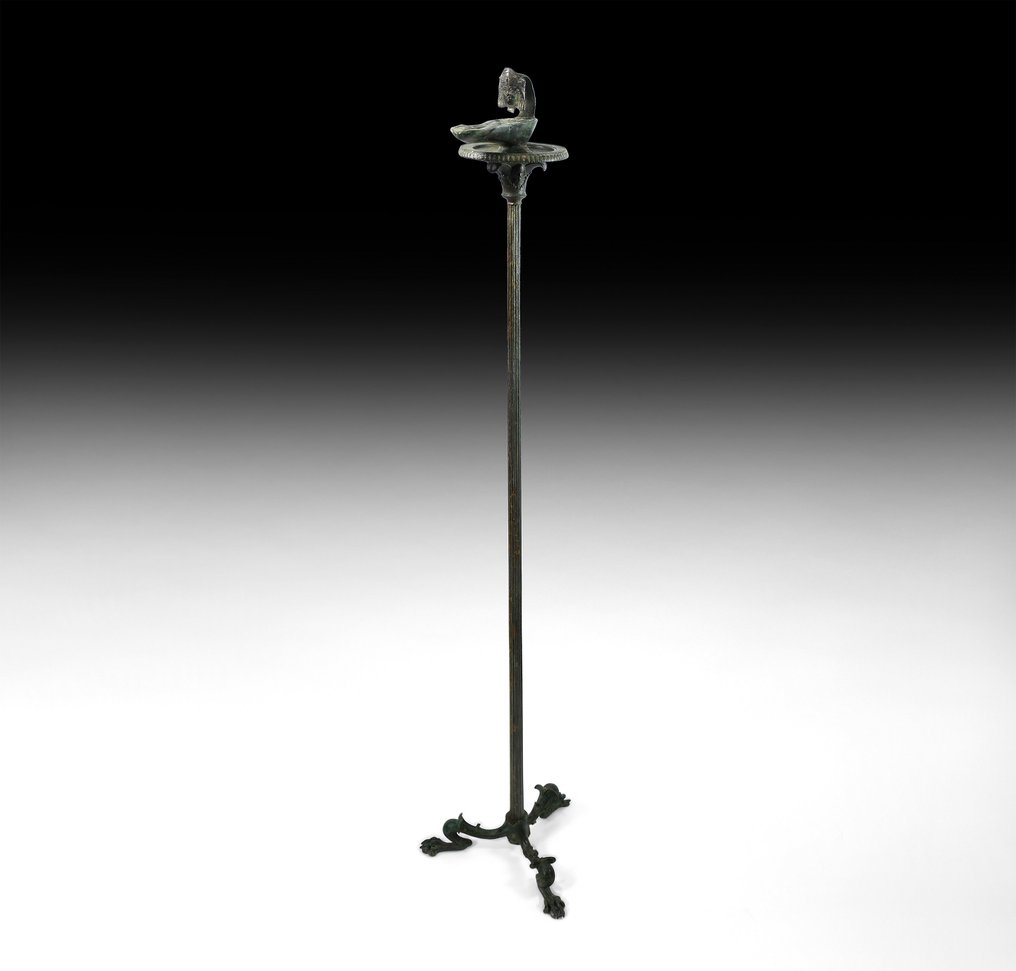
Ancient Roman Bronze Lamp with theatre mask and chandelier. 1st - 2nd century AD. Height 130.17 cm.


10
days
13
hours
33
minutes
07
seconds
Starting bid
€ 1
Reserve price not met

Expert
Selected by Ruth Garrido Vila
Directed the Ifergan Collection Museum, specialising in Phoenician and Mediterranean archaeology.
Estimate € 55,000 - € 61,000
No bids placed
Catawiki Buyer Protection
Your payment’s safe with us until you receive your object.View details
Trustpilot 4.4 | 122910 reviews
Rated Excellent on Trustpilot.
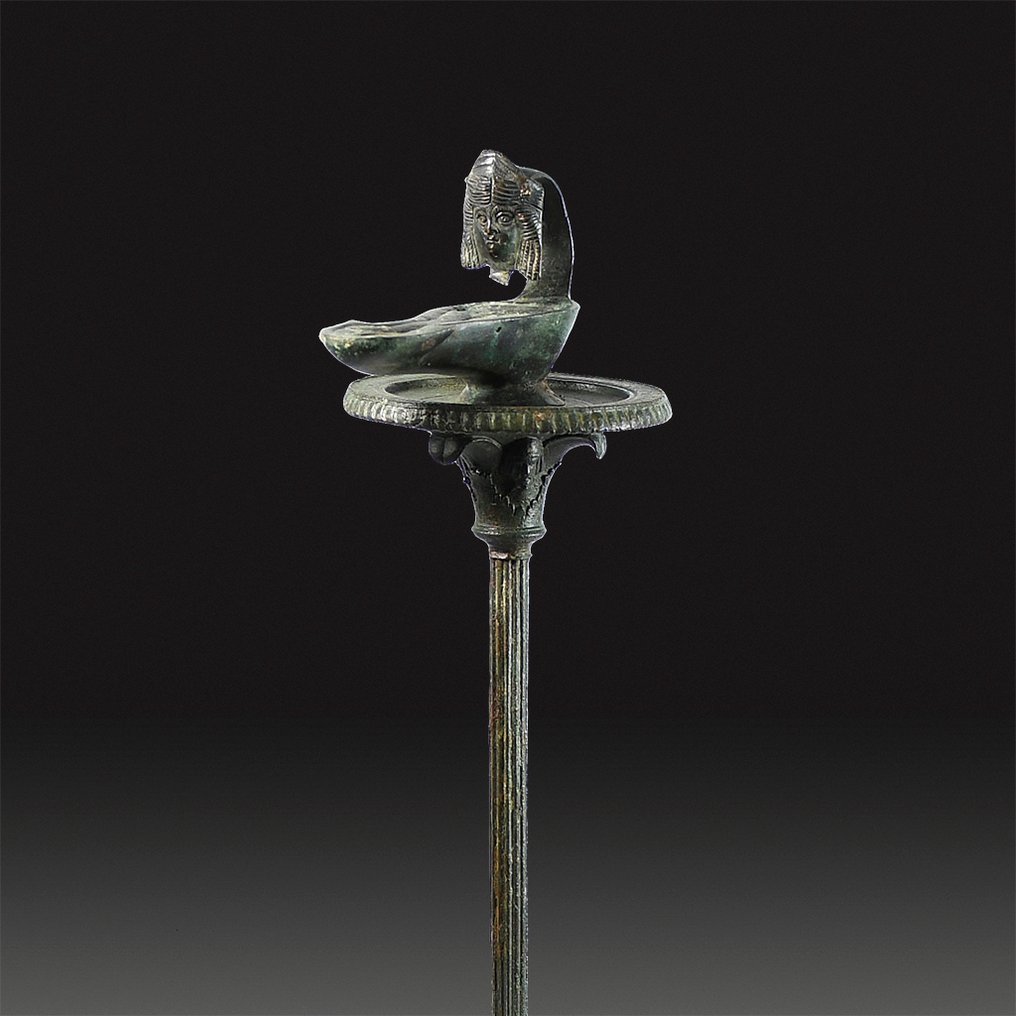
Bronze Ancient Roman lamp with a theatre mask and chandelier dating to the 1st–2nd century AD, with a height of 130.17 cm and a weight of 7 kg, made by lost-wax casting and featuring a long guitar-shaped body and a handle ending in a tragic theatre mask.
AI-assisted summary
Description from the seller
Lamp with theatre mask.
Ancient Roman, 1st - 2nd century AD.
Bronze.
Height 130.17 cm and weight 7kg.
PROVENANCE:
- Private collection, Holland, before 2000.
- Private collection, England.
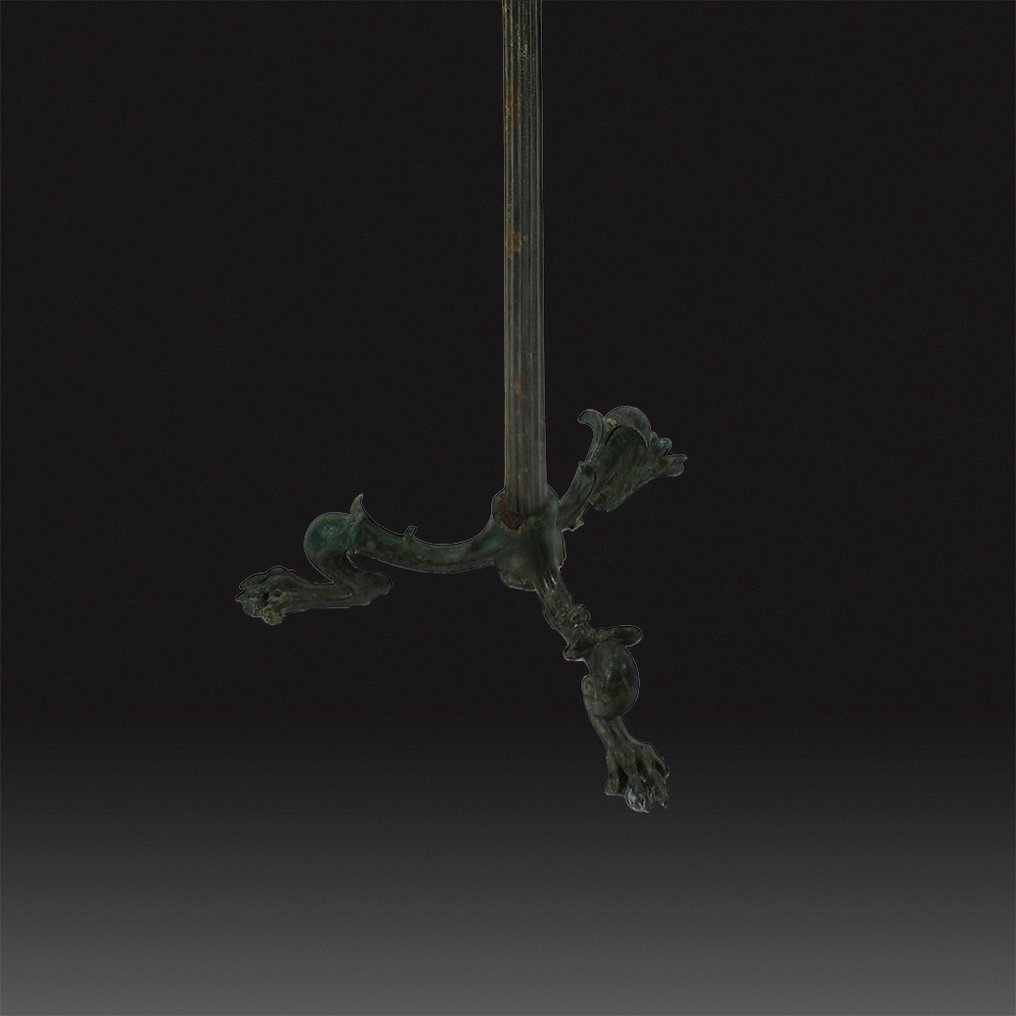
CONDITION: In a good state of conservation, without restorations. The lamp has a small crack in the back of the neck that joins the mask with the body of the lamp. The chandelier has lost two of the four central claws on one of its feet.
DOCUMENTS: Attached is a study on the age of the piece issued by Dr. Raffaele D'Amato. Turin-based researcher of the ancient and medieval military worlds. Doctorate in Roman-Byzantine Law and Doctorate in Roman Military Archaeology. He currently works as deputy director of the Laboratory of the Danube Provinces at the Università Degli Studi di Ferrara.
DESCRIPTION:
A bronze lamp made by the lost wax technique, with the body, or infundibulum, in the form of a long guitar shape. A handle curves up from the back end with a tragic theatre mask terminal.
Ancient Roman lamps were small utensils, normally made from clay, but also made in bronze, which were used by the ancient Romans and later by the Visigoths to provide artificial light. They were fueled by olive oil and had from one to a dozen wicks. Some had handles so they could be moved easily from one room to another. They could also be carried by participants in ritual activities or by actors in plays, as is the case with this piece, as can be seen by the theatre mask terminal decoration.
Masks could be decorated with erotic scenes, with gladiators, mythological figures and floral motifs. These lamps became very popular as they could be collected and were relatively cheap. They were turned out in masse using moulds rather than being hand crafted.
Ethnologists place the origin of masks at the time of the birth of self-consciousness. Their use goes back far in antiquity and they can be found in use among the Egyptians, Greeks and Romans. The Greeks used them in Dionysian festivals, the Romans during the lupercalia and saturnalia festivals and other theatrical representations.
Among the Greeks and Romans, masks were a sort of helmet that entirely covered the head. As well as displaying very marked facial features, they had hair, ears and beards. The Greeks were the first to use them in theatres so that the actors could resemble physically the characters whose roles they were playing. Ritual festivals gave way to theatrical representations which set a distance between the theatrical character and the masked actor.
The technique of lost wax casting is a sculptural procedure using a mould made from a prototype of the piece to be worked, and this prototype is usually made from beeswax. This is covered with a thick layer of soft material, usually clay, which then solidifies. Once this has hardened it is put in a kiln where the wax inside melts and leaks out through expressly made holes in the clay. In its place molten metal is injected and this takes on the exact form of the mould. To release the final piece the mould must be removed.
BIBLIOGRAPHY:
- BAILEY, D.M. A catalogue of the lamps in the British Museum, IV, Lamps of metal and stone, and lampstand. London. 1996. nn. Q3669, Q3670, Q3871, Q3669, Q3882, Q3911.
- GREEN, J. R. Roman bronze lamps with masks: Dionysos, Pantomime and Mediterraneas popular culture. Heron. Journal on Hellenistic and Roman material culture. Vol 1. Leuven University Press. 2012.
- ROBERTS, P. Life and death in Pompeii and Herculaneum. London. 2013.
Notes:
- The piece includes authenticity certificate.
- The piece includes Spanish Export License (Passport for European Union) - If the piece is destined outside the European Union a substitution of the export permit should be requested, can take between 1-2 weeks maximum.
- The seller guarantees that he acquired this piece according to all national and international laws related to the ownership of cultural property. Provenance statement seen by Catawiki.
Seller's Story
Gallery of Ancient Art - Archeology based in Barcelona with more than fifteen years of experience. Specialized in classical art, Egyptian art, Asian art and pre-Columbian art. It guarantees the authenticity of all its pieces. It participates in the most important art fairs in Spain, such as Feriarte, as well as in fairs abroad, BRAFA, Parcours des Mondes, Cultures Brussels.
All the pieces are sent with an Export Permit issued by the Spanish Ministry of Culture.
We are quick to ship via DHL Express or Direct Art Transport.
Translated by Google TranslateLamp with theatre mask.
Ancient Roman, 1st - 2nd century AD.
Bronze.
Height 130.17 cm and weight 7kg.
PROVENANCE:
- Private collection, Holland, before 2000.
- Private collection, England.
CONDITION: In a good state of conservation, without restorations. The lamp has a small crack in the back of the neck that joins the mask with the body of the lamp. The chandelier has lost two of the four central claws on one of its feet.
DOCUMENTS: Attached is a study on the age of the piece issued by Dr. Raffaele D'Amato. Turin-based researcher of the ancient and medieval military worlds. Doctorate in Roman-Byzantine Law and Doctorate in Roman Military Archaeology. He currently works as deputy director of the Laboratory of the Danube Provinces at the Università Degli Studi di Ferrara.
DESCRIPTION:
A bronze lamp made by the lost wax technique, with the body, or infundibulum, in the form of a long guitar shape. A handle curves up from the back end with a tragic theatre mask terminal.
Ancient Roman lamps were small utensils, normally made from clay, but also made in bronze, which were used by the ancient Romans and later by the Visigoths to provide artificial light. They were fueled by olive oil and had from one to a dozen wicks. Some had handles so they could be moved easily from one room to another. They could also be carried by participants in ritual activities or by actors in plays, as is the case with this piece, as can be seen by the theatre mask terminal decoration.
Masks could be decorated with erotic scenes, with gladiators, mythological figures and floral motifs. These lamps became very popular as they could be collected and were relatively cheap. They were turned out in masse using moulds rather than being hand crafted.
Ethnologists place the origin of masks at the time of the birth of self-consciousness. Their use goes back far in antiquity and they can be found in use among the Egyptians, Greeks and Romans. The Greeks used them in Dionysian festivals, the Romans during the lupercalia and saturnalia festivals and other theatrical representations.
Among the Greeks and Romans, masks were a sort of helmet that entirely covered the head. As well as displaying very marked facial features, they had hair, ears and beards. The Greeks were the first to use them in theatres so that the actors could resemble physically the characters whose roles they were playing. Ritual festivals gave way to theatrical representations which set a distance between the theatrical character and the masked actor.
The technique of lost wax casting is a sculptural procedure using a mould made from a prototype of the piece to be worked, and this prototype is usually made from beeswax. This is covered with a thick layer of soft material, usually clay, which then solidifies. Once this has hardened it is put in a kiln where the wax inside melts and leaks out through expressly made holes in the clay. In its place molten metal is injected and this takes on the exact form of the mould. To release the final piece the mould must be removed.
BIBLIOGRAPHY:
- BAILEY, D.M. A catalogue of the lamps in the British Museum, IV, Lamps of metal and stone, and lampstand. London. 1996. nn. Q3669, Q3670, Q3871, Q3669, Q3882, Q3911.
- GREEN, J. R. Roman bronze lamps with masks: Dionysos, Pantomime and Mediterraneas popular culture. Heron. Journal on Hellenistic and Roman material culture. Vol 1. Leuven University Press. 2012.
- ROBERTS, P. Life and death in Pompeii and Herculaneum. London. 2013.
Notes:
- The piece includes authenticity certificate.
- The piece includes Spanish Export License (Passport for European Union) - If the piece is destined outside the European Union a substitution of the export permit should be requested, can take between 1-2 weeks maximum.
- The seller guarantees that he acquired this piece according to all national and international laws related to the ownership of cultural property. Provenance statement seen by Catawiki.
Seller's Story
Gallery of Ancient Art - Archeology based in Barcelona with more than fifteen years of experience. Specialized in classical art, Egyptian art, Asian art and pre-Columbian art. It guarantees the authenticity of all its pieces. It participates in the most important art fairs in Spain, such as Feriarte, as well as in fairs abroad, BRAFA, Parcours des Mondes, Cultures Brussels.
All the pieces are sent with an Export Permit issued by the Spanish Ministry of Culture.
We are quick to ship via DHL Express or Direct Art Transport.
Translated by Google TranslateDetails
Culture
Ancient Roman
Century/ Timeframe
1st - 2nd century AD
Name of object
Lamp with theatre mask and chandelier. 1st - 2nd century AD. Height 130.17 cm.
Acquired from
Private collection
Material
Bronze
Condition
Good
Disclaimer
The seller was informed by Catawiki about documentation requirements and guarantees the following: - the object was legally obtained, - the seller has the right to sell and/or export the object, as relevant, - the seller will provide the necessary provenance information and arrange required documentation and permits/licenses, as applicable and as per local laws, - the seller will notify the buyer of any delays in obtaining permits/licenses. By bidding, you acknowledge that import documentation may be required depending on your country of residence and that obtaining permits/licenses may cause delays in the delivery of your object.
The seller was informed by Catawiki about documentation requirements and guarantees the following: - the object was legally obtained, - the seller has the right to sell and/or export the object, as relevant, - the seller will provide the necessary provenance information and arrange required documentation and permits/licenses, as applicable and as per local laws, - the seller will notify the buyer of any delays in obtaining permits/licenses. By bidding, you acknowledge that import documentation may be required depending on your country of residence and that obtaining permits/licenses may cause delays in the delivery of your object.
