Ancient Greek, Attica Pottery Bell Krater with warriors. MASTERPIECE of the Persephone Painter. Circa 450 BC. 36 cm H. TL Test.


05
days
04
hours
22
minutes
51
seconds
Current bid
€ 4,020
Reserve price not met

Expert
Selected by Ruth Garrido Vila
Directed the Ifergan Collection Museum, specialising in Phoenician and Mediterranean archaeology.
Estimate € 135,000 - € 150,000
55 other people are watching this object
 Bidder 3626 Bidder 3626 | €4,020 | |
|---|---|---|
 Bidder 3829 Bidder 3829 | €3,820 | |
| Bidder 3829 | €3,620 | |
Catawiki Buyer Protection
Your payment’s safe with us until you receive your object.View details
Trustpilot 4.4 | 123878 reviews
Rated Excellent on Trustpilot.
Bell krater with three warriors, attributed to the Persephone Painter, circa 450 BC, Attica, pottery, height 36 cm, repaired from fragments with no repainting, from a private Belgian collection since the 1970s, verified with a thermoluminescence test and export license.
AI-assisted summary
Description from the seller
Krater with warriors
CULTURE: Greek, Attica
PERIOD: Circa 450 BC
AUTHOR: Attributed to the Persephone Painter by a main expert and scholar of Attic painted vases and museum curtator. (Details will be provided to the buyer).
MATERIAL: Pottery
DIMENSIONS: Height 36 cm.
PROVENANCE: Private collection, Belgium, 1970s.
PUBLICATIONS:
- Imagenes Praeteriti. J. Bagot Arqueología. Barcelona. 2016. Fig 20.
- Puerta de los Dioses. J. Bagot Arqueología. Barcelona. 2016. Fig 30.
- Lord of Truth. J. Bagot Arqueología. Barcelona. 2017. Fig 31.
EXHIBITIONS:
- TEFAF, Maastricht 2012 with a price of 280.000 € (more information will be provided to the buyer).
- BRAFA, Brussels, 2016.
CONDITION: Repaired from original fragments, without any missing fragment and without repainting.
DOCUMENTS:
-With Thermoluminescence test,
-With export license issued by the Ministry of Culture.
-With Art loss register certificate.
DESCRIPTION:
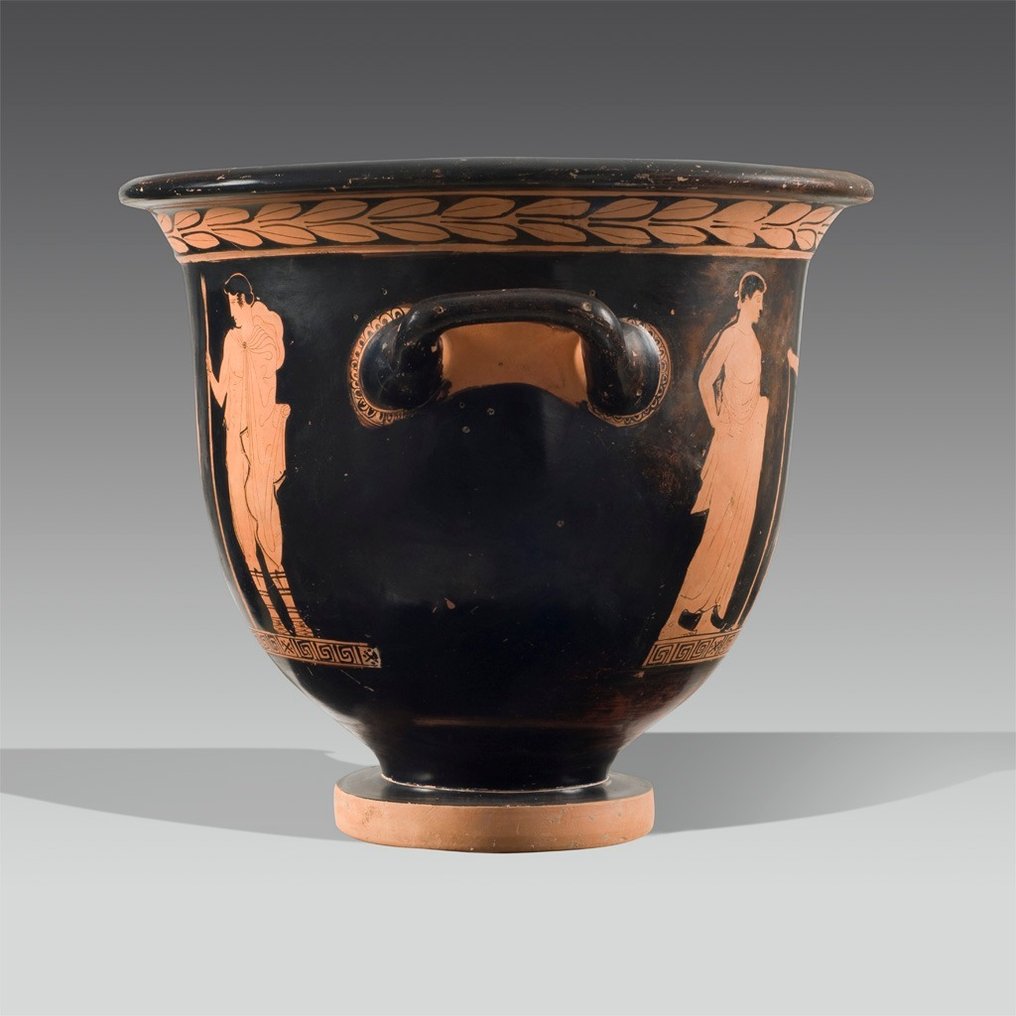
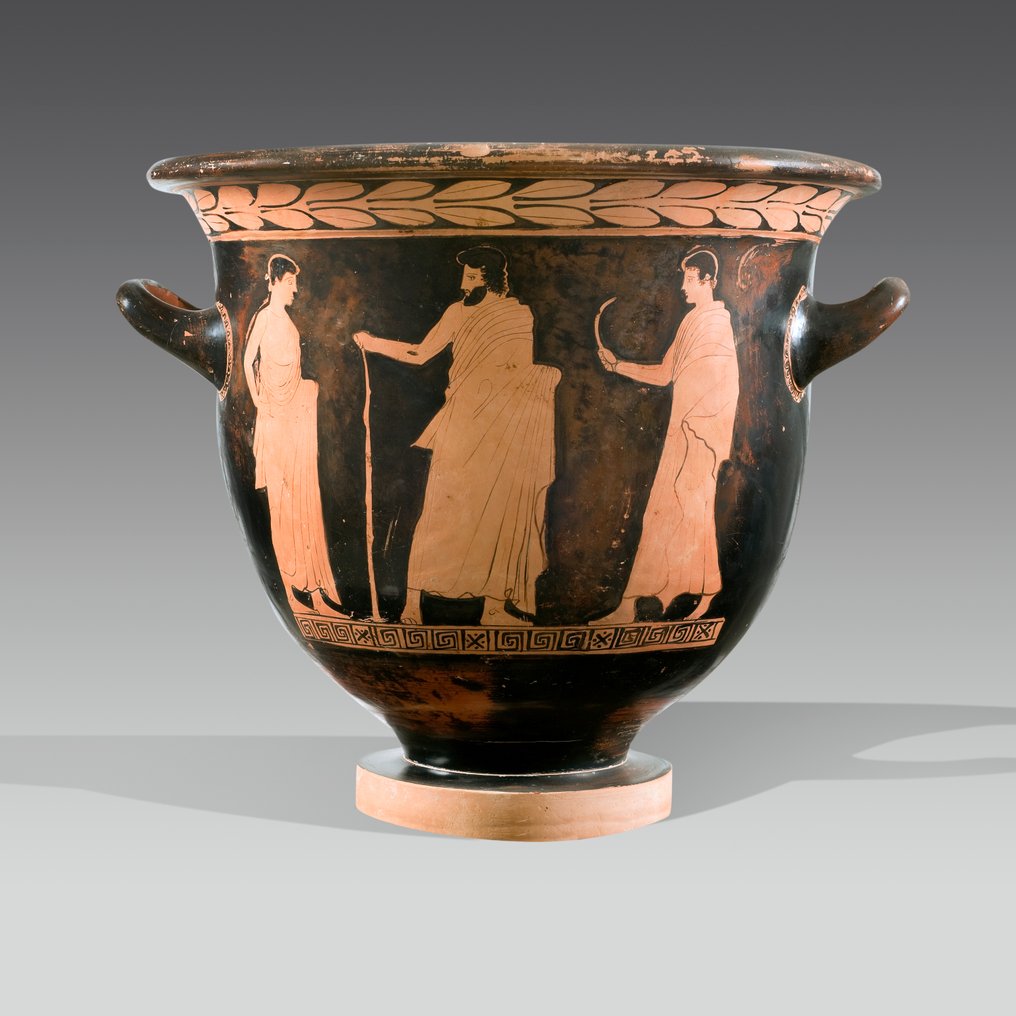
Bell krater with a scene framed below on the body of the vase by a band of meander and above, by a laurel leaf wreath around the outer rim of the bell.
The obverse, side A, is decorated with three warriors. The central one is naked, is wearing a helmet, and carrying a spear and shield. The warrior on the right is wearing a helmet and a breastplate, and is carrying a spear. The one on the left is wearing a chlamys, sandals and a hat, and is carrying a double spear.
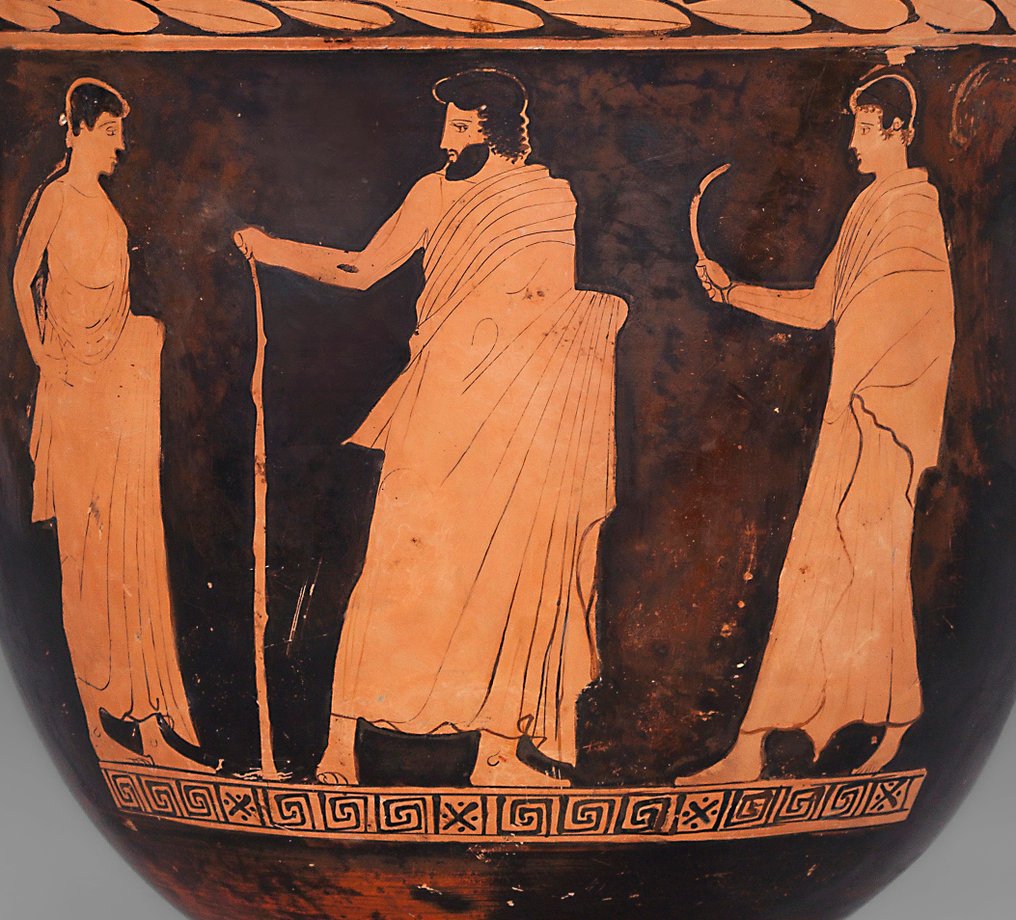
On the reverse, side B, three athletes clothed in himations, can be seen in conversation. The central one holds a sceptre and has a beard (possibly the trainer from the palaistra) . The one on the left is carrying a strigil.
The quality of the painting is the product of a master drawer, some details such as the interior of the shield of the central figure if side A of the vase makes this crater a masterpiece to be compared with the best known works by the Persephone Painter and the attic vase painting of his period, Athens 450’s B.C. in the middle of Persephone painter when he produced his most refined works.
The Persephone Painter, who worked from about 475 to 425 BC, is the pseudonym of an ancient Attic Greek vase painter, given this name by John Beazley after his investigations of red-figure kraters to try to identify the different artists. As in other cases, the name comes from one particular krater that helped him to identify this particular artist, a krater on which is drawn the mythological scene of the return of Persephone from Hades. This piece can be seen in the Metropolitan Museum of Art in New York. This painter is known for his close relationship to the Achilles Painter, through whose workshop the Persephone Painter passed.
There are only 26 works attributed to the Persephone Painter. Among them there are both large and small vases. This indicates not only the importance of this piece as an object, but also its rarity, as there are so few other pieces of this master artist in existence. There are known to scholars only 3 other bell kraters to exist by this artist, them all in public collections. The one at New York (NY), Metropolitan Museum with inventory 1928.57.23 witch is the vase that gives the name to this artist and the most celebrated vase by his hand, one at Munich Antikensammlungen with inventory 8955 and one at the Toledo (Ohio) Museum with inventory 1967.154. Our Krater is as fine as the best known examples, the MET one and the one in Toledo. Also is the only known bell krater by the Persephone painter still in private hands and the first one to appear over the market on the last 6 decades, when the Metropolitan museum bought his example.
We know also some calyx kraters and other large vases by this artist but most of them not as refined as the bell kraters known. The shape of the bell krater with a large, relatively flat areas gives the opportunity to a master painter to produce large and detailed figures more than any other shape of Greek vases.
The krater is a type of Greek pottery used to mix water and wine and from which cups were filled. It was moved to the space were a meal was to be eaten and was placed either on the ground or on a dais and the steward in charge of drawing the wine used a ladle to pour it into the guests’ cups. Kraters were mostly ceramic but some were made from precious metals, and were made in a variety of shapes according to the taste of the artist, although they did always have a wide mouth. The mostly widely occurring ones are column kraters, calyx kraters, bell kraters and volute ones.
Red-figure pottery was one of the most important figurative styles of Greek production. It developed in Greece around the year 530 BC and was used until the 3rd Century BC. It took the place of the previously dominant style of black-figure pottery within a few decades. The technical base was the same in both cases, but in the red-figure pieces the colour was reversed, so that the figures stood out against a dark background as if they were lit up by theatrical lighting, following a more natural scheme. The painters who worked with black figures were forced to keep motifs clearly separated one from the other and to limit the complexity of the illustration. In contrast, the red-figure technique allowed greater freedom. Each figure was silhouetted against a dark background allowing the painters to render anatomic details with greater exactitude and variety.
The technique consisted of painting motifs on a still moist piece, using a transparent glossy slip which, on firing, took on an intense black coloration. The motifs were therefore invisible before the firing and so painters had to work completely from memory without seeing the result of their work beforehand. Once the piece had been fired the zones not covered by the slip retained the reddish tone of the clay, while those that had been “painted” with the slip took on a dense, brilliant black coloration.
PARALLELS:
Works of the Persephone Painter:
- Bell krater with Helen and Menelaus at the sacking of Troy (440 - 430 BC). Toledo Museum of Art Toledo, Ohio, USA.
- Calyx krater with Odysseus pursuing Cyrene. Inventory Number: 41.83. Metropolitan Museum of Art, New York, USA.
- Bell krater with the return of Persephone from Hades. Inventory Number: 28.57.23. Metropolitan Museum of Art, New York, USA.
BIBLIOGRAPHY
- BOARDMAN, J. Athenian Red Figure Vases. Thames and Hudson World of Art. 2003.
Notes:
The seller guarantees that he acquired this piece according to all national and international laws related to the ownership of cultural property. Provenance statement seen by Catawiki.
The piece includes authenticity certificate.
The piece includes Spanish Export License (Passport for European Union) - If the piece is destined outside the European Union a substitution of the export permit should be requested. This process could take between 1 and 2 months.
#ancientolympics
Seller's Story
Gallery of Ancient Art - Archeology based in Barcelona with more than fifteen years of experience. Specialized in classical art, Egyptian art, Asian art and pre-Columbian art. It guarantees the authenticity of all its pieces. It participates in the most important art fairs in Spain, such as Feriarte, as well as in fairs abroad, BRAFA, Parcours des Mondes, Cultures Brussels.
All the pieces are sent with an Export Permit issued by the Spanish Ministry of Culture.
We are quick to ship via DHL Express or Direct Art Transport.
Translated by Google TranslateKrater with warriors
CULTURE: Greek, Attica
PERIOD: Circa 450 BC
AUTHOR: Attributed to the Persephone Painter by a main expert and scholar of Attic painted vases and museum curtator. (Details will be provided to the buyer).
MATERIAL: Pottery
DIMENSIONS: Height 36 cm.
PROVENANCE: Private collection, Belgium, 1970s.
PUBLICATIONS:
- Imagenes Praeteriti. J. Bagot Arqueología. Barcelona. 2016. Fig 20.
- Puerta de los Dioses. J. Bagot Arqueología. Barcelona. 2016. Fig 30.
- Lord of Truth. J. Bagot Arqueología. Barcelona. 2017. Fig 31.
EXHIBITIONS:
- TEFAF, Maastricht 2012 with a price of 280.000 € (more information will be provided to the buyer).
- BRAFA, Brussels, 2016.
CONDITION: Repaired from original fragments, without any missing fragment and without repainting.
DOCUMENTS:
-With Thermoluminescence test,
-With export license issued by the Ministry of Culture.
-With Art loss register certificate.
DESCRIPTION:
Bell krater with a scene framed below on the body of the vase by a band of meander and above, by a laurel leaf wreath around the outer rim of the bell.
The obverse, side A, is decorated with three warriors. The central one is naked, is wearing a helmet, and carrying a spear and shield. The warrior on the right is wearing a helmet and a breastplate, and is carrying a spear. The one on the left is wearing a chlamys, sandals and a hat, and is carrying a double spear.
On the reverse, side B, three athletes clothed in himations, can be seen in conversation. The central one holds a sceptre and has a beard (possibly the trainer from the palaistra) . The one on the left is carrying a strigil.
The quality of the painting is the product of a master drawer, some details such as the interior of the shield of the central figure if side A of the vase makes this crater a masterpiece to be compared with the best known works by the Persephone Painter and the attic vase painting of his period, Athens 450’s B.C. in the middle of Persephone painter when he produced his most refined works.
The Persephone Painter, who worked from about 475 to 425 BC, is the pseudonym of an ancient Attic Greek vase painter, given this name by John Beazley after his investigations of red-figure kraters to try to identify the different artists. As in other cases, the name comes from one particular krater that helped him to identify this particular artist, a krater on which is drawn the mythological scene of the return of Persephone from Hades. This piece can be seen in the Metropolitan Museum of Art in New York. This painter is known for his close relationship to the Achilles Painter, through whose workshop the Persephone Painter passed.
There are only 26 works attributed to the Persephone Painter. Among them there are both large and small vases. This indicates not only the importance of this piece as an object, but also its rarity, as there are so few other pieces of this master artist in existence. There are known to scholars only 3 other bell kraters to exist by this artist, them all in public collections. The one at New York (NY), Metropolitan Museum with inventory 1928.57.23 witch is the vase that gives the name to this artist and the most celebrated vase by his hand, one at Munich Antikensammlungen with inventory 8955 and one at the Toledo (Ohio) Museum with inventory 1967.154. Our Krater is as fine as the best known examples, the MET one and the one in Toledo. Also is the only known bell krater by the Persephone painter still in private hands and the first one to appear over the market on the last 6 decades, when the Metropolitan museum bought his example.
We know also some calyx kraters and other large vases by this artist but most of them not as refined as the bell kraters known. The shape of the bell krater with a large, relatively flat areas gives the opportunity to a master painter to produce large and detailed figures more than any other shape of Greek vases.
The krater is a type of Greek pottery used to mix water and wine and from which cups were filled. It was moved to the space were a meal was to be eaten and was placed either on the ground or on a dais and the steward in charge of drawing the wine used a ladle to pour it into the guests’ cups. Kraters were mostly ceramic but some were made from precious metals, and were made in a variety of shapes according to the taste of the artist, although they did always have a wide mouth. The mostly widely occurring ones are column kraters, calyx kraters, bell kraters and volute ones.
Red-figure pottery was one of the most important figurative styles of Greek production. It developed in Greece around the year 530 BC and was used until the 3rd Century BC. It took the place of the previously dominant style of black-figure pottery within a few decades. The technical base was the same in both cases, but in the red-figure pieces the colour was reversed, so that the figures stood out against a dark background as if they were lit up by theatrical lighting, following a more natural scheme. The painters who worked with black figures were forced to keep motifs clearly separated one from the other and to limit the complexity of the illustration. In contrast, the red-figure technique allowed greater freedom. Each figure was silhouetted against a dark background allowing the painters to render anatomic details with greater exactitude and variety.
The technique consisted of painting motifs on a still moist piece, using a transparent glossy slip which, on firing, took on an intense black coloration. The motifs were therefore invisible before the firing and so painters had to work completely from memory without seeing the result of their work beforehand. Once the piece had been fired the zones not covered by the slip retained the reddish tone of the clay, while those that had been “painted” with the slip took on a dense, brilliant black coloration.
PARALLELS:
Works of the Persephone Painter:
- Bell krater with Helen and Menelaus at the sacking of Troy (440 - 430 BC). Toledo Museum of Art Toledo, Ohio, USA.
- Calyx krater with Odysseus pursuing Cyrene. Inventory Number: 41.83. Metropolitan Museum of Art, New York, USA.
- Bell krater with the return of Persephone from Hades. Inventory Number: 28.57.23. Metropolitan Museum of Art, New York, USA.
BIBLIOGRAPHY
- BOARDMAN, J. Athenian Red Figure Vases. Thames and Hudson World of Art. 2003.
Notes:
The seller guarantees that he acquired this piece according to all national and international laws related to the ownership of cultural property. Provenance statement seen by Catawiki.
The piece includes authenticity certificate.
The piece includes Spanish Export License (Passport for European Union) - If the piece is destined outside the European Union a substitution of the export permit should be requested. This process could take between 1 and 2 months.
#ancientolympics
Seller's Story
Gallery of Ancient Art - Archeology based in Barcelona with more than fifteen years of experience. Specialized in classical art, Egyptian art, Asian art and pre-Columbian art. It guarantees the authenticity of all its pieces. It participates in the most important art fairs in Spain, such as Feriarte, as well as in fairs abroad, BRAFA, Parcours des Mondes, Cultures Brussels.
All the pieces are sent with an Export Permit issued by the Spanish Ministry of Culture.
We are quick to ship via DHL Express or Direct Art Transport.
Translated by Google TranslateDetails
Culture
Ancient Greek, Attica
Century/ Timeframe
Circa 450 BC
Name of object
Bell Krater with warriors. MASTERPIECE of the Persephone Painter. Circa 450 BC. 36 cm H. TL Test.
Acquired from
Private collection
Year acquired
2013
Material
Pottery
Country acquired from
Belgium
Condition
Very good
Previous owner acquired from
Gallery / Antique dealer
Previous owner - year acquired
1970
Previous owner - country acquired from
Belgium
I verify that I have obtained this object legally and that I am allowed to sell it
Yes
Disclaimer
The seller was informed by Catawiki about documentation requirements and guarantees the following: - the object was legally obtained, - the seller has the right to sell and/or export the object, as relevant, - the seller will provide the necessary provenance information and arrange required documentation and permits/licenses, as applicable and as per local laws, - the seller will notify the buyer of any delays in obtaining permits/licenses. By bidding, you acknowledge that import documentation may be required depending on your country of residence and that obtaining permits/licenses may cause delays in the delivery of your object.
The seller was informed by Catawiki about documentation requirements and guarantees the following: - the object was legally obtained, - the seller has the right to sell and/or export the object, as relevant, - the seller will provide the necessary provenance information and arrange required documentation and permits/licenses, as applicable and as per local laws, - the seller will notify the buyer of any delays in obtaining permits/licenses. By bidding, you acknowledge that import documentation may be required depending on your country of residence and that obtaining permits/licenses may cause delays in the delivery of your object.
