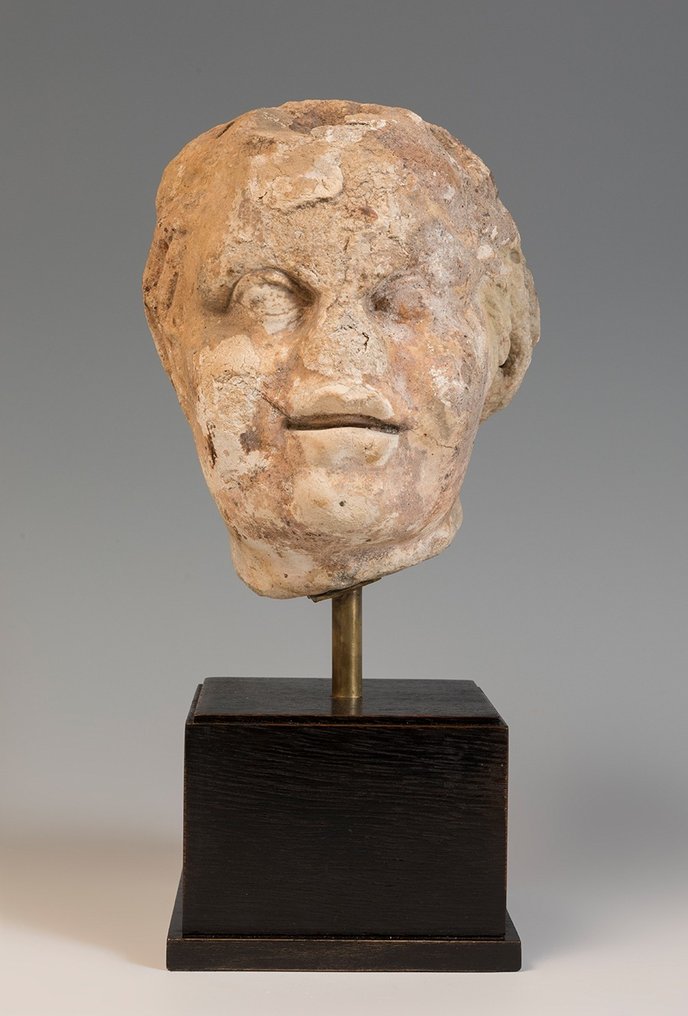
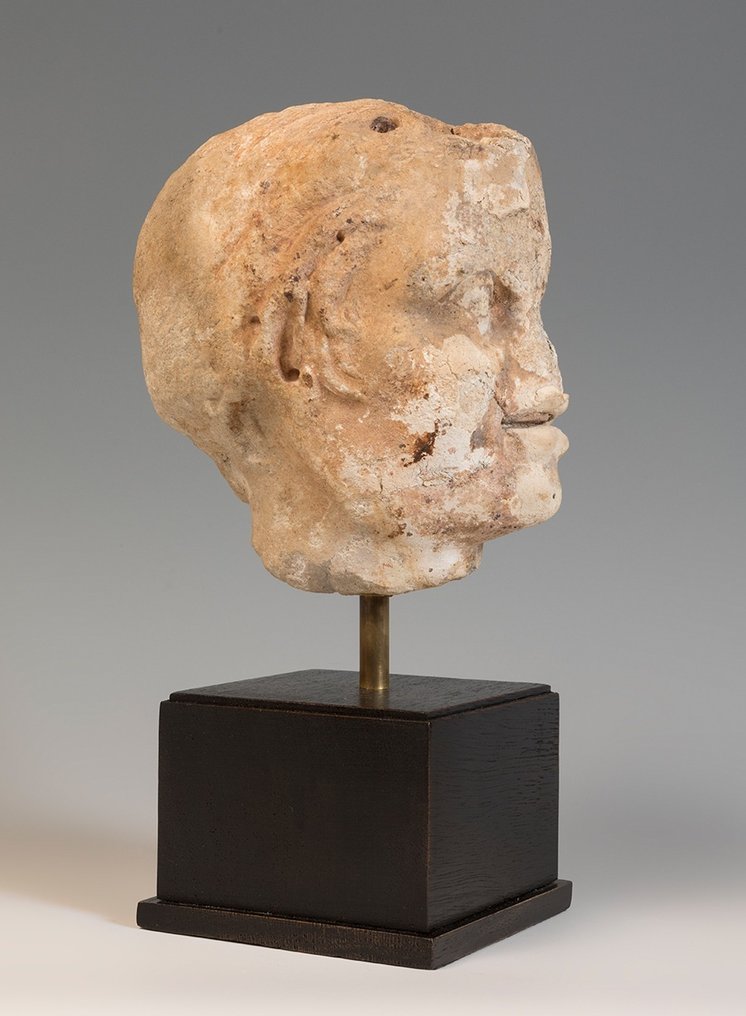
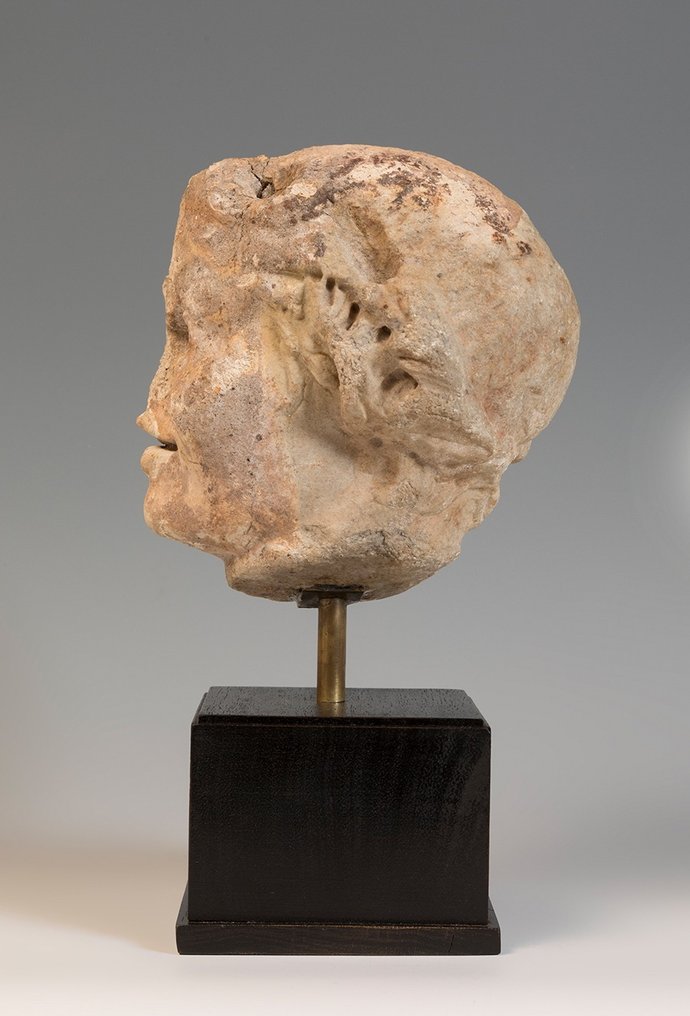
Ancient Roman Marble Head of a Satyr. 1st - 3rd century AD. 30 cm H. Spanish Export Permit.

09
days
09
hours
32
minutes
30
seconds
Current bid
€ 2
Reserve price not met

Expert
Selected by Ruth Garrido Vila
Directed the Ifergan Collection Museum, specialising in Phoenician and Mediterranean archaeology.
Estimate € 9,900 - € 10,900
6 other people are watching this object
 Bidder 6261 Bidder 6261 | €2 | |
|---|---|---|
| Bidder 6261 | €1 |
Catawiki Buyer Protection
Your payment’s safe with us until you receive your object.View details
Trustpilot 4.4 | 122986 reviews
Rated Excellent on Trustpilot.
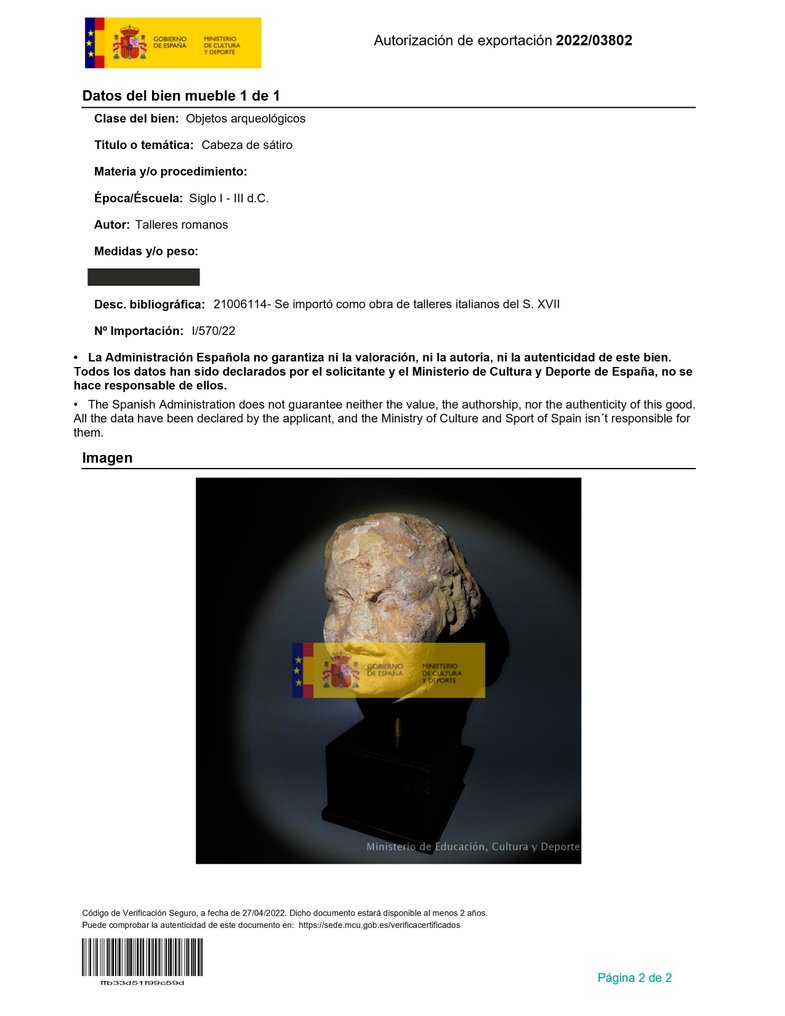
Ancient Roman marble head of a satyr, 30 cm high with stand (17 cm without stand), dating to 1st–3rd century AD; provenance from a private collection in Berlin, Germany; acquired in 2021 at auction; good condition, not restored; includes Spanish export permit and authentication certificate.
AI-assisted summary
Description from the seller
Head of a Satyr
- refined style -
Roman Empire, 1st - 3rd century AD
MATERIAL: Marble.
DIMENSIONS: 30 cm height with stand, 17 cm height without stand.
PROVENANCE: Private collection, Berlin, Germany. Old collection before 2nd world war.
CONDITION: Good conditon, not restored.
DESCRIPTION:
Roman head made in marble representing a satyr, which can be deduced from the treatment of the hair, through the somewhat anarchic-looking curls (although, due to erosion, part of this disorderly representation of the locks has been lost) and, above all, the large mouth, insinuating a sardonic smile, which are common characteristics in the representation of this mythological character. The carver combines idealism and realism, a fact that was common in Roman statuary. The hair, the treatment of the eyes, and the strict symmetry bring us closer to this idealism that sought to represent harmony. However, the protruding lips and cheekbones show an almost animalistic expressiveness.
Related to the Maenads, the satyrs form the 'Dionysian retinue' that accompanies the god Dionysus. They are depicted in various forms; the most common (and basically Roman) is that of a half-man half-ram creature, with pointed ears and horns on the head, abundant hair, a flat nose, a goat's tail and a permanent priapism. One tradition considered the sons of Silenus, named Maron, Leneus and Astreo, to have been the fathers of the satyrs. All three were in the retinue of Dionysus when he travelled to India and, in fact, Astreo was the driver of his chariot. As we can see in this Roman sculpture, satyrs are cheerful and mischievous creatures, although their lighthearted and festive nature can turn dangerous and even violent (which explains why our sculpture has a frown on its face). As Dionysian creatures, they are lovers of wine and enjoy carnal pleasures.
Satyr and Silenus, in Greek mythology, creatures of the wild, part man and part beast, who in Classical times were closely associated with the god Dionysus. Their Italian counterparts were the Fauns (see Faunus). Satyrs and Sileni were at first represented as uncouth men, each with a horse’s tail and ears and an erect phallus. In the Hellenistic age they were represented as men having a goat’s legs and tail. The occurrence of two different names for the creatures has been explained by two rival theories: that Silenus was the Asian Greek and Satyr the mainland name for the same mythical being; or that the Sileni were part horse and the Satyrs part goat. Neither theory, however, fits all the examples in early art and literature. From the 5th century BC the name Silenus was applied to Dionysus’ foster father, which thus aided the gradual absorption of the Satyrs and Sileni into the Dionysiac cult. In the Great Dionysia festival at Athens three tragedies were followed by a Satyr play (e.g., Euripides’ Cyclops), in which the chorus was dressed to represent Satyrs. Silenus, although bibulous like the Satyrs in the Satyr plays, also appeared in legend as a dispenser of homely wisdom.
In art the Satyrs and Sileni were depicted in company with nymphs or Maenads whom they pursued. (Their amorous relations with nymphs are described as early as the Homeric Hymn to Aphrodite.) The Greek sculptor Praxiteles represented a new artistic type in which the Satyr was young and handsome, with only the smallest vestiges of animal parts. Hellenistic artists developed that concept into humorous or forceful representation of half-animal subjects as an escape from the merely human.
Notes:
The seller guarantees that he acquired this piece according to all national and international laws related to the ownership of cultural property. Provenance statement seen by Catawiki.
The seller will take care that any necessary permits, like an export license will be arranged, he will inform the buyer about the status of it if this takes more than a few days.
The piece includes authenticity certificate.
The piece includes Spanish Export License.
#ExclusiveCabinetofCuriosities
Seller's Story
Gallery of Ancient Art - Archeology based in Barcelona with more than fifteen years of experience. Specialized in classical art, Egyptian art, Asian art and pre-Columbian art. It guarantees the authenticity of all its pieces. It participates in the most important art fairs in Spain, such as Feriarte, as well as in fairs abroad, BRAFA, Parcours des Mondes, Cultures Brussels.
All the pieces are sent with an Export Permit issued by the Spanish Ministry of Culture.
We are quick to ship via DHL Express or Direct Art Transport.
Translated by Google TranslateHead of a Satyr
- refined style -
Roman Empire, 1st - 3rd century AD
MATERIAL: Marble.
DIMENSIONS: 30 cm height with stand, 17 cm height without stand.
PROVENANCE: Private collection, Berlin, Germany. Old collection before 2nd world war.
CONDITION: Good conditon, not restored.
DESCRIPTION:
Roman head made in marble representing a satyr, which can be deduced from the treatment of the hair, through the somewhat anarchic-looking curls (although, due to erosion, part of this disorderly representation of the locks has been lost) and, above all, the large mouth, insinuating a sardonic smile, which are common characteristics in the representation of this mythological character. The carver combines idealism and realism, a fact that was common in Roman statuary. The hair, the treatment of the eyes, and the strict symmetry bring us closer to this idealism that sought to represent harmony. However, the protruding lips and cheekbones show an almost animalistic expressiveness.
Related to the Maenads, the satyrs form the 'Dionysian retinue' that accompanies the god Dionysus. They are depicted in various forms; the most common (and basically Roman) is that of a half-man half-ram creature, with pointed ears and horns on the head, abundant hair, a flat nose, a goat's tail and a permanent priapism. One tradition considered the sons of Silenus, named Maron, Leneus and Astreo, to have been the fathers of the satyrs. All three were in the retinue of Dionysus when he travelled to India and, in fact, Astreo was the driver of his chariot. As we can see in this Roman sculpture, satyrs are cheerful and mischievous creatures, although their lighthearted and festive nature can turn dangerous and even violent (which explains why our sculpture has a frown on its face). As Dionysian creatures, they are lovers of wine and enjoy carnal pleasures.
Satyr and Silenus, in Greek mythology, creatures of the wild, part man and part beast, who in Classical times were closely associated with the god Dionysus. Their Italian counterparts were the Fauns (see Faunus). Satyrs and Sileni were at first represented as uncouth men, each with a horse’s tail and ears and an erect phallus. In the Hellenistic age they were represented as men having a goat’s legs and tail. The occurrence of two different names for the creatures has been explained by two rival theories: that Silenus was the Asian Greek and Satyr the mainland name for the same mythical being; or that the Sileni were part horse and the Satyrs part goat. Neither theory, however, fits all the examples in early art and literature. From the 5th century BC the name Silenus was applied to Dionysus’ foster father, which thus aided the gradual absorption of the Satyrs and Sileni into the Dionysiac cult. In the Great Dionysia festival at Athens three tragedies were followed by a Satyr play (e.g., Euripides’ Cyclops), in which the chorus was dressed to represent Satyrs. Silenus, although bibulous like the Satyrs in the Satyr plays, also appeared in legend as a dispenser of homely wisdom.
In art the Satyrs and Sileni were depicted in company with nymphs or Maenads whom they pursued. (Their amorous relations with nymphs are described as early as the Homeric Hymn to Aphrodite.) The Greek sculptor Praxiteles represented a new artistic type in which the Satyr was young and handsome, with only the smallest vestiges of animal parts. Hellenistic artists developed that concept into humorous or forceful representation of half-animal subjects as an escape from the merely human.
Notes:
The seller guarantees that he acquired this piece according to all national and international laws related to the ownership of cultural property. Provenance statement seen by Catawiki.
The seller will take care that any necessary permits, like an export license will be arranged, he will inform the buyer about the status of it if this takes more than a few days.
The piece includes authenticity certificate.
The piece includes Spanish Export License.
#ExclusiveCabinetofCuriosities
Seller's Story
Gallery of Ancient Art - Archeology based in Barcelona with more than fifteen years of experience. Specialized in classical art, Egyptian art, Asian art and pre-Columbian art. It guarantees the authenticity of all its pieces. It participates in the most important art fairs in Spain, such as Feriarte, as well as in fairs abroad, BRAFA, Parcours des Mondes, Cultures Brussels.
All the pieces are sent with an Export Permit issued by the Spanish Ministry of Culture.
We are quick to ship via DHL Express or Direct Art Transport.
Translated by Google TranslateDetails
Culture
Ancient Roman
Century/ Timeframe
1st - 3rd century AD.
Name of object
Head of a Satyr. 1st - 3rd century AD. 30 cm H. Spanish Export Permit.
Acquired from
Auction house
Year acquired
2021
Material
Marble
Country acquired from
Germany
Condition
Good
Previous owner acquired from
Private collection
Previous owner - year acquired
1980
Previous owner - country acquired from
Germany
I verify that I have obtained this object legally and that I am allowed to sell it
Yes
Disclaimer
The seller was informed by Catawiki about documentation requirements and guarantees the following: - the object was legally obtained, - the seller has the right to sell and/or export the object, as relevant, - the seller will provide the necessary provenance information and arrange required documentation and permits/licenses, as applicable and as per local laws, - the seller will notify the buyer of any delays in obtaining permits/licenses. By bidding, you acknowledge that import documentation may be required depending on your country of residence and that obtaining permits/licenses may cause delays in the delivery of your object.
The seller was informed by Catawiki about documentation requirements and guarantees the following: - the object was legally obtained, - the seller has the right to sell and/or export the object, as relevant, - the seller will provide the necessary provenance information and arrange required documentation and permits/licenses, as applicable and as per local laws, - the seller will notify the buyer of any delays in obtaining permits/licenses. By bidding, you acknowledge that import documentation may be required depending on your country of residence and that obtaining permits/licenses may cause delays in the delivery of your object.
