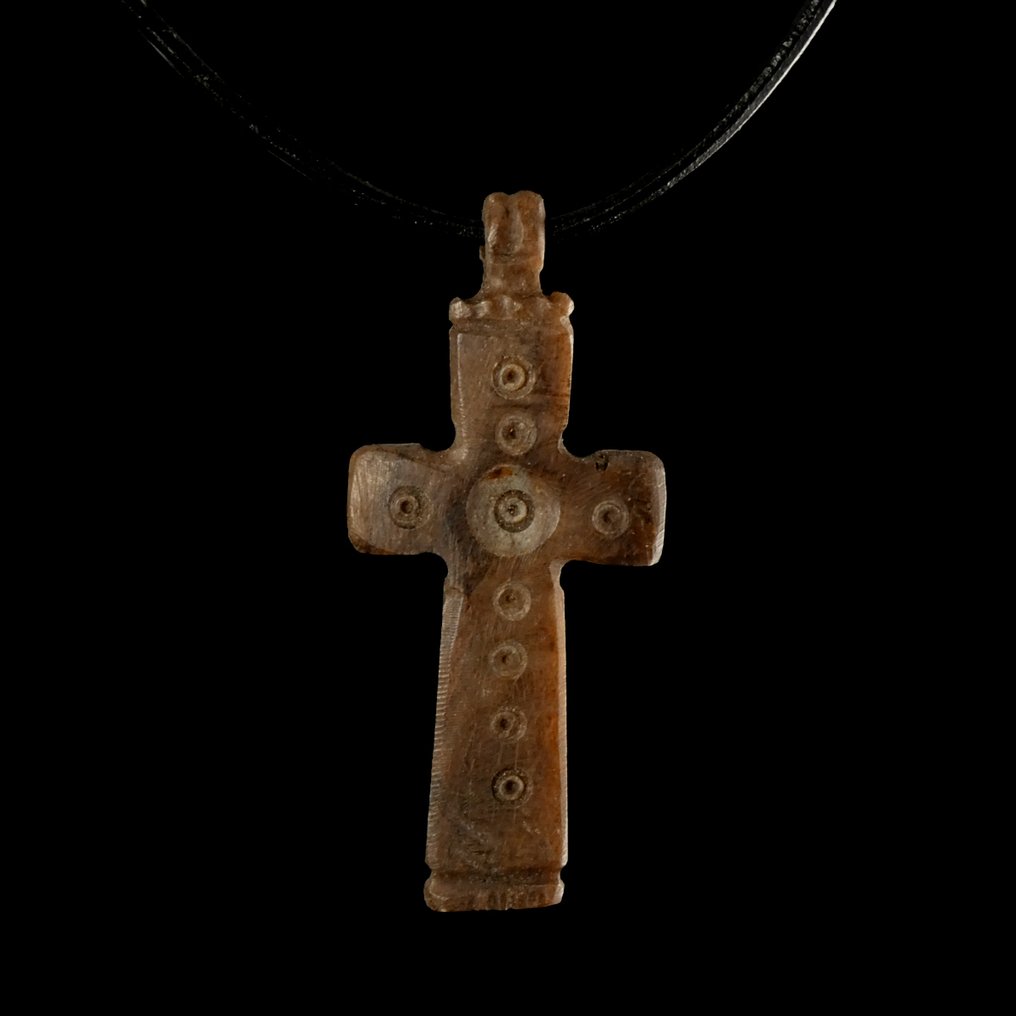
Medieval, Crusaders Era Bone Latin, Cross pendant (No reserve price)


Opens 19:00
Starting bid
€ 1
Add to your favourites to get an alert when the auction starts.

Expert
Selected by Peter Reynaers
Has nearly 30 years’ experience and moderated multiple online art research groups.
Estimate € 180 - € 220
Catawiki Buyer Protection
Your payment’s safe with us until you receive your object.View details
Trustpilot 4.4 | 122910 reviews
Rated Excellent on Trustpilot.
Description from the seller
Attention: due to customs regulations we can only ship inside the European Union. Please ensure you have a valid EU shipping address before placing a bid.
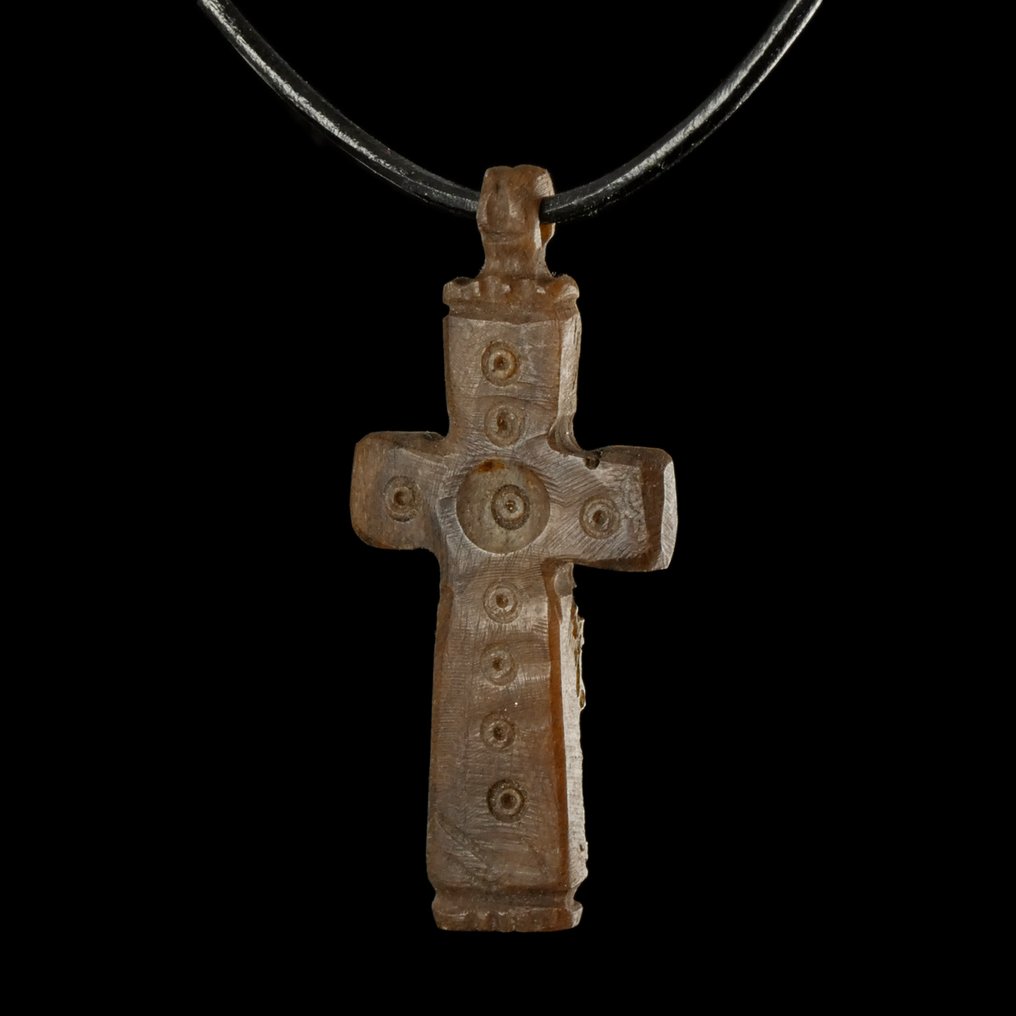
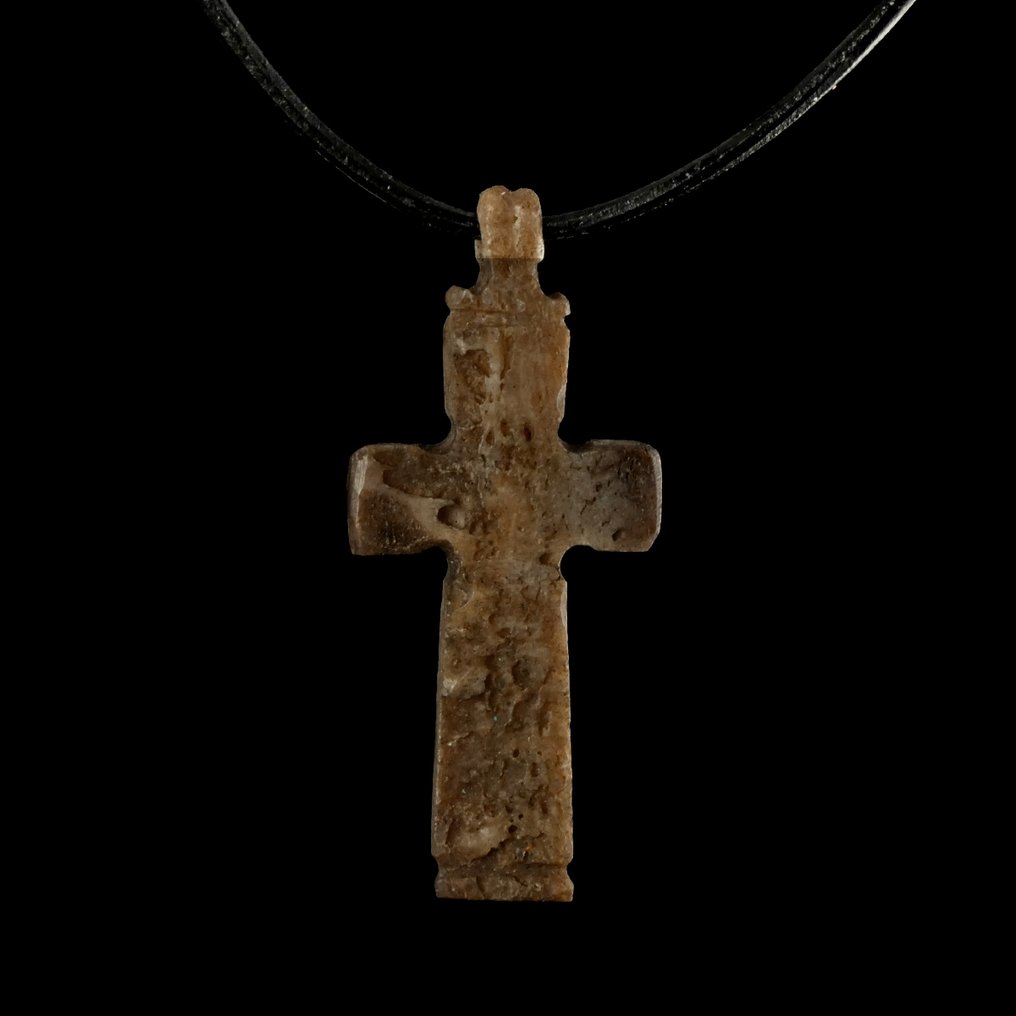
A carved bone Latin cross pendant dating to the Byzantine / Crusader period. The front is decorated with a series of incised circular motifs, arranged symmetrically around a larger central roundel. The reverse side is plain, the cross is complete with an integral suspension loop.
The cross will be delivered on a modern leather jewellery cord, perfect for modern wear and easy to remove if preferred.
Size: ± 53,1 x 23,4 mm
Condition: good solid condition. Surface wear and minor irregularities, consistent with age and use.
An evocative devotional object, closely associated with early Christian tradition during the Byzantine and Crusader era.
Certificate of Authenticity (PDF) is available upon request for lots with a hammer price of €100 or higher.
The Latin cross, characterised by a long vertical shaft intersected by a shorter horizontal arm positioned above the centre, appears in Christian art towards the end of Late Antiquity. Its distinctive proportions came to represent Christianity and Christendom as a whole.
Many medieval churches were designed according to the Latin cross plan; when viewed from above, the ground plan mirrors this form. One of the earliest and most influential examples in Europe is Old St Peter’s Basilica in Rome, begun around 319 AD.
During the first centuries AD, Christian symbols were worshipped and worn discreetly. After Christianity was adopted as the official religion of the Roman Empire in 380 AD, the cross became a prominent and openly displayed symbol. It offered comfort and spiritual reassurance in times of hardship, particularly during the Crusades and the recurrent pandemics that affected medieval Europe.
To this day, Christians continue to wear crosses and sacred pendants close to the heart as tangible expressions of faith and of God’s presence in their lives.
Seller's Story
Please read our information carefully.
*SHIPPING INFO Due to insurance procedures, combined shipping is only possible with a single payment. (1 payment reference = 1 insured parcel.) If you accept an offer after the auction and pay separately, shipments cannot be manually combined afterward. Please ensure your shipping address is complete and correct before paying. Changes made after payment are not automatically forwarded to us.
* CERTIFICATE OF AUTHENTICITY (COA) For insurance purposes we can provide a digital Certificate of Authenticity (PDF) for every item with a hammer price of Euro 100 or more. The COA is available upon request within 20 days of the auction date. Instructions will be provided when your order is shipped. Certificates are not included in the package.
* INSURANCE & CLAIMS All our parcels are shipped with external insurance. This insurance requires the following:
-> Monitor the online tracking and notify delays within 14 days after the shipping date.
-> In case of damage: write a reservation on the delivery note, keep all packaging and send us photos of the damage.
* IMPORTANT BUYERS OUTSIDE THE EU: We cannot ship to countries outside the European Union. Please ensure you have an EU shipping address before bidding. No exceptions can be made. Switzerland, Norway and the United Kingdom are not part of the EU.
* DOCUMENTATION NOTICE: Previous invoices and import/export documents will not be shared with customers.
----------------------
Thank you for your interest, and best of luck with your bids!
Attention: due to customs regulations we can only ship inside the European Union. Please ensure you have a valid EU shipping address before placing a bid.
A carved bone Latin cross pendant dating to the Byzantine / Crusader period. The front is decorated with a series of incised circular motifs, arranged symmetrically around a larger central roundel. The reverse side is plain, the cross is complete with an integral suspension loop.
The cross will be delivered on a modern leather jewellery cord, perfect for modern wear and easy to remove if preferred.
Size: ± 53,1 x 23,4 mm
Condition: good solid condition. Surface wear and minor irregularities, consistent with age and use.
An evocative devotional object, closely associated with early Christian tradition during the Byzantine and Crusader era.
Certificate of Authenticity (PDF) is available upon request for lots with a hammer price of €100 or higher.
The Latin cross, characterised by a long vertical shaft intersected by a shorter horizontal arm positioned above the centre, appears in Christian art towards the end of Late Antiquity. Its distinctive proportions came to represent Christianity and Christendom as a whole.
Many medieval churches were designed according to the Latin cross plan; when viewed from above, the ground plan mirrors this form. One of the earliest and most influential examples in Europe is Old St Peter’s Basilica in Rome, begun around 319 AD.
During the first centuries AD, Christian symbols were worshipped and worn discreetly. After Christianity was adopted as the official religion of the Roman Empire in 380 AD, the cross became a prominent and openly displayed symbol. It offered comfort and spiritual reassurance in times of hardship, particularly during the Crusades and the recurrent pandemics that affected medieval Europe.
To this day, Christians continue to wear crosses and sacred pendants close to the heart as tangible expressions of faith and of God’s presence in their lives.
Seller's Story
Please read our information carefully.
*SHIPPING INFO Due to insurance procedures, combined shipping is only possible with a single payment. (1 payment reference = 1 insured parcel.) If you accept an offer after the auction and pay separately, shipments cannot be manually combined afterward. Please ensure your shipping address is complete and correct before paying. Changes made after payment are not automatically forwarded to us.
* CERTIFICATE OF AUTHENTICITY (COA) For insurance purposes we can provide a digital Certificate of Authenticity (PDF) for every item with a hammer price of Euro 100 or more. The COA is available upon request within 20 days of the auction date. Instructions will be provided when your order is shipped. Certificates are not included in the package.
* INSURANCE & CLAIMS All our parcels are shipped with external insurance. This insurance requires the following:
-> Monitor the online tracking and notify delays within 14 days after the shipping date.
-> In case of damage: write a reservation on the delivery note, keep all packaging and send us photos of the damage.
* IMPORTANT BUYERS OUTSIDE THE EU: We cannot ship to countries outside the European Union. Please ensure you have an EU shipping address before bidding. No exceptions can be made. Switzerland, Norway and the United Kingdom are not part of the EU.
* DOCUMENTATION NOTICE: Previous invoices and import/export documents will not be shared with customers.
----------------------
Thank you for your interest, and best of luck with your bids!
Details
Culture
Medieval, Crusaders Era
Century/ Timeframe
11th-12th century AD
Name of object
Latin, Cross pendant
Acquired from
Dealer at a fair
Year acquired
2024
Material
Bone
Country acquired from
Belgium
Condition
Good
Previous owner acquired from
Dealer at a fair
Previous owner - year acquired
2024
Previous owner - country acquired from
Belgium
I verify that I have obtained this object legally and that I am allowed to sell it
Yes
Sold by
Disclaimer
The seller was informed by Catawiki about documentation requirements and guarantees the following: - the object was legally obtained, - the seller has the right to sell and/or export the object, as relevant, - the seller will provide the necessary provenance information and arrange required documentation and permits/licenses, as applicable and as per local laws, - the seller will notify the buyer of any delays in obtaining permits/licenses. By bidding, you acknowledge that import documentation may be required depending on your country of residence and that obtaining permits/licenses may cause delays in the delivery of your object.
The seller was informed by Catawiki about documentation requirements and guarantees the following: - the object was legally obtained, - the seller has the right to sell and/or export the object, as relevant, - the seller will provide the necessary provenance information and arrange required documentation and permits/licenses, as applicable and as per local laws, - the seller will notify the buyer of any delays in obtaining permits/licenses. By bidding, you acknowledge that import documentation may be required depending on your country of residence and that obtaining permits/licenses may cause delays in the delivery of your object.
