Ancient Roman square Glass Bottle, large


13
days
19
hours
06
minutes
17
seconds
Current bid
€ 100
Reserve price not met

Expert
Selected by Peter Reynaers
Has nearly 30 years’ experience and moderated multiple online art research groups.
Estimate € 800 - € 950
16 other people are watching this object
 Bidder 4407 Bidder 4407 | €100 | |
|---|---|---|
 Bidder 4928 Bidder 4928 | €1 |
Catawiki Buyer Protection
Your payment’s safe with us until you receive your object.View details
Trustpilot 4.4 | 123253 reviews
Rated Excellent on Trustpilot.
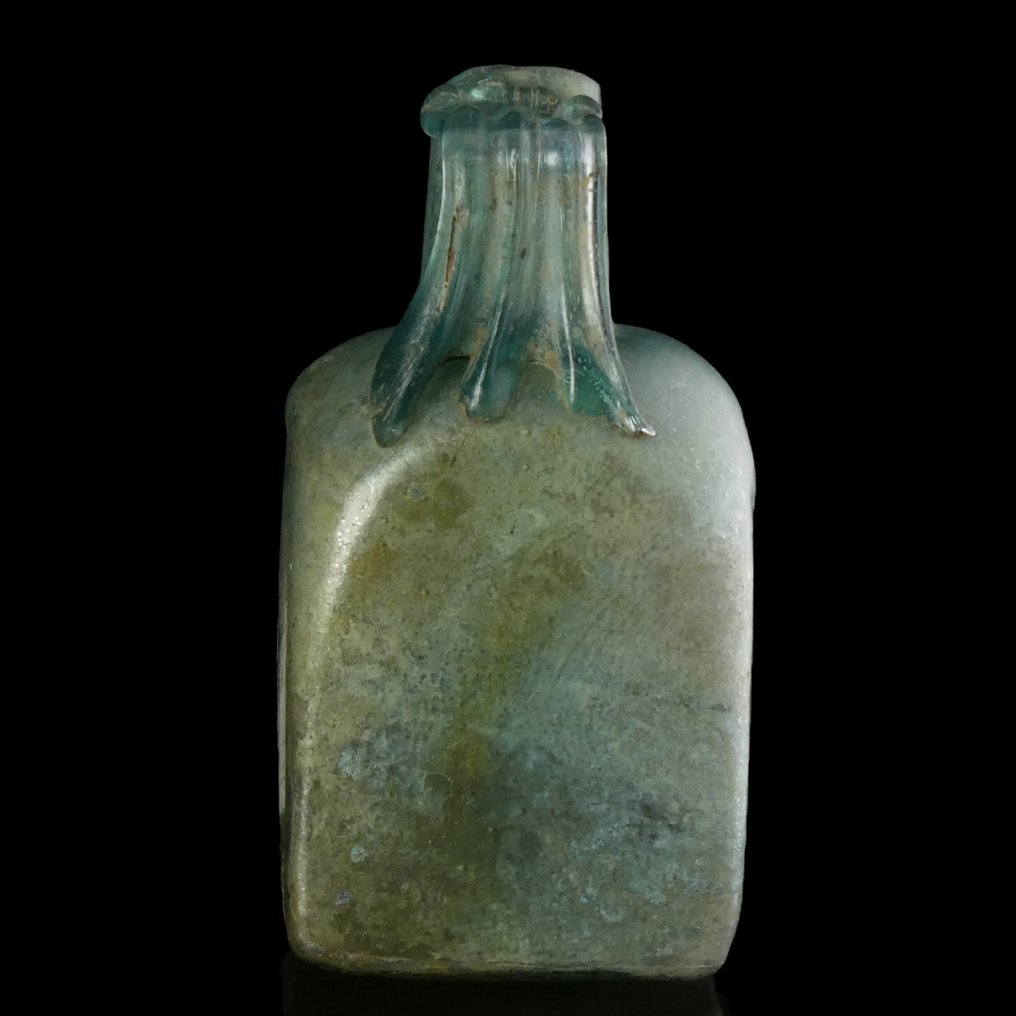
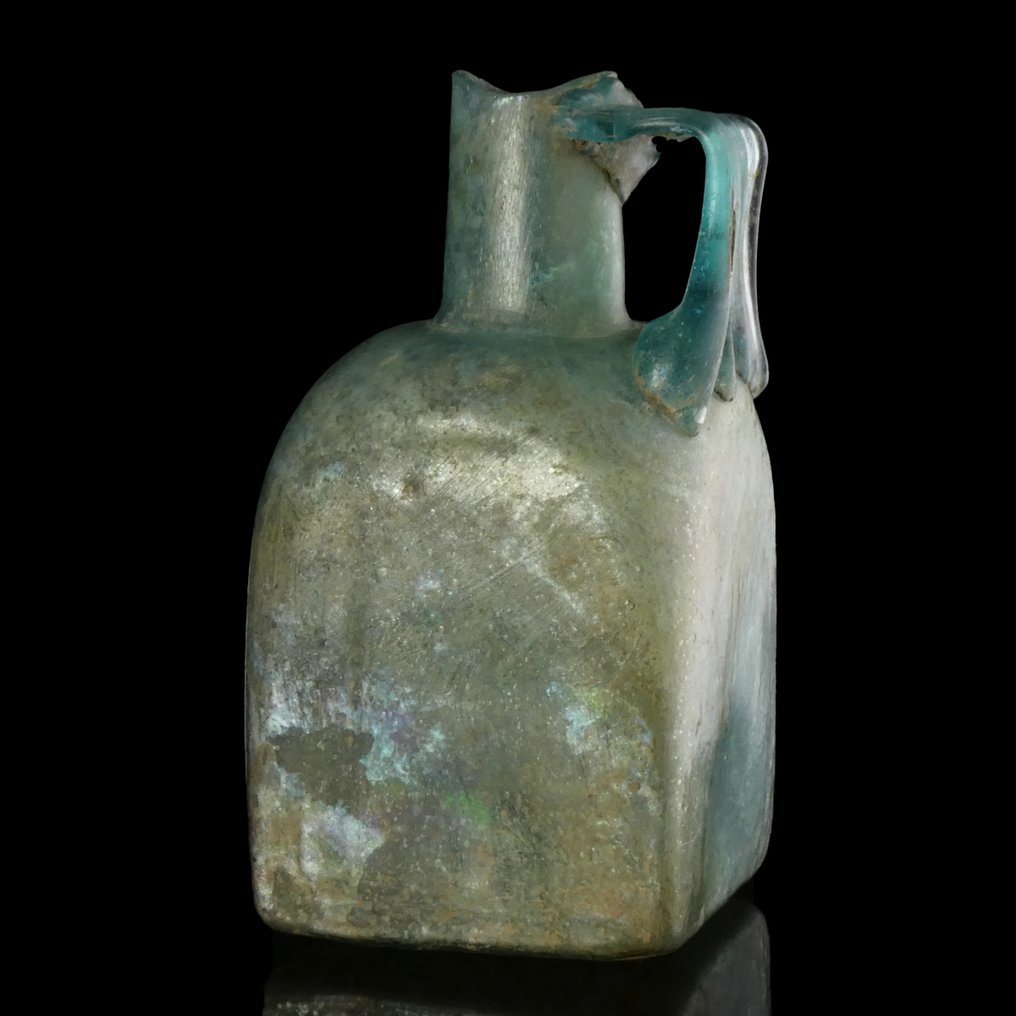
Ancient Roman large square glass bottle, mould-made and in good condition with iridescence, about 17.5 cm high, semi-translucent light blue with a greenish tinge, featuring a four-ribbed strap handle added from the shoulders, dating to the 1st–2nd century AD and acquired in 2024 from the Netherlands, with a certificate of authenticity available on request and EU shipping only.
AI-assisted summary
Description from the seller
Attention: due to customs regulations we can only ship inside the European Union. Please ensure you have a valid EU shipping address before placing a bid.
Large and impressive Roman square glass bottle in semi-translucent light blue with greenish tinge. The semi-translucent strap handle has four ribs and shows a beautiful distribution of light. The bottle was made in a mould, the handle has been put on from the shoulders with a post of glass separately, fed up and placed against the neck and lower part of the edge. A superb example of Roman glass art.
Height: ± 17,5 cm
Condition: good condition with very appealing iridescence. This type usually has a flat rim which is no longer present, unclear if this is an adaptation from the time to make pouring more easy or if it is removed in a later time. Apart from the mentioned flat rim, the bottle is fully intact without cracks and only a small internal hairline along the neck. See images.
Certificate of Authenticity: available upon request (pdf-format).
ANCIENT GLASS
Glass has always been found in nature, but the humans first created glass about 4.000 years ago. when ancient craftsmen in Mesopotamia discovered the art of mixing sand, soda and lime to make glass.
For centuries, glass was a luxury item and reserved for the upper classes.
Glassmaking centers around the Mediterranean world experimented with new techniques (casting, core-forming, mosaic glass) and with colours by adding metallic oxides (cobalt, copper, etc) to the mixture.
The Romans learned the glass-making craft after the conquest of Egypt in the 1st century BC. During the 1st century AD the glassblowing technique revolutionized the production and made it possible to produce larger quantities. By adding manganese dioxide Roman glassmakers successfully produced colourless or ‘aqua’ glass for the first time.
Roman glass became a very popular material, used for beads, glass windows, mosaic tiles, tableware pieces etc. Roman glass was traded all over the Roman Empire and far beyond to Central Africa, Scandinavia and via the Silk Route to China.
Seller's Story
Please read our information carefully.
*SHIPPING INFO Due to insurance procedures, combined shipping is only possible with a single payment. (1 payment reference = 1 insured parcel.) If you accept an offer after the auction and pay separately, shipments cannot be manually combined afterward. Please ensure your shipping address is complete and correct before paying. Changes made after payment are not automatically forwarded to us.
* CERTIFICATE OF AUTHENTICITY (COA) For insurance purposes we can provide a digital Certificate of Authenticity (PDF) for every item with a hammer price of Euro 100 or more. The COA is available upon request within 20 days of the auction date. Instructions will be provided when your order is shipped. Certificates are not included in the package.
* INSURANCE & CLAIMS All our parcels are shipped with external insurance. This insurance requires the following:
-> Monitor the online tracking and notify delays to the seller within 14 days after the shipping date.
-> In case of damage: write a reservation on the delivery note and report the damage to the seller via the Catawiki online chat within 24 hours. Keep all packaging and send us photos of the damage.
* IMPORTANT BUYERS OUTSIDE THE EU: We cannot ship to countries outside the European Union. Please ensure you have an EU shipping address before bidding. No exceptions can be made. Switzerland, Norway and the United Kingdom are not part of the EU.
* DOCUMENTATION NOTICE: Previous invoices and import/export documents will not be shared with customers.
----------------------
Thank you for your interest, and best of luck with your bids!
Attention: due to customs regulations we can only ship inside the European Union. Please ensure you have a valid EU shipping address before placing a bid.
Large and impressive Roman square glass bottle in semi-translucent light blue with greenish tinge. The semi-translucent strap handle has four ribs and shows a beautiful distribution of light. The bottle was made in a mould, the handle has been put on from the shoulders with a post of glass separately, fed up and placed against the neck and lower part of the edge. A superb example of Roman glass art.
Height: ± 17,5 cm
Condition: good condition with very appealing iridescence. This type usually has a flat rim which is no longer present, unclear if this is an adaptation from the time to make pouring more easy or if it is removed in a later time. Apart from the mentioned flat rim, the bottle is fully intact without cracks and only a small internal hairline along the neck. See images.
Certificate of Authenticity: available upon request (pdf-format).
ANCIENT GLASS
Glass has always been found in nature, but the humans first created glass about 4.000 years ago. when ancient craftsmen in Mesopotamia discovered the art of mixing sand, soda and lime to make glass.
For centuries, glass was a luxury item and reserved for the upper classes.
Glassmaking centers around the Mediterranean world experimented with new techniques (casting, core-forming, mosaic glass) and with colours by adding metallic oxides (cobalt, copper, etc) to the mixture.
The Romans learned the glass-making craft after the conquest of Egypt in the 1st century BC. During the 1st century AD the glassblowing technique revolutionized the production and made it possible to produce larger quantities. By adding manganese dioxide Roman glassmakers successfully produced colourless or ‘aqua’ glass for the first time.
Roman glass became a very popular material, used for beads, glass windows, mosaic tiles, tableware pieces etc. Roman glass was traded all over the Roman Empire and far beyond to Central Africa, Scandinavia and via the Silk Route to China.
Seller's Story
Please read our information carefully.
*SHIPPING INFO Due to insurance procedures, combined shipping is only possible with a single payment. (1 payment reference = 1 insured parcel.) If you accept an offer after the auction and pay separately, shipments cannot be manually combined afterward. Please ensure your shipping address is complete and correct before paying. Changes made after payment are not automatically forwarded to us.
* CERTIFICATE OF AUTHENTICITY (COA) For insurance purposes we can provide a digital Certificate of Authenticity (PDF) for every item with a hammer price of Euro 100 or more. The COA is available upon request within 20 days of the auction date. Instructions will be provided when your order is shipped. Certificates are not included in the package.
* INSURANCE & CLAIMS All our parcels are shipped with external insurance. This insurance requires the following:
-> Monitor the online tracking and notify delays to the seller within 14 days after the shipping date.
-> In case of damage: write a reservation on the delivery note and report the damage to the seller via the Catawiki online chat within 24 hours. Keep all packaging and send us photos of the damage.
* IMPORTANT BUYERS OUTSIDE THE EU: We cannot ship to countries outside the European Union. Please ensure you have an EU shipping address before bidding. No exceptions can be made. Switzerland, Norway and the United Kingdom are not part of the EU.
* DOCUMENTATION NOTICE: Previous invoices and import/export documents will not be shared with customers.
----------------------
Thank you for your interest, and best of luck with your bids!
Details
Culture
Ancient Roman
Century/ Timeframe
1st - 2nd century AD
Name of object
square Glass Bottle, large
Acquired from
Antique market
Year acquired
2024
Country acquired from
Netherlands
Condition
Good
Previous owner acquired from
Antique market
Previous owner - year acquired
2024
Previous owner - country acquired from
Netherlands
I verify that I have obtained this object legally and that I am allowed to sell it
Yes
Sold by
Disclaimer
The seller was informed by Catawiki about documentation requirements and guarantees the following: - the object was legally obtained, - the seller has the right to sell and/or export the object, as relevant, - the seller will provide the necessary provenance information and arrange required documentation and permits/licenses, as applicable and as per local laws, - the seller will notify the buyer of any delays in obtaining permits/licenses. By bidding, you acknowledge that import documentation may be required depending on your country of residence and that obtaining permits/licenses may cause delays in the delivery of your object.
The seller was informed by Catawiki about documentation requirements and guarantees the following: - the object was legally obtained, - the seller has the right to sell and/or export the object, as relevant, - the seller will provide the necessary provenance information and arrange required documentation and permits/licenses, as applicable and as per local laws, - the seller will notify the buyer of any delays in obtaining permits/licenses. By bidding, you acknowledge that import documentation may be required depending on your country of residence and that obtaining permits/licenses may cause delays in the delivery of your object.
