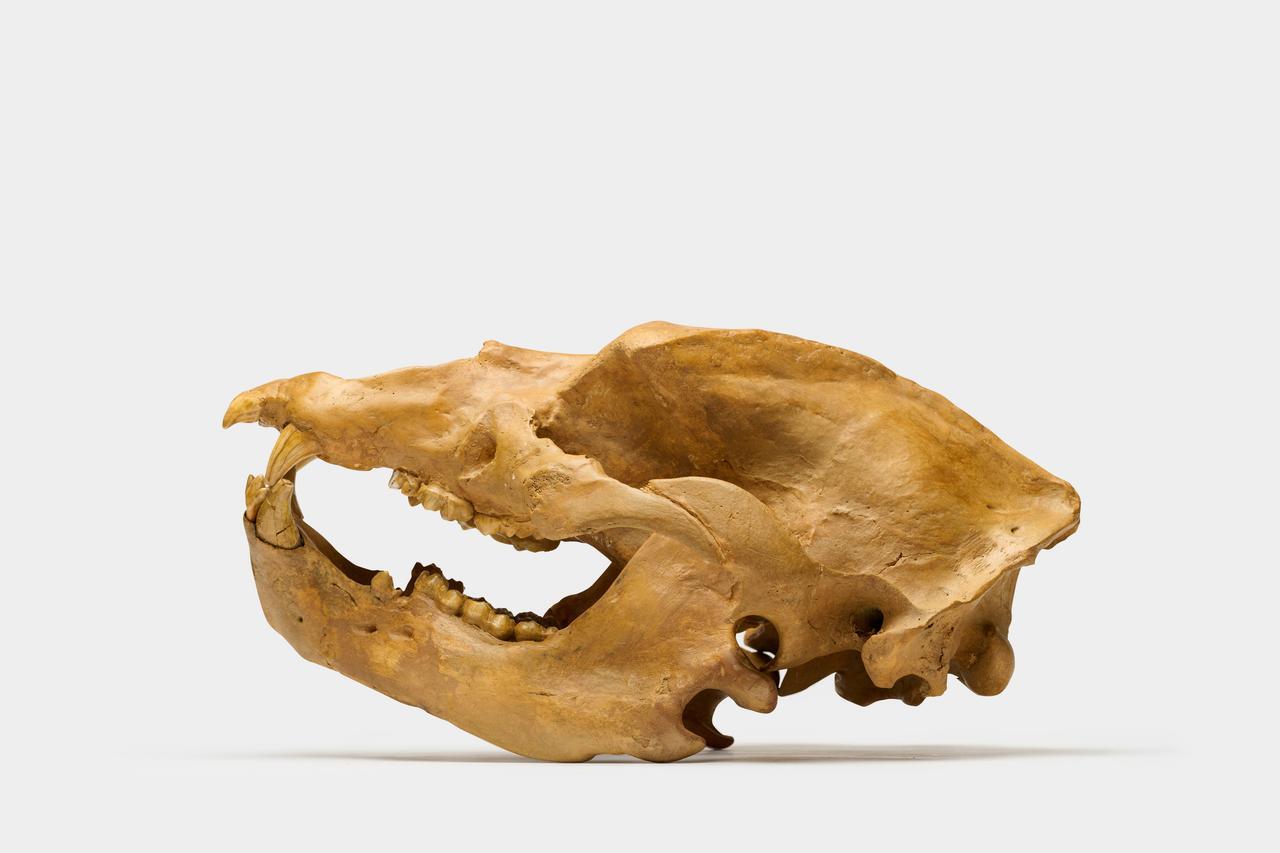
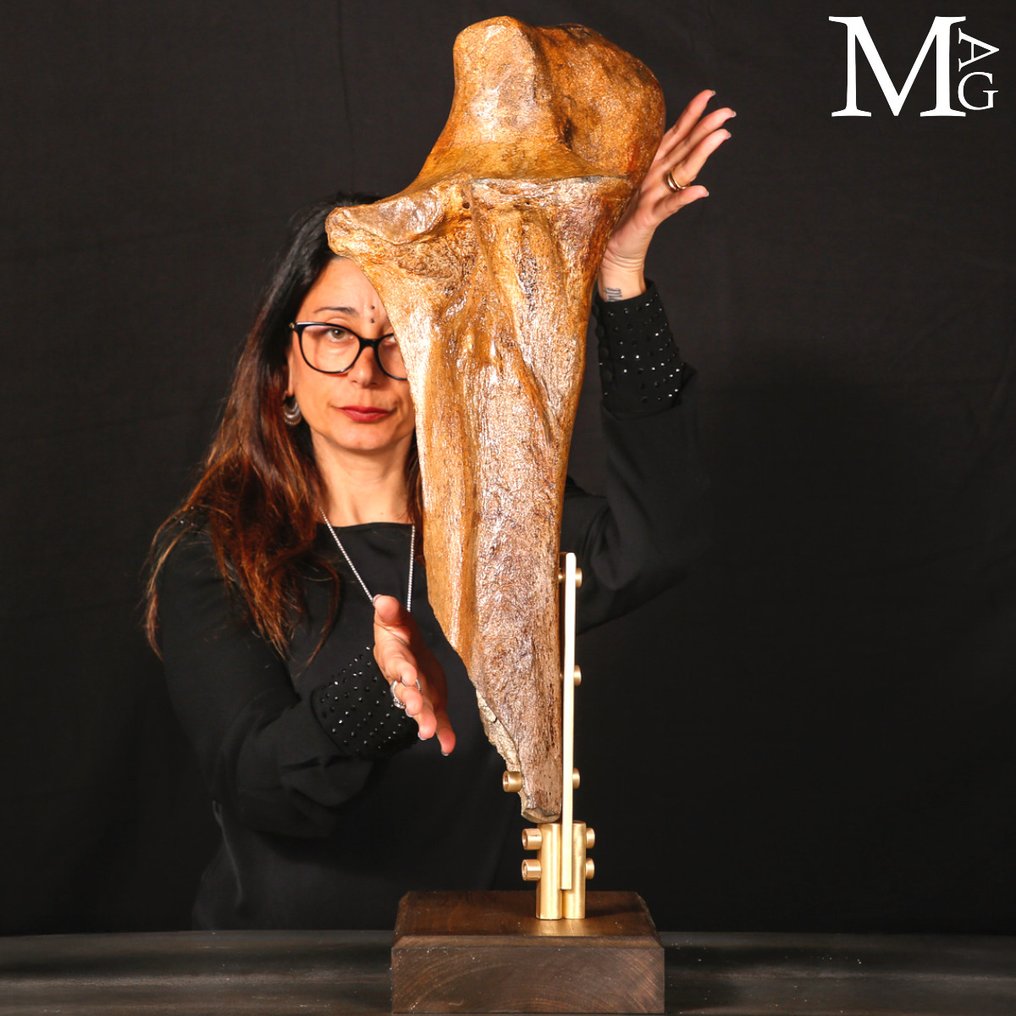
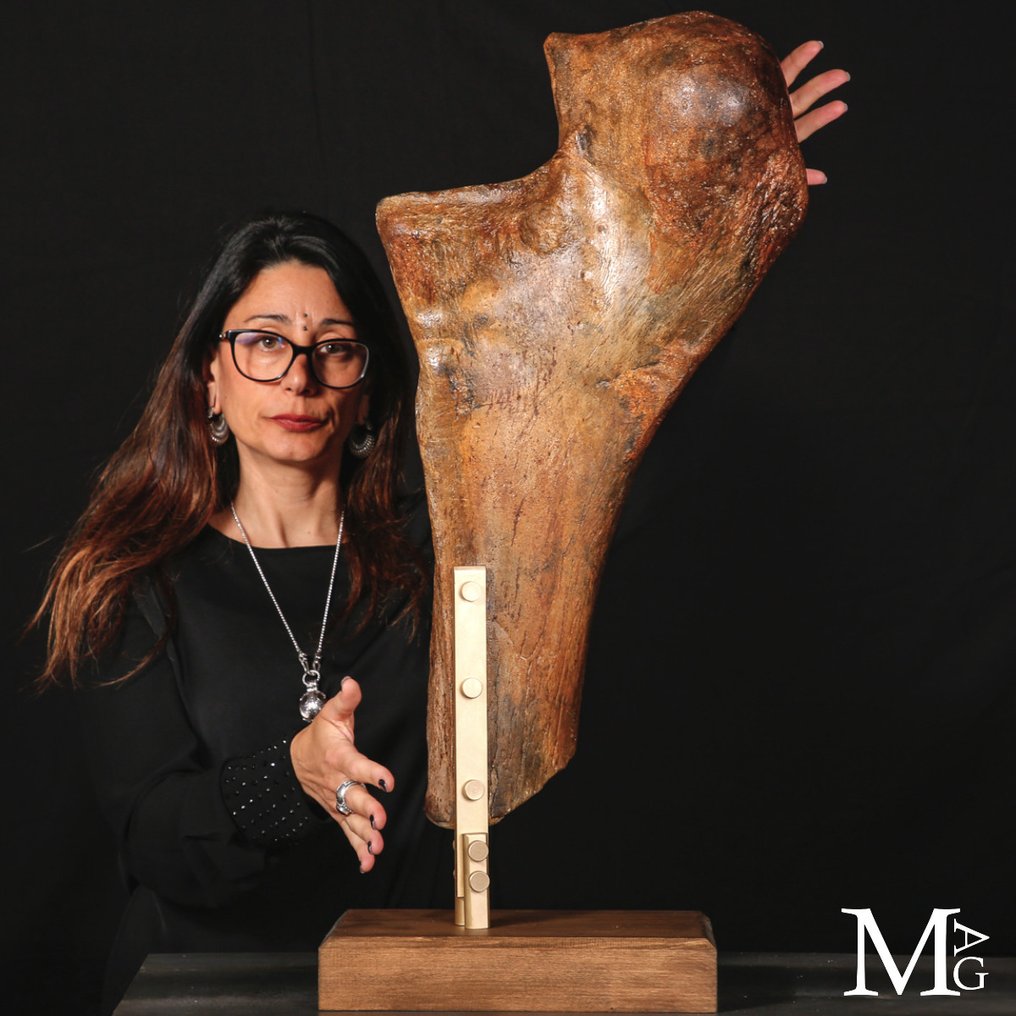
Fossil > Woolly Mammoth "Mammuthus primigenius" A beautiful fossil femur of a Woolly Mammoth. - Height: 760 mm - Width: 300 mm- 13672 g


Opens tomorrow
Starting bid
€ 1
Add to your favourites to get an alert when the auction starts.

Catawiki Buyer Protection
Your payment’s safe with us until you receive your object.View details
Trustpilot 4.4 | 122986 reviews
Rated Excellent on Trustpilot.
Description from the seller
A beautiful fossil femur of a woolly mammoth (Mammuthus primigenius), discovered in Siberia following the melting of the permafrost. This extraordinary specimen has been expertly mounted on a solid wood base with a brass support, enhancing its grandeur and allowing it to be displayed in museums, private collections, or cabinets of curiosities.
The fossil's surface, with its natural patina and earthy hues, preserves intact the signs of time and fossilization. Every morphological detail tells the story of a prehistoric giant that roamed the frozen steppes of Eurasia during the Pleistocene.
The woolly mammoth was adapted to harsh climates thanks to its thick fur, fat glands, and long, curved tusks. It became extinct around 4,000 years ago, likely due to a combination of climate change, habitat loss, and pressure from prehistoric humans. The best-preserved remains come from the Arctic regions of Siberia, where the freezing temperatures ensured their extraordinary preservation.
Features
Species: Mammuthus primigenius
Period: Late Pleistocene (about 30,000 – 10,000 years ago)
Origin: Siberia
Assembly: Wooden base, brass support
Style: Wunderkammer, naturalia, decorative paleontology
Category: Original collector's item
An imposing and aesthetically stunning piece, combining scientific value, aesthetic power, and museum appeal. Ideal for nature galleries or collections dedicated to Quaternary megafauna.
Seller's Story
The Mineral Art Gallery offers minerals, fossils, shells and natural elements.
Born in Italy in 2017, today she collaborates with international galleries and collectors, she is a direct importer of large minerals and naturalistic collectible elements; deals with the processing to insert them inside the living space. A section of the gallery was dedicated to the Wunderkammer, "chamber of wonders or cabinet of curiosities" in which Mirabilia elements are presented: naturalia and italiania, a union between "the present is the past".
All lots are shipped via DHL Express and Fercam couriers, with insured parcel and tracking.
Translated by Google TranslateA beautiful fossil femur of a woolly mammoth (Mammuthus primigenius), discovered in Siberia following the melting of the permafrost. This extraordinary specimen has been expertly mounted on a solid wood base with a brass support, enhancing its grandeur and allowing it to be displayed in museums, private collections, or cabinets of curiosities.
The fossil's surface, with its natural patina and earthy hues, preserves intact the signs of time and fossilization. Every morphological detail tells the story of a prehistoric giant that roamed the frozen steppes of Eurasia during the Pleistocene.
The woolly mammoth was adapted to harsh climates thanks to its thick fur, fat glands, and long, curved tusks. It became extinct around 4,000 years ago, likely due to a combination of climate change, habitat loss, and pressure from prehistoric humans. The best-preserved remains come from the Arctic regions of Siberia, where the freezing temperatures ensured their extraordinary preservation.
Features
Species: Mammuthus primigenius
Period: Late Pleistocene (about 30,000 – 10,000 years ago)
Origin: Siberia
Assembly: Wooden base, brass support
Style: Wunderkammer, naturalia, decorative paleontology
Category: Original collector's item
An imposing and aesthetically stunning piece, combining scientific value, aesthetic power, and museum appeal. Ideal for nature galleries or collections dedicated to Quaternary megafauna.
Seller's Story
The Mineral Art Gallery offers minerals, fossils, shells and natural elements.
Born in Italy in 2017, today she collaborates with international galleries and collectors, she is a direct importer of large minerals and naturalistic collectible elements; deals with the processing to insert them inside the living space. A section of the gallery was dedicated to the Wunderkammer, "chamber of wonders or cabinet of curiosities" in which Mirabilia elements are presented: naturalia and italiania, a union between "the present is the past".
All lots are shipped via DHL Express and Fercam couriers, with insured parcel and tracking.
Translated by Google TranslateDetails
Main Mineral
Fossil > Woolly Mammoth "Mammuthus primigenius"
Mineral Form
A beautiful fossil femur of a Woolly Mammoth.
Weight
13672 g
Country of Origin
Siberia - Russia
Height
760 mm
Width
300 mm
Depth
200 mm
Sold by