Ancient Greek, Hellenistic Gold Lunula Pendant with Nike and filigree decoration

05
days
04
hours
30
minutes
31
seconds
Current bid
€ 1,075
Reserve price not met

Expert
Selected by Peter Reynaers
Has nearly 30 years’ experience and moderated multiple online art research groups.
Estimate € 2,700 - € 3,300
67 other people are watching this object
 Bidder 8758 Bidder 8758 | €1,075 | |
|---|---|---|
 Bidder 3153 Bidder 3153 | €650 | |
 Bidder 2167 Bidder 2167 | €600 | |
Catawiki Buyer Protection
Your payment’s safe with us until you receive your object.View details
Trustpilot 4.4 | 123759 reviews
Rated Excellent on Trustpilot.
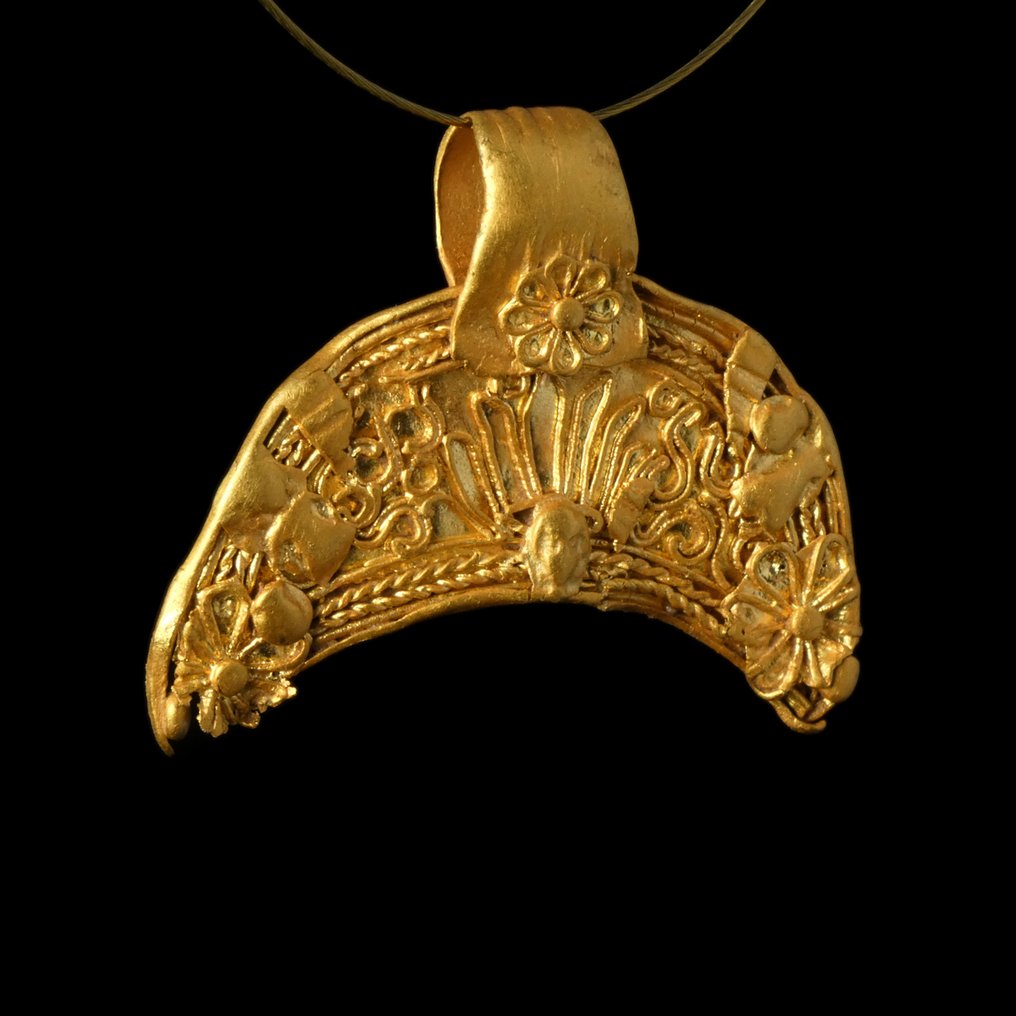
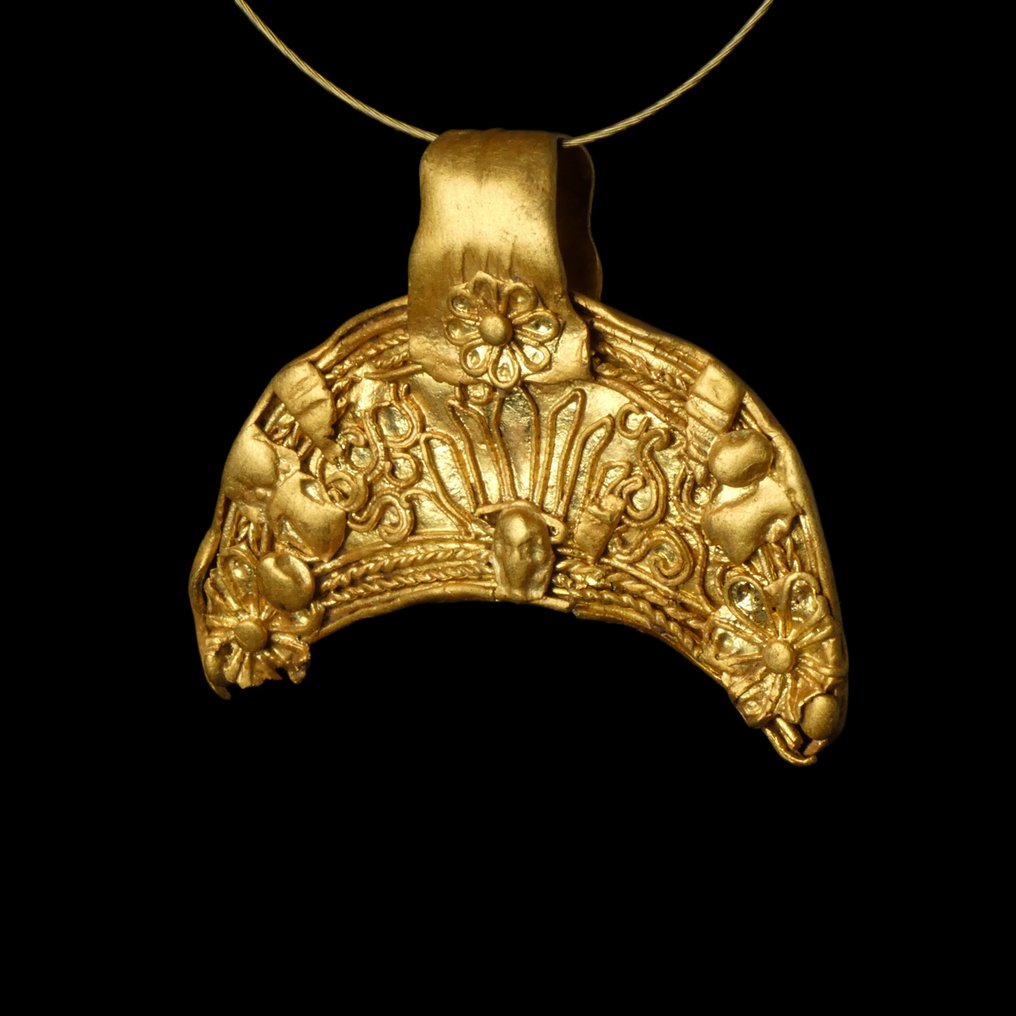
Ancient Greek Hellenistic gold Lunula pendant with Nike head and filigree decoration, ca. 4th–2nd century BC; width about 35.6 mm, weight 6.33 g, in good condition and wearable with care, ribbed suspension loop with a central 8-petalled rosette, reverse undecorated, acquired in 2025 from the Netherlands, certificate of authenticity available on request, and shipment limited to the European Union.
AI-assisted summary
Description from the seller
Attention: due to customs regulations we can only ship inside the European Union. Please ensure you have a valid EU shipping address before placing a bid.
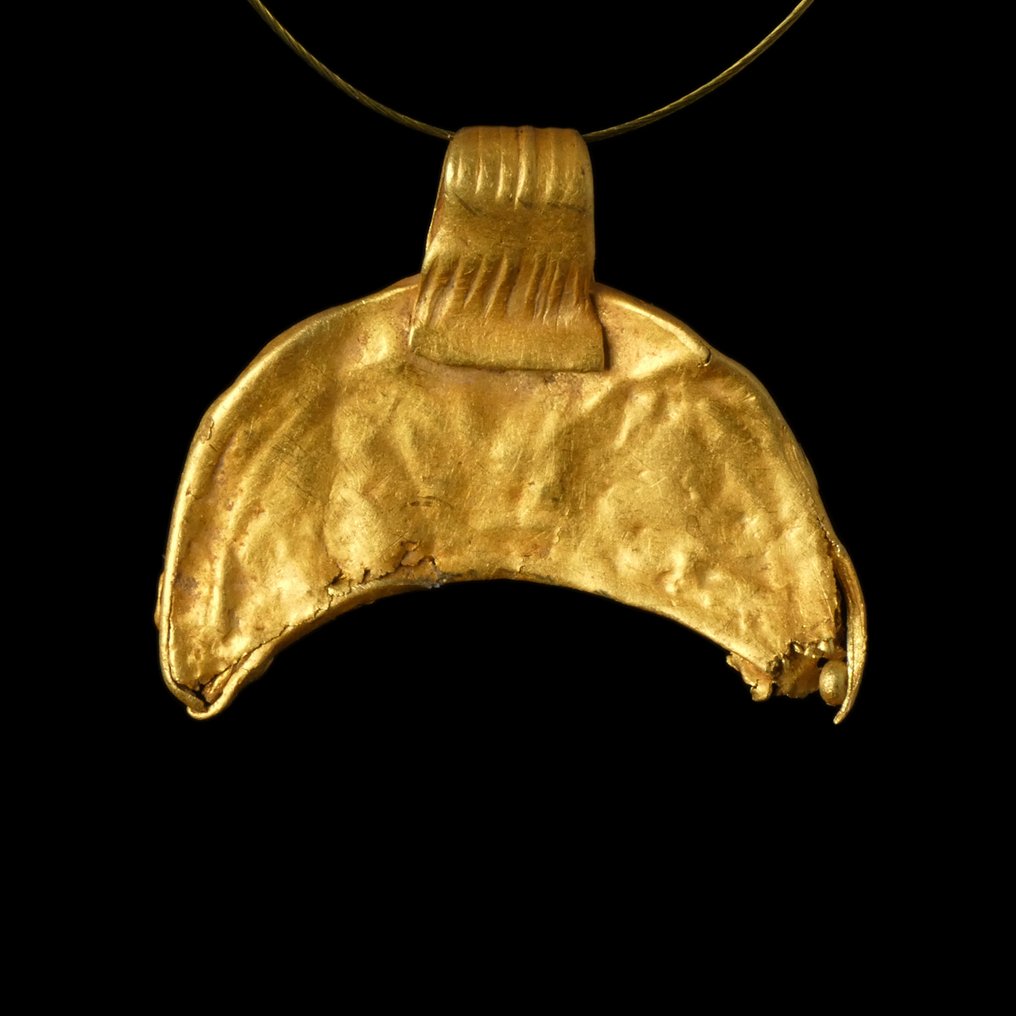
A beautiful Greek Hellenistic gold Lunula pendant with finely detailed filigree work. The front of the crescent shows a central palmette with head of Nike, flanked by finely detailed filigree spirals. The pendant is framed with a twisted border, the tips are decorated with two rosettes in filigree. The pendant has a ribbed suspension loop with a central 8 petalled rosette. The reverse side is undecorated.
Width: ± 35,6 mm
Weight: ± 6,33 grams
Good and solid condition, wearable with care. The surface shows signs of typical hand-worked gold and some signs of wear, consistent with an ancient artefact. The applied bosses and wirework enhance the surface, creating a lively interplay of texture and relief.
Certificate of Authenticity: available upon request (pdf-format).
In Greek mythology Nike is the personification of victory, symbolizing triumph in battles and competitions. She is often depicted with wings, representing speed and success or with a laurel wreath or palm frond, the traditional emblems of success, awarded to victors in competitions or contests.
Nike was closely associated with Zeus and Athena.
The Roman equivalent is the goddess Victoria.
A crescent (Lunula) was a popular symbol in many ancient cultures. It is associated with Artemis/Diana as a symbol of virginity and female chastity. Lunulae were worn as protective amulets, closely associated with fertility, protection and the lunar cycle, and were commonly used in both Greek and Roman cultural contexts.
In Christianity, the Lunula entered Marian iconography. In the Crusades, it became associated with the Orient (Byzantine Empire, Levant and Outremer) and was widely used in Crusader seals and coins.
Seller's Story
Please read our information carefully.
*SHIPPING INFO Due to insurance procedures, combined shipping is only possible with a single payment. (1 payment reference = 1 insured parcel.) If you accept an offer after the auction and pay separately, shipments cannot be manually combined afterward. Please ensure your shipping address is complete and correct before paying. Changes made after payment are not automatically forwarded to us.
* CERTIFICATE OF AUTHENTICITY (COA) For insurance purposes we can provide a digital Certificate of Authenticity (PDF) for every item with a hammer price of Euro 100 or more. The COA is available upon request within 20 days of the auction date. Instructions will be provided when your order is shipped. Certificates are not included in the package.
* INSURANCE & CLAIMS All our parcels are shipped with external insurance. This insurance requires the following:
-> Monitor the online tracking and notify delays to the seller within 14 days after the shipping date.
-> In case of damage: write a reservation on the delivery note and report the damage to the seller via the Catawiki online chat within 24 hours. Keep all packaging and send us photos of the damage.
* IMPORTANT BUYERS OUTSIDE THE EU: We cannot ship to countries outside the European Union. Please ensure you have an EU shipping address before bidding. No exceptions can be made. Switzerland, Norway and the United Kingdom are not part of the EU.
* DOCUMENTATION NOTICE: Previous invoices and import/export documents will not be shared with customers.
----------------------
Thank you for your interest, and best of luck with your bids!
Attention: due to customs regulations we can only ship inside the European Union. Please ensure you have a valid EU shipping address before placing a bid.
A beautiful Greek Hellenistic gold Lunula pendant with finely detailed filigree work. The front of the crescent shows a central palmette with head of Nike, flanked by finely detailed filigree spirals. The pendant is framed with a twisted border, the tips are decorated with two rosettes in filigree. The pendant has a ribbed suspension loop with a central 8 petalled rosette. The reverse side is undecorated.
Width: ± 35,6 mm
Weight: ± 6,33 grams
Good and solid condition, wearable with care. The surface shows signs of typical hand-worked gold and some signs of wear, consistent with an ancient artefact. The applied bosses and wirework enhance the surface, creating a lively interplay of texture and relief.
Certificate of Authenticity: available upon request (pdf-format).
In Greek mythology Nike is the personification of victory, symbolizing triumph in battles and competitions. She is often depicted with wings, representing speed and success or with a laurel wreath or palm frond, the traditional emblems of success, awarded to victors in competitions or contests.
Nike was closely associated with Zeus and Athena.
The Roman equivalent is the goddess Victoria.
A crescent (Lunula) was a popular symbol in many ancient cultures. It is associated with Artemis/Diana as a symbol of virginity and female chastity. Lunulae were worn as protective amulets, closely associated with fertility, protection and the lunar cycle, and were commonly used in both Greek and Roman cultural contexts.
In Christianity, the Lunula entered Marian iconography. In the Crusades, it became associated with the Orient (Byzantine Empire, Levant and Outremer) and was widely used in Crusader seals and coins.
Seller's Story
Please read our information carefully.
*SHIPPING INFO Due to insurance procedures, combined shipping is only possible with a single payment. (1 payment reference = 1 insured parcel.) If you accept an offer after the auction and pay separately, shipments cannot be manually combined afterward. Please ensure your shipping address is complete and correct before paying. Changes made after payment are not automatically forwarded to us.
* CERTIFICATE OF AUTHENTICITY (COA) For insurance purposes we can provide a digital Certificate of Authenticity (PDF) for every item with a hammer price of Euro 100 or more. The COA is available upon request within 20 days of the auction date. Instructions will be provided when your order is shipped. Certificates are not included in the package.
* INSURANCE & CLAIMS All our parcels are shipped with external insurance. This insurance requires the following:
-> Monitor the online tracking and notify delays to the seller within 14 days after the shipping date.
-> In case of damage: write a reservation on the delivery note and report the damage to the seller via the Catawiki online chat within 24 hours. Keep all packaging and send us photos of the damage.
* IMPORTANT BUYERS OUTSIDE THE EU: We cannot ship to countries outside the European Union. Please ensure you have an EU shipping address before bidding. No exceptions can be made. Switzerland, Norway and the United Kingdom are not part of the EU.
* DOCUMENTATION NOTICE: Previous invoices and import/export documents will not be shared with customers.
----------------------
Thank you for your interest, and best of luck with your bids!
Details
Culture
Ancient Greek, Hellenistic
Century/ Timeframe
4th-2nd century BC
Name of object
Lunula Pendant with Nike and filigree decoration
Acquired from
Dealer at a fair
Year acquired
2025
Material
Gold
Country acquired from
Netherlands
Condition
Good
Previous owner acquired from
Dealer at a fair
Previous owner - year acquired
2025
Previous owner - country acquired from
Netherlands
I verify that I have obtained this object legally and that I am allowed to sell it
Yes
Sold by
Disclaimer
The seller was informed by Catawiki about documentation requirements and guarantees the following: - the object was legally obtained, - the seller has the right to sell and/or export the object, as relevant, - the seller will provide the necessary provenance information and arrange required documentation and permits/licenses, as applicable and as per local laws, - the seller will notify the buyer of any delays in obtaining permits/licenses. By bidding, you acknowledge that import documentation may be required depending on your country of residence and that obtaining permits/licenses may cause delays in the delivery of your object.
The seller was informed by Catawiki about documentation requirements and guarantees the following: - the object was legally obtained, - the seller has the right to sell and/or export the object, as relevant, - the seller will provide the necessary provenance information and arrange required documentation and permits/licenses, as applicable and as per local laws, - the seller will notify the buyer of any delays in obtaining permits/licenses. By bidding, you acknowledge that import documentation may be required depending on your country of residence and that obtaining permits/licenses may cause delays in the delivery of your object.
