Luristan Iron (cast/wrought) Sword - 55 cm (No reserve price)


01
day
02
hours
36
minutes
53
seconds
Current bid
€ 701
No reserve price

Expert
Selected by Ruth Garrido Vila
Directed the Ifergan Collection Museum, specialising in Phoenician and Mediterranean archaeology.
Estimate € 2,500 - € 3,000
63 other people are watching this object
 Bidder 8170 Bidder 8170 | €701 | |
|---|---|---|
 Bidder 6635 Bidder 6635 | €651 | |
 Bidder 4042 Bidder 4042 | €601 | |
Catawiki Buyer Protection
Your payment’s safe with us until you receive your object.View details
Trustpilot 4.4 | 123718 reviews
Rated Excellent on Trustpilot.
Iron Sword, Mask Type, Luristan culture, ca. 1000 BC, forged iron, total length 55 cm, blade width 3.5 cm with a 7.6 cm crescent grip, in excellent condition; origin Alemania and acquired from España in 2024.
AI-assisted summary
Description from the seller
Iron Sword of the Bronze Age, Mask Type
Ca. 10th century BC
Iron Sword
Type/model: Iron Sword called Mask.
Very special item, extremely rare.
Historical period: Iron Age III. 10th century BC.
Culture: Bronze Age
Material: Iron.
Preparation: using the forging technique.
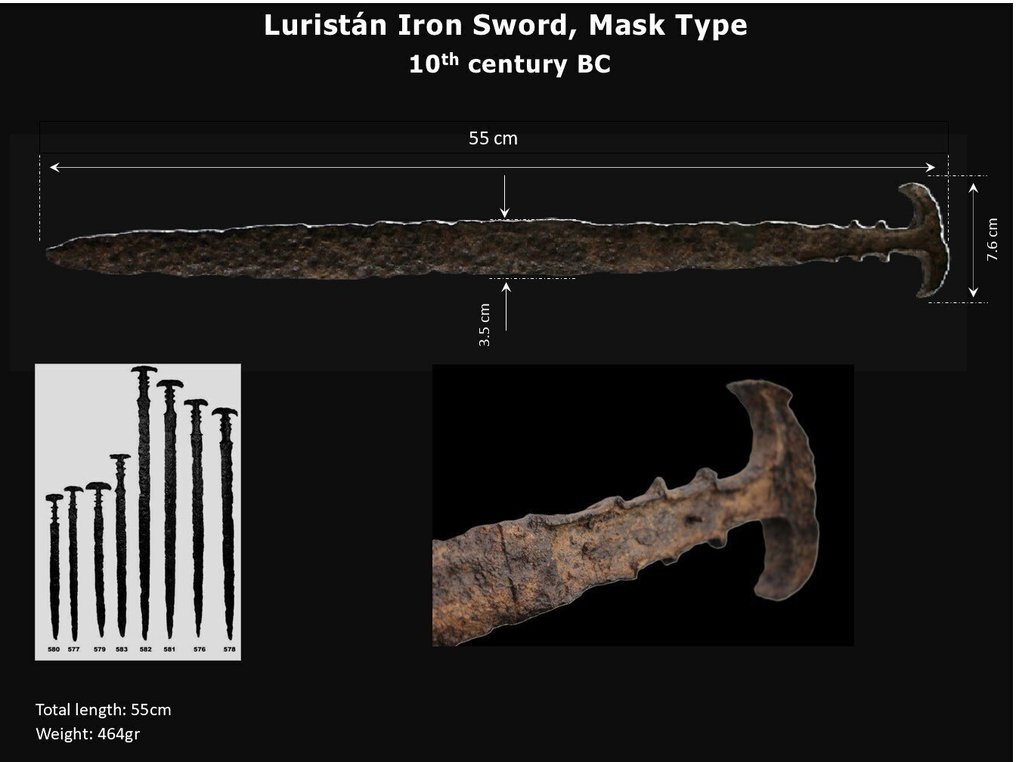
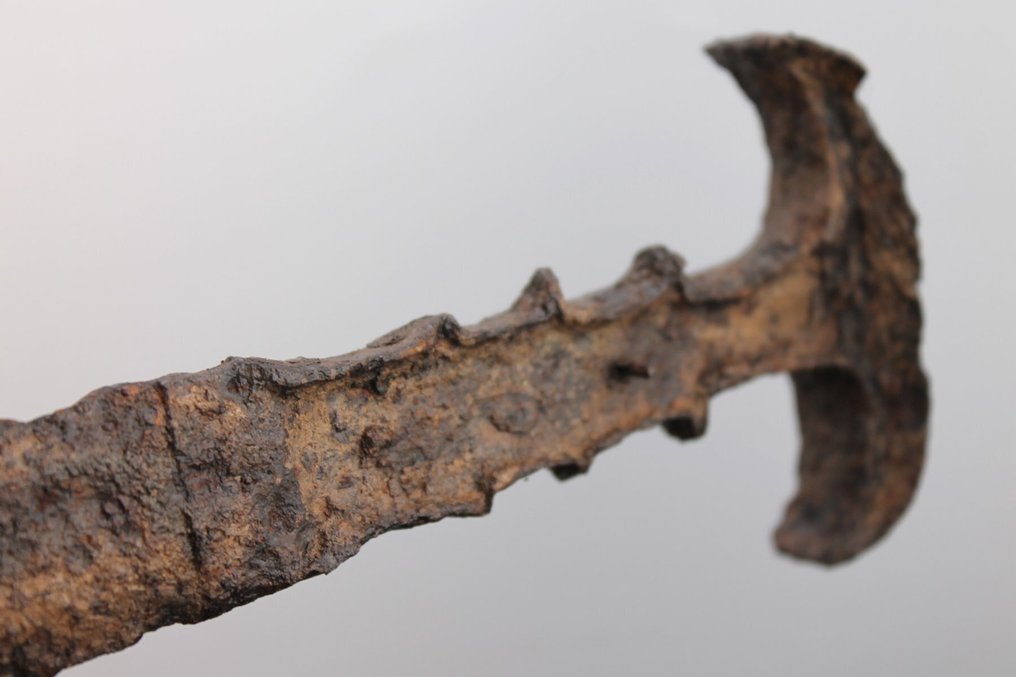
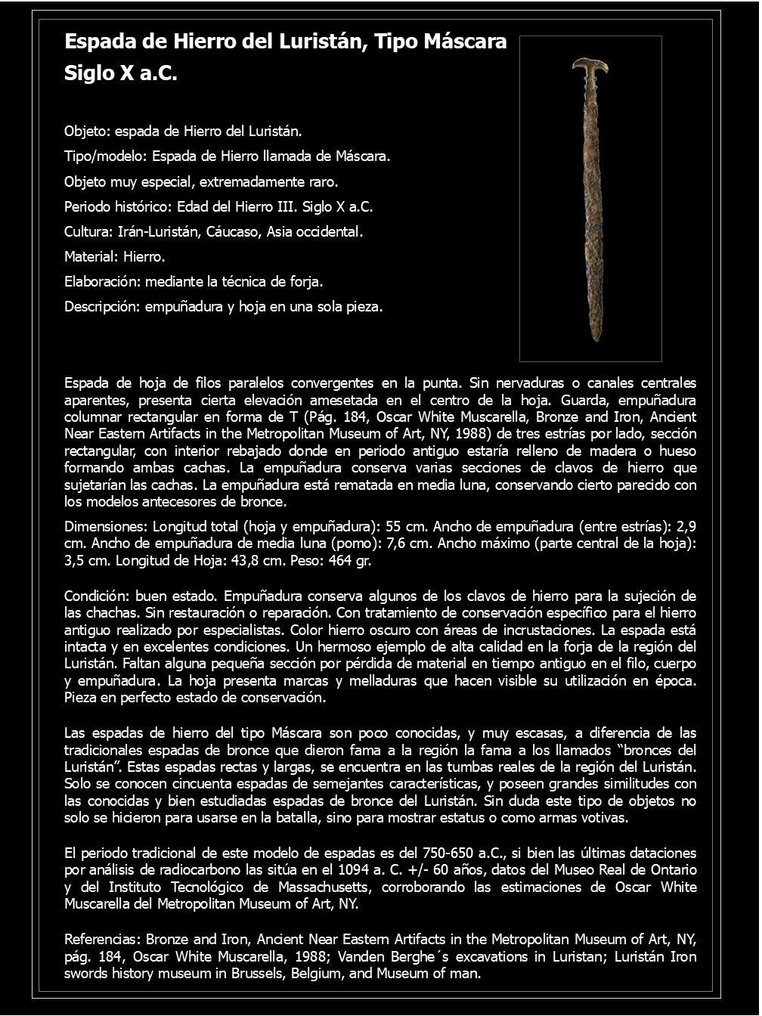
Sword with a one-piece hilt and blade, the blade featuring parallel edges that converge at the tip. It lacks apparent central ribs or channels, but has a certain flattened elevation in the center of the blade. The guard is a rectangular T-shaped columnar hilt (p. 184, Oscar White Muscarella, Bronze and Iron, Ancient Near Eastern Artifacts in the Metropolitan Museum of Art, NY, 1988) with three grooves on each side, rectangular in section, with a lowered interior that in ancient times would have been filled with wood or bone to form both handles. The handle retains several sections of iron nails that would have secured the handles in place. It is finished with a half-moon shape, maintaining a resemblance to the earlier bronze models.
Dimensions: Overall length (blade and hilt): 55 cm. Grip width (between grooves): 2.9 cm. Crescent grip width (pommel): 7.6 cm. Maximum width (central part of the blade): 3.5 cm. Blade length: 43.8 cm. Weight: 464 g.
Condition: good condition. Handle preserves some of the iron nails for holding the blades. No restoration or repair. With specific conservation treatment for old iron carried out by specialists. Dark iron color with inlaid areas. The sword is intact and in excellent condition. A beautiful example of high quality forging. Some small sections are missing due to loss of material in ancient times on the edge, body, and handle. The blade has marks and dents that make its use at the time visible. Piece in perfect condition.
The Mask type iron swords are little known and very rare. These long, straight swords are found in royal tombs. Only fifty swords with similar characteristics are known, and they have great similarities with the well-known and well-studied bronze swords. No doubt, these types of objects were not only made to be used in battle but also to show status or as votive weapons.
The traditional period for this model of swords is 750-650 BC, although the latest dating by radiocarbon analysis places them at 1094 BC ± 60 years, based on data from the Royal Ontario Museum and the Massachusetts Institute of Technology, corroborating the estimates of Oscar White Muscarella of the Metropolitan Museum of Art, NY.
References: Bronze and Iron, Ancient Near Eastern Artifacts in the Metropolitan Museum of Art, NY, p. 184, Oscar White Muscarella, 1988; Vanden Berghe's excavations Iron swords history museum in Brussels, Belgium, and Museum of man.
See details and dimensions in attached photos. In good condition. Acquired in 2000 from a specialized gallery. A copy of the certificate of authenticity and a copy of the catalog are sent with the object(s).
Shipments with tracking number.
Copies of all the purchase information and authenticity documents are sent with the item(s). The seller can prove that the lot was obtained legally, with a declaration of provenance seen by Catawiki.
Registered shipping. The seller will arrange for any necessary permits, such as an export license if necessary. The seller will inform the buyer of the permit status if this takes more than a few days.
Iron Sword of the Bronze Age, Mask Type
Ca. 10th century BC
Iron Sword
Type/model: Iron Sword called Mask.
Very special item, extremely rare.
Historical period: Iron Age III. 10th century BC.
Culture: Bronze Age
Material: Iron.
Preparation: using the forging technique.
Sword with a one-piece hilt and blade, the blade featuring parallel edges that converge at the tip. It lacks apparent central ribs or channels, but has a certain flattened elevation in the center of the blade. The guard is a rectangular T-shaped columnar hilt (p. 184, Oscar White Muscarella, Bronze and Iron, Ancient Near Eastern Artifacts in the Metropolitan Museum of Art, NY, 1988) with three grooves on each side, rectangular in section, with a lowered interior that in ancient times would have been filled with wood or bone to form both handles. The handle retains several sections of iron nails that would have secured the handles in place. It is finished with a half-moon shape, maintaining a resemblance to the earlier bronze models.
Dimensions: Overall length (blade and hilt): 55 cm. Grip width (between grooves): 2.9 cm. Crescent grip width (pommel): 7.6 cm. Maximum width (central part of the blade): 3.5 cm. Blade length: 43.8 cm. Weight: 464 g.
Condition: good condition. Handle preserves some of the iron nails for holding the blades. No restoration or repair. With specific conservation treatment for old iron carried out by specialists. Dark iron color with inlaid areas. The sword is intact and in excellent condition. A beautiful example of high quality forging. Some small sections are missing due to loss of material in ancient times on the edge, body, and handle. The blade has marks and dents that make its use at the time visible. Piece in perfect condition.
The Mask type iron swords are little known and very rare. These long, straight swords are found in royal tombs. Only fifty swords with similar characteristics are known, and they have great similarities with the well-known and well-studied bronze swords. No doubt, these types of objects were not only made to be used in battle but also to show status or as votive weapons.
The traditional period for this model of swords is 750-650 BC, although the latest dating by radiocarbon analysis places them at 1094 BC ± 60 years, based on data from the Royal Ontario Museum and the Massachusetts Institute of Technology, corroborating the estimates of Oscar White Muscarella of the Metropolitan Museum of Art, NY.
References: Bronze and Iron, Ancient Near Eastern Artifacts in the Metropolitan Museum of Art, NY, p. 184, Oscar White Muscarella, 1988; Vanden Berghe's excavations Iron swords history museum in Brussels, Belgium, and Museum of man.
See details and dimensions in attached photos. In good condition. Acquired in 2000 from a specialized gallery. A copy of the certificate of authenticity and a copy of the catalog are sent with the object(s).
Shipments with tracking number.
Copies of all the purchase information and authenticity documents are sent with the item(s). The seller can prove that the lot was obtained legally, with a declaration of provenance seen by Catawiki.
Registered shipping. The seller will arrange for any necessary permits, such as an export license if necessary. The seller will inform the buyer of the permit status if this takes more than a few days.
Details
Era
Before 1400
Culture
Luristan
Country of Origin
Germany
Century/ Timeframe
1000 BC
Material
Iron (cast/wrought)
Acquired from
Private collection
Condition
Excellent
Year acquired
2024
Style
Luristan
Country acquired from
Spain
Previous owner acquired from
Private collection
Height
55 cm
Width
7.6 cm
Previous owner - year acquired
2000
Depth
2.5 cm
Previous owner - country acquired from
Germany
I verify that I have obtained this object legally and that I am allowed to sell it
Yes
Overall Length
55 cm
Sold by
