Icon - Feast day icon - Wood


02
days
11
hours
00
minutes
46
seconds
Current bid
€ 85
Reserve price not met

Expert
Selected by Justus Heutink
Holds broad knowledge of religious icons with six years of collecting experience.
Estimate € 250 - € 350
32 other people are watching this object
 Bidder 3672 Bidder 3672 | €85 | |
|---|---|---|
| Bidder 2191 | €80 | |
 Bidder 0597 Bidder 0597 | €70 |
Catawiki Buyer Protection
Your payment’s safe with us until you receive your object.View details
Trustpilot 4.4 | 123234 reviews
Rated Excellent on Trustpilot.
Description from the seller
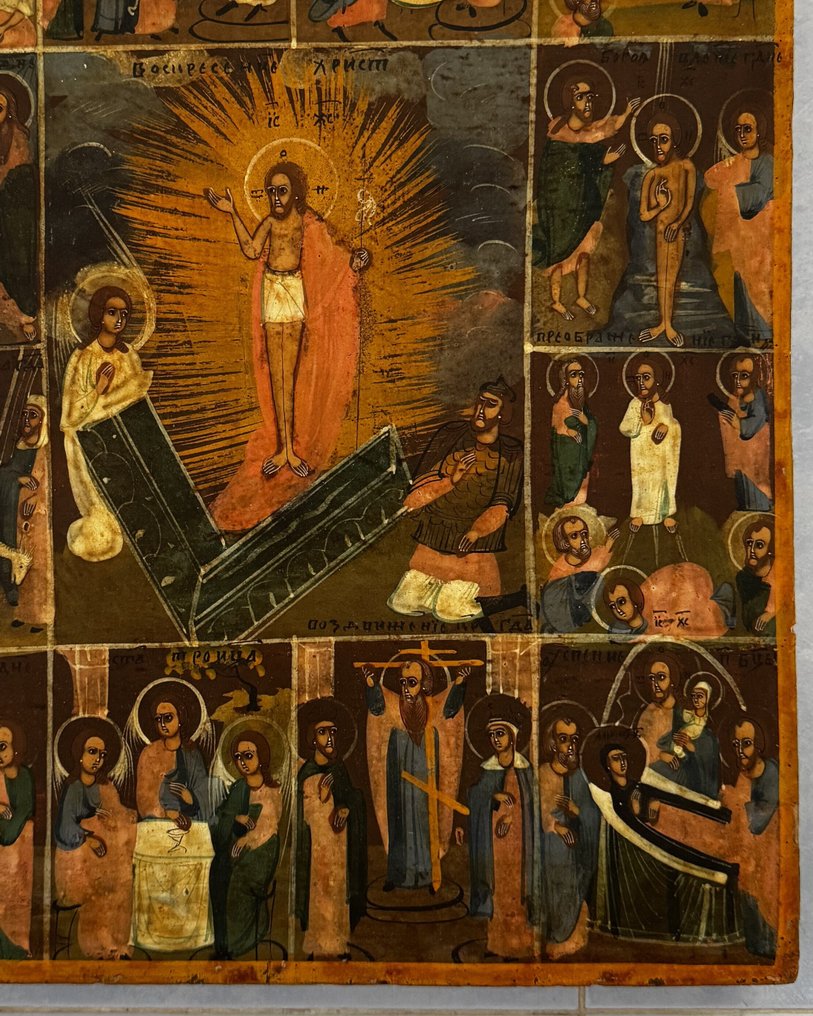
Russian Orthodox narrative icon of the Resurrection of Christ, accompanied by scenes from the Easter cycle and Christology.
Main theme
The Resurrection of Christ (Anástasis), characterized in a very distinctive way within the Russian Orthodox tradition.
Type of icon:
Icon or festal icon, composed of a dominant central scene and secondary scenes around, that depict key episodes of Christ's life related to Easter.
Central scene (the most important)
Christ Resurrected appears.
Standing on the gates of Hades, fallen in the shape of a cross.
Surrounded by a radiant golden mandorla (a symbol of divine glory).
With the Resurrection flag (cross with banner).
Blessing with the right hand.
At his/her feet
Hades personified, defeated and chained.
Broken locks, nails, and bolts: symbols of victory over death.
This image does not depict the empty tomb (typical of the West), but rather the victorious descent of Christ into the realm of the dead, which liberates humanity.
Peripheral scenes (around)
Arranged in rectangular panels, they depict biblical episodes. Among the most recognizable:
Cycle of Passion and Resurrection
The Crucifixion
The Descent
The Deposition in the Tomb
The women gazed before the tomb.
Christ appearing to the disciples
Christological cycle
The Nativity
The Presentation in the Temple
The Baptism of Christ
The Entry into Jerusalem
The Transfiguration
Each scene is identified by inscriptions in ecclesiastical Slavic, visible despite being worn.
Style and dating
Origin: Russia
Technique: Egg temple on a board
Background: Dark with abundant use of ochres and golds.
Linear, hieratic, with stylized figures.
Condition: visible wear, cracking, and losses of polychromy.
Probable dating
Late 18th century – first half of the 19th century.
This type of icons was common in:
rural churches
Chapels
Instructional domestic devotion for reading the sacred history.
This icon is a visual synthesis of the central dogma of Eastern Christianity.
Christ conquers death, descends to Hades, and opens the path of resurrection for all humanity.
That is why the Resurrection occupies the center and dominates the entire set.
An authenticity certificate is provided, endorsed by the Ministry of Culture of Estonia.
Russian Orthodox narrative icon of the Resurrection of Christ, accompanied by scenes from the Easter cycle and Christology.
Main theme
The Resurrection of Christ (Anástasis), characterized in a very distinctive way within the Russian Orthodox tradition.
Type of icon:
Icon or festal icon, composed of a dominant central scene and secondary scenes around, that depict key episodes of Christ's life related to Easter.
Central scene (the most important)
Christ Resurrected appears.
Standing on the gates of Hades, fallen in the shape of a cross.
Surrounded by a radiant golden mandorla (a symbol of divine glory).
With the Resurrection flag (cross with banner).
Blessing with the right hand.
At his/her feet
Hades personified, defeated and chained.
Broken locks, nails, and bolts: symbols of victory over death.
This image does not depict the empty tomb (typical of the West), but rather the victorious descent of Christ into the realm of the dead, which liberates humanity.
Peripheral scenes (around)
Arranged in rectangular panels, they depict biblical episodes. Among the most recognizable:
Cycle of Passion and Resurrection
The Crucifixion
The Descent
The Deposition in the Tomb
The women gazed before the tomb.
Christ appearing to the disciples
Christological cycle
The Nativity
The Presentation in the Temple
The Baptism of Christ
The Entry into Jerusalem
The Transfiguration
Each scene is identified by inscriptions in ecclesiastical Slavic, visible despite being worn.
Style and dating
Origin: Russia
Technique: Egg temple on a board
Background: Dark with abundant use of ochres and golds.
Linear, hieratic, with stylized figures.
Condition: visible wear, cracking, and losses of polychromy.
Probable dating
Late 18th century – first half of the 19th century.
This type of icons was common in:
rural churches
Chapels
Instructional domestic devotion for reading the sacred history.
This icon is a visual synthesis of the central dogma of Eastern Christianity.
Christ conquers death, descends to Hades, and opens the path of resurrection for all humanity.
That is why the Resurrection occupies the center and dominates the entire set.
An authenticity certificate is provided, endorsed by the Ministry of Culture of Estonia.
Details
Era
1400-1900
Iconography
Feast day icon
Weight
1.35 kg
Material
Wood
Country of Origin
Russia
Height
36.4 cm
Width
29 cm
Depth
2.5 cm
Condition
Good condition - used with small signs of aging & blemishes
Estimated period
1800-1850
Sold by
