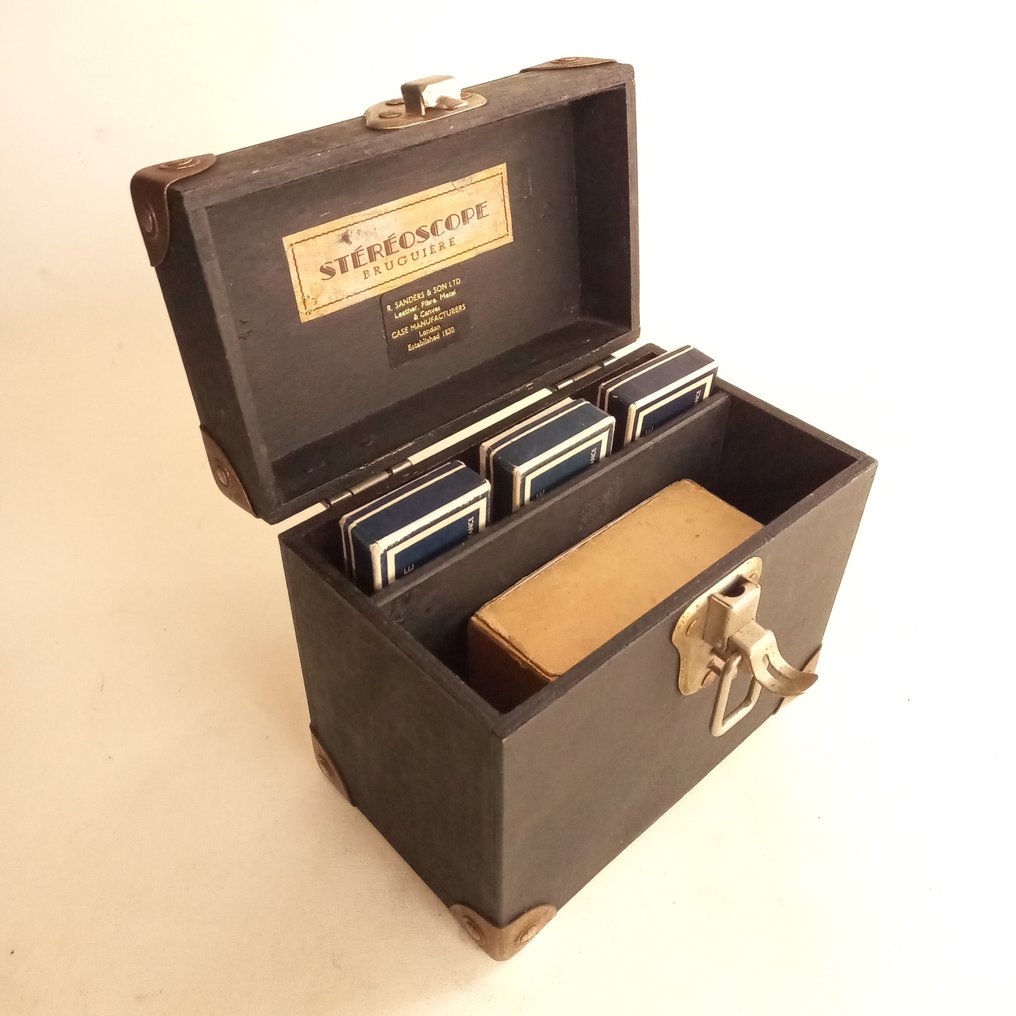
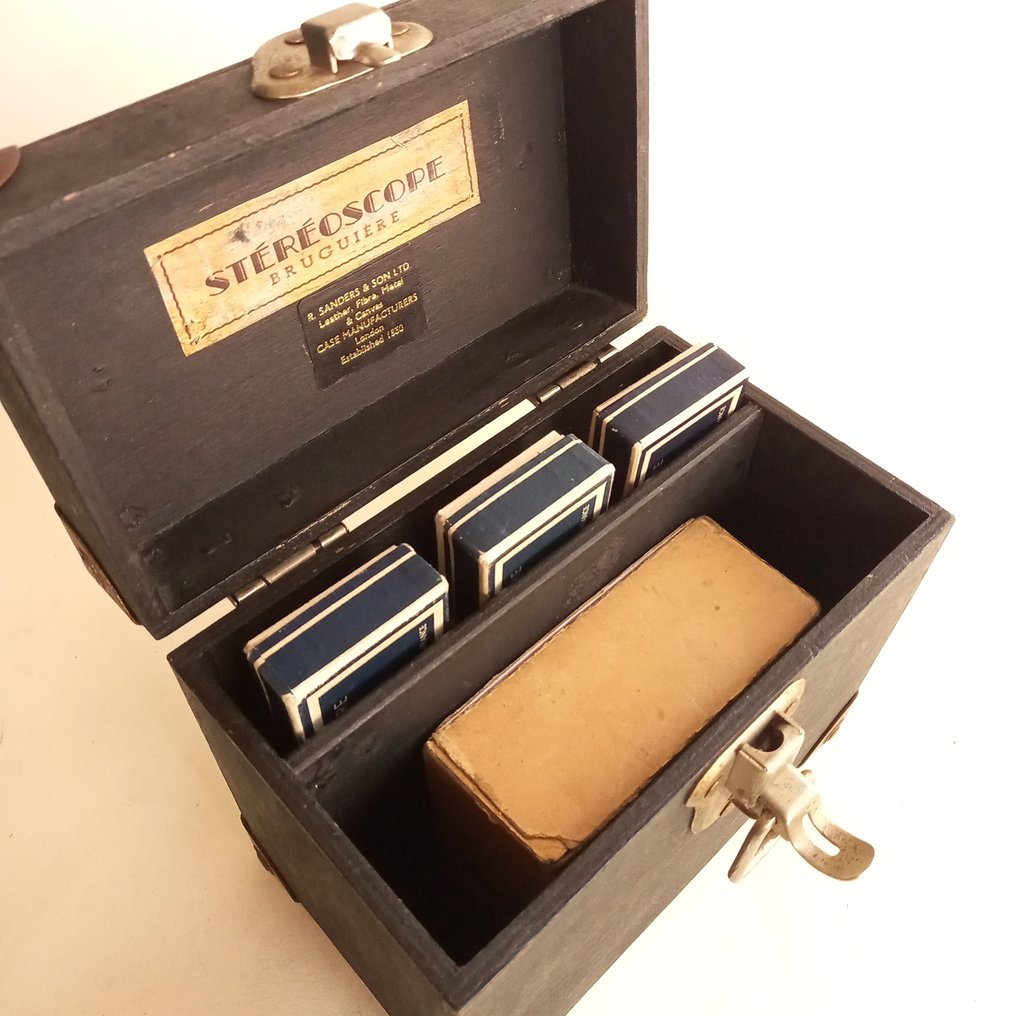
Bruguière Stèrèoscope 1940s with 36 Stèrèofilms Stereo viewer


Open for bids in 9min
Starting bid
€ 1
Add to your favourites to get an alert when the auction starts.

Catawiki Buyer Protection
Your payment’s safe with us until you receive your object.View details
Trustpilot 4.4 | 123609 reviews
Rated Excellent on Trustpilot.
Description from the seller
Old stereoscope, by the brand Bruguière, manufactured in France in the 1940s, with a beautiful wooden box (21cm x 13cm x 20cm) and 36 Bruguière stereofilms (positive on flexible film), distributed across three complete boxes, with 12 stereofilms each (see photos). The set is in very good condition considering its age (the stereoscope's cardboard box has been restored - see photos).
The stereoscope is an optical instrument that presents two slightly different images, one for each eye, to give the effect of depth. One of the most popular and enduring forms of stereoscope, it was invented by the American author Oliver Wendell Holmes (1809-1894) in 1861.
Stereoscopy is the process of creating the visual illusion of depth by placing two nearly identical images side by side. These images are slightly offset to represent the difference in perspective between the left and right eyes. Known as stereograms and typically mounted on a card, they are viewed through a device called a stereoscope. The stereoscope contains lenses that slightly magnify the images and also make them appear more distant. The two separate images then merge and appear as a single 'stereo' image, which is a virtual three-dimensional recreation of the photographed image.
Please see the attached photos to check the overall condition. The photos are part of the description.
Old stereoscope, by the brand Bruguière, manufactured in France in the 1940s, with a beautiful wooden box (21cm x 13cm x 20cm) and 36 Bruguière stereofilms (positive on flexible film), distributed across three complete boxes, with 12 stereofilms each (see photos). The set is in very good condition considering its age (the stereoscope's cardboard box has been restored - see photos).
The stereoscope is an optical instrument that presents two slightly different images, one for each eye, to give the effect of depth. One of the most popular and enduring forms of stereoscope, it was invented by the American author Oliver Wendell Holmes (1809-1894) in 1861.
Stereoscopy is the process of creating the visual illusion of depth by placing two nearly identical images side by side. These images are slightly offset to represent the difference in perspective between the left and right eyes. Known as stereograms and typically mounted on a card, they are viewed through a device called a stereoscope. The stereoscope contains lenses that slightly magnify the images and also make them appear more distant. The two separate images then merge and appear as a single 'stereo' image, which is a virtual three-dimensional recreation of the photographed image.
Please see the attached photos to check the overall condition. The photos are part of the description.
Details
Era
1900-2000
Brand
Bruguière
Model/ type nr
Stèrèoscope 1940s with 36 Stèrèofilms
Physical condition
Very good
Functional condition
Tested and working
Estimated Period
1930-1940
Sold by