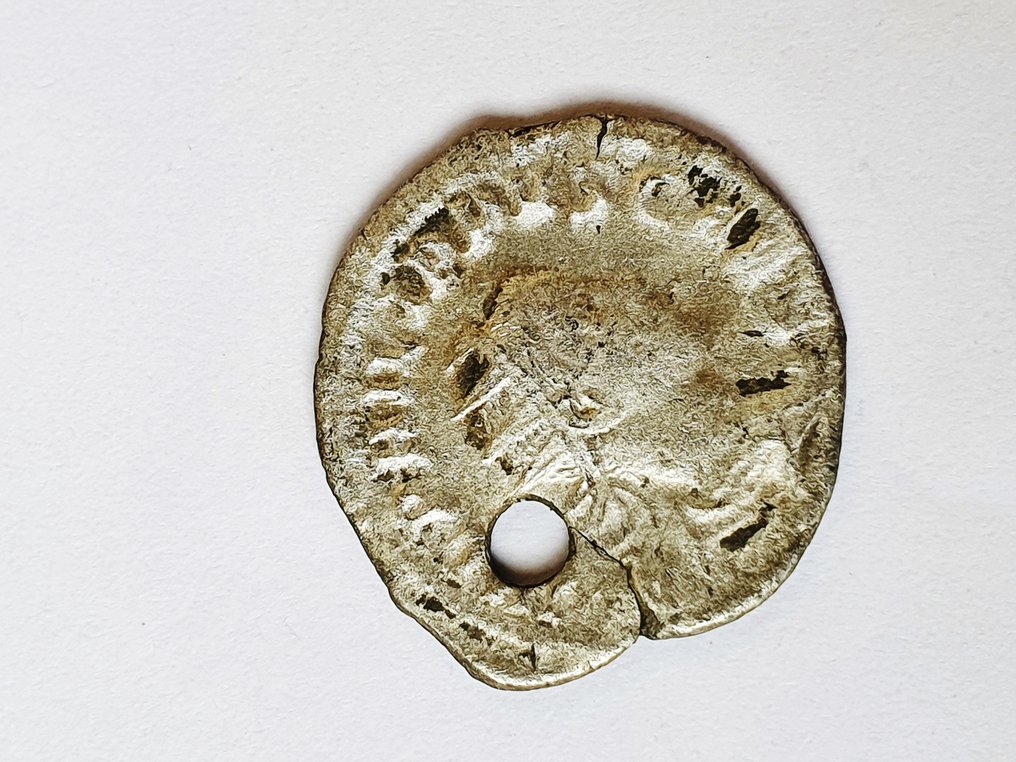
Ancient Roman, Empire Silver Antoninianus of Gordian III — Worn by a Roman Legionary - 21 mm (No reserve price)




03
days
06
hours
49
minutes
49
seconds
Current bid
€ 45
No reserve price

Expert
Selected by Ruth Garrido Vila
Directed the Ifergan Collection Museum, specialising in Phoenician and Mediterranean archaeology.
Estimate € 150 - € 200
38 other people are watching this object
 Bidder 4500 Bidder 4500 | €45 | |
|---|---|---|
 Bidder 4010 Bidder 4010 | €40 | |
| Bidder 4500 | €35 | |
Catawiki Buyer Protection
Your payment’s safe with us until you receive your object.View details
Trustpilot 4.4 | 123878 reviews
Rated Excellent on Trustpilot.
Ancient Roman silver Antoninianus of Gordian III, dating to AD 238–239, pierced in antiquity and worn as a pendant by a Roman legionary, weighing about 3 g with a diameter of 21–23 mm, leather cord included.
AI-assisted summary
Description from the seller
Silver Antoninianus of Gordian III — Worn by a Roman Legionary
Roman Empire, AD 238–239
Authentic silver antoninianus of Emperor Gordian III, struck at the very beginning of his reign and pierced in antiquity, a clear indication that the coin was worn as a personal amulet or pendant.
GORDIAN III, Marcus Antonius (born January 20, 225, in Rome — died February 11, 244, near Circesium) was Roman emperor from July–August 238 AD. He was the son of Gordian II and the grandson of Gordian I. After the murder of Maximinus and the brief reign of the emperors Pupienus and Balbinus, he was proclaimed emperor by the Praetorian Guard. Following frontier conflicts along the Danube in 242–244 AD, Gordian III led the campaign against the Persians in Syria and Mesopotamia and died on the Euphrates.
Obverse:
Radiate, draped and cuirassed bust of Gordian III facing right.
Legend: IMP GORDIANVS PIVS FEL AVG
Reverse:
Providentia standing front, head left, holding a globe in the right hand and a sceptre in the left.
Legend: P M TR P II COS P P
Details:
• Coin: Antoninianus
• Material: Silver
• Weight: 3 g
• Diameter: approx. 21–23 mm
• Period: AD 238–239
• Condition: Satisfactory; ancient circulation and wear consistent with age
• Ancient pierced hole – worn on a cord in Roman times
• Origin: Roman Empire
• Leather cord included as a gift
• Shipping: European Union only
In Roman antiquity, silver coins were often pierced and worn around the neck by soldiers and legionaries as protective talismans, symbols of loyalty to the emperor, or personal keepsakes carried into battle.
The reverse figure Providentia represents divine foresight and destiny — a powerful message for a young emperor ruling during the Crisis of the Third Century. The globe signifies world dominion, the sceptre imperial authority.
This coin may once have rested on the chest of a Roman soldier, carried through marches, camps, and battles. Today, it survives as a tangible link to the everyday spiritual life of the Roman army.
A rare and emotionally charged artifact — part coin, part amulet, part personal history.
Silver Antoninianus of Gordian III — Worn by a Roman Legionary
Roman Empire, AD 238–239
Authentic silver antoninianus of Emperor Gordian III, struck at the very beginning of his reign and pierced in antiquity, a clear indication that the coin was worn as a personal amulet or pendant.
GORDIAN III, Marcus Antonius (born January 20, 225, in Rome — died February 11, 244, near Circesium) was Roman emperor from July–August 238 AD. He was the son of Gordian II and the grandson of Gordian I. After the murder of Maximinus and the brief reign of the emperors Pupienus and Balbinus, he was proclaimed emperor by the Praetorian Guard. Following frontier conflicts along the Danube in 242–244 AD, Gordian III led the campaign against the Persians in Syria and Mesopotamia and died on the Euphrates.
Obverse:
Radiate, draped and cuirassed bust of Gordian III facing right.
Legend: IMP GORDIANVS PIVS FEL AVG
Reverse:
Providentia standing front, head left, holding a globe in the right hand and a sceptre in the left.
Legend: P M TR P II COS P P
Details:
• Coin: Antoninianus
• Material: Silver
• Weight: 3 g
• Diameter: approx. 21–23 mm
• Period: AD 238–239
• Condition: Satisfactory; ancient circulation and wear consistent with age
• Ancient pierced hole – worn on a cord in Roman times
• Origin: Roman Empire
• Leather cord included as a gift
• Shipping: European Union only
In Roman antiquity, silver coins were often pierced and worn around the neck by soldiers and legionaries as protective talismans, symbols of loyalty to the emperor, or personal keepsakes carried into battle.
The reverse figure Providentia represents divine foresight and destiny — a powerful message for a young emperor ruling during the Crisis of the Third Century. The globe signifies world dominion, the sceptre imperial authority.
This coin may once have rested on the chest of a Roman soldier, carried through marches, camps, and battles. Today, it survives as a tangible link to the everyday spiritual life of the Roman army.
A rare and emotionally charged artifact — part coin, part amulet, part personal history.
Details
Culture
Ancient Roman, Empire
Century/ Timeframe
Roman Empire, AD 238–239
Name of object
Antoninianus of Gordian III — Worn by a Roman Legionary
Acquired from
Private collection
Year acquired
2022
Material
Silver
Country acquired from
Germany
Condition
Very good
Previous owner acquired from
Private collection
Height
21 mm
Previous owner - year acquired
2000
Width
23 mm
Previous owner - country acquired from
Germany
I verify that I have obtained this object legally and that I am allowed to sell it
Yes
Sold by
Disclaimer
The seller was informed by Catawiki about documentation requirements and guarantees the following: - the object was legally obtained, - the seller has the right to sell and/or export the object, as relevant, - the seller will provide the necessary provenance information and arrange required documentation and permits/licenses, as applicable and as per local laws, - the seller will notify the buyer of any delays in obtaining permits/licenses. By bidding, you acknowledge that import documentation may be required depending on your country of residence and that obtaining permits/licenses may cause delays in the delivery of your object.
The seller was informed by Catawiki about documentation requirements and guarantees the following: - the object was legally obtained, - the seller has the right to sell and/or export the object, as relevant, - the seller will provide the necessary provenance information and arrange required documentation and permits/licenses, as applicable and as per local laws, - the seller will notify the buyer of any delays in obtaining permits/licenses. By bidding, you acknowledge that import documentation may be required depending on your country of residence and that obtaining permits/licenses may cause delays in the delivery of your object.
