Germano Celant - Precronistoria 1966-69 - 1976



12
days
16
hours
26
minutes
06
seconds

7 other people are watching this object
 Bidder 7884 Bidder 7884 | €3 |
|---|
Catawiki Buyer Protection
Your payment’s safe with us until you receive your object.View details
Trustpilot 4.4 | 123253 reviews
Rated Excellent on Trustpilot.
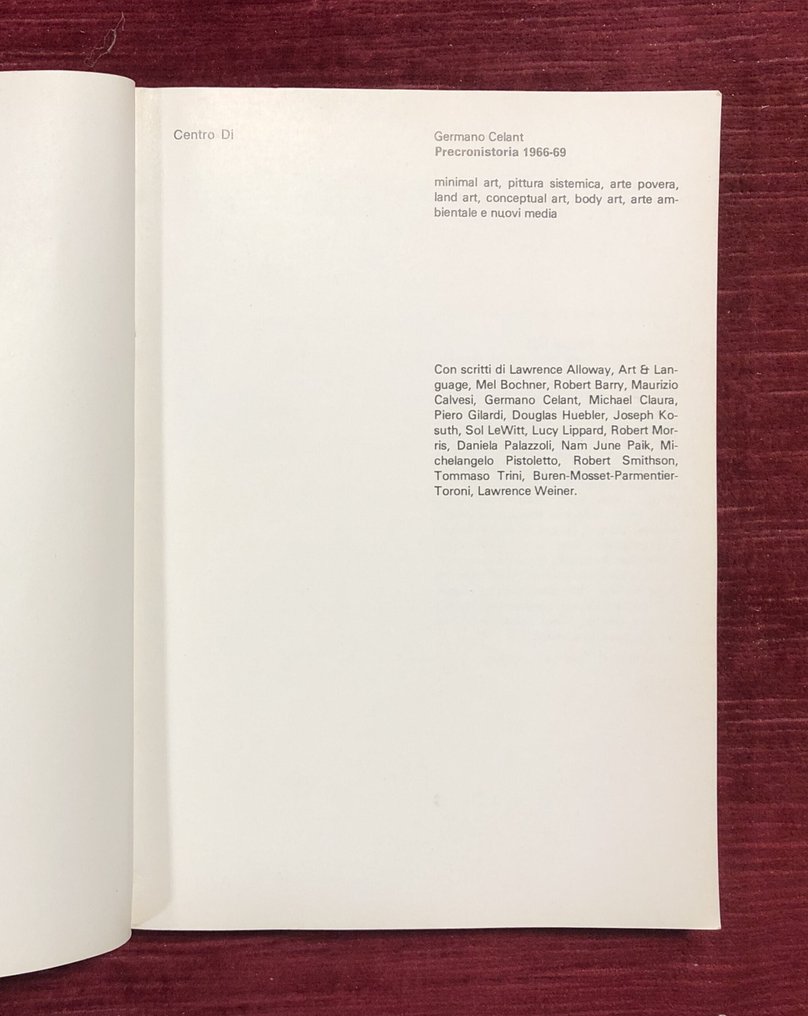
Precronistoria 1966-69 by Germano Celant, first Italian edition, paperback, 178 pages, 21 x 14 cm, published in 1976 by Edt. Centro Di, Firenze, in good condition.
AI-assisted summary
Description from the seller
Prehistory 1966-69
German Celant. Ed. Centro Di, Florence 1976. Hardcover. Very illustrated. Text in Italian. 178 pages. 21x15 cm. First edition.
An important prehistory that examines the precursors of conceptual art, land art, minimalism, arte povera, and body art. Celant argues that these developments were based on the use of non-traditional artistic media, such as photography, video, audio recordings, books, and films.
With texts (in Italian): Celant, Lawrence Alloway, Michel Claura, Sol LeWitt, Lucy Lippard, Nam June Paik, Michelangelo Pistoletto, Robert Smithson, Buren-Mosset-Parmentier-Toroni, Lawrence Weiner, and others.
Arte Povera
Name created by the Italian art critic Germano Celant under which very diverse artistic activities are integrated, but which generally share the use of poor materials such as straw, sand, stones, branches, leaves, fragments, or metal objects, as well as porcelain or glass pieces, although the artists of the movement also used gold, silk, marble, or Murano glass.
Prehistory 1966-69
German Celant. Ed. Centro Di, Florence 1976. Hardcover. Very illustrated. Text in Italian. 178 pages. 21x15 cm. First edition.
An important prehistory that examines the precursors of conceptual art, land art, minimalism, arte povera, and body art. Celant argues that these developments were based on the use of non-traditional artistic media, such as photography, video, audio recordings, books, and films.
With texts (in Italian): Celant, Lawrence Alloway, Michel Claura, Sol LeWitt, Lucy Lippard, Nam June Paik, Michelangelo Pistoletto, Robert Smithson, Buren-Mosset-Parmentier-Toroni, Lawrence Weiner, and others.
Arte Povera
Name created by the Italian art critic Germano Celant under which very diverse artistic activities are integrated, but which generally share the use of poor materials such as straw, sand, stones, branches, leaves, fragments, or metal objects, as well as porcelain or glass pieces, although the artists of the movement also used gold, silk, marble, or Murano glass.
Details
Number of Books
1
Subject
Applied art
Book Title
Precronistoria 1966-69
Author/ Illustrator
Germano Celant
Condition
Good
Publication year oldest item
1976
Height
21 cm
Edition
1st Edition
Width
14 cm
Language
Italian
Original language
Yes
Publisher
Edt. Centro Di, Firenze 1976
Binding/ Material
Softback
Number of pages
178
Sold by