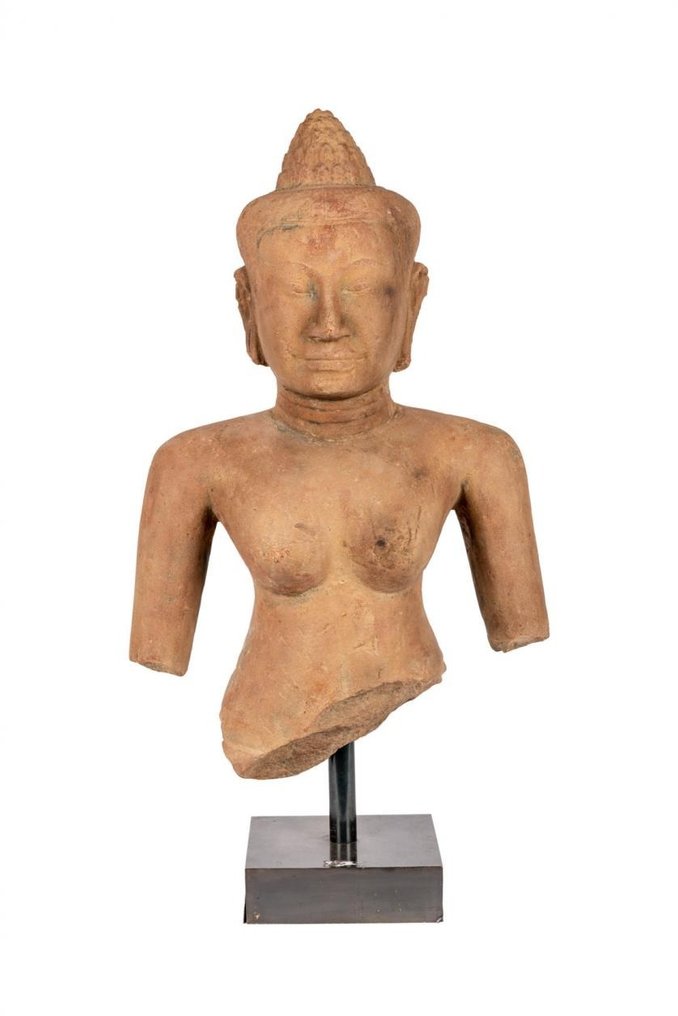
Khmer Lopburi Stone Deity Torso. Very big. - 55 cm
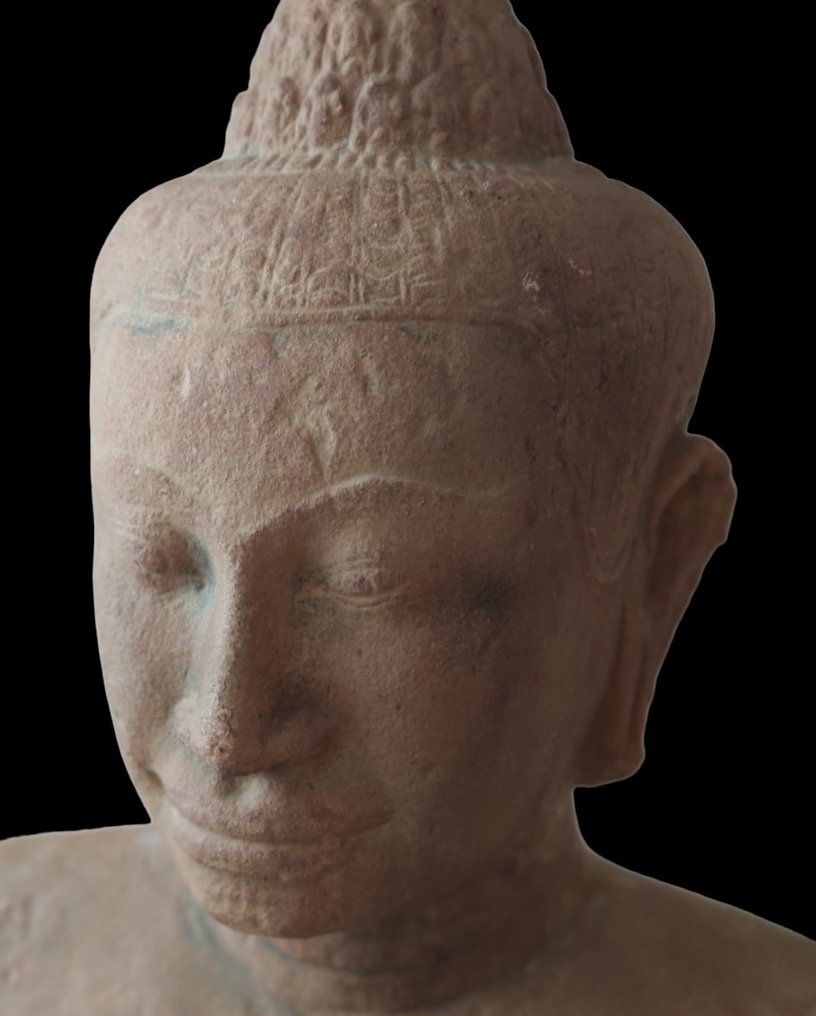
06
days
11
hours
06
minutes
24
seconds
Starting bid
€ 1
Reserve price not met

Expert
Selected by Ruth Garrido Vila
Directed the Ifergan Collection Museum, specialising in Phoenician and Mediterranean archaeology.
Estimate € 14,000 - € 16,000
No bids placed
Catawiki Buyer Protection
Your payment’s safe with us until you receive your object.View details
Trustpilot 4.4 | 123327 reviews
Rated Excellent on Trustpilot.
Description from the seller
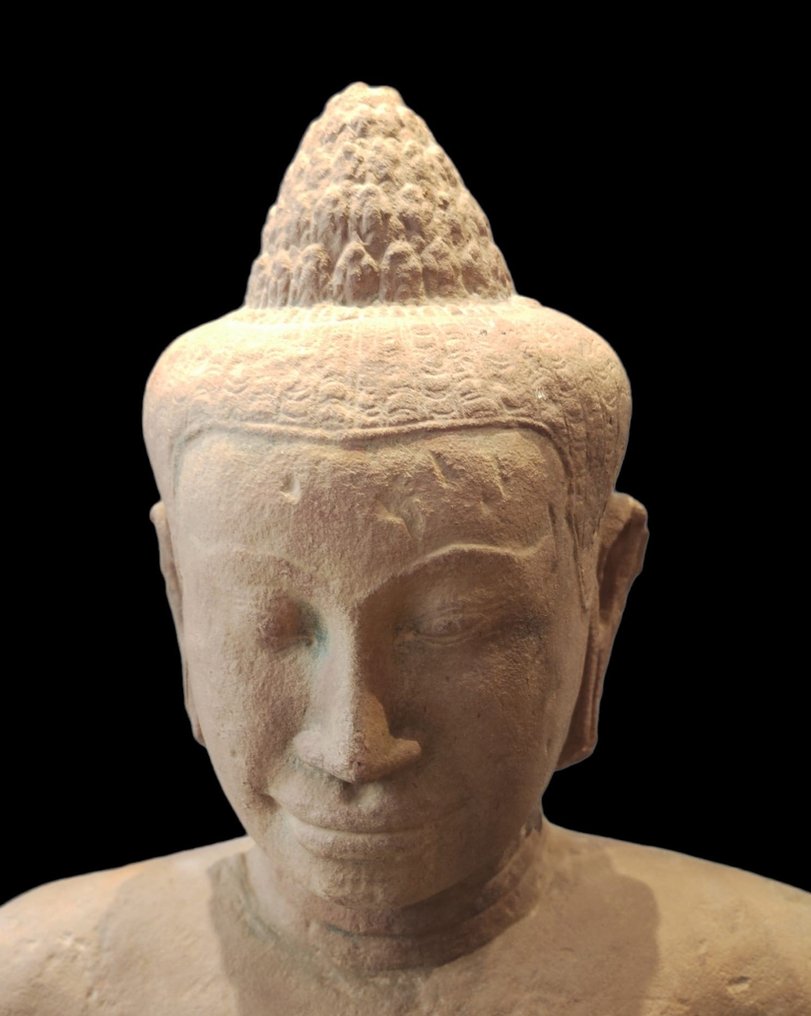
Khmer Lopburi deity torso, 11th century AD.
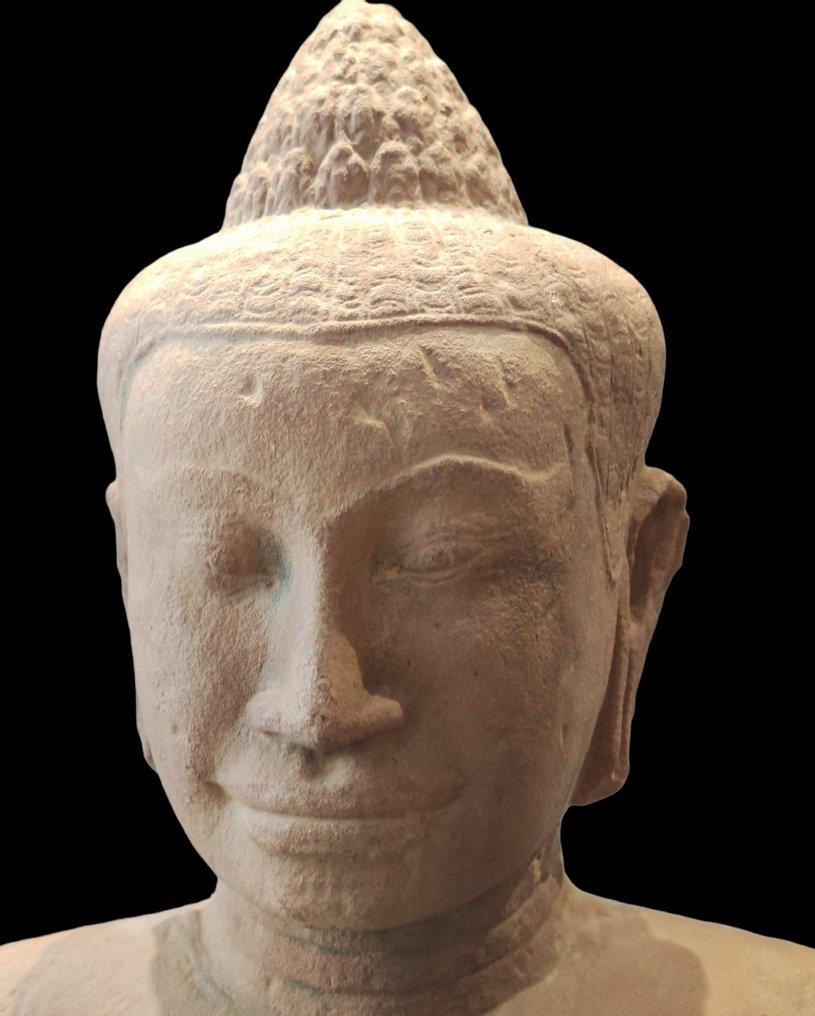
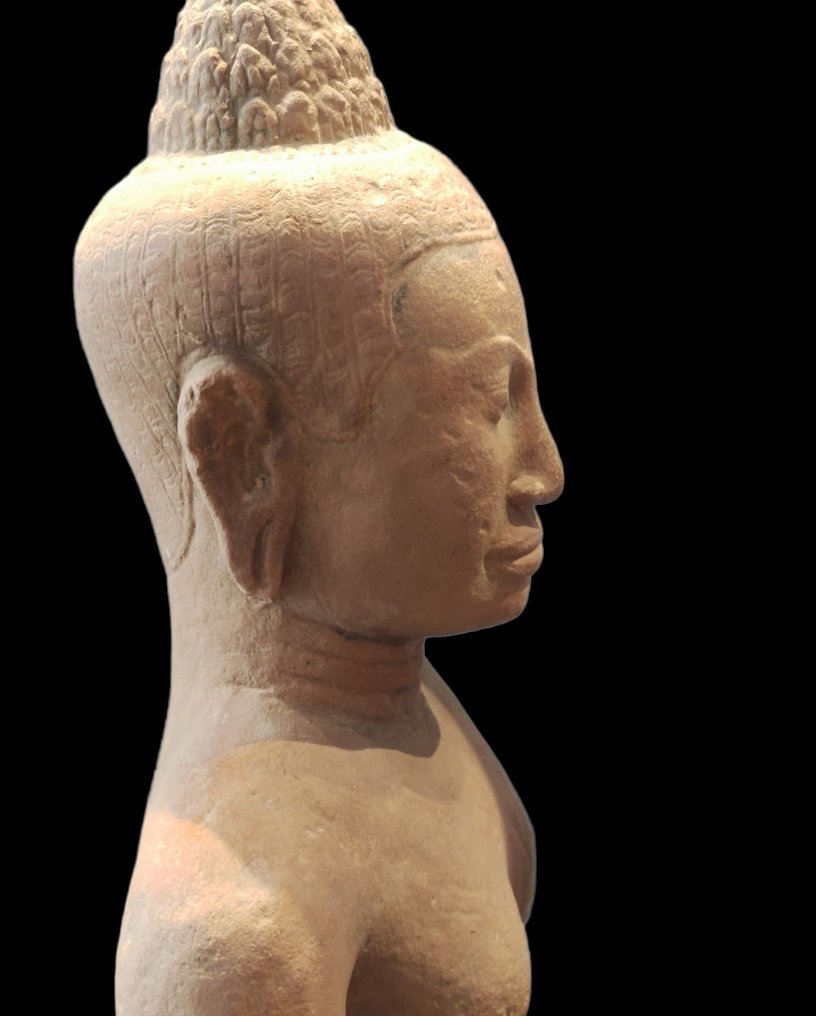
This Buddha torso, endowed with exceptional refinement in every detail of its chiseling, iconographically presents some of the 'lakshana' or specific features that allow us to recognize him as Siddhartha Gautama. The slightly closed eyelids symbolize spiritual concentration and purity, resembling lotus petals. The serene face is illuminated by a barely hinted smile. A sinuous line traces the lip profile, delicately marking the perfect arch of the eyebrows, the almonds of the eye sockets, and the bridge of the nose. Each curve has been carefully considered and balanced to convey the serenity characteristic of a perfect being. The elongated earlobes allude to the large earrings worn by members of the upper classes in contemporary India, representing concepts of greatness, nobility, and wisdom.
The Khmer Empire was the largest empire in Southeast Asia, and its core roughly corresponded to present-day Cambodia. The empire, which had become independent from the kingdom of Srivijaya and eventually replaced the kingdom of Chenla, controlled or made vassals of present-day Malaysia, Thailand, Laos, Vietnam, Myanmar, and Indonesia. During the empire's formation, the Khmer Empire had very close cultural, political, and trade ties with Java first, and with Srivijaya, which lay in the south of the empire. Its most important legacy is Angkor, which was the capital of the empire during its heyday. Angkor is the best testament to the power and wealth of the empire, as well as the diversity of beliefs that followed one another over the centuries. The official religions of the empire were Hinduism and Mahayana Buddhism until Theravada Buddhism took over after its introduction from Sri Lanka in the 13th century. Modern satellites have revealed that Angkor was the largest pre-industrial human settlement in the world, larger than modern New York and all. Angkor's history as the center of the historic Kambuja kingdom is also the history of the Khmer Empire from the 9th to the 15th century. 55 x 35 x 13cm.
Khmer Torso
Measurements: 55 x 35 x 13 cm
This lot requires an Export Permit.
Provenance: Private collection United Kingdom 1960.
Khmer style Lapbur Buddha torso, 11th century.
This Buddha torso, endowed with singular refinement in every detail of its chiseling, presents iconographically some of the 'lakshana' or specific traits that allow it to be recognized as Siddhartha Gautama. The slightly closed eyelids symbolize spiritual concentration and purity due to their similarity to lotus petals. The serene face is illuminated by a barely hinted smile. A sinuous line traces the lip profile, delicately marking the perfect arch of the eyebrows, the almond-shaped eye sockets, and the bridge of the nose. Each curve has been carefully considered and balanced to convey the serenity characteristic of a perfect being. The elongated earlobes allude to the large earrings worn by members of the high classes in contemporary India to Gautama Siddhartha and represent concepts of greatness, nobility, and wisdom.
The Khmer Empire was the largest empire in Southeast Asia, with its core roughly corresponding to present-day Cambodia. The empire, which had gained independence from the kingdom of Srivijaya and eventually replaced the kingdom of Chenla, controlled or made vassals of present-day Malaysia, Thailand, Laos, Vietnam, Myanmar, and Indonesia. During the formation of the empire, the Khmer Empire had very close cultural, political, and commercial ties with Java initially and with Srivijaya, which were located in the south of the empire. Its most important legacy is Angkor, which was the empire's capital during its peak. Angkor is the best testament to the power and wealth of the empire, as well as the diversity of beliefs that succeeded each other over the centuries. The official religions of the empire were Hinduism and Mahayana Buddhism until Theravada Buddhism was imposed after its introduction from Sri Lanka in the 13th century. Modern satellites have revealed that Angkor was the largest preindustrial human settlement in the world, larger than modern New York and everything else. The history of Angkor as the center of the historic kingdom of Kambuja is also the history of the Khmer Empire from the 9th to the 15th century. 55 x 35 x 13 cm
Khmer Torso Object
Measurements: 55 x 35 x 13 cm
This lot requires an export permit.
Provenance: Private Collection, United Kingdom, 1960.
Notes: The piece includes a Spanish Export License (Passport for the European Union), issued at the time of sale in the buyer's name. The process takes one to two weeks. - If the piece is destined outside the European Union, a replacement export permit will be requested. This process involves Fee charges that the buyer must pay during the application process. This process can take 2 to 4 weeks. SENT WITH INSURANCE.
Important information. The seller guarantees that they have the right to send this batch.
The seller will ensure that the necessary permits are processed.
The seller will inform the buyer about this if it takes more than a few days.
Seller's Story
Galería Fuentenebro emerged in 2018 to combine ancient art and contemporary art with a selection of high-quality works in a single space.
Created by art experts with more than fifteen years of experience specialized in Archaeology, Antiquities of the s. XX and in the last great styles of the 50s, 60s, 70s, 80s and Art Decó. In 2019 he creates a space in Madrid combining masterpieces from different eras in a single eclectic and different space.
We search and select the best pieces to introduce the international market trends in Spain.
Translated by Google TranslateKhmer Lopburi deity torso, 11th century AD.
This Buddha torso, endowed with exceptional refinement in every detail of its chiseling, iconographically presents some of the 'lakshana' or specific features that allow us to recognize him as Siddhartha Gautama. The slightly closed eyelids symbolize spiritual concentration and purity, resembling lotus petals. The serene face is illuminated by a barely hinted smile. A sinuous line traces the lip profile, delicately marking the perfect arch of the eyebrows, the almonds of the eye sockets, and the bridge of the nose. Each curve has been carefully considered and balanced to convey the serenity characteristic of a perfect being. The elongated earlobes allude to the large earrings worn by members of the upper classes in contemporary India, representing concepts of greatness, nobility, and wisdom.
The Khmer Empire was the largest empire in Southeast Asia, and its core roughly corresponded to present-day Cambodia. The empire, which had become independent from the kingdom of Srivijaya and eventually replaced the kingdom of Chenla, controlled or made vassals of present-day Malaysia, Thailand, Laos, Vietnam, Myanmar, and Indonesia. During the empire's formation, the Khmer Empire had very close cultural, political, and trade ties with Java first, and with Srivijaya, which lay in the south of the empire. Its most important legacy is Angkor, which was the capital of the empire during its heyday. Angkor is the best testament to the power and wealth of the empire, as well as the diversity of beliefs that followed one another over the centuries. The official religions of the empire were Hinduism and Mahayana Buddhism until Theravada Buddhism took over after its introduction from Sri Lanka in the 13th century. Modern satellites have revealed that Angkor was the largest pre-industrial human settlement in the world, larger than modern New York and all. Angkor's history as the center of the historic Kambuja kingdom is also the history of the Khmer Empire from the 9th to the 15th century. 55 x 35 x 13cm.
Khmer Torso
Measurements: 55 x 35 x 13 cm
This lot requires an Export Permit.
Provenance: Private collection United Kingdom 1960.
Khmer style Lapbur Buddha torso, 11th century.
This Buddha torso, endowed with singular refinement in every detail of its chiseling, presents iconographically some of the 'lakshana' or specific traits that allow it to be recognized as Siddhartha Gautama. The slightly closed eyelids symbolize spiritual concentration and purity due to their similarity to lotus petals. The serene face is illuminated by a barely hinted smile. A sinuous line traces the lip profile, delicately marking the perfect arch of the eyebrows, the almond-shaped eye sockets, and the bridge of the nose. Each curve has been carefully considered and balanced to convey the serenity characteristic of a perfect being. The elongated earlobes allude to the large earrings worn by members of the high classes in contemporary India to Gautama Siddhartha and represent concepts of greatness, nobility, and wisdom.
The Khmer Empire was the largest empire in Southeast Asia, with its core roughly corresponding to present-day Cambodia. The empire, which had gained independence from the kingdom of Srivijaya and eventually replaced the kingdom of Chenla, controlled or made vassals of present-day Malaysia, Thailand, Laos, Vietnam, Myanmar, and Indonesia. During the formation of the empire, the Khmer Empire had very close cultural, political, and commercial ties with Java initially and with Srivijaya, which were located in the south of the empire. Its most important legacy is Angkor, which was the empire's capital during its peak. Angkor is the best testament to the power and wealth of the empire, as well as the diversity of beliefs that succeeded each other over the centuries. The official religions of the empire were Hinduism and Mahayana Buddhism until Theravada Buddhism was imposed after its introduction from Sri Lanka in the 13th century. Modern satellites have revealed that Angkor was the largest preindustrial human settlement in the world, larger than modern New York and everything else. The history of Angkor as the center of the historic kingdom of Kambuja is also the history of the Khmer Empire from the 9th to the 15th century. 55 x 35 x 13 cm
Khmer Torso Object
Measurements: 55 x 35 x 13 cm
This lot requires an export permit.
Provenance: Private Collection, United Kingdom, 1960.
Notes: The piece includes a Spanish Export License (Passport for the European Union), issued at the time of sale in the buyer's name. The process takes one to two weeks. - If the piece is destined outside the European Union, a replacement export permit will be requested. This process involves Fee charges that the buyer must pay during the application process. This process can take 2 to 4 weeks. SENT WITH INSURANCE.
Important information. The seller guarantees that they have the right to send this batch.
The seller will ensure that the necessary permits are processed.
The seller will inform the buyer about this if it takes more than a few days.
Seller's Story
Galería Fuentenebro emerged in 2018 to combine ancient art and contemporary art with a selection of high-quality works in a single space.
Created by art experts with more than fifteen years of experience specialized in Archaeology, Antiquities of the s. XX and in the last great styles of the 50s, 60s, 70s, 80s and Art Decó. In 2019 he creates a space in Madrid combining masterpieces from different eras in a single eclectic and different space.
We search and select the best pieces to introduce the international market trends in Spain.
Translated by Google TranslateDetails
Culture
Khmer Lopburi
Century/ Timeframe
11th century AD.
Name of object
Deity Torso. Very big.
Acquired from
Gallery / Antique dealer
Year acquired
2022
Material
Stone
Country acquired from
Spain
Condition
Very good
Previous owner acquired from
Auction house
Height
55 cm
Previous owner - year acquired
2022
Width
35 cm
Previous owner - country acquired from
United Kingdom
Depth
13 cm
I verify that I have obtained this object legally and that I am allowed to sell it
Yes
Sold by
Disclaimer
The seller was informed by Catawiki about documentation requirements and guarantees the following: - the object was legally obtained, - the seller has the right to sell and/or export the object, as relevant, - the seller will provide the necessary provenance information and arrange required documentation and permits/licenses, as applicable and as per local laws, - the seller will notify the buyer of any delays in obtaining permits/licenses. By bidding, you acknowledge that import documentation may be required depending on your country of residence and that obtaining permits/licenses may cause delays in the delivery of your object.
The seller was informed by Catawiki about documentation requirements and guarantees the following: - the object was legally obtained, - the seller has the right to sell and/or export the object, as relevant, - the seller will provide the necessary provenance information and arrange required documentation and permits/licenses, as applicable and as per local laws, - the seller will notify the buyer of any delays in obtaining permits/licenses. By bidding, you acknowledge that import documentation may be required depending on your country of residence and that obtaining permits/licenses may cause delays in the delivery of your object.
