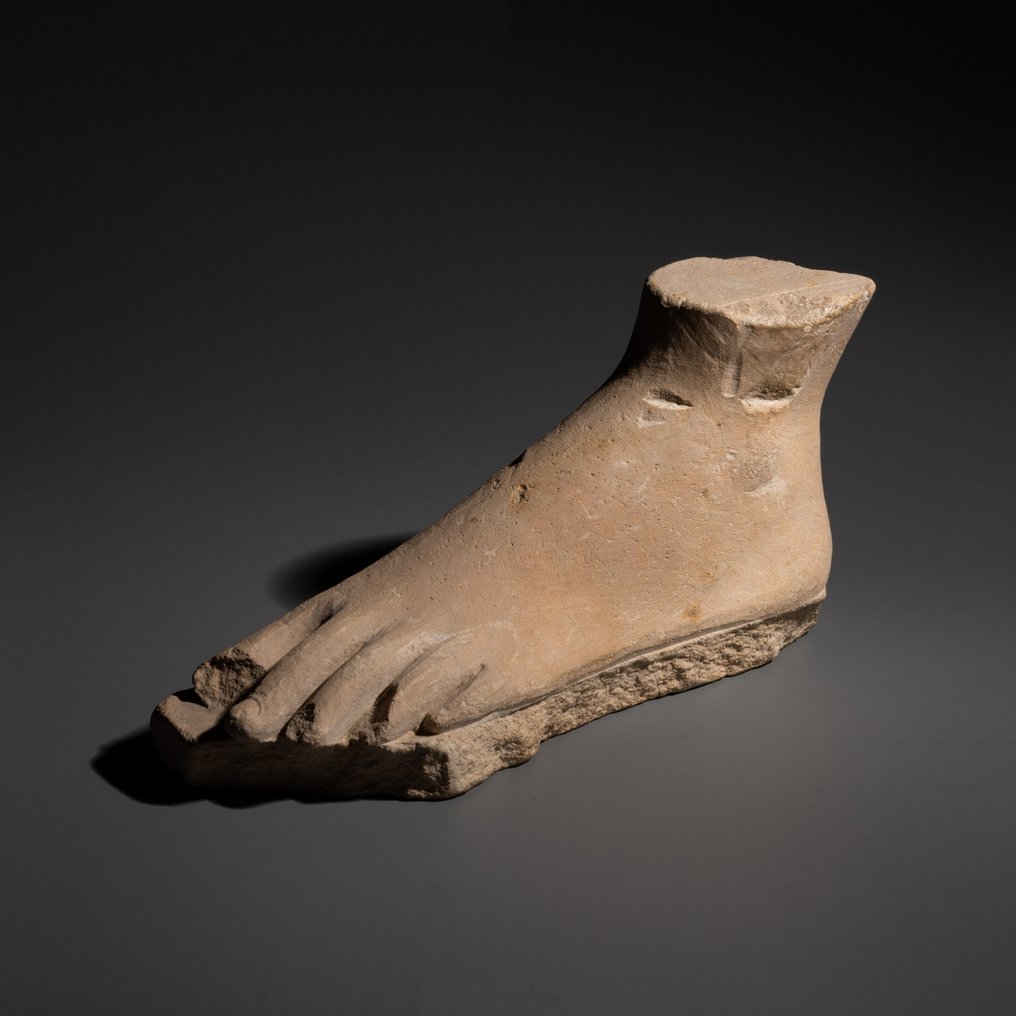
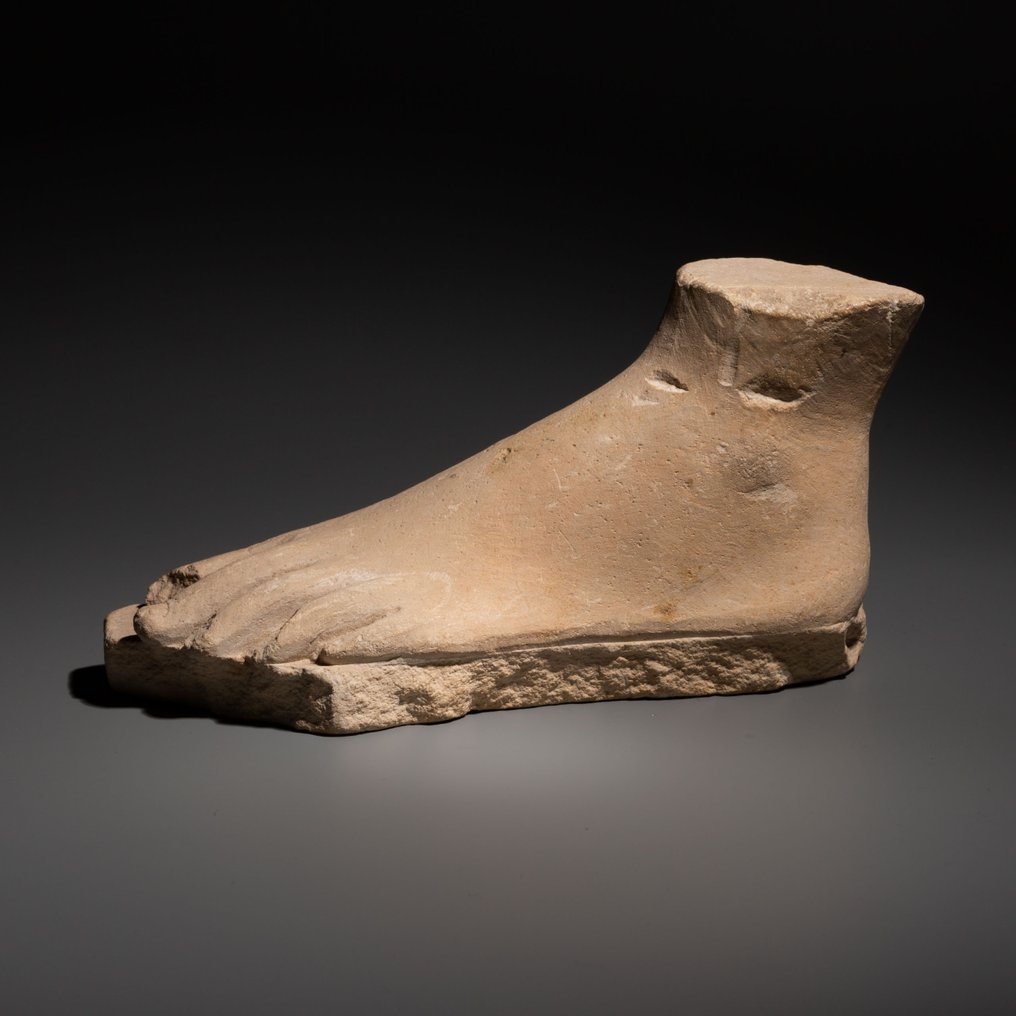
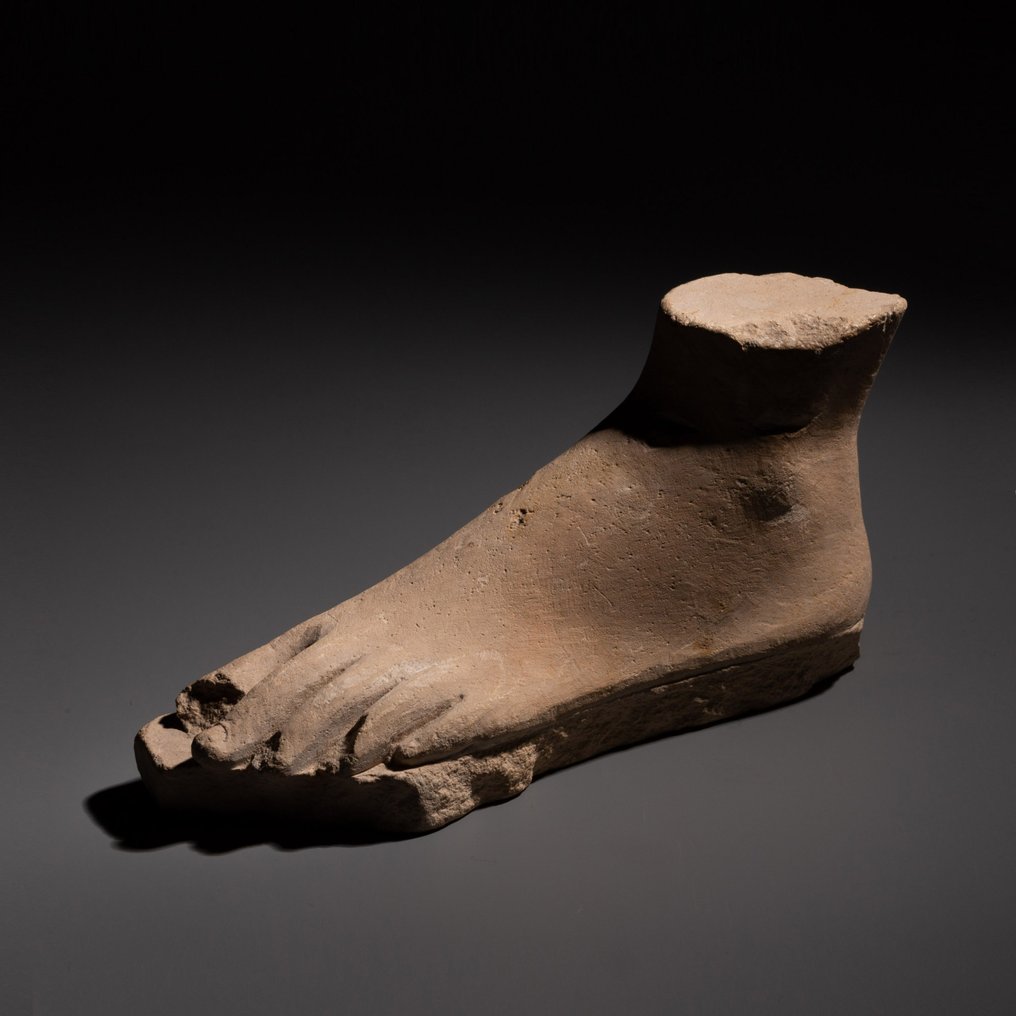
Ancient Egyptian Hardened limestone Sculptor's Model in the Shape of a Foot. Ptolemaic Period 332-30 BC. 15 cm L. Spanish Export


05
days
10
hours
39
minutes
39
seconds
Current bid
€ 110
Reserve price not met

Expert
Selected by Ruth Garrido Vila
Directed the Ifergan Collection Museum, specialising in Phoenician and Mediterranean archaeology.
Estimate € 4,500 - € 5,000
13 other people are watching this object
 Bidder 6863 Bidder 6863 | €110 | |
|---|---|---|
 Bidder 5614 Bidder 5614 | €100 | |
| Bidder 5614 | €50 | |
Catawiki Buyer Protection
Your payment’s safe with us until you receive your object.View details
Trustpilot 4.4 | 123779 reviews
Rated Excellent on Trustpilot.
Ancient Egyptian sculptor's model in the shape of a foot from the Ptolemaic Period (332–30 BC), carved in hardened limestone, about 15 cm long and 7.5 cm high, in Good condition, with authenticity certificate and Spanish Export License, provenance: private collection.
AI-assisted summary
Description from the seller
Sculptor's Model in the Shape of a Foot.
Ptolemaic Period 332-30 BC.
Hardened limestone.
Length 15 cm and height 7.5 cm.
PROVENANCE: Private collection of G.L., Schleswig-Holstein, Germany. Acquired prior to the 1970s.
CONDITION: Good condition, no restorations.
DESCRIPTION:
The sculptor's models are rectangular plaques and round sculptures of small format, between thirty and eight centimetres in height, sculpted in white limestone and with a common characteristic: an unfinished appearance. These were test or study pieces, intended to improve the sculpting technique of the apprentice in the trade.
Egyptian round sculptures are mainly heads or busts of royal personages, although a small number of busts representing private individuals or deities have also been found, and others are only profiles. In addition to heads, there are numerous models of feet, in most cases the left one, presumably because in Egyptian statuary this foot, together with the leg, is advanced in a marching attitude, and is therefore more visible. Hands, arms, legs and, to a lesser extent, torsos are also sculpted to a very realistic degree. Likewise, there are also animals or parts of animals (especially front parts), as is the case with the lion: the head of this animal was used during this period of Greek domination as a decorative architectural element, an example of which are the two heads located on the back wall of the temple of Dendera. But others such as the ram, bull, monkey, cat, horse and falcon are also included.
Among the reliefs used as sculptor's models we find a greater variety of examples. Again, royal personages are predominant, heads, busts and almost complete figures; but individual forms of hieroglyphs, animals and birds are equally common. There is also a selection of private personages, deities - most are profiles of female goddesses with vulture crowns - sacred symbols and body parts. In many cases, where only the head of an animal is shown, it is intended to represent the deity with which it is associated, a fact evidenced by the addition of human shoulders, or by the wig covering the mane or by an extra set of horns on the head, as in the relief image with the head of the ram god Khnum. This leads us to see in other animal reliefs divine representations where there are no human elements, only animals.
No Egyptian work is ever left in an incomplete state unless it is expressly so; they are always finished. In this typology of models, we can see some with a wider and more rectilinear chiselling, delimiting the forms, and others in which the chisel marks are not found, but the surface is not perfectly smooth and polished. In the majority of busts representing a pharaoh, vertical and horizontal marks can be seen, especially on the back and sides, used by the craftsmen to delimit the different parts of the face in a grid in order to achieve symmetry. In Egyptian art these grids, whether on reliefs or sculptures, are made with red or black paint to outline the proportions of the figure in accordance with the canon used in this period, and are then erased, with only the finished result being visible. There are short lines marking the location of individual features such as eyes, nose, mouth, chin... in many examples these marks are depicted on the backs or sides, in order to be able to be guided at the moment of frontal sculpting. In these real representations in particular, these squares are incised and have not been removed, thus allowing their modelling to be seen. This is the clearest evidence of the pedagogical nature of the work. Another evidence is the absence of painted examples. A limestone sculpture was usually polychromed, and there is no evidence of any painting on these carvings. Not even to mark the lines of expression on the faces and hide the subtleties of the carving, the sculptor does not polychrome it to observe his work, his strokes, his hand. This is the clearest example showing that these works were intended to train a student or serve as a model for them.
For the Egyptians, the representation of an object or an entity, on any medium, gave it life and it was identified with the real object or person. This fact meant that they would never leave a work unfinished, unless it was for a specific reason, such as this one, in which they were carried out as practice in order to be able to sculpt to such a degree of perfection that they were considered true sculptors.
BIBLIOGRAPHY:
TOMOUN, Nadja. The Scuptors' models of the Late and Ptolemaic Periods. A study of the type and function of a group of ancient egyptian artefacts. National Center for Documentation of Cultural and Natural Heritage. Supreme Council of Antiquities. Cairo, Egypt. 2005.
Notes:
- The piece includes authenticity certificate.
- The piece includes Spanish Export License.
- The seller guarantees that he acquired this piece according to all national and international laws related to the ownership of cultural property. Provenance statement seen by Catawiki.
Seller's Story
Gallery of Ancient Art - Archeology based in Barcelona with more than fifteen years of experience. Specialized in classical art, Egyptian art, Asian art and pre-Columbian art. It guarantees the authenticity of all its pieces. It participates in the most important art fairs in Spain, such as Feriarte, as well as in fairs abroad, BRAFA, Parcours des Mondes, Cultures Brussels.
All the pieces are sent with an Export Permit issued by the Spanish Ministry of Culture.
We are quick to ship via DHL Express or Direct Art Transport.
Translated by Google TranslateSculptor's Model in the Shape of a Foot.
Ptolemaic Period 332-30 BC.
Hardened limestone.
Length 15 cm and height 7.5 cm.
PROVENANCE: Private collection of G.L., Schleswig-Holstein, Germany. Acquired prior to the 1970s.
CONDITION: Good condition, no restorations.
DESCRIPTION:
The sculptor's models are rectangular plaques and round sculptures of small format, between thirty and eight centimetres in height, sculpted in white limestone and with a common characteristic: an unfinished appearance. These were test or study pieces, intended to improve the sculpting technique of the apprentice in the trade.
Egyptian round sculptures are mainly heads or busts of royal personages, although a small number of busts representing private individuals or deities have also been found, and others are only profiles. In addition to heads, there are numerous models of feet, in most cases the left one, presumably because in Egyptian statuary this foot, together with the leg, is advanced in a marching attitude, and is therefore more visible. Hands, arms, legs and, to a lesser extent, torsos are also sculpted to a very realistic degree. Likewise, there are also animals or parts of animals (especially front parts), as is the case with the lion: the head of this animal was used during this period of Greek domination as a decorative architectural element, an example of which are the two heads located on the back wall of the temple of Dendera. But others such as the ram, bull, monkey, cat, horse and falcon are also included.
Among the reliefs used as sculptor's models we find a greater variety of examples. Again, royal personages are predominant, heads, busts and almost complete figures; but individual forms of hieroglyphs, animals and birds are equally common. There is also a selection of private personages, deities - most are profiles of female goddesses with vulture crowns - sacred symbols and body parts. In many cases, where only the head of an animal is shown, it is intended to represent the deity with which it is associated, a fact evidenced by the addition of human shoulders, or by the wig covering the mane or by an extra set of horns on the head, as in the relief image with the head of the ram god Khnum. This leads us to see in other animal reliefs divine representations where there are no human elements, only animals.
No Egyptian work is ever left in an incomplete state unless it is expressly so; they are always finished. In this typology of models, we can see some with a wider and more rectilinear chiselling, delimiting the forms, and others in which the chisel marks are not found, but the surface is not perfectly smooth and polished. In the majority of busts representing a pharaoh, vertical and horizontal marks can be seen, especially on the back and sides, used by the craftsmen to delimit the different parts of the face in a grid in order to achieve symmetry. In Egyptian art these grids, whether on reliefs or sculptures, are made with red or black paint to outline the proportions of the figure in accordance with the canon used in this period, and are then erased, with only the finished result being visible. There are short lines marking the location of individual features such as eyes, nose, mouth, chin... in many examples these marks are depicted on the backs or sides, in order to be able to be guided at the moment of frontal sculpting. In these real representations in particular, these squares are incised and have not been removed, thus allowing their modelling to be seen. This is the clearest evidence of the pedagogical nature of the work. Another evidence is the absence of painted examples. A limestone sculpture was usually polychromed, and there is no evidence of any painting on these carvings. Not even to mark the lines of expression on the faces and hide the subtleties of the carving, the sculptor does not polychrome it to observe his work, his strokes, his hand. This is the clearest example showing that these works were intended to train a student or serve as a model for them.
For the Egyptians, the representation of an object or an entity, on any medium, gave it life and it was identified with the real object or person. This fact meant that they would never leave a work unfinished, unless it was for a specific reason, such as this one, in which they were carried out as practice in order to be able to sculpt to such a degree of perfection that they were considered true sculptors.
BIBLIOGRAPHY:
TOMOUN, Nadja. The Scuptors' models of the Late and Ptolemaic Periods. A study of the type and function of a group of ancient egyptian artefacts. National Center for Documentation of Cultural and Natural Heritage. Supreme Council of Antiquities. Cairo, Egypt. 2005.
Notes:
- The piece includes authenticity certificate.
- The piece includes Spanish Export License.
- The seller guarantees that he acquired this piece according to all national and international laws related to the ownership of cultural property. Provenance statement seen by Catawiki.
Seller's Story
Gallery of Ancient Art - Archeology based in Barcelona with more than fifteen years of experience. Specialized in classical art, Egyptian art, Asian art and pre-Columbian art. It guarantees the authenticity of all its pieces. It participates in the most important art fairs in Spain, such as Feriarte, as well as in fairs abroad, BRAFA, Parcours des Mondes, Cultures Brussels.
All the pieces are sent with an Export Permit issued by the Spanish Ministry of Culture.
We are quick to ship via DHL Express or Direct Art Transport.
Translated by Google TranslateDetails
Culture
Ancient Egyptian
Century/ Timeframe
Ptolemaic Period 332-30 BC
Name of object
Sculptor's Model in the Shape of a Foot. Ptolemaic Period 332-30 BC. 15 cm L. Spanish Export
Acquired from
Private collection
Material
Hardened limestone
Condition
Good
Disclaimer
The seller was informed by Catawiki about documentation requirements and guarantees the following: - the object was legally obtained, - the seller has the right to sell and/or export the object, as relevant, - the seller will provide the necessary provenance information and arrange required documentation and permits/licenses, as applicable and as per local laws, - the seller will notify the buyer of any delays in obtaining permits/licenses. By bidding, you acknowledge that import documentation may be required depending on your country of residence and that obtaining permits/licenses may cause delays in the delivery of your object.
The seller was informed by Catawiki about documentation requirements and guarantees the following: - the object was legally obtained, - the seller has the right to sell and/or export the object, as relevant, - the seller will provide the necessary provenance information and arrange required documentation and permits/licenses, as applicable and as per local laws, - the seller will notify the buyer of any delays in obtaining permits/licenses. By bidding, you acknowledge that import documentation may be required depending on your country of residence and that obtaining permits/licenses may cause delays in the delivery of your object.
