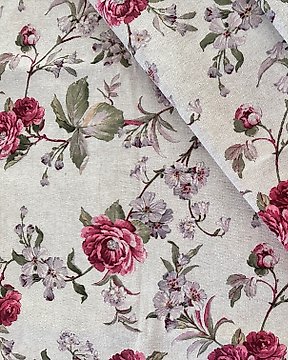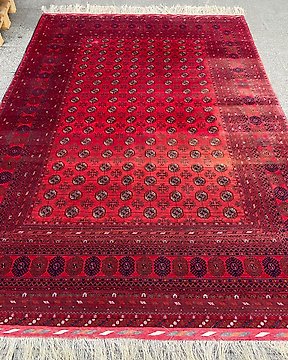

Gohm - Rug - 180 cm - 123 cm
Rugs can be made by hand or machine. Whether made by hand or machine, the process starts with selecting a natural material like wool, cotton, or silk, or a synthetic one.
Generally, wool is the most popular material for making rugs. To make woollen rugs, first, unprocessed wool is separated by hand to split up clumps and remove unwanted materials. It is then put into a machine that pulls it into individual strands. These strands are then spun into yarn.
Subsequently, the yarn is washed to get rid of dirt, dust, and other impurities. It is then immersed in a detergent bath, wrung several times, and washed with clean water to remove the detergent.
Afterward, the yarn is sun-dried for up to three days, hung onto a rack, dyed to produce a particular color, and dried again. The longer it's dried, the deeper the color.
Once the yarn dries, it's woven. Hand-knotting is typically the most common weaving process. The process starts with an artisan creating a rug design on a special graph paper. The artisan then places the design on a loom where threads, called warps, are stretched up and down.
The artisan then weaves the yarn around the warps, knot-by-knot. Different artisans use different knotting techniques to make rugs, as they vary from region to region. Some popular techniques include the Tibetan, Persian, and Turkish knot.
Rugs of superior quality can be highly costly for a variety of reasons.
The cost of a rug is largely determined by the material used to produce it, with natural fibres like silk and wool being more costly than synthetic materials because of their longevity and aesthetic appeal.
The manner of construction has an effect on the price as well. Handwoven rugs are more expensive than machine-made rugs since they demand a high level of skill and take longer to manufacture.
A rug's country of origin can also have an impact on its cost because of things like labour and production expenses, as well as the reputation of the country in the rug-making industry.
Because labour costs are cheaper in China, for instance, rugs from that country may be more affordable than those from Turkey or Iran, two countries with rich cultural traditions in rug-making; these rugs are valued for their cultural significance and expert craftsmanship.
In addition, the size of a rug affects its cost; larger rugs usually have higher costs because they take more materials and labour to create.
Last but not least, a brand's reputation might affect the cost; opulent rugs from well-known producers tend to fetch higher costs than those from unknown firms.
Without a doubt, the priciest rugs in the world are Persian ones. Persian rugs are made in Iran and are highly sought after because of the skill of the rug makers who weave them, the use of high-quality materials like silk and wool, the intricate patterns, the high knot density, and their timeless beauty. A few of the most expensive and highly sought-after Persian rugs are those from Isfahan, Heriz, Kashan, Tabriz, Qashqai, and Bidjar.
The Oriental rug is yet another high-quality rug. Oriental rugs originate from many different nations, including Pakistan, Turkey, India, and Tibet, and they come in a wide range of styles. All Oriental carpets are handmade, just as Persian rugs. Although some craftspeople use cotton, jute, or even bamboo, they are usually constructed of silk or wool.
Like its Persian equivalents, many Oriental rugs have beautiful colours, varied textures, elaborate knotwork, and complicated designs. Because of these characteristics, collectors are willing to pay a premium for them. For instance, Turkish-made Oushak rugs are highly valued for their distinctive patterns, which include enormous geometric and floral motifs and subdued hues that are aesthetically pleasing.