Divers - Feuillets manuscrits sous le règne de Louis XIV. - 1708


02
days
12
hours
23
minutes
15
seconds

7 other people are watching this object
 Bidder 8559 Bidder 8559 | €1 |
|---|
Catawiki Buyer Protection
Your payment’s safe with us until you receive your object.View details
Trustpilot 4.4 | 123759 reviews
Rated Excellent on Trustpilot.
Feuillets manuscrits sous le règne de Louis XIV, a single 5‑page French manuscript item dating from circa 1708, in a simple binding on antique laid paper, measuring 21 × 15 cm and issued as the first edition.
AI-assisted summary
Description from the seller
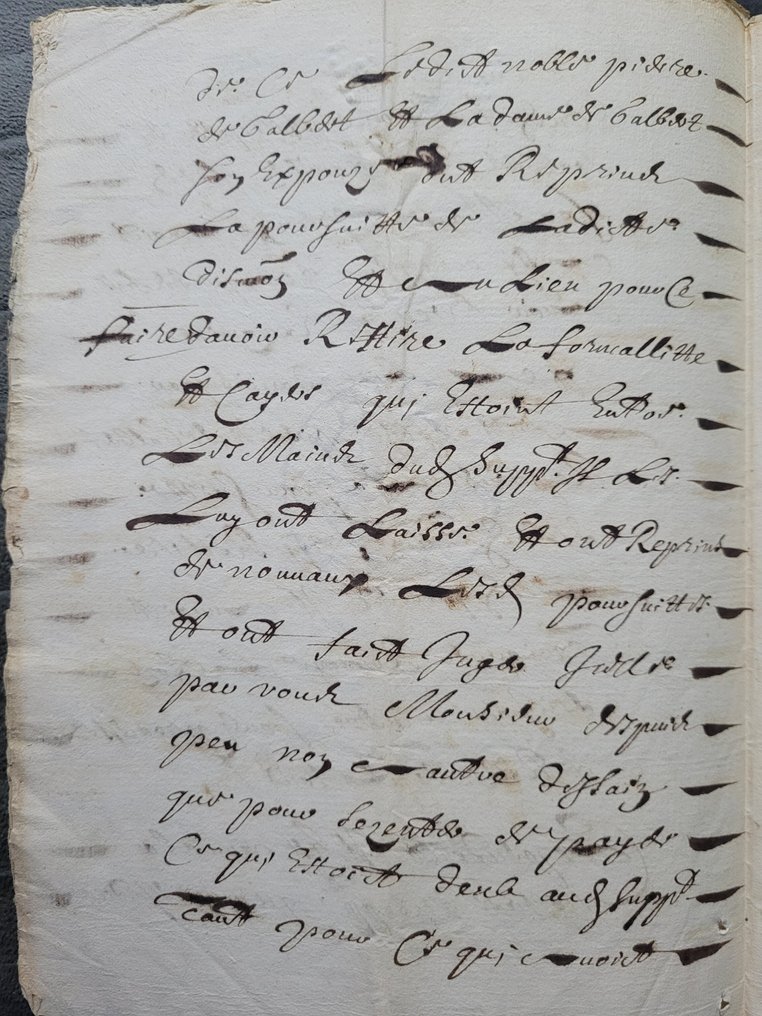
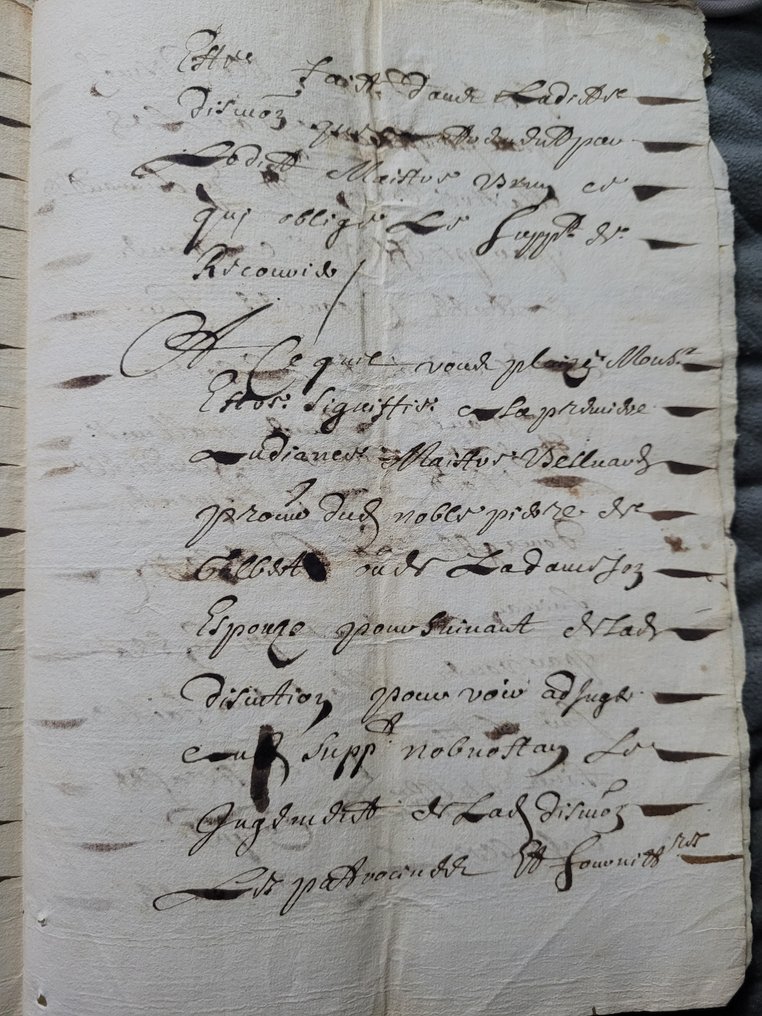
Set of handwritten judicial sheets from around 1708-1710.
Civil procedures, service of process, and incidental writings.
Provincial Royal Justice – Ancien Régime
The presented collection consists of several original handwritten sheets (recto/verso for some), written in brown ink on old laid paper, featuring judicial folds, handling marks, as well as recording and validation marks.
These leaflets form a homogeneous procedural corpus, unambiguously relevant:
civil justice under the Ancien Régime
and more precisely, the complete procedural chain of an instance: exploits → meanings → responses → mentions of appearance or default → final validations.
These are neither copies nor private drafts, but actual procedural documents produced to be filed in the court record.
Precise legal typology of pages
By cross-reading the pages, we identify several categories of acts.
Exploits and notifications, Several sheets clearly relate to the exploit of notification, with designation of a requesting party, mention of a prosecutor or practitioner, formal notification made to an adverse party, reminder of the subject of the dispute or the served act.
These documents serve the purpose of legally informing a party, an essential condition for continuing the proceedings.
Incident writings and responses, other pages feature denser and more argumentative writing, characteristic of exploit responses, objections, or incidental declarations.
One recognizes the typical formulas there.
considering that
notwithstanding
proceeding in this way
without prejudice to...
These elements attest to a real contradictory procedure, with exchanges between parties. Mentions of appearance, default, or prosecution.
Some passages reveal
Mentions of appearance or non-appearance, formulations suggesting a defect or the continuation of the procedure despite the absence of a party. These elements are essential in Old Regime law, where formal validity conditions determine the decision.
3. Parties and judicial actors. Even if not all names are systematically legible, the pages clearly mention private parties (individuals), prosecutors acting 'for and on behalf of', and justice officers (clerk, sergeant, bailiff, or similar practitioner).
The recurring presence of signatures, complex initials, and graphic validation marks confirms the involvement of legal professionals, rather than casual writers.
4. Dating is based on several matching elements: paleographic style (rapid legal cursive), language and procedural formulas, watermarked paper and judicial folds, mentions of dates in figures or fully written out visible on certain sheets.
Coherent dating from the early 18th century, around 1708–1710, a period fully compatible with the observed practices.
5. Paleographic and material analysis
Writing, professional judicial cursive.
Numerous abbreviations, ductus fluid and safe.
Hand variations indicating multiple participants (prosecutor, clerk, officer).
Support old laid paper.
Irregular edges, untrimmed.
Typical vertical fold traces of judicial transport.
Rust marks, ink stains, oxidation consistent with age.
No signs of forgery, late copying, or reconstitution.
Archival function. This type of document precisely corresponds to items currently preserved in judicial series (B, C) at the departmental archives or in private collections of legal practitioners, often scattered.
Most of these documents have been either destroyed or dissociated. Having such a clear and coherent collection is a genuine heritage interest.
A concrete illustration of the daily functioning of civil justice under Louis XIV and the Regency.
Direct testimony of private conflicts, their procedural handling, and the central role of prosecutors.
Ideal set for collector of legal manuscripts, legal historian.
amateur of Old Regime archives.
Photos are an integral part of the description.
Shipping via Chronopost or another method depending on the country, with insurance.
Set of handwritten judicial sheets from around 1708-1710.
Civil procedures, service of process, and incidental writings.
Provincial Royal Justice – Ancien Régime
The presented collection consists of several original handwritten sheets (recto/verso for some), written in brown ink on old laid paper, featuring judicial folds, handling marks, as well as recording and validation marks.
These leaflets form a homogeneous procedural corpus, unambiguously relevant:
civil justice under the Ancien Régime
and more precisely, the complete procedural chain of an instance: exploits → meanings → responses → mentions of appearance or default → final validations.
These are neither copies nor private drafts, but actual procedural documents produced to be filed in the court record.
Precise legal typology of pages
By cross-reading the pages, we identify several categories of acts.
Exploits and notifications, Several sheets clearly relate to the exploit of notification, with designation of a requesting party, mention of a prosecutor or practitioner, formal notification made to an adverse party, reminder of the subject of the dispute or the served act.
These documents serve the purpose of legally informing a party, an essential condition for continuing the proceedings.
Incident writings and responses, other pages feature denser and more argumentative writing, characteristic of exploit responses, objections, or incidental declarations.
One recognizes the typical formulas there.
considering that
notwithstanding
proceeding in this way
without prejudice to...
These elements attest to a real contradictory procedure, with exchanges between parties. Mentions of appearance, default, or prosecution.
Some passages reveal
Mentions of appearance or non-appearance, formulations suggesting a defect or the continuation of the procedure despite the absence of a party. These elements are essential in Old Regime law, where formal validity conditions determine the decision.
3. Parties and judicial actors. Even if not all names are systematically legible, the pages clearly mention private parties (individuals), prosecutors acting 'for and on behalf of', and justice officers (clerk, sergeant, bailiff, or similar practitioner).
The recurring presence of signatures, complex initials, and graphic validation marks confirms the involvement of legal professionals, rather than casual writers.
4. Dating is based on several matching elements: paleographic style (rapid legal cursive), language and procedural formulas, watermarked paper and judicial folds, mentions of dates in figures or fully written out visible on certain sheets.
Coherent dating from the early 18th century, around 1708–1710, a period fully compatible with the observed practices.
5. Paleographic and material analysis
Writing, professional judicial cursive.
Numerous abbreviations, ductus fluid and safe.
Hand variations indicating multiple participants (prosecutor, clerk, officer).
Support old laid paper.
Irregular edges, untrimmed.
Typical vertical fold traces of judicial transport.
Rust marks, ink stains, oxidation consistent with age.
No signs of forgery, late copying, or reconstitution.
Archival function. This type of document precisely corresponds to items currently preserved in judicial series (B, C) at the departmental archives or in private collections of legal practitioners, often scattered.
Most of these documents have been either destroyed or dissociated. Having such a clear and coherent collection is a genuine heritage interest.
A concrete illustration of the daily functioning of civil justice under Louis XIV and the Regency.
Direct testimony of private conflicts, their procedural handling, and the central role of prosecutors.
Ideal set for collector of legal manuscripts, legal historian.
amateur of Old Regime archives.
Photos are an integral part of the description.
Shipping via Chronopost or another method depending on the country, with insurance.
Details
Number of Books
1
Subject
Incunabula & early printing
Book Title
Feuillets manuscrits sous le règne de Louis XIV.
Author/ Illustrator
Divers
Condition
Good
Publication year oldest item
1708
Height
21 cm
Edition
1st Edition
Width
15 cm
Language
French
Original language
Yes
Binding/ Material
Single page
Number of pages
5