Rack - Wood - Wooden stone mold


05
days
05
hours
01
minute
47
seconds

30 other people are watching this object
 Bidder 8267 Bidder 8267 | €15 | |
|---|---|---|
 Bidder 3413 Bidder 3413 | €10 | |
 Bidder 5194 Bidder 5194 | €5 | |
Catawiki Buyer Protection
Your payment’s safe with us until you receive your object.View details
Trustpilot 4.4 | 123253 reviews
Rated Excellent on Trustpilot.
Wooden stone mold wall rack from the Netherlands, made of wood, in good used condition with small signs of aging and stains.
AI-assisted summary
Description from the seller
Decorative wall shelf, originally a stone mold
Overall, these authentic, handmade stone molds are considered antique. They date from the period of manual brick production.
Identical molds are estimated to be around 100 years old, dating from the 1920s to 1940s.
Sometimes even the 19th century (the 1800s).
Main features of 19th-century stone molds: made of (oak) wood. They were four-sided, rectangular boxes without top or bottom. The upper edge was usually fitted with metal strips to prevent wear from constant use. Extended sides served as handles. And it was custom-made. Some of these features are present in this mold.
I date it to 1920-1940. There are visible physical signs of wear, such as holes from insects and, of course, endless layers of (scrub) wash. However, I estimate the fabric to be no older than 100 years.
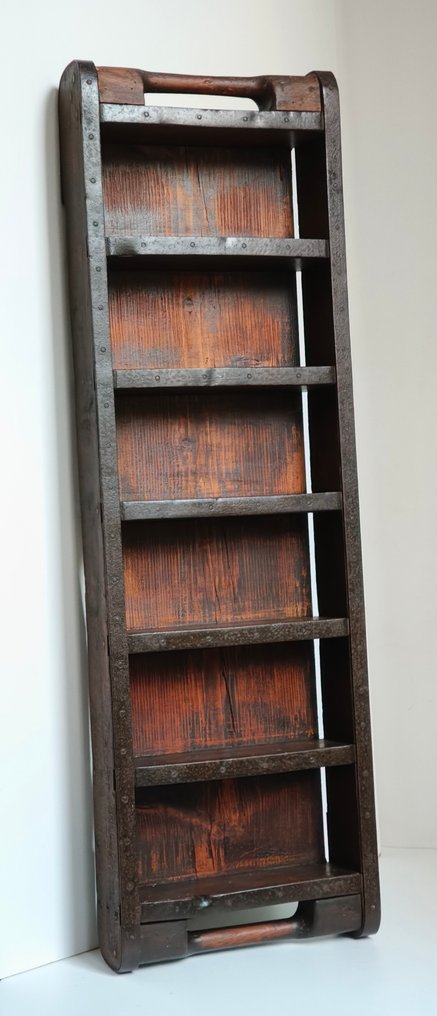
This mold is a substantial piece, with a beautiful patina and a warm, worn appearance. It will certainly not look out of place in an industrial interior.
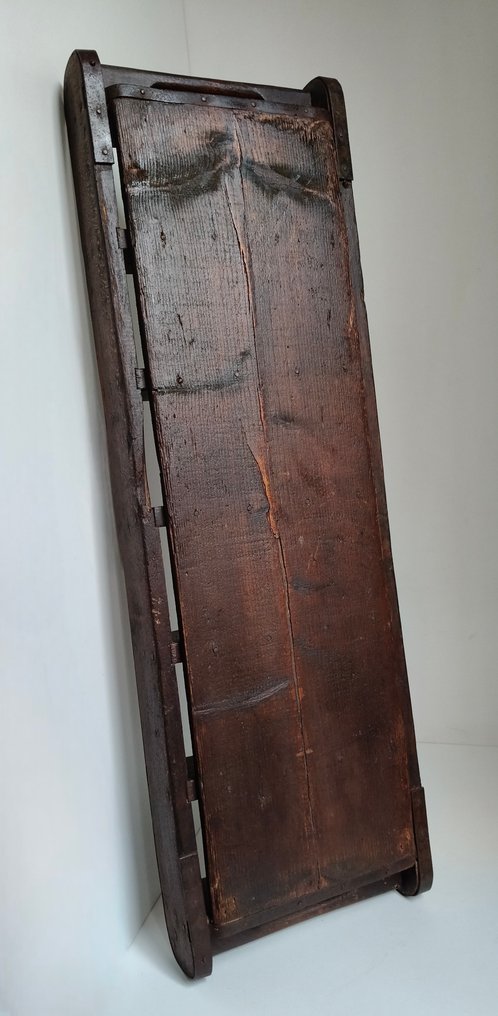
The weight is 6.4 kilograms. The nailed framework, which partly extends to the back, also contributes to the mold's weight. This framework ensured durability. Additionally, it provided stability during filling: when manually making bricks, wet clay was pressed or smeared into the mold with force. A heavy, stable mold was essential to stay in place and maintain a consistent shape while the clay was pressed in and excess was removed.
Wooden stone molds were traditionally used in brick factories to make hand-formed bricks. Today, they are very popular as decorative objects in rural or industrial interiors and are often reused for decorative purposes.
This type of object is often referred to as a 'steenmal wandrek' or 'steenmal letterbak.' Small items, spice jars, or miniatures can be displayed in it. A photo has been added.
In this area where the clay comes from, there have been several stone factories. The presence of river clay and the possibility of water transport (via the rivers and later canals) around the Waal and Maas rivers were the main reasons for establishing this industry. These industries were concentrated particularly in the central river region (between Maas and Waal, the Land of Maas and Waal), but also upstream in Limburg, where this industry was prominent in the Netherlands. Almost all of these artisanal stone factories have closed.
The meal:
Height 90 cm
Width 28 cm
Depth 8 cm
Weight 6.4 kg
In the photos, you can observe the condition of this object. The mold has a worn, rough appearance. Knots, nails, dents—everything is visible. That is why detailed photos were also taken. The photos are part of the description. You will only receive the mold; the other objects in the photos are for illustration purposes.
The mold is well packaged before being sent to you.
Decorative wall shelf, originally a stone mold
Overall, these authentic, handmade stone molds are considered antique. They date from the period of manual brick production.
Identical molds are estimated to be around 100 years old, dating from the 1920s to 1940s.
Sometimes even the 19th century (the 1800s).
Main features of 19th-century stone molds: made of (oak) wood. They were four-sided, rectangular boxes without top or bottom. The upper edge was usually fitted with metal strips to prevent wear from constant use. Extended sides served as handles. And it was custom-made. Some of these features are present in this mold.
I date it to 1920-1940. There are visible physical signs of wear, such as holes from insects and, of course, endless layers of (scrub) wash. However, I estimate the fabric to be no older than 100 years.
This mold is a substantial piece, with a beautiful patina and a warm, worn appearance. It will certainly not look out of place in an industrial interior.
The weight is 6.4 kilograms. The nailed framework, which partly extends to the back, also contributes to the mold's weight. This framework ensured durability. Additionally, it provided stability during filling: when manually making bricks, wet clay was pressed or smeared into the mold with force. A heavy, stable mold was essential to stay in place and maintain a consistent shape while the clay was pressed in and excess was removed.
Wooden stone molds were traditionally used in brick factories to make hand-formed bricks. Today, they are very popular as decorative objects in rural or industrial interiors and are often reused for decorative purposes.
This type of object is often referred to as a 'steenmal wandrek' or 'steenmal letterbak.' Small items, spice jars, or miniatures can be displayed in it. A photo has been added.
In this area where the clay comes from, there have been several stone factories. The presence of river clay and the possibility of water transport (via the rivers and later canals) around the Waal and Maas rivers were the main reasons for establishing this industry. These industries were concentrated particularly in the central river region (between Maas and Waal, the Land of Maas and Waal), but also upstream in Limburg, where this industry was prominent in the Netherlands. Almost all of these artisanal stone factories have closed.
The meal:
Height 90 cm
Width 28 cm
Depth 8 cm
Weight 6.4 kg
In the photos, you can observe the condition of this object. The mold has a worn, rough appearance. Knots, nails, dents—everything is visible. That is why detailed photos were also taken. The photos are part of the description. You will only receive the mold; the other objects in the photos are for illustration purposes.
The mold is well packaged before being sent to you.
Details
Era
1900-2000
Weight
6.4 kg
Specific region of origin
Rivierengebied Midden Nederland
Title additional information
Wooden stone mold
No. of items
1
Country of Origin
Netherlands
Material
Wood
Style
Industrial
Colour
Brown
Condition
Good condition - used with small signs of aging & blemishes
Height
90 cm
Width
28 cm
Depth
8 cm
Estimated Period
1920-1930
Sold by