F.S.C. - Chalice - .950 silver - Large French goblet



09
days
04
hours
33
minutes
59
seconds
Current bid
€ 651
Reserve price not met

Expert
Selected by Clément Floch
Has 20 years of experience trading curios, including 15 years with a leading French dealer.
Estimate € 900 - € 1,000
33 other people are watching this object
 Bidder 0207 Bidder 0207 | €651 | |
|---|---|---|
 Bidder 8234 Bidder 8234 | €600 | |
 Bidder 5266 Bidder 5266 | €550 | |
Catawiki Buyer Protection
Your payment’s safe with us until you receive your object.View details
Trustpilot 4.4 | 123718 reviews
Rated Excellent on Trustpilot.
Description from the seller
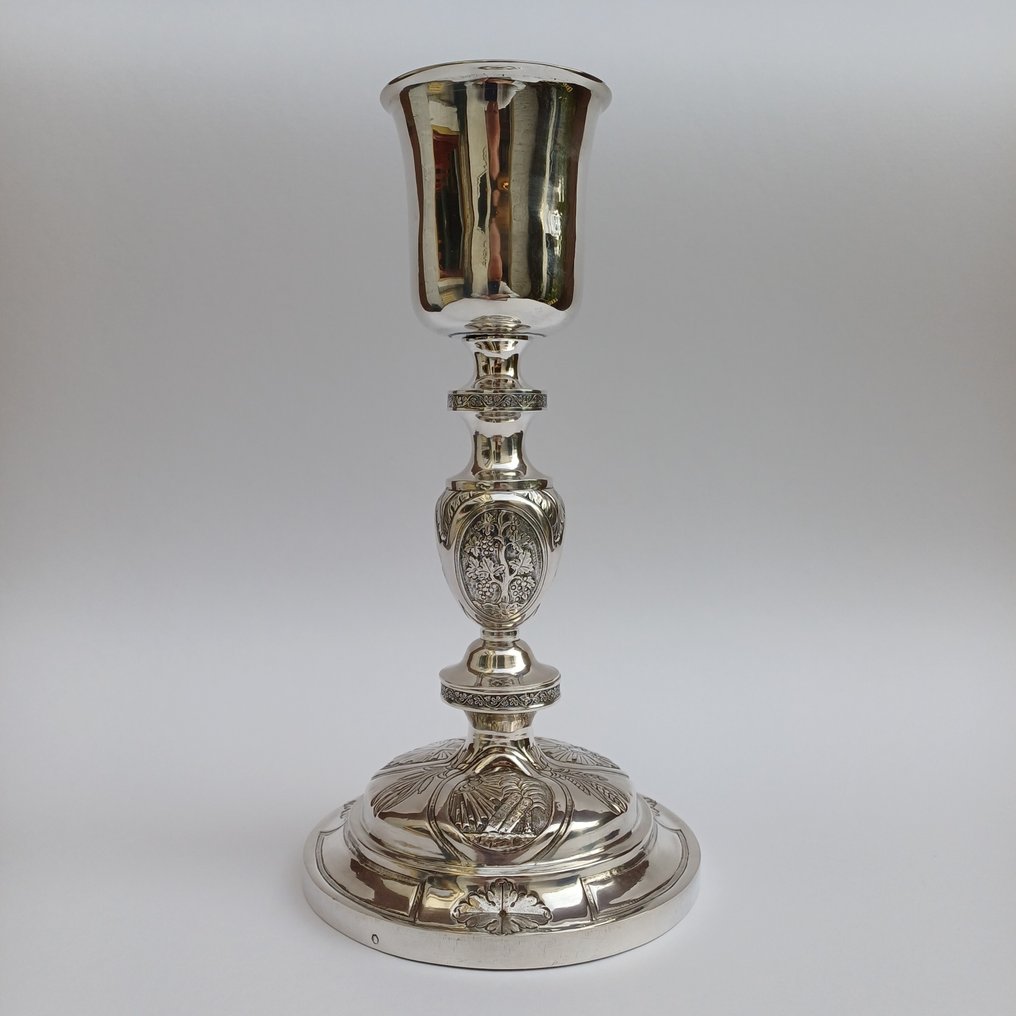
Gilded silver neoclassical 19th-century chalice from the period 1819-1838 (circa 1825, Charles X).
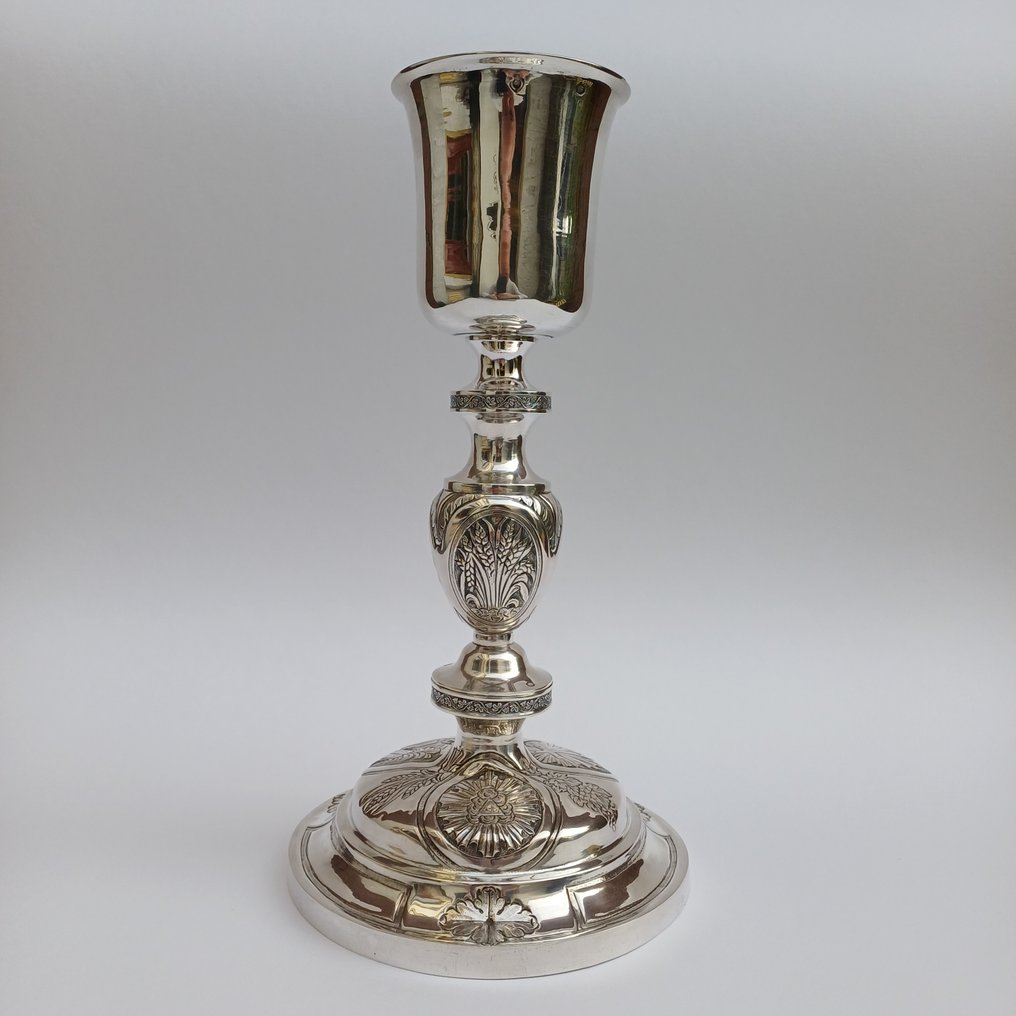
The entire piece is made of first-grade .950 silver and gilded as prescribed for the interior of a chalice. Rising from a round, collar-shaped foot is the stem, which has three nodes, above which the smooth, bell-shaped cup is located. The exterior is decorated in a neoclassical style. The decoration on the foot consists of three medallions alternated with floral motifs. The medallions depict images of the God's name Yahweh within a triangle surrounded by clouds and a halo, the tablets of the covenant, and a cross surrounded by a halo. Between the medallions, we see a bundle of wheat, a bundle of reed stalks, and a bundle of grape bunches. Above the first knot, there is a frieze with grapevines. On the oval central node, there are three medallions with wheat, reed stalks, and grape bunches. These symbolize the body and blood of Christ (the wheat and grapes) and the reed stalk representing the weaker members of society (Christ who did not break the knotted reed). On the third knot, there is a frieze with grapevines.
The whole can be disassembled into three parts.
The chalice (calix in Latin) is a cup that belongs to the vasa sacra (the sacred vessels) of liturgical ware within the Catholic Church. The chalice consists of a bowl (cupa), a foot, and between them a decorated knot (nodus). During the Eucharistic celebration, the chalice is used to hold the wine that is consecrated and, after the epiclesis, becomes the blood of Jesus Christ. Because the chalice is involved in the part of the Eucharist considered the most sacred, most chalices are particularly richly and lovingly decorated.
Silver markings
These are applied on the foot, the node, and on the cup.
- Master mark, master punch: F.S.C. 3x
- Silver content: 0.950 silver, hallmark of silver: 'old woman' in hexagon 3x
a deer head in an oval
- Large guarantee from the departments, 'Hercule' in an oval shape. 67th department, Bas-Rhin (possibly Strasbourg).
Dimensions
29 x 15 cm
409 grams
Condition
Very good, the gilding on the inside of the cup is lightly worn. Light signs of use (see photos).
Gilded silver neoclassical 19th-century chalice from the period 1819-1838 (circa 1825, Charles X).
The entire piece is made of first-grade .950 silver and gilded as prescribed for the interior of a chalice. Rising from a round, collar-shaped foot is the stem, which has three nodes, above which the smooth, bell-shaped cup is located. The exterior is decorated in a neoclassical style. The decoration on the foot consists of three medallions alternated with floral motifs. The medallions depict images of the God's name Yahweh within a triangle surrounded by clouds and a halo, the tablets of the covenant, and a cross surrounded by a halo. Between the medallions, we see a bundle of wheat, a bundle of reed stalks, and a bundle of grape bunches. Above the first knot, there is a frieze with grapevines. On the oval central node, there are three medallions with wheat, reed stalks, and grape bunches. These symbolize the body and blood of Christ (the wheat and grapes) and the reed stalk representing the weaker members of society (Christ who did not break the knotted reed). On the third knot, there is a frieze with grapevines.
The whole can be disassembled into three parts.
The chalice (calix in Latin) is a cup that belongs to the vasa sacra (the sacred vessels) of liturgical ware within the Catholic Church. The chalice consists of a bowl (cupa), a foot, and between them a decorated knot (nodus). During the Eucharistic celebration, the chalice is used to hold the wine that is consecrated and, after the epiclesis, becomes the blood of Jesus Christ. Because the chalice is involved in the part of the Eucharist considered the most sacred, most chalices are particularly richly and lovingly decorated.
Silver markings
These are applied on the foot, the node, and on the cup.
- Master mark, master punch: F.S.C. 3x
- Silver content: 0.950 silver, hallmark of silver: 'old woman' in hexagon 3x
a deer head in an oval
- Large guarantee from the departments, 'Hercule' in an oval shape. 67th department, Bas-Rhin (possibly Strasbourg).
Dimensions
29 x 15 cm
409 grams
Condition
Very good, the gilding on the inside of the cup is lightly worn. Light signs of use (see photos).
Details
Over 200 years old
Yes
Specific region of origin
Elzas
Silver type
.950 silver
Gross weight
409 g
Style subtype
Neoclassical Style
Era
1400-1900
Title additional information
Large French goblet
No. of items
1
Country of Origin
France
Designer/Artist/Maker
F.S.C.
Material
Gold plated, Silver
Style
Antique
Condition
Good condition - used with small signs of ageing
Height
29 cm
Width
15 cm
Diameter
15 cm
Depth
15 cm
Estimated period
1819-1838
