Silver Filigree Amulet Pendant (Ta’wiz / Hirz) with Chain - Silver - Yemen - Early 20th century



04
days
17
hours
39
minutes
20
seconds
Current bid
€ 52
No reserve price

Expert
Selected by Amy Wassing
Nearly 20 years' experience in Indonesian and Oceanian art with museum expertise.
Estimate € 200 - € 250
53 other people are watching this object
 Bidder 6003 Bidder 6003 | €52 | |
|---|---|---|
 Bidder 6724 Bidder 6724 | €47 | |
| Bidder 6003 | €42 | |
Catawiki Buyer Protection
Your payment’s safe with us until you receive your object.View details
Trustpilot 4.4 | 123779 reviews
Rated Excellent on Trustpilot.
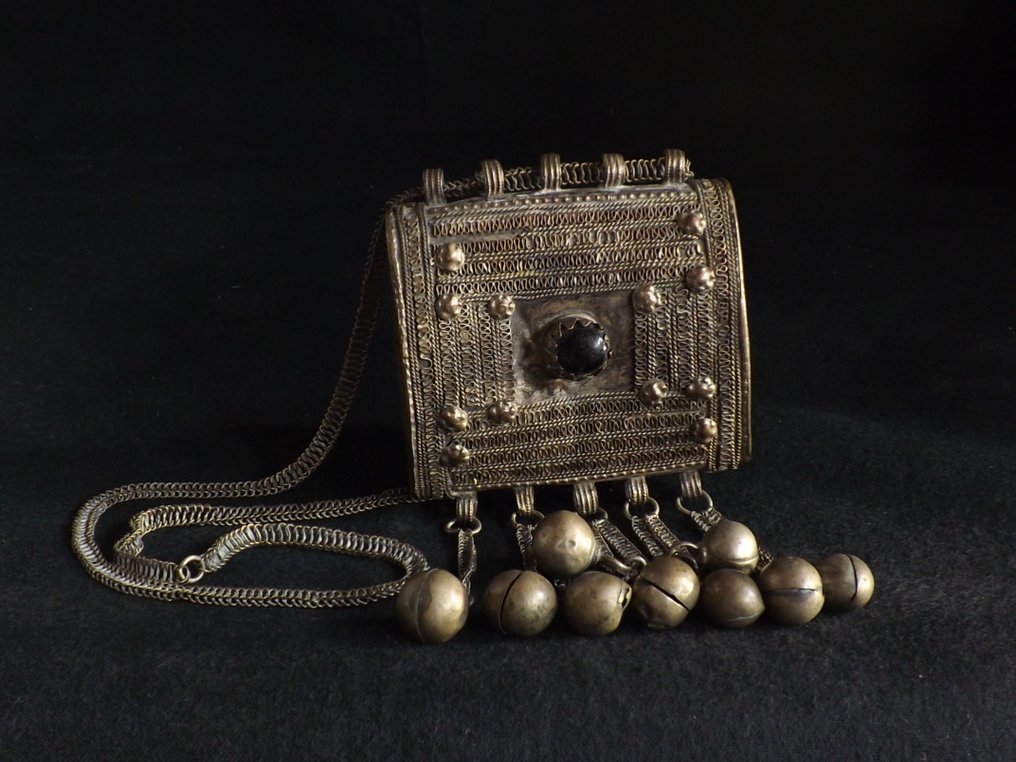
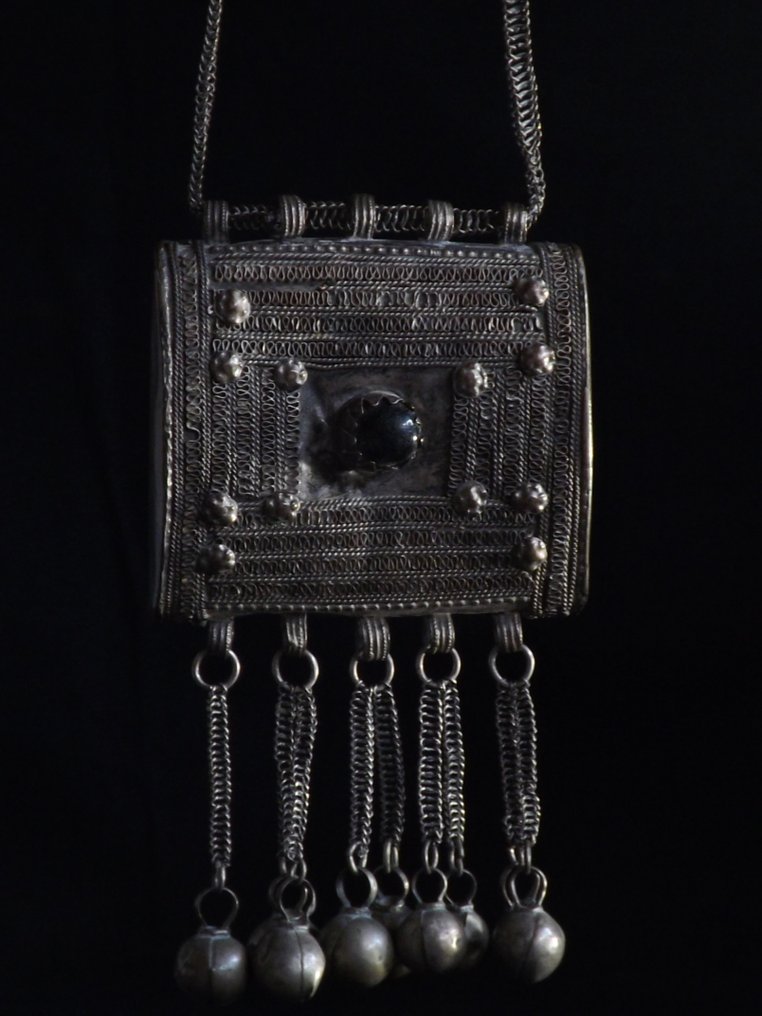
Silver Filigree Amulet Pendant (Ta’wiz / Hirz) with Chain from Yemen, Early 20th century, Good condition, silver hollow construction with a central black cabochon stone and multiple dangling chain elements.
AI-assisted summary
Description from the seller
Silver Filigree Amulet Pendant (Ta’wiz / Hirz) with Chain – Yemen / Middle East, late 19th–early 20th century
Large traditional amulet pendant (Ta’wiz / Hirz), hollow worked, with suspension chain and multiple dangling elements.
Origin
Middle East
Very likely Yemen (Southern Arabia)
Dating
Late 19th – early 20th century
(circa 1880–1930)
Material & Technique
Silver (traditional low-alloy silver, unstamped – typical for the region)
Hollow construction
Entirely hand-made
Rich filigree decoration using twisted and looped silver wires
Multiple articulated chain pendants with hollow silver beads
Central black cabochon stone, most likely onyx or black agate, set in a traditional serrated bezel
Description
This is an authentic Middle Eastern silver amulet pendant of rectangular form, traditionally known as a Ta’wiz (Hirz).
Such amulets were worn for spiritual protection and originally contained folded prayer texts or talismans inside the hollow body.
The front is densely decorated with fine hand-made filigree wirework and applied silver elements. A black cabochon stone is mounted centrally, framed by a serrated bezel typical of traditional Arabian silverwork.
The lower edge is fitted with multiple suspended chains terminating in hollow silver beads, creating both visual movement and sound, a feature believed to enhance the amuletic protective function.
A small original side opening is present. This opening was traditionally used for inserting or replacing protective texts or prayers inside the amulet. It is a functional and expected feature of genuine amulets of this type and period.
The reverse shows the typical slightly concave form of a hollow silver construction, with age-related irregularities consistent with long-term use.
Weight: 190 g (including chain and pendants)
Condition
Good antique condition, consistent with age and use:
Natural dents and minor deformations typical for hollow silver objects
Oxidation and surface wear
Filigree largely intact
No modern repairs detected
The piece has not been cleaned, retaining its original patina.
Provenance
From a European private collection.
Remarks
This is not modern ethnic jewellery, but a genuine historic amulet made for actual use. The combination of hollow construction, filigree work, suspended elements and the functional side opening strongly supports an authentic late 19th to early 20th century origin.
Silver Filigree Amulet Pendant (Ta’wiz / Hirz) with Chain – Yemen / Middle East, late 19th–early 20th century
Large traditional amulet pendant (Ta’wiz / Hirz), hollow worked, with suspension chain and multiple dangling elements.
Origin
Middle East
Very likely Yemen (Southern Arabia)
Dating
Late 19th – early 20th century
(circa 1880–1930)
Material & Technique
Silver (traditional low-alloy silver, unstamped – typical for the region)
Hollow construction
Entirely hand-made
Rich filigree decoration using twisted and looped silver wires
Multiple articulated chain pendants with hollow silver beads
Central black cabochon stone, most likely onyx or black agate, set in a traditional serrated bezel
Description
This is an authentic Middle Eastern silver amulet pendant of rectangular form, traditionally known as a Ta’wiz (Hirz).
Such amulets were worn for spiritual protection and originally contained folded prayer texts or talismans inside the hollow body.
The front is densely decorated with fine hand-made filigree wirework and applied silver elements. A black cabochon stone is mounted centrally, framed by a serrated bezel typical of traditional Arabian silverwork.
The lower edge is fitted with multiple suspended chains terminating in hollow silver beads, creating both visual movement and sound, a feature believed to enhance the amuletic protective function.
A small original side opening is present. This opening was traditionally used for inserting or replacing protective texts or prayers inside the amulet. It is a functional and expected feature of genuine amulets of this type and period.
The reverse shows the typical slightly concave form of a hollow silver construction, with age-related irregularities consistent with long-term use.
Weight: 190 g (including chain and pendants)
Condition
Good antique condition, consistent with age and use:
Natural dents and minor deformations typical for hollow silver objects
Oxidation and surface wear
Filigree largely intact
No modern repairs detected
The piece has not been cleaned, retaining its original patina.
Provenance
From a European private collection.
Remarks
This is not modern ethnic jewellery, but a genuine historic amulet made for actual use. The combination of hollow construction, filigree work, suspended elements and the functional side opening strongly supports an authentic late 19th to early 20th century origin.
Details
Dynastic Style/Period
Early 20th century
Country of Origin
Yemen
Material
Silver
Width
10 cm
Title of artwork
Silver Filigree Amulet Pendant (Ta’wiz / Hirz) with Chain
Condition
Good condition
Sold by