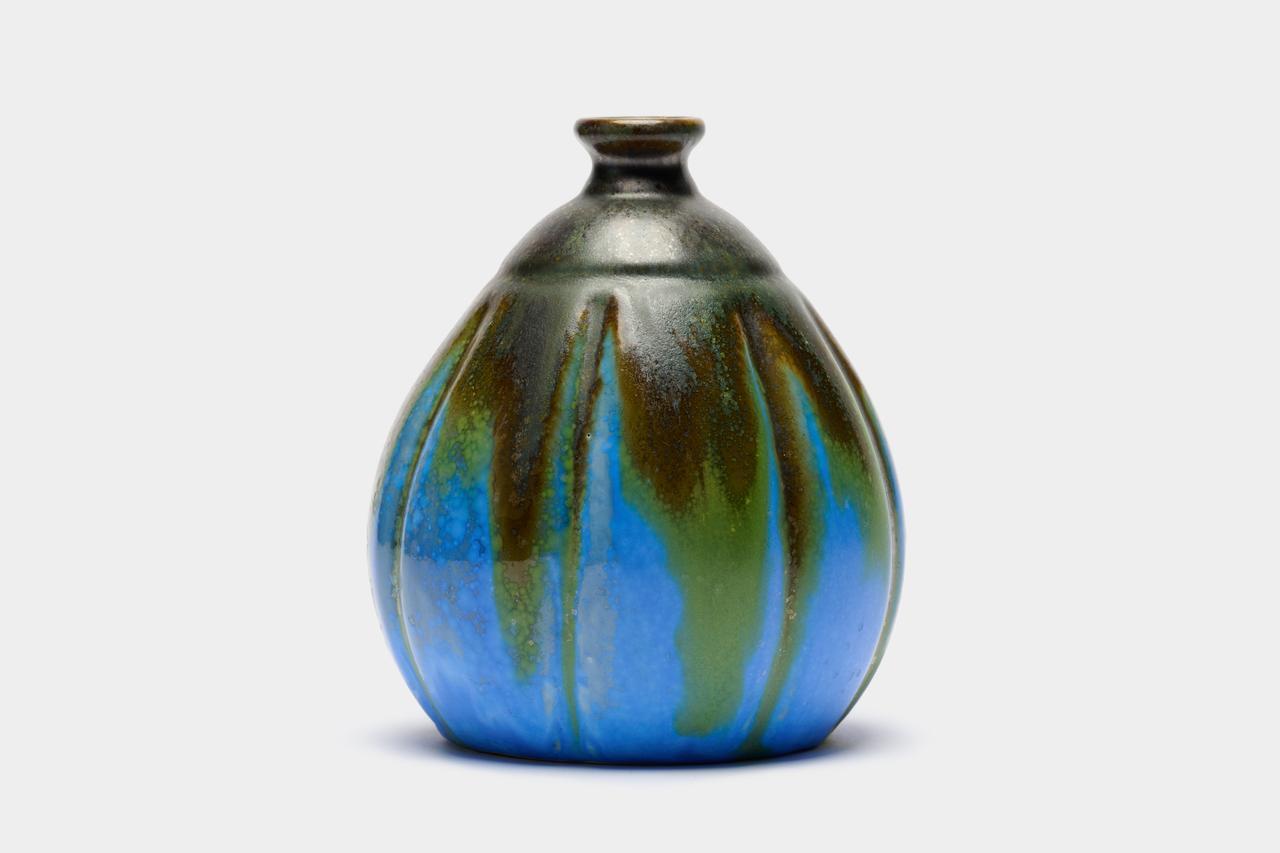
De Olde Kruyk D.O.K. Milsbeek - Pitcher - Crock, rustic decor, reddish-brown speckled glaze • marked, 1950s–1960s - Stoneware


00
days
06
hours
32
minutes
32
seconds
Current bid
€ 15
No reserve price

Expert
Selected by John Laurance
Thirty years' experience in decorative objects and two decades as shop owner.
Estimate € 110 - € 170
27 other people are watching this object
 Bidder 6094 Bidder 6094 | €15 | |
|---|---|---|
 Bidder 6981 Bidder 6981 | €10 | |
| Bidder 6094 | €9 | |
Catawiki Buyer Protection
Your payment’s safe with us until you receive your object.View details
Trustpilot 4.4 | 123718 reviews
Rated Excellent on Trustpilot.
Ceramic stoneware jug with a rustic décor in a deep iron-brown speckled glaze, hand-thrown by De Olde Kruyk Milsbeek and dated to the 1950s–1960s; 12 cm high, 13 cm diameter, about 705 g, in good used condition with a glaze flake at the upper rim.
AI-assisted summary
Description from the seller
Title
Crock, rustic decor, reddish-brown speckled glaze, De Olde Kruyk Milsbeek, marked, 1950s–1960s
705 grams
Description
Handcrafted earthenware jug with a globular body, short cylindrical neck, and applied handle, executed in a deep reddish-brown to iron-brown speckled glaze with a lively, slightly irregular surface. The object is wheel-thrown and exhibits a sober, archaic form language, emphasizing functionality and material expression.
On the underside, fitted with the original paper atelier sticker bearing the inscription 'Olde Kruyk – Handwerk – Milsbeek – Holland'. This brand sticker was used in the post-war period, particularly in the 1950s and 1960s, and indicates artisanal production intended for both the Dutch and international markets.
The jug was produced at De Olde Kruyk in Milsbeek, a Dutch ceramic studio that, after World War II, took a recognizable place within post-war artisanal pottery. During this period, the Netherlands experienced a renewed appreciation for craftsmanship and natural materials, partly as a reaction to industrial mass production. In this context, De Olde Kruyk developed a production style where simple forms, robust proportions, and iron-rich, earthy glazes played an important role.
From the mid-1950s, the artistic direction of the studio was also shaped by Piet Kurstjens, under whose leadership the focus shifted to jewelry ware and studio-like production. The objects from this period were largely produced collectively; individual makers were not signed, and forms and glazes were applied studio-wide.
Condition: in good used condition with a glaze chip at the upper edge. This does not detract from the decorative value of the special jug.
The iron oxide-rich glaze used, with its warm color nuances and subtle texture variations, is characteristic of De Olde Kruyk and closely aligns with the aesthetic preferences of the 1950s and 1960s. The jug thus serves as a representative example of Dutch post-war studio pottery, in which simplicity, craftsmanship, and material experience were deliberately prioritized over decorative exuberance.
Seller's Story
Decaders Gallery – Eindhoven Region, Netherlands
Our passion lies in 20th century applied arts and design, with a particular focus on the Art Nouveau, Art Deco and Mid-Century Modern periods. But styles from the sixties, seventies and later also attract our attention. Each decade has made a unique contribution to the art world, which our name – *Decaders Gallery* – perfectly reflects.
Thanks to our love for art and design, we present new, special decorative objects every week. In addition, we have a broad interest in Asian art, antiques and collectibles. Our searches throughout Europe have led to a valuable network of like-minded enthusiasts, who help us track down unique finds.
This network has paid off: we are proud to have supplied artworks to renowned museums, including:
**The Netherlands:**
- CODA Museum, Apeldoorn
- Drents Museum, Assen
- National Textile Museum, Tilburg
- National Glass Museum, Leerdam
- Museum 'Amsterdam School' (*'t Schip*), Amsterdam
- PSV Football Museum, Eindhoven
- National War Museum, Overloon
**Belgium:**
- Musée de la Famenne, Marche-en-Famenne
- Museum of Natural Sciences, Belgium
**Spain:**
- Maritime Museum, Barcelona
We warmly invite you to visit our auctions with surprising artworks and follow us on Instagram. Discover your favorite decade at *Decaders Gallery*!
**Marc van der Heijden**
*Decaders Gallery, Netherlands*
Translated by Google TranslateTitle
Crock, rustic decor, reddish-brown speckled glaze, De Olde Kruyk Milsbeek, marked, 1950s–1960s
705 grams
Description
Handcrafted earthenware jug with a globular body, short cylindrical neck, and applied handle, executed in a deep reddish-brown to iron-brown speckled glaze with a lively, slightly irregular surface. The object is wheel-thrown and exhibits a sober, archaic form language, emphasizing functionality and material expression.
On the underside, fitted with the original paper atelier sticker bearing the inscription 'Olde Kruyk – Handwerk – Milsbeek – Holland'. This brand sticker was used in the post-war period, particularly in the 1950s and 1960s, and indicates artisanal production intended for both the Dutch and international markets.
The jug was produced at De Olde Kruyk in Milsbeek, a Dutch ceramic studio that, after World War II, took a recognizable place within post-war artisanal pottery. During this period, the Netherlands experienced a renewed appreciation for craftsmanship and natural materials, partly as a reaction to industrial mass production. In this context, De Olde Kruyk developed a production style where simple forms, robust proportions, and iron-rich, earthy glazes played an important role.
From the mid-1950s, the artistic direction of the studio was also shaped by Piet Kurstjens, under whose leadership the focus shifted to jewelry ware and studio-like production. The objects from this period were largely produced collectively; individual makers were not signed, and forms and glazes were applied studio-wide.
Condition: in good used condition with a glaze chip at the upper edge. This does not detract from the decorative value of the special jug.
The iron oxide-rich glaze used, with its warm color nuances and subtle texture variations, is characteristic of De Olde Kruyk and closely aligns with the aesthetic preferences of the 1950s and 1960s. The jug thus serves as a representative example of Dutch post-war studio pottery, in which simplicity, craftsmanship, and material experience were deliberately prioritized over decorative exuberance.
Seller's Story
Decaders Gallery – Eindhoven Region, Netherlands
Our passion lies in 20th century applied arts and design, with a particular focus on the Art Nouveau, Art Deco and Mid-Century Modern periods. But styles from the sixties, seventies and later also attract our attention. Each decade has made a unique contribution to the art world, which our name – *Decaders Gallery* – perfectly reflects.
Thanks to our love for art and design, we present new, special decorative objects every week. In addition, we have a broad interest in Asian art, antiques and collectibles. Our searches throughout Europe have led to a valuable network of like-minded enthusiasts, who help us track down unique finds.
This network has paid off: we are proud to have supplied artworks to renowned museums, including:
**The Netherlands:**
- CODA Museum, Apeldoorn
- Drents Museum, Assen
- National Textile Museum, Tilburg
- National Glass Museum, Leerdam
- Museum 'Amsterdam School' (*'t Schip*), Amsterdam
- PSV Football Museum, Eindhoven
- National War Museum, Overloon
**Belgium:**
- Musée de la Famenne, Marche-en-Famenne
- Museum of Natural Sciences, Belgium
**Spain:**
- Maritime Museum, Barcelona
We warmly invite you to visit our auctions with surprising artworks and follow us on Instagram. Discover your favorite decade at *Decaders Gallery*!
**Marc van der Heijden**
*Decaders Gallery, Netherlands*
Translated by Google TranslateDetails
Era
1900-2000
Ceramics type
Stoneware
Material
Ceramic
Manufacturer/ Brand
De Olde Kruyk D.O.K. Milsbeek
Country of Origin
Netherlands
Model
Crock, rustic decor, reddish-brown speckled glaze • marked, 1950s–1960s
Style
Mid-century modern
Condition
Good condition - used with small signs of aging & blemishes
Height
12 cm
Width
13 cm
Diameter
13 cm
Estimated Period
1950-1960
Sold by