WMF (Württembergische Metallwarenfabrik), Geislingen - Platter - Copper Jugendstil serving bowl with floral relief decoration • Germany • 1910 - 1920 - Brass




00
days
09
hours
33
minutes
47
seconds
Current bid
€ 29
No reserve price

Expert
Selected by Michel Karis
Art historian with extensive experience working at various auction houses in antiques.
Estimate € 130 - € 190
31 other people are watching this object
 Bidder 8966 Bidder 8966 | €29 | |
|---|---|---|
 Bidder 2365 Bidder 2365 | €24 | |
| Bidder 8966 | €15 | |
Catawiki Buyer Protection
Your payment’s safe with us until you receive your object.View details
Trustpilot 4.4 | 123779 reviews
Rated Excellent on Trustpilot.
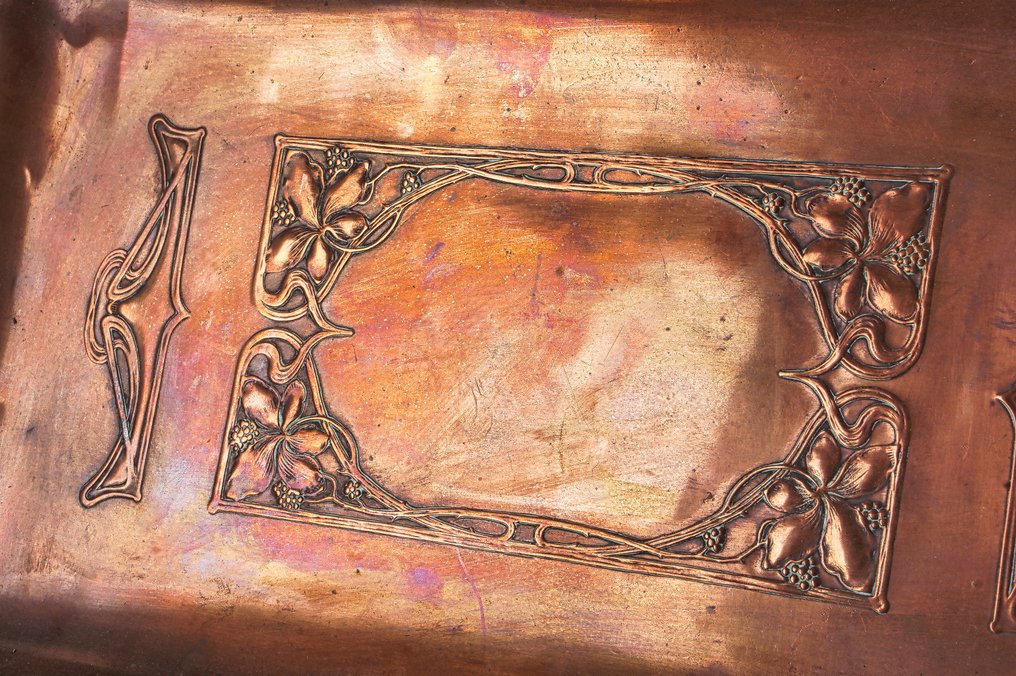
Rectangular copper serving bowl with hammered brass handles by WMF, Germany, circa 1903–1910, in high relief with a Jugendstil floral ornament; dimensions 48 cm × 23 cm × 3 cm; weight 755 g.
AI-assisted summary
Description from the seller
Title
Copper Jugendstil serving bowl with floral relief decoration, Württembergische Metallwarenfabrik (WMF), Germany, circa 1903–1910
Description
Rectangular serving tray in hammered copper with attached brass handles, made by Württembergische Metallwarenfabrik (WMF), Germany, circa 1903–1910. The tray features high relief and is richly decorated with a symmetrical Jugendstil ornament of stylized flowers and flowing, intertwined lines in characteristic whiplash shapes. The central rectangular cartouche is framed by floral motifs in the corners, connected by elegant line ornamentation, while on both sides, vertical abstract panels are added to visually enhance the design. The gently undulating raised edge emphasizes both the decorative and functional qualities of the object. The underside bears the square WMF factory stamp. The surface displays a warm, naturally developed patina with light signs of use, fully consistent with age and wear. A beautiful and representative example of German Jugendstil metal art from the early twentieth century.
History of WMF
The Württembergische Metallwarenfabrik (WMF) was founded in 1853 in Geislingen an der Steige and grew to become one of the leading European producers of artistic metalwork. Around 1900, WMF played a key role in the spread of Jugendstil, combining high-quality industrial manufacturing techniques with progressive artistic design. The company worked with an internal design team and introduced innovative forms and decorations heavily influenced by the international Art Nouveau movement. During the period circa 1900–1910, WMF reached an artistic peak, with copper, silver, and silver-plated metal as important materials. Objects from this phase are today valued for their aesthetic quality, craftsmanship, and their representative place within the history of European applied arts.
Seller's Story
Decaders Gallery – Eindhoven Region, Netherlands
Our passion lies in 20th century applied arts and design, with a particular focus on the Art Nouveau, Art Deco and Mid-Century Modern periods. But styles from the sixties, seventies and later also attract our attention. Each decade has made a unique contribution to the art world, which our name – *Decaders Gallery* – perfectly reflects.
Thanks to our love for art and design, we present new, special decorative objects every week. In addition, we have a broad interest in Asian art, antiques and collectibles. Our searches throughout Europe have led to a valuable network of like-minded enthusiasts, who help us track down unique finds.
This network has paid off: we are proud to have supplied artworks to renowned museums, including:
**The Netherlands:**
- CODA Museum, Apeldoorn
- Drents Museum, Assen
- National Textile Museum, Tilburg
- National Glass Museum, Leerdam
- Museum 'Amsterdam School' (*'t Schip*), Amsterdam
- PSV Football Museum, Eindhoven
- National War Museum, Overloon
**Belgium:**
- Musée de la Famenne, Marche-en-Famenne
- Museum of Natural Sciences, Belgium
**Spain:**
- Maritime Museum, Barcelona
We warmly invite you to visit our auctions with surprising artworks and follow us on Instagram. Discover your favorite decade at *Decaders Gallery*!
**Marc van der Heijden**
*Decaders Gallery, Netherlands*
Translated by Google TranslateTitle
Copper Jugendstil serving bowl with floral relief decoration, Württembergische Metallwarenfabrik (WMF), Germany, circa 1903–1910
Description
Rectangular serving tray in hammered copper with attached brass handles, made by Württembergische Metallwarenfabrik (WMF), Germany, circa 1903–1910. The tray features high relief and is richly decorated with a symmetrical Jugendstil ornament of stylized flowers and flowing, intertwined lines in characteristic whiplash shapes. The central rectangular cartouche is framed by floral motifs in the corners, connected by elegant line ornamentation, while on both sides, vertical abstract panels are added to visually enhance the design. The gently undulating raised edge emphasizes both the decorative and functional qualities of the object. The underside bears the square WMF factory stamp. The surface displays a warm, naturally developed patina with light signs of use, fully consistent with age and wear. A beautiful and representative example of German Jugendstil metal art from the early twentieth century.
History of WMF
The Württembergische Metallwarenfabrik (WMF) was founded in 1853 in Geislingen an der Steige and grew to become one of the leading European producers of artistic metalwork. Around 1900, WMF played a key role in the spread of Jugendstil, combining high-quality industrial manufacturing techniques with progressive artistic design. The company worked with an internal design team and introduced innovative forms and decorations heavily influenced by the international Art Nouveau movement. During the period circa 1900–1910, WMF reached an artistic peak, with copper, silver, and silver-plated metal as important materials. Objects from this phase are today valued for their aesthetic quality, craftsmanship, and their representative place within the history of European applied arts.
Seller's Story
Decaders Gallery – Eindhoven Region, Netherlands
Our passion lies in 20th century applied arts and design, with a particular focus on the Art Nouveau, Art Deco and Mid-Century Modern periods. But styles from the sixties, seventies and later also attract our attention. Each decade has made a unique contribution to the art world, which our name – *Decaders Gallery* – perfectly reflects.
Thanks to our love for art and design, we present new, special decorative objects every week. In addition, we have a broad interest in Asian art, antiques and collectibles. Our searches throughout Europe have led to a valuable network of like-minded enthusiasts, who help us track down unique finds.
This network has paid off: we are proud to have supplied artworks to renowned museums, including:
**The Netherlands:**
- CODA Museum, Apeldoorn
- Drents Museum, Assen
- National Textile Museum, Tilburg
- National Glass Museum, Leerdam
- Museum 'Amsterdam School' (*'t Schip*), Amsterdam
- PSV Football Museum, Eindhoven
- National War Museum, Overloon
**Belgium:**
- Musée de la Famenne, Marche-en-Famenne
- Museum of Natural Sciences, Belgium
**Spain:**
- Maritime Museum, Barcelona
We warmly invite you to visit our auctions with surprising artworks and follow us on Instagram. Discover your favorite decade at *Decaders Gallery*!
**Marc van der Heijden**
*Decaders Gallery, Netherlands*
Translated by Google TranslateDetails
Era
1900-2000
Weight
755 g
Style subtype
Jugendstil
Material
Brass
Manufacturer/ Brand
WMF (Württembergische Metallwarenfabrik), Geislingen
Model
Copper Jugendstil serving bowl with floral relief decoration • Germany • 1910 - 1920
Country of Origin
Germany
Style
Art Nouveau
Condition
Good condition - used with small signs of aging & blemishes
Height
3 cm
Width
48 cm
Depth
23 cm
Estimated Period
1900-1910, 1910-1920
Sold by
