A wood sculpture - Hemba - DR Congo (No reserve price)



00
days
17
hours
29
minutes
59
seconds
Current bid
€ 39
No reserve price

Expert
Selected by Dimitri André
Holds a postgraduate degree in African studies and 15 years experience in African art.
Estimate € 350 - € 430
46 other people are watching this object
 Bidder 7953 Bidder 7953 | €39 | |
|---|---|---|
 Bidder 2382 Bidder 2382 | €34 | |
| Bidder 7953 | €29 | |
Catawiki Buyer Protection
Your payment’s safe with us until you receive your object.View details
Trustpilot 4.4 | 123641 reviews
Rated Excellent on Trustpilot.
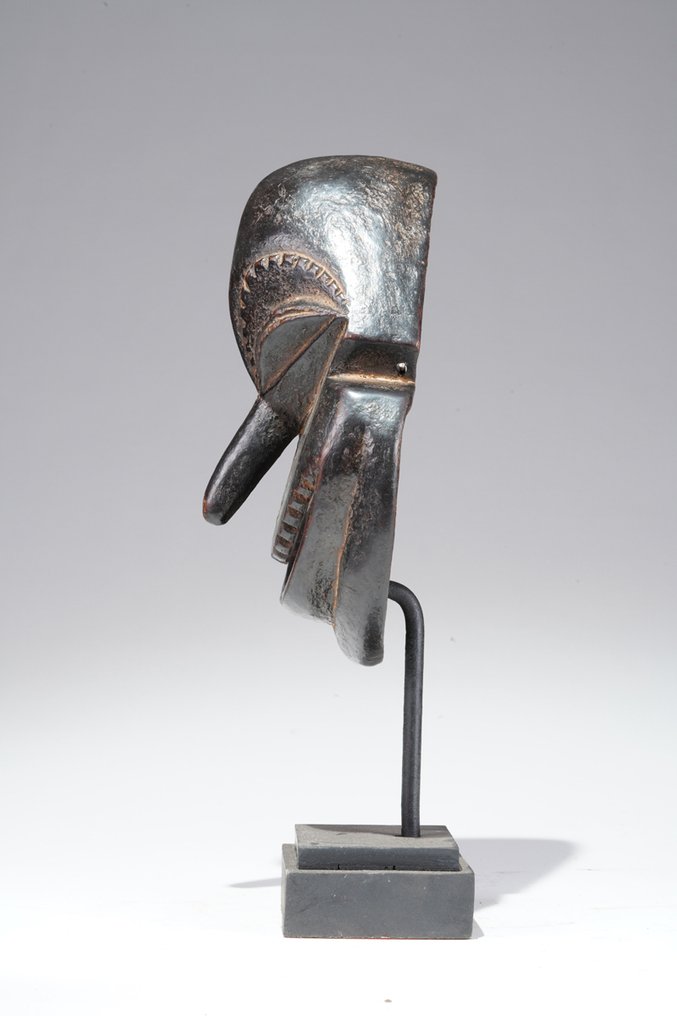
A wood sculpture from the Hemba of DR Congo, titled "A wood sculpture", 27 cm tall, weighing 960 g, in fair condition, provenance Manono, DR Congo, associated with the Misi gwa soo masquerade.
AI-assisted summary
Description from the seller
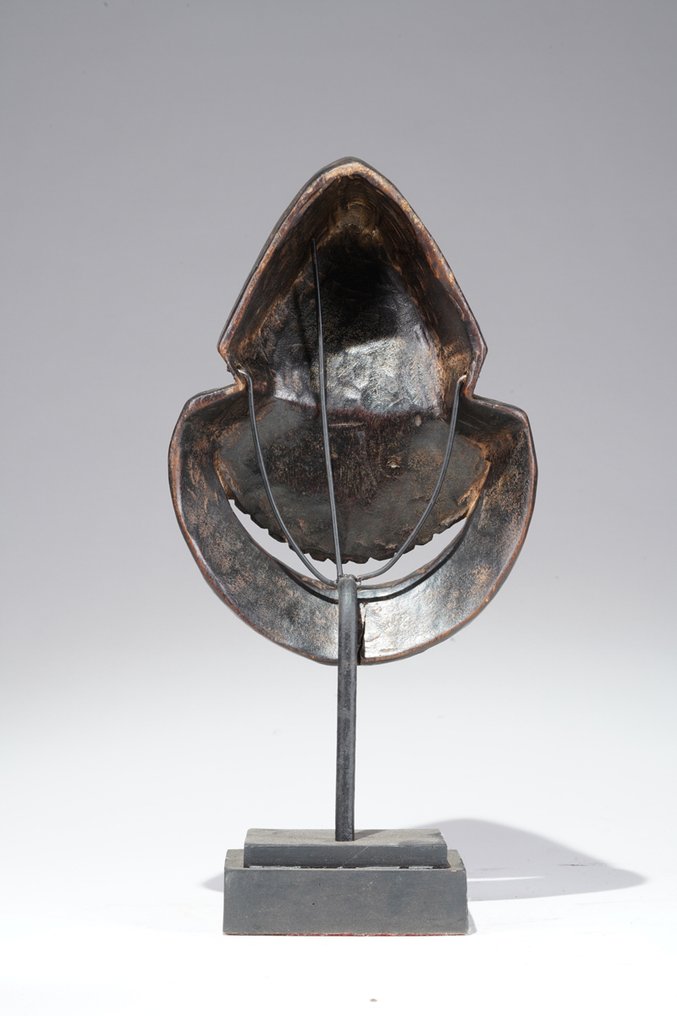
A Hemba chimpanzee mask collected in Manono, DR Congo, known as Misi gwa so'o, with a striking wide opened mouth with slight indented teeth. Glossy patina; signs of ritual use and age. Incl. stand.
Misi gwa soo masks are associated with the Hemba peoples of the southeastern Democratic Republic of the Congo and belong to a category of masquerade objects that articulate relationships between human society, animal behavior, and moral regulation. The term Misi gwa soo refers to a masquerade persona characterized by references to the chimpanzee, an animal understood locally as occupying a liminal position between the human community and the forest world. The mask does not depict a chimpanzee naturalistically but mobilizes selected traits to construct a symbolic agent activated through performance.
Carved in wood and often combined with fiber attachments and dark surface treatments, Misi gwa soo masks exhibit a synthesis of zoomorphic and anthropomorphic features. Protruding muzzles, exposed or bared teeth, and pronounced brow ridges evoke simian physiognomy, while bilateral symmetry and controlled proportions maintain a recognizable human framework. This formal hybridity underscores the masquerade’s function as a mediator between categories rather than a fixed representation of an animal type.
The masquerade associated with Misi gwa soo appears in public contexts where social tensions, moral infractions, or moments of transition require collective attention. The chimpanzee persona embodies behaviors perceived as excessive or uncontrolled, such as greed, aggression, or sexual impropriety, while also referencing intelligence and social mimicry. Through dance, gesture, and vocalization, the performer enacts these traits in exaggerated form, allowing the community to confront and discipline them symbolically.
Meaning is generated through movement and sound as much as through carved form. The mask’s expressive features are calibrated for kinetic visibility, particularly in outdoor performance settings at the edge of settlements or near forest zones. Raffia costumes, percussive accompaniment, and choreographed gestures complete the transformation, temporarily suspending the performer’s personal identity in favor of the masquerade persona.
Material accretions such as patina, abrasion, and pigment residue attest to repeated activation rather than age alone. The mask’s efficacy depends on proper handling, restricted knowledge, and adherence to performative protocols. Its power is not intrinsic to the object as sculpture but emerges through the convergence of form, body, sound, and audience.
Biebuyck, Daniel. The Arts of Zaire. University of California Press, 1985.
Felix, Marc Leo. 100 Peoples of Zaire and Their Sculpture. Zaire Basin Art History Research Center, 1987.
Merriam, Alan P. African Music in Perspective. Northwestern University Press, 1982.
Roberts, Allen F., and Mary Nooter Roberts. Memory: Luba Art and the Making of History. Prestel, 1996.
Vogel, Susan Mullin. Africa Explores: 20th Century African Art. Center for African Art, 1991.
CAB27948
Height: 27 cm without stand
Seller's Story
For over twenty-five years, Wolfgang Jaenicke has been active as a collector and, for the past two decades, as a specialist dealer in African art, with a particular focus on material often subsumed under the term “Tribal Art”. His early engagement with cultural history was shaped by his father’s extensive archive on the former “German Colonies”, a collection of documents, publications and artefacts that introduced him to the evidentiary and historical significance of objects at a young age.
Jaenicke pursued studies in ethnology, art history and comparative law at the Freie Universität Berlin. Motivated by an interest in cultural dynamics beyond the limitations of academic formalism, he left the university to undertake extended research and travel in West and Central Africa. His fieldwork and professional activities took him through Cameroon, Mali, Côte d’Ivoire, Burkina Faso, Togo and Ghana, establishing long-term relationships with artists, collectors, researchers and local institutions.
From 2002 to 2012 he lived primarily in Mali, based in Bamako and Ségou. During this period he directed Tribalartforum, a gallery housed in a historic colonial building overlooking the Ségou harbour. The gallery became a notable site for contemporary and historical cultural production, hosting exhibitions of Bamana sculpture and ceramics, as well as photographic works including those of Malick Sidibé, whose images of the 1970s youth culture in Mali remain internationally influential. The outbreak of the war in Mali in 2012 necessitated the closure of the gallery.
Following his departure from Mali, Jaenicke established his base of operations in Lomé, Togo, where he and his partners maintain a permanent branch. The Jaenicke-Njoya GmbH, founded sixteen years earlier, serves as the organisational and legal framework for these activities. In 2018, the Galerie Wolfgang Jaenicke opened its Berlin location opposite Charlottenburg Palace, operating today with a team of approximately twelve specialists.
A significant focus of the gallery’s curatorial and research work lies in West African bronzes and terracotta. As part of ongoing efforts toward transparency and precise cultural documentation, Jaenicke collaborated with the Technische Universität Berlin’s “Translocation Project”, contributing insight into the circulation of archaeological and ethnographic objects within the international art trade in Lomé. The gallery maintains continuous dialogue with national museums across West Africa and regularly publishes updates on its activities in Lomé and Berlin via its website: wolfgang-jaenicke
Jaenicke’s practice combines long-term field engagement with a commitment to provenance research, museum-level documentation, and the ethical stewardship of cultural heritage. His work continues to bridge local knowledge networks and international scholarly discourse.
A Hemba chimpanzee mask collected in Manono, DR Congo, known as Misi gwa so'o, with a striking wide opened mouth with slight indented teeth. Glossy patina; signs of ritual use and age. Incl. stand.
Misi gwa soo masks are associated with the Hemba peoples of the southeastern Democratic Republic of the Congo and belong to a category of masquerade objects that articulate relationships between human society, animal behavior, and moral regulation. The term Misi gwa soo refers to a masquerade persona characterized by references to the chimpanzee, an animal understood locally as occupying a liminal position between the human community and the forest world. The mask does not depict a chimpanzee naturalistically but mobilizes selected traits to construct a symbolic agent activated through performance.
Carved in wood and often combined with fiber attachments and dark surface treatments, Misi gwa soo masks exhibit a synthesis of zoomorphic and anthropomorphic features. Protruding muzzles, exposed or bared teeth, and pronounced brow ridges evoke simian physiognomy, while bilateral symmetry and controlled proportions maintain a recognizable human framework. This formal hybridity underscores the masquerade’s function as a mediator between categories rather than a fixed representation of an animal type.
The masquerade associated with Misi gwa soo appears in public contexts where social tensions, moral infractions, or moments of transition require collective attention. The chimpanzee persona embodies behaviors perceived as excessive or uncontrolled, such as greed, aggression, or sexual impropriety, while also referencing intelligence and social mimicry. Through dance, gesture, and vocalization, the performer enacts these traits in exaggerated form, allowing the community to confront and discipline them symbolically.
Meaning is generated through movement and sound as much as through carved form. The mask’s expressive features are calibrated for kinetic visibility, particularly in outdoor performance settings at the edge of settlements or near forest zones. Raffia costumes, percussive accompaniment, and choreographed gestures complete the transformation, temporarily suspending the performer’s personal identity in favor of the masquerade persona.
Material accretions such as patina, abrasion, and pigment residue attest to repeated activation rather than age alone. The mask’s efficacy depends on proper handling, restricted knowledge, and adherence to performative protocols. Its power is not intrinsic to the object as sculpture but emerges through the convergence of form, body, sound, and audience.
Biebuyck, Daniel. The Arts of Zaire. University of California Press, 1985.
Felix, Marc Leo. 100 Peoples of Zaire and Their Sculpture. Zaire Basin Art History Research Center, 1987.
Merriam, Alan P. African Music in Perspective. Northwestern University Press, 1982.
Roberts, Allen F., and Mary Nooter Roberts. Memory: Luba Art and the Making of History. Prestel, 1996.
Vogel, Susan Mullin. Africa Explores: 20th Century African Art. Center for African Art, 1991.
CAB27948
Height: 27 cm without stand
Seller's Story
For over twenty-five years, Wolfgang Jaenicke has been active as a collector and, for the past two decades, as a specialist dealer in African art, with a particular focus on material often subsumed under the term “Tribal Art”. His early engagement with cultural history was shaped by his father’s extensive archive on the former “German Colonies”, a collection of documents, publications and artefacts that introduced him to the evidentiary and historical significance of objects at a young age.
Jaenicke pursued studies in ethnology, art history and comparative law at the Freie Universität Berlin. Motivated by an interest in cultural dynamics beyond the limitations of academic formalism, he left the university to undertake extended research and travel in West and Central Africa. His fieldwork and professional activities took him through Cameroon, Mali, Côte d’Ivoire, Burkina Faso, Togo and Ghana, establishing long-term relationships with artists, collectors, researchers and local institutions.
From 2002 to 2012 he lived primarily in Mali, based in Bamako and Ségou. During this period he directed Tribalartforum, a gallery housed in a historic colonial building overlooking the Ségou harbour. The gallery became a notable site for contemporary and historical cultural production, hosting exhibitions of Bamana sculpture and ceramics, as well as photographic works including those of Malick Sidibé, whose images of the 1970s youth culture in Mali remain internationally influential. The outbreak of the war in Mali in 2012 necessitated the closure of the gallery.
Following his departure from Mali, Jaenicke established his base of operations in Lomé, Togo, where he and his partners maintain a permanent branch. The Jaenicke-Njoya GmbH, founded sixteen years earlier, serves as the organisational and legal framework for these activities. In 2018, the Galerie Wolfgang Jaenicke opened its Berlin location opposite Charlottenburg Palace, operating today with a team of approximately twelve specialists.
A significant focus of the gallery’s curatorial and research work lies in West African bronzes and terracotta. As part of ongoing efforts toward transparency and precise cultural documentation, Jaenicke collaborated with the Technische Universität Berlin’s “Translocation Project”, contributing insight into the circulation of archaeological and ethnographic objects within the international art trade in Lomé. The gallery maintains continuous dialogue with national museums across West Africa and regularly publishes updates on its activities in Lomé and Berlin via its website: wolfgang-jaenicke
Jaenicke’s practice combines long-term field engagement with a commitment to provenance research, museum-level documentation, and the ethical stewardship of cultural heritage. His work continues to bridge local knowledge networks and international scholarly discourse.
Details
Ethnic group/ culture
Hemba
Country of Origin
DR Congo
Material
Wood
Sold with stand
No
Condition
Fair condition
Title of artwork
A wood sculpture
Height
27 cm
Weight
960 g
Sold by
GermanyVerified
protop
Rechtliche Informationen des Verkäufers
- Unternehmen:
- Jaenicke Njoya GmbH
- Repräsentant:
- Wolfgang Jaenicke
- Adresse:
- Jaenicke Njoya GmbH
Klausenerplatz 7
14059 Berlin
GERMANY - Telefonnummer:
- +493033951033
- Email:
- w.jaenicke@jaenicke-njoya.com
- USt-IdNr.:
- DE241193499
AGB
AGB des Verkäufers. Mit einem Gebot auf dieses Los akzeptieren Sie ebenfalls die AGB des Verkäufers.
Widerrufsbelehrung
- Frist: 14 Tage sowie gemäß den hier angegebenen Bedingungen
- Rücksendkosten: Käufer trägt die unmittelbaren Kosten der Rücksendung der Ware
- Vollständige Widerrufsbelehrung
