A wood sculpture - Senufo - Côte d'Ivoire



01
day
11
hours
43
minutes
11
seconds
Current bid
€ 150
Reserve price not met

Expert
Selected by Dimitri André
Holds a postgraduate degree in African studies and 15 years experience in African art.
Estimate € 1,200 - € 1,400
16 other people are watching this object
 Bidder 9954 Bidder 9954 | €150 | |
|---|---|---|
| Bidder 9954 | €125 |
Catawiki Buyer Protection
Your payment’s safe with us until you receive your object.View details
Trustpilot 4.4 | 123609 reviews
Rated Excellent on Trustpilot.
Description from the seller
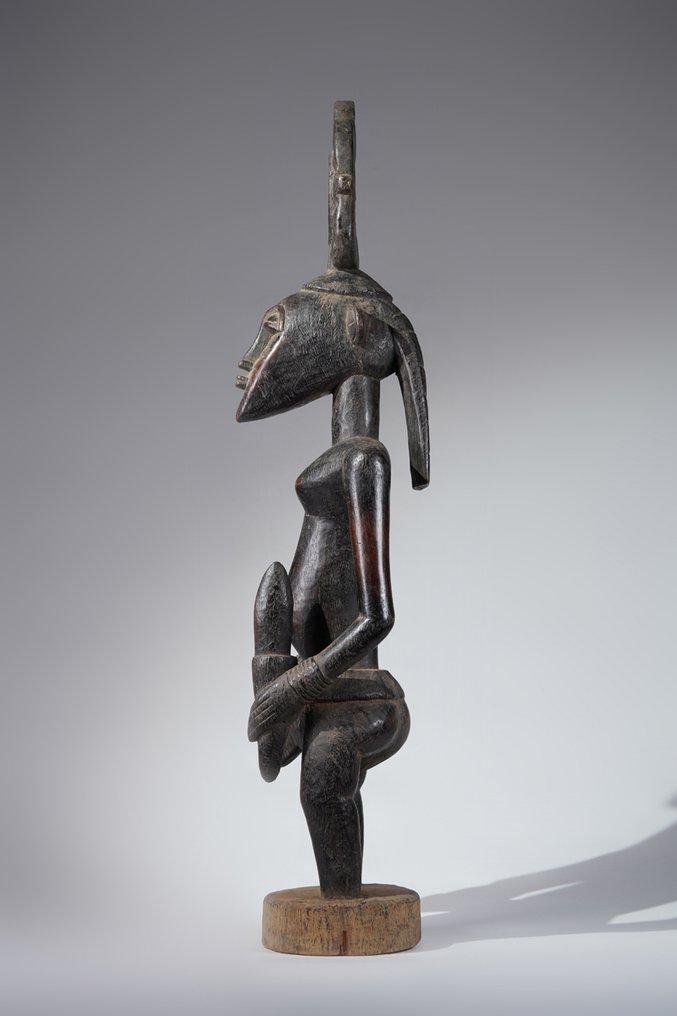
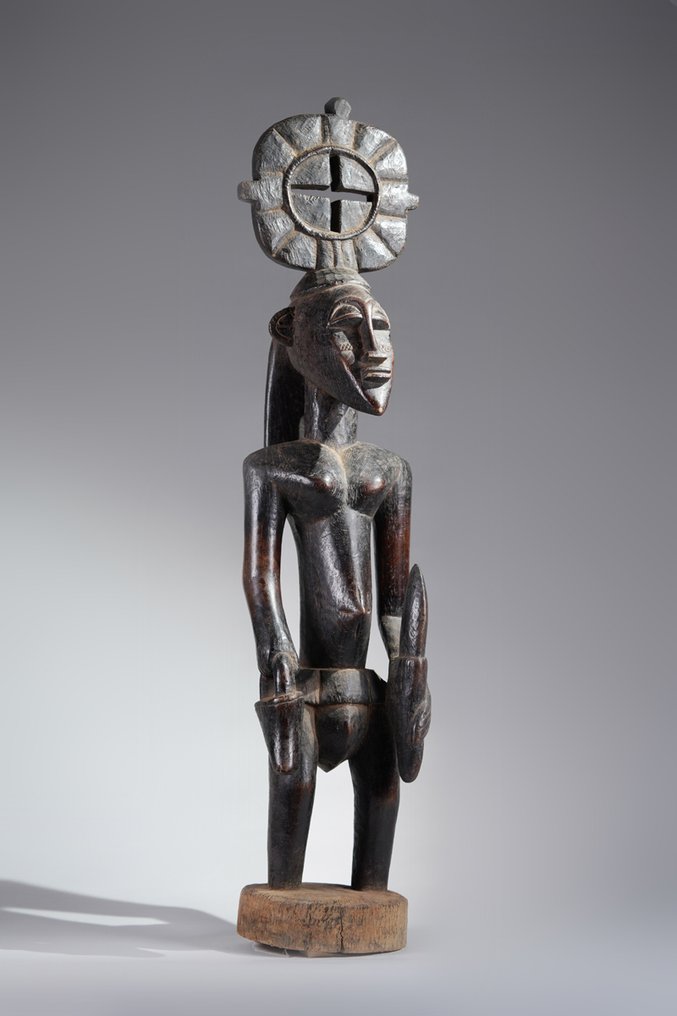
A large female guardian Senufo sculpture from the Region of Boundiali, village Tingrela, related to the well known Rhythm Pounders or "Deblé", standing on a cylindrical base, carrying a double-edged knife in the left hand and a fetish bell in the right hand. On the top of the head sits a plaque attachment with an X carved out in the middle. The plaque attachment means that the object plays a double role: First it is a field guard and second it plays a ceremonial role. Heavy hard "Lenke" wood (not a Senari a Djula word), on the plaque small remnants of white pigments.
. The object functions both as a rhythm-pounder (déblé, used in Poro performance) and as a shrine or field guardian; several published examples bear a superstructure or plaque on the head that signals this dual role.Brooklyn Museum+1
Materials and surface. Carved from local hardwood and darkened by ritual handling and age; surfaces frequently bear a burnished patina, traces of soil, ochre or sacrificial residue, and wear on the arms and head consistent with repetitive handling and pounding. Several published pieces are described specifically as having fine blackened patina and traces of ritual use.Galerie Wolfgang Jaenicke+1
Provenance note. Museum and dealer records indicate multiple variant spellings of the place-name (Tingrla, Tingréla, Tengréla) and village-level attributions such as Nafoungolo or Korhogo-region localities in published provenance statements. Gallery catalogues sometimes list former owners or regional collectors (for example: provenance recorded from Belo Mohamed Garba, Korhogo). Provenance chains for market examples are documented in specialist gallery entries and in museum accession records.Galerie Wolfgang Jaenicke+2Galerie Wolfgang Jaenicke+2
Interpretation. Figures termed déblé perform a double register of meaning: materially they operate in performance as rhythm-pounders—objects held and struck to mark dance rhythms during Poro ceremonies and funerary observances—and socially they operate as protective or mediating presences within shrines and cultivated fields. The Tingrla-associated examples register a high degree of formal abstraction that emphasizes bodily zones (navel, hands, coiffure) important to Senufo cosmologies; the presence of an added head-plate or plaque in some examples signals an expanded ritual agency, linking the embodied figure to visible emblems of place-protection or ancestral power. Scholarly and museum treatments therefore emphasise both the performative biography (wear from use) and the shrine biography (attachments, accretions, ownership marks) when interpreting such objects.
Select published examples and repositories. The following institutions and specialist publications have published or exhibited Senufo guardian figures and rhythm-pounders attributed to northern Senufo localities (including Tingrla / Tingréla): Cleveland Museum of Art (major exhibition and catalogue on Senufo art); Brooklyn Museum (object records for déblé figures); Allen Art Collection, Oberlin College (Rhythm Pounder entry); Musée du quai Branly — Jacques Chirac (exhibition programmes and catalogues including Senufo master sculptures); and specialist dealer / gallery catalogues and object entries such as those published by Wolfgang Jaenicke Galerie (which lists Tingrela-provenanced examples). These institutional records provide photographs, dimensions, condition notes, and provenance statements useful for catalogue entries.Galerie Wolfgang Jaenicke+4Cleveland Museum of Art+4Brooklyn Museum+4
Senufo guardian (déblé). Tingrla (village Nafoungolo), northern Côte d’Ivoire. Mid–20th century. Hardwood, darkened patina; traces of handling and soil; head-plate attachment; surface scarification around navel. Height: 158.8 cm (example scale). Provenance: acquired from Belo Mohamed Garba, Korhogo region; in trade; comparable published examples in the Brooklyn Museum and Allen Art Collection. Interpretation: rhythm-pounder/shrine guardian combining performative function in Poro ritual with protective, place-bound agency; formal features (elongated torso, emphasized navel, head plaque) index both aesthetic ideals and shrine-signalling functions. Footnotes and documentary references follow.Galerie Wolfgang Jaenicke+2Brooklyn Museum+2
Footnotes.
Cleveland Museum of Art, exhibition “Senufo: Art and Identity in West Africa” (exhibition pages and press material). Cleveland Museum of Art+1
Brooklyn Museum, object record: “Rhythm Pounder (Siibele)” and “Rhythm Pounder (Déblé) with Male Figure” (catalogue entries and measurement data). Brooklyn Museum+1
Allen Art Collection, Oberlin College, object record “Rhythm Pounder” (object number and dimensions; accession information). Allen Memorial Art Museum
Musée du quai Branly — Jacques Chirac, exhibition pages and catalogue programme on West African sculpture and “masters of sculpture” presentations. Quai Branly+1
Wolfgang Jaenicke Galerie, catalogue/object pages for Tingrela-provenanced Senufo guardian figures and rhythm-pounders (example entries with village-level attributions Nafoungolo, Korhogo region). Galerie Wolfgang Jaenicke+2Galerie Wolfgang Jaenicke+2
If you approve this draft I will convert the suggested short catalogue entry into your exact plain-text catalogue layout (single-line object title, one-line provenance, single paragraph description, measurements line, materials line, condition line, one-line interpretive note, and numbered footnotes.
Seller's Story
For over twenty-five years, Wolfgang Jaenicke has been active as a collector and, for the past two decades, as a specialist dealer in African art, with a particular focus on material often subsumed under the term “Tribal Art”. His early engagement with cultural history was shaped by his father’s extensive archive on the former “German Colonies”, a collection of documents, publications and artefacts that introduced him to the evidentiary and historical significance of objects at a young age.
Jaenicke pursued studies in ethnology, art history and comparative law at the Freie Universität Berlin. Motivated by an interest in cultural dynamics beyond the limitations of academic formalism, he left the university to undertake extended research and travel in West and Central Africa. His fieldwork and professional activities took him through Cameroon, Mali, Côte d’Ivoire, Burkina Faso, Togo and Ghana, establishing long-term relationships with artists, collectors, researchers and local institutions.
From 2002 to 2012 he lived primarily in Mali, based in Bamako and Ségou. During this period he directed Tribalartforum, a gallery housed in a historic colonial building overlooking the Ségou harbour. The gallery became a notable site for contemporary and historical cultural production, hosting exhibitions of Bamana sculpture and ceramics, as well as photographic works including those of Malick Sidibé, whose images of the 1970s youth culture in Mali remain internationally influential. The outbreak of the war in Mali in 2012 necessitated the closure of the gallery.
Following his departure from Mali, Jaenicke established his base of operations in Lomé, Togo, where he and his partners maintain a permanent branch. The Jaenicke-Njoya GmbH, founded sixteen years earlier, serves as the organisational and legal framework for these activities. In 2018, the Galerie Wolfgang Jaenicke opened its Berlin location opposite Charlottenburg Palace, operating today with a team of approximately twelve specialists.
A significant focus of the gallery’s curatorial and research work lies in West African bronzes and terracotta. As part of ongoing efforts toward transparency and precise cultural documentation, Jaenicke collaborated with the Technische Universität Berlin’s “Translocation Project”, contributing insight into the circulation of archaeological and ethnographic objects within the international art trade in Lomé. The gallery maintains continuous dialogue with national museums across West Africa and regularly publishes updates on its activities in Lomé and Berlin via its website: wolfgang-jaenicke
Jaenicke’s practice combines long-term field engagement with a commitment to provenance research, museum-level documentation, and the ethical stewardship of cultural heritage. His work continues to bridge local knowledge networks and international scholarly discourse.
A large female guardian Senufo sculpture from the Region of Boundiali, village Tingrela, related to the well known Rhythm Pounders or "Deblé", standing on a cylindrical base, carrying a double-edged knife in the left hand and a fetish bell in the right hand. On the top of the head sits a plaque attachment with an X carved out in the middle. The plaque attachment means that the object plays a double role: First it is a field guard and second it plays a ceremonial role. Heavy hard "Lenke" wood (not a Senari a Djula word), on the plaque small remnants of white pigments.
. The object functions both as a rhythm-pounder (déblé, used in Poro performance) and as a shrine or field guardian; several published examples bear a superstructure or plaque on the head that signals this dual role.Brooklyn Museum+1
Materials and surface. Carved from local hardwood and darkened by ritual handling and age; surfaces frequently bear a burnished patina, traces of soil, ochre or sacrificial residue, and wear on the arms and head consistent with repetitive handling and pounding. Several published pieces are described specifically as having fine blackened patina and traces of ritual use.Galerie Wolfgang Jaenicke+1
Provenance note. Museum and dealer records indicate multiple variant spellings of the place-name (Tingrla, Tingréla, Tengréla) and village-level attributions such as Nafoungolo or Korhogo-region localities in published provenance statements. Gallery catalogues sometimes list former owners or regional collectors (for example: provenance recorded from Belo Mohamed Garba, Korhogo). Provenance chains for market examples are documented in specialist gallery entries and in museum accession records.Galerie Wolfgang Jaenicke+2Galerie Wolfgang Jaenicke+2
Interpretation. Figures termed déblé perform a double register of meaning: materially they operate in performance as rhythm-pounders—objects held and struck to mark dance rhythms during Poro ceremonies and funerary observances—and socially they operate as protective or mediating presences within shrines and cultivated fields. The Tingrla-associated examples register a high degree of formal abstraction that emphasizes bodily zones (navel, hands, coiffure) important to Senufo cosmologies; the presence of an added head-plate or plaque in some examples signals an expanded ritual agency, linking the embodied figure to visible emblems of place-protection or ancestral power. Scholarly and museum treatments therefore emphasise both the performative biography (wear from use) and the shrine biography (attachments, accretions, ownership marks) when interpreting such objects.
Select published examples and repositories. The following institutions and specialist publications have published or exhibited Senufo guardian figures and rhythm-pounders attributed to northern Senufo localities (including Tingrla / Tingréla): Cleveland Museum of Art (major exhibition and catalogue on Senufo art); Brooklyn Museum (object records for déblé figures); Allen Art Collection, Oberlin College (Rhythm Pounder entry); Musée du quai Branly — Jacques Chirac (exhibition programmes and catalogues including Senufo master sculptures); and specialist dealer / gallery catalogues and object entries such as those published by Wolfgang Jaenicke Galerie (which lists Tingrela-provenanced examples). These institutional records provide photographs, dimensions, condition notes, and provenance statements useful for catalogue entries.Galerie Wolfgang Jaenicke+4Cleveland Museum of Art+4Brooklyn Museum+4
Senufo guardian (déblé). Tingrla (village Nafoungolo), northern Côte d’Ivoire. Mid–20th century. Hardwood, darkened patina; traces of handling and soil; head-plate attachment; surface scarification around navel. Height: 158.8 cm (example scale). Provenance: acquired from Belo Mohamed Garba, Korhogo region; in trade; comparable published examples in the Brooklyn Museum and Allen Art Collection. Interpretation: rhythm-pounder/shrine guardian combining performative function in Poro ritual with protective, place-bound agency; formal features (elongated torso, emphasized navel, head plaque) index both aesthetic ideals and shrine-signalling functions. Footnotes and documentary references follow.Galerie Wolfgang Jaenicke+2Brooklyn Museum+2
Footnotes.
Cleveland Museum of Art, exhibition “Senufo: Art and Identity in West Africa” (exhibition pages and press material). Cleveland Museum of Art+1
Brooklyn Museum, object record: “Rhythm Pounder (Siibele)” and “Rhythm Pounder (Déblé) with Male Figure” (catalogue entries and measurement data). Brooklyn Museum+1
Allen Art Collection, Oberlin College, object record “Rhythm Pounder” (object number and dimensions; accession information). Allen Memorial Art Museum
Musée du quai Branly — Jacques Chirac, exhibition pages and catalogue programme on West African sculpture and “masters of sculpture” presentations. Quai Branly+1
Wolfgang Jaenicke Galerie, catalogue/object pages for Tingrela-provenanced Senufo guardian figures and rhythm-pounders (example entries with village-level attributions Nafoungolo, Korhogo region). Galerie Wolfgang Jaenicke+2Galerie Wolfgang Jaenicke+2
If you approve this draft I will convert the suggested short catalogue entry into your exact plain-text catalogue layout (single-line object title, one-line provenance, single paragraph description, measurements line, materials line, condition line, one-line interpretive note, and numbered footnotes.
Seller's Story
For over twenty-five years, Wolfgang Jaenicke has been active as a collector and, for the past two decades, as a specialist dealer in African art, with a particular focus on material often subsumed under the term “Tribal Art”. His early engagement with cultural history was shaped by his father’s extensive archive on the former “German Colonies”, a collection of documents, publications and artefacts that introduced him to the evidentiary and historical significance of objects at a young age.
Jaenicke pursued studies in ethnology, art history and comparative law at the Freie Universität Berlin. Motivated by an interest in cultural dynamics beyond the limitations of academic formalism, he left the university to undertake extended research and travel in West and Central Africa. His fieldwork and professional activities took him through Cameroon, Mali, Côte d’Ivoire, Burkina Faso, Togo and Ghana, establishing long-term relationships with artists, collectors, researchers and local institutions.
From 2002 to 2012 he lived primarily in Mali, based in Bamako and Ségou. During this period he directed Tribalartforum, a gallery housed in a historic colonial building overlooking the Ségou harbour. The gallery became a notable site for contemporary and historical cultural production, hosting exhibitions of Bamana sculpture and ceramics, as well as photographic works including those of Malick Sidibé, whose images of the 1970s youth culture in Mali remain internationally influential. The outbreak of the war in Mali in 2012 necessitated the closure of the gallery.
Following his departure from Mali, Jaenicke established his base of operations in Lomé, Togo, where he and his partners maintain a permanent branch. The Jaenicke-Njoya GmbH, founded sixteen years earlier, serves as the organisational and legal framework for these activities. In 2018, the Galerie Wolfgang Jaenicke opened its Berlin location opposite Charlottenburg Palace, operating today with a team of approximately twelve specialists.
A significant focus of the gallery’s curatorial and research work lies in West African bronzes and terracotta. As part of ongoing efforts toward transparency and precise cultural documentation, Jaenicke collaborated with the Technische Universität Berlin’s “Translocation Project”, contributing insight into the circulation of archaeological and ethnographic objects within the international art trade in Lomé. The gallery maintains continuous dialogue with national museums across West Africa and regularly publishes updates on its activities in Lomé and Berlin via its website: wolfgang-jaenicke
Jaenicke’s practice combines long-term field engagement with a commitment to provenance research, museum-level documentation, and the ethical stewardship of cultural heritage. His work continues to bridge local knowledge networks and international scholarly discourse.
Details
Ethnic group/ culture
Senufo
Country of Origin
Côte d'Ivoire
Material
Wood
Sold with stand
No
Condition
Fair condition
Title of artwork
A wood sculpture
Height
117 cm
Weight
9.2 kg
Sold by
GermanyVerified
protop
Rechtliche Informationen des Verkäufers
- Unternehmen:
- Jaenicke Njoya GmbH
- Repräsentant:
- Wolfgang Jaenicke
- Adresse:
- Jaenicke Njoya GmbH
Klausenerplatz 7
14059 Berlin
GERMANY - Telefonnummer:
- +493033951033
- Email:
- w.jaenicke@jaenicke-njoya.com
- USt-IdNr.:
- DE241193499
AGB
AGB des Verkäufers. Mit einem Gebot auf dieses Los akzeptieren Sie ebenfalls die AGB des Verkäufers.
Widerrufsbelehrung
- Frist: 14 Tage sowie gemäß den hier angegebenen Bedingungen
- Rücksendkosten: Käufer trägt die unmittelbaren Kosten der Rücksendung der Ware
- Vollständige Widerrufsbelehrung
