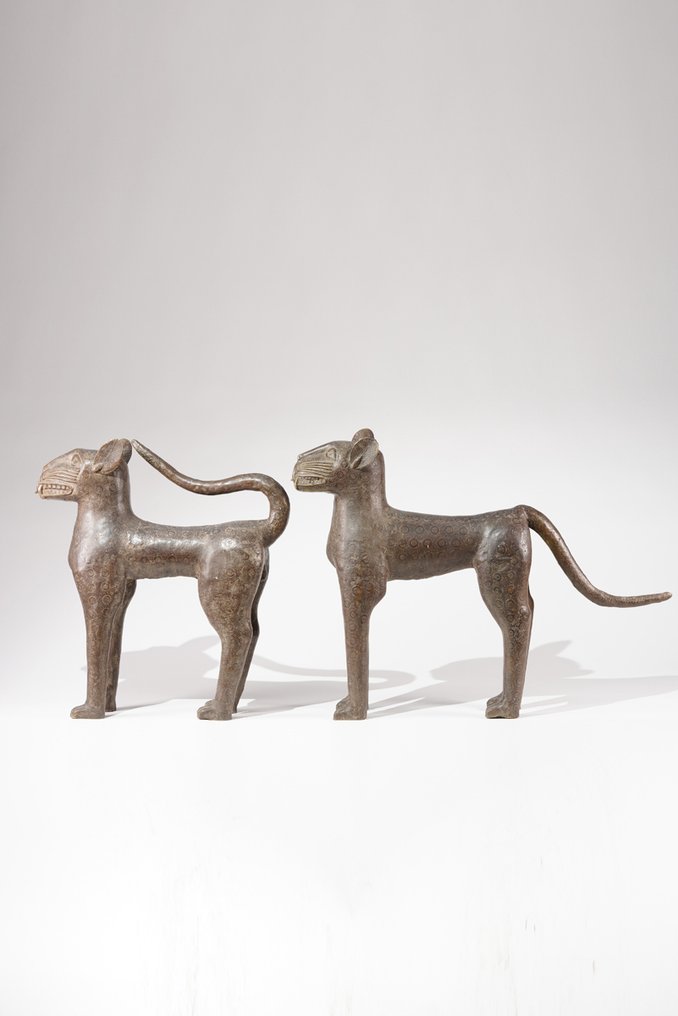
A bronze sculpture - Benin - Nigeria



06
days
00
hours
52
minutes
00
seconds
Current bid
€ 600
Reserve price not met

Expert
Selected by Dimitri André
Holds a postgraduate degree in African studies and 15 years experience in African art.
Estimate € 4,000 - € 4,400
14 other people are watching this object
 Bidder 3858 Bidder 3858 | €600 | |
|---|---|---|
 Bidder 1434 Bidder 1434 | €550 | |
| Bidder 2392 | €500 |
Catawiki Buyer Protection
Your payment’s safe with us until you receive your object.View details
Trustpilot 4.4 | 123327 reviews
Rated Excellent on Trustpilot.
A bronze sculpture titled A bronze sculpture from Nigeria, Benin culture, weighing 49.4 kg with a height of 66 cm and depth of 88 cm, in fair condition and sold without a stand.
AI-assisted summary
Description from the seller
A couple of Bronze Leopards, in the style of Benin, Nigeria, signs of age and unprofessional repairs, which were sometimes made even before colonial times using traditional techniques by local craftsmen.
The Benin Bronze leopards are royal artworks from the Kingdom of Benin located in what is now Nigeria They were crafted from brass or bronze by highly skilled guild artists during the height of the Benin Empire between the 15th and 17th centuries
Leopards held great symbolic significance in Benin culture representing power authority and the divine nature of the Oba the king of Benin The Oba was often associated with the leopard as a spiritual and political figure combining human and animal strength
These bronze sculptures were used as royal emblems displayed in the palace and sometimes used in rituals They often show detailed muscular forms and expressive features showcasing the technical mastery of Benin metalworkers
"The oba of Benin is a sacred monarch, a living link to the powerful realm of ancestors and deities. He is considered to be beyond the needs and restraints that limit humankind, such as eating, sleeping, illness, and even death. The oba is referred to metaphorically as "the leopard of the hosue" and images of the beautiful, cunning, and immensely dangerous cat appear frequently in Benin’s royal arts. Before the British invasion in 1897, domesticated leopards were kept in the palace to demonstrate the oba’s mastery over the wilderness.Leopard imageryis also frequently linked to the oba’s military might.
The oba’s divine right to rule is reiterated in his regalia. His coralcrowns, shirts, aprons, necklaces, and accessories refer to those that Oba Ewuare is said to have stolen from Olokun, the god of the waters and prosperity. Coral and red stones such as jasper and agate are also filled with supernatural energy, or ase, as are elephant ivory and brass two other valuable materials that the oba has historically controlled.
Despite his divine status, the oba cannot rule alone. He must rely on others to fulfill his destiny, a dependence that is physically expressed when he walks or sits with his arms supported at the elbows and wrists by attendants. They help him bear the weight of his regalia, a constant reminder of the burden of kingship"
Source: The Art Institute of Chicago
sold
"I believe that the import of all art objects from Africa—whether copies or originals—should be prohibited to protect Africa." Quote: Prof. Dr. Viola König, former director of the Ethnological Museum of Berlin, now HUMBOLDTFORUM
Legal Framework
Under the 1970 UNESCO Convention in combination with the Kulturgutschutz Gesetz (KGSG) any claim for the restitution of cultural property becomes time-barred three years after the competent authorities of the State of origin obtain knowledge of the object’s location and the identity of its possessor.
All bronzes and terracotta items offered have been publicly exhibited in Wolfgang Jaenicke Gallery since 2001. Organisations such as DIGITAL BENIN and academic institutions such as the Technical University of Berlin, which have been intensively involved in restitution-reseaches (translocation-project) over the past seven years, are aware of our work, have inspected large parts of our collection and have visited us in our dependance in Lomé, Togo, among other places, to learn about the international Art trade on site. Furthermore, the National Commission for Museums and Monuments (NCMM) in Abuja, Nigeria, has been informed about our collection. In no case in the past have there been restitution claims against private institutions such as the Wolfgang Jaenicke Gallery
Our Gallery addresses these structural challenges through a policy of maximum transparency and documentation. Should any questions or uncertainties arise, we invite you to contact us. Each matter will be reviewed diligently using all available resources.
Height: 64 cm / 66 cm
Length: 88 cm / 60 cm
Weight: 25,5 kg / 24 kg
Seller's Story
For over twenty-five years, Wolfgang Jaenicke has been active as a collector and, for the past two decades, as a specialist dealer in African art, with a particular focus on material often subsumed under the term “Tribal Art”. His early engagement with cultural history was shaped by his father’s extensive archive on the former “German Colonies”, a collection of documents, publications and artefacts that introduced him to the evidentiary and historical significance of objects at a young age.
Jaenicke pursued studies in ethnology, art history and comparative law at the Freie Universität Berlin. Motivated by an interest in cultural dynamics beyond the limitations of academic formalism, he left the university to undertake extended research and travel in West and Central Africa. His fieldwork and professional activities took him through Cameroon, Mali, Côte d’Ivoire, Burkina Faso, Togo and Ghana, establishing long-term relationships with artists, collectors, researchers and local institutions.
From 2002 to 2012 he lived primarily in Mali, based in Bamako and Ségou. During this period he directed Tribalartforum, a gallery housed in a historic colonial building overlooking the Ségou harbour. The gallery became a notable site for contemporary and historical cultural production, hosting exhibitions of Bamana sculpture and ceramics, as well as photographic works including those of Malick Sidibé, whose images of the 1970s youth culture in Mali remain internationally influential. The outbreak of the war in Mali in 2012 necessitated the closure of the gallery.
Following his departure from Mali, Jaenicke established his base of operations in Lomé, Togo, where he and his partners maintain a permanent branch. The Jaenicke-Njoya GmbH, founded sixteen years earlier, serves as the organisational and legal framework for these activities. In 2018, the Galerie Wolfgang Jaenicke opened its Berlin location opposite Charlottenburg Palace, operating today with a team of approximately twelve specialists.
A significant focus of the gallery’s curatorial and research work lies in West African bronzes and terracotta. As part of ongoing efforts toward transparency and precise cultural documentation, Jaenicke collaborated with the Technische Universität Berlin’s “Translocation Project”, contributing insight into the circulation of archaeological and ethnographic objects within the international art trade in Lomé. The gallery maintains continuous dialogue with national museums across West Africa and regularly publishes updates on its activities in Lomé and Berlin via its website: wolfgang-jaenicke
Jaenicke’s practice combines long-term field engagement with a commitment to provenance research, museum-level documentation, and the ethical stewardship of cultural heritage. His work continues to bridge local knowledge networks and international scholarly discourse.
A couple of Bronze Leopards, in the style of Benin, Nigeria, signs of age and unprofessional repairs, which were sometimes made even before colonial times using traditional techniques by local craftsmen.
The Benin Bronze leopards are royal artworks from the Kingdom of Benin located in what is now Nigeria They were crafted from brass or bronze by highly skilled guild artists during the height of the Benin Empire between the 15th and 17th centuries
Leopards held great symbolic significance in Benin culture representing power authority and the divine nature of the Oba the king of Benin The Oba was often associated with the leopard as a spiritual and political figure combining human and animal strength
These bronze sculptures were used as royal emblems displayed in the palace and sometimes used in rituals They often show detailed muscular forms and expressive features showcasing the technical mastery of Benin metalworkers
"The oba of Benin is a sacred monarch, a living link to the powerful realm of ancestors and deities. He is considered to be beyond the needs and restraints that limit humankind, such as eating, sleeping, illness, and even death. The oba is referred to metaphorically as "the leopard of the hosue" and images of the beautiful, cunning, and immensely dangerous cat appear frequently in Benin’s royal arts. Before the British invasion in 1897, domesticated leopards were kept in the palace to demonstrate the oba’s mastery over the wilderness.Leopard imageryis also frequently linked to the oba’s military might.
The oba’s divine right to rule is reiterated in his regalia. His coralcrowns, shirts, aprons, necklaces, and accessories refer to those that Oba Ewuare is said to have stolen from Olokun, the god of the waters and prosperity. Coral and red stones such as jasper and agate are also filled with supernatural energy, or ase, as are elephant ivory and brass two other valuable materials that the oba has historically controlled.
Despite his divine status, the oba cannot rule alone. He must rely on others to fulfill his destiny, a dependence that is physically expressed when he walks or sits with his arms supported at the elbows and wrists by attendants. They help him bear the weight of his regalia, a constant reminder of the burden of kingship"
Source: The Art Institute of Chicago
sold
"I believe that the import of all art objects from Africa—whether copies or originals—should be prohibited to protect Africa." Quote: Prof. Dr. Viola König, former director of the Ethnological Museum of Berlin, now HUMBOLDTFORUM
Legal Framework
Under the 1970 UNESCO Convention in combination with the Kulturgutschutz Gesetz (KGSG) any claim for the restitution of cultural property becomes time-barred three years after the competent authorities of the State of origin obtain knowledge of the object’s location and the identity of its possessor.
All bronzes and terracotta items offered have been publicly exhibited in Wolfgang Jaenicke Gallery since 2001. Organisations such as DIGITAL BENIN and academic institutions such as the Technical University of Berlin, which have been intensively involved in restitution-reseaches (translocation-project) over the past seven years, are aware of our work, have inspected large parts of our collection and have visited us in our dependance in Lomé, Togo, among other places, to learn about the international Art trade on site. Furthermore, the National Commission for Museums and Monuments (NCMM) in Abuja, Nigeria, has been informed about our collection. In no case in the past have there been restitution claims against private institutions such as the Wolfgang Jaenicke Gallery
Our Gallery addresses these structural challenges through a policy of maximum transparency and documentation. Should any questions or uncertainties arise, we invite you to contact us. Each matter will be reviewed diligently using all available resources.
Height: 64 cm / 66 cm
Length: 88 cm / 60 cm
Weight: 25,5 kg / 24 kg
Seller's Story
For over twenty-five years, Wolfgang Jaenicke has been active as a collector and, for the past two decades, as a specialist dealer in African art, with a particular focus on material often subsumed under the term “Tribal Art”. His early engagement with cultural history was shaped by his father’s extensive archive on the former “German Colonies”, a collection of documents, publications and artefacts that introduced him to the evidentiary and historical significance of objects at a young age.
Jaenicke pursued studies in ethnology, art history and comparative law at the Freie Universität Berlin. Motivated by an interest in cultural dynamics beyond the limitations of academic formalism, he left the university to undertake extended research and travel in West and Central Africa. His fieldwork and professional activities took him through Cameroon, Mali, Côte d’Ivoire, Burkina Faso, Togo and Ghana, establishing long-term relationships with artists, collectors, researchers and local institutions.
From 2002 to 2012 he lived primarily in Mali, based in Bamako and Ségou. During this period he directed Tribalartforum, a gallery housed in a historic colonial building overlooking the Ségou harbour. The gallery became a notable site for contemporary and historical cultural production, hosting exhibitions of Bamana sculpture and ceramics, as well as photographic works including those of Malick Sidibé, whose images of the 1970s youth culture in Mali remain internationally influential. The outbreak of the war in Mali in 2012 necessitated the closure of the gallery.
Following his departure from Mali, Jaenicke established his base of operations in Lomé, Togo, where he and his partners maintain a permanent branch. The Jaenicke-Njoya GmbH, founded sixteen years earlier, serves as the organisational and legal framework for these activities. In 2018, the Galerie Wolfgang Jaenicke opened its Berlin location opposite Charlottenburg Palace, operating today with a team of approximately twelve specialists.
A significant focus of the gallery’s curatorial and research work lies in West African bronzes and terracotta. As part of ongoing efforts toward transparency and precise cultural documentation, Jaenicke collaborated with the Technische Universität Berlin’s “Translocation Project”, contributing insight into the circulation of archaeological and ethnographic objects within the international art trade in Lomé. The gallery maintains continuous dialogue with national museums across West Africa and regularly publishes updates on its activities in Lomé and Berlin via its website: wolfgang-jaenicke
Jaenicke’s practice combines long-term field engagement with a commitment to provenance research, museum-level documentation, and the ethical stewardship of cultural heritage. His work continues to bridge local knowledge networks and international scholarly discourse.
Details
Ethnic group/ culture
Benin
Country of Origin
Nigeria
Material
Bronze
Sold with stand
No
Condition
Fair condition
Title of artwork
A bronze sculpture
Height
66 cm
Depth
88 cm
Weight
49.4 kg
Sold by
GermanyVerified
protop
Rechtliche Informationen des Verkäufers
- Unternehmen:
- Jaenicke Njoya GmbH
- Repräsentant:
- Wolfgang Jaenicke
- Adresse:
- Jaenicke Njoya GmbH
Klausenerplatz 7
14059 Berlin
GERMANY - Telefonnummer:
- +493033951033
- Email:
- w.jaenicke@jaenicke-njoya.com
- USt-IdNr.:
- DE241193499
AGB
AGB des Verkäufers. Mit einem Gebot auf dieses Los akzeptieren Sie ebenfalls die AGB des Verkäufers.
Widerrufsbelehrung
- Frist: 14 Tage sowie gemäß den hier angegebenen Bedingungen
- Rücksendkosten: Käufer trägt die unmittelbaren Kosten der Rücksendung der Ware
- Vollständige Widerrufsbelehrung
