A bronze sculpture - Okhuo - Benin - Nigeria




05
days
07
hours
09
minutes
37
seconds
Current bid
€ 125
Reserve price not met

Expert
Selected by Dimitri André
Holds a postgraduate degree in African studies and 15 years experience in African art.
Estimate € 1,800 - € 2,200
31 other people are watching this object
 Bidder 2032 Bidder 2032 | €125 | |
|---|---|---|
 Bidder 3044 Bidder 3044 | €80 | |
| Bidder 2032 | €75 | |
Catawiki Buyer Protection
Your payment’s safe with us until you receive your object.View details
Trustpilot 4.4 | 123327 reviews
Rated Excellent on Trustpilot.
A Benin-style Okhuo female bronze sculpture from Nigeria, titled A bronze sculpture, with provenance restituted by the SPK to Nigeria.
AI-assisted summary
Description from the seller
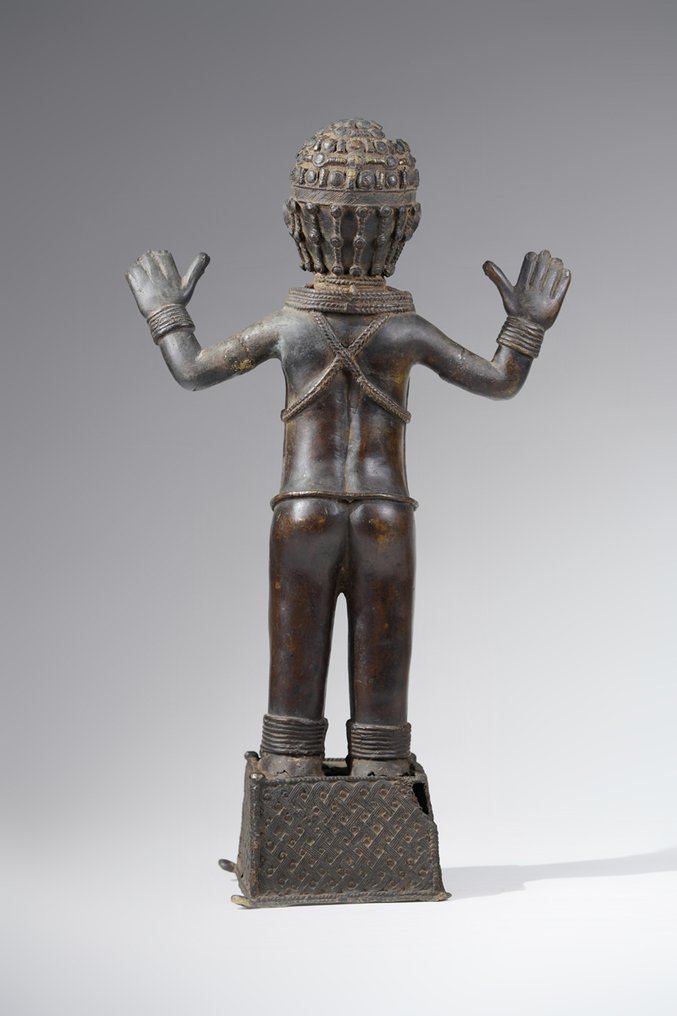
An Okhuo female Bronze sculpture, in the style of Benin, Nigeria, standing on a square plinth that is decorated with a bow and arrow, long flat feet, ankle bracelets, short legs, a necklace around the waist, a cylindrical body, a braided necklace around the neck crossing between her breasts, short arms rising towards the sky, the hands are upwards, open, she has a large rounded head composed of serene features, a closed mouth, pointed nose and two large eyes, her hair is short and composed of small lines and dots. The arms are reattached, by a later restoration, which has not the quality of the fragentary sculpture, documented in the last photo of this sequence.
"Many of these Okhuo represent young unmarried women, which we know as they are naked except for a girdle of Ekan or Ivie around their waist or hips. They would mostly likely have been maidens serving in the royal court of the Ọba or that of the Iy’Ọba.,"Source Digital Benin
The well known Okhuo female Bronze sculpture, which was restituted by the SPK (Stiftung Preußischer Kultur Besitz /Humboldtforum former Ethnological Museum Berlin, to Nigeria (Penultimate photo sequence).
The term Okhuo refers to a particular category of female bronze representations within the cultural sphere of the Benin Kingdom, most often associated with courtly contexts and the visual codification of female prestige. These sculptures typically present a mature woman whose physiognomy and adornment communicate her role within the dynastic and ritual order of the palace.
In historical terms, such bronzes belong to a corpus shaped by the guild of brasscasters (Igun Eronmwon) serving the Oba. Their formal vocabulary combines idealised anatomy with the emblematic features of Benin court style: a carefully modelled coiffure, an emphasis on the curvature of the torso, and a compositional stillness that suggests controlled dignity. Female bronzes of this type are frequently interpreted as commemorative images of titled women, palace attendants, or royal mothers whose social agency is embedded in the reproductive and ritual maintenance of kingship.
Their significance draws from the political theology of the Benin court, where women of rank participated in the cyclical renewal of authority. In this sense the Okhuo sculpture functions as a mnemonic vehicle, linking the dynastic present to an ancestral continuum. Some examples show traces of red camwood or sacrificial patina, indicating their involvement in rites of invocation or remembrance.
Stylistically, the Okhuo bronzes reveal a tension between iconic fixity and subtle naturalism. The sculptural modelling of the eyelids, lips and chin recalls the canonical forms that matured between the sixteenth and eighteenth centuries, yet the articulation of jewellery and cloth registers the specific status of an individual whose ceremonial appearance would have been defined by palace sumptuary regulations.
Comparable works preserved in museum collections indicate that these sculptures served as part of larger assemblages placed on ancestral altars. Their function was therefore simultaneously devotional and historiographic, preserving the presence of significant women whose authority or motherhood contributed to the transmission of royal legitimacy.
Comparable works preserved in museum collections indicate that these sculptures served as part of larger assemblages placed on ancestral altars. Their function was therefore simultaneously devotional and historiographic, preserving the presence of significant women whose authority or motherhood contributed to the transmission of royal legitimacy.
The interpretation of Okhuo bronzes has been informed by early colonial records as well as later ethnographic testimonies, though these must be approached critically due to their fragmentary character. Scholarly analysis has repeatedly emphasised the intimate connection between feminine prestige and the metaphysical structure of monarchy in Benin, with the bronze medium itself underscoring permanence and dynastic endurance.
Fragmentary female bronzes attributable specifically to a named type such as “Okhuo female bronze” are uncommon in the online catalogues of major museums; images that do appear are more often single dealer records or aggregated catalogue entries for damaged masks or partial castings.²
If you wish I will: provide high-resolution catalogue entries (downloadable pages) for specific fragmentary objects found in dealer or institutional records; compile a short checklist of institutions that hold fragmentary Benin bronzes (with direct catalogue references); or search museum collection databases for particular object numbers or provenances.
Fragmentary Bronze sculpture in the style of Tada, former Wolfgang Jaenicke collection (last photo sequence).
CAB22038
"I believe that the import of all art objects from Africa—whether copies or originals—should be prohibited to protect Africa." Quote: Prof. Dr. Viola König, former director of the Ethnological Museum of Berlin, now HUMBOLDTFORUM
Legal Framework
Under the 1970 UNESCO Convention in combination with the Kulturgutschutz Gesetz (KGSG) any claim for the restitution of cultural property becomes time-barred three years after the competent authorities of the State of origin obtain knowledge of the object’s location and the identity of its possessor.
All bronzes and terracotta items offered have been publicly exhibited in Wolfgang Jaenicke Gallery since 2001. Organisations such as DIGITAL BENIN and academic institutions such as the Technical University of Berlin, which have been intensively involved in restitution-reseaches (translocation-project) over the past seven years, are aware of our work, have inspected large parts of our collection and have visited us in our dependance in Lomé, Togo, among other places, to learn about the international Art trade on site. Furthermore, the National Commission for Museums and Monuments (NCMM) in Abuja, Nigeria, has been informed about our collection. In no case in the past have there been restitution claims against private institutions such as the Wolfgang Jaenicke Gallery
Our Gallery addresses these structural challenges through a policy of maximum transparency and documentation. Should any questions or uncertainties arise, we invite you to contact us. Each matter will be reviewed diligently using all available resources.
Seller's Story
For over twenty-five years, Wolfgang Jaenicke has been active as a collector and, for the past two decades, as a specialist dealer in African art, with a particular focus on material often subsumed under the term “Tribal Art”. His early engagement with cultural history was shaped by his father’s extensive archive on the former “German Colonies”, a collection of documents, publications and artefacts that introduced him to the evidentiary and historical significance of objects at a young age.
Jaenicke pursued studies in ethnology, art history and comparative law at the Freie Universität Berlin. Motivated by an interest in cultural dynamics beyond the limitations of academic formalism, he left the university to undertake extended research and travel in West and Central Africa. His fieldwork and professional activities took him through Cameroon, Mali, Côte d’Ivoire, Burkina Faso, Togo and Ghana, establishing long-term relationships with artists, collectors, researchers and local institutions.
From 2002 to 2012 he lived primarily in Mali, based in Bamako and Ségou. During this period he directed Tribalartforum, a gallery housed in a historic colonial building overlooking the Ségou harbour. The gallery became a notable site for contemporary and historical cultural production, hosting exhibitions of Bamana sculpture and ceramics, as well as photographic works including those of Malick Sidibé, whose images of the 1970s youth culture in Mali remain internationally influential. The outbreak of the war in Mali in 2012 necessitated the closure of the gallery.
Following his departure from Mali, Jaenicke established his base of operations in Lomé, Togo, where he and his partners maintain a permanent branch. The Jaenicke-Njoya GmbH, founded sixteen years earlier, serves as the organisational and legal framework for these activities. In 2018, the Galerie Wolfgang Jaenicke opened its Berlin location opposite Charlottenburg Palace, operating today with a team of approximately twelve specialists.
A significant focus of the gallery’s curatorial and research work lies in West African bronzes and terracotta. As part of ongoing efforts toward transparency and precise cultural documentation, Jaenicke collaborated with the Technische Universität Berlin’s “Translocation Project”, contributing insight into the circulation of archaeological and ethnographic objects within the international art trade in Lomé. The gallery maintains continuous dialogue with national museums across West Africa and regularly publishes updates on its activities in Lomé and Berlin via its website: wolfgang-jaenicke
Jaenicke’s practice combines long-term field engagement with a commitment to provenance research, museum-level documentation, and the ethical stewardship of cultural heritage. His work continues to bridge local knowledge networks and international scholarly discourse.
An Okhuo female Bronze sculpture, in the style of Benin, Nigeria, standing on a square plinth that is decorated with a bow and arrow, long flat feet, ankle bracelets, short legs, a necklace around the waist, a cylindrical body, a braided necklace around the neck crossing between her breasts, short arms rising towards the sky, the hands are upwards, open, she has a large rounded head composed of serene features, a closed mouth, pointed nose and two large eyes, her hair is short and composed of small lines and dots. The arms are reattached, by a later restoration, which has not the quality of the fragentary sculpture, documented in the last photo of this sequence.
"Many of these Okhuo represent young unmarried women, which we know as they are naked except for a girdle of Ekan or Ivie around their waist or hips. They would mostly likely have been maidens serving in the royal court of the Ọba or that of the Iy’Ọba.,"Source Digital Benin
The well known Okhuo female Bronze sculpture, which was restituted by the SPK (Stiftung Preußischer Kultur Besitz /Humboldtforum former Ethnological Museum Berlin, to Nigeria (Penultimate photo sequence).
The term Okhuo refers to a particular category of female bronze representations within the cultural sphere of the Benin Kingdom, most often associated with courtly contexts and the visual codification of female prestige. These sculptures typically present a mature woman whose physiognomy and adornment communicate her role within the dynastic and ritual order of the palace.
In historical terms, such bronzes belong to a corpus shaped by the guild of brasscasters (Igun Eronmwon) serving the Oba. Their formal vocabulary combines idealised anatomy with the emblematic features of Benin court style: a carefully modelled coiffure, an emphasis on the curvature of the torso, and a compositional stillness that suggests controlled dignity. Female bronzes of this type are frequently interpreted as commemorative images of titled women, palace attendants, or royal mothers whose social agency is embedded in the reproductive and ritual maintenance of kingship.
Their significance draws from the political theology of the Benin court, where women of rank participated in the cyclical renewal of authority. In this sense the Okhuo sculpture functions as a mnemonic vehicle, linking the dynastic present to an ancestral continuum. Some examples show traces of red camwood or sacrificial patina, indicating their involvement in rites of invocation or remembrance.
Stylistically, the Okhuo bronzes reveal a tension between iconic fixity and subtle naturalism. The sculptural modelling of the eyelids, lips and chin recalls the canonical forms that matured between the sixteenth and eighteenth centuries, yet the articulation of jewellery and cloth registers the specific status of an individual whose ceremonial appearance would have been defined by palace sumptuary regulations.
Comparable works preserved in museum collections indicate that these sculptures served as part of larger assemblages placed on ancestral altars. Their function was therefore simultaneously devotional and historiographic, preserving the presence of significant women whose authority or motherhood contributed to the transmission of royal legitimacy.
Comparable works preserved in museum collections indicate that these sculptures served as part of larger assemblages placed on ancestral altars. Their function was therefore simultaneously devotional and historiographic, preserving the presence of significant women whose authority or motherhood contributed to the transmission of royal legitimacy.
The interpretation of Okhuo bronzes has been informed by early colonial records as well as later ethnographic testimonies, though these must be approached critically due to their fragmentary character. Scholarly analysis has repeatedly emphasised the intimate connection between feminine prestige and the metaphysical structure of monarchy in Benin, with the bronze medium itself underscoring permanence and dynastic endurance.
Fragmentary female bronzes attributable specifically to a named type such as “Okhuo female bronze” are uncommon in the online catalogues of major museums; images that do appear are more often single dealer records or aggregated catalogue entries for damaged masks or partial castings.²
If you wish I will: provide high-resolution catalogue entries (downloadable pages) for specific fragmentary objects found in dealer or institutional records; compile a short checklist of institutions that hold fragmentary Benin bronzes (with direct catalogue references); or search museum collection databases for particular object numbers or provenances.
Fragmentary Bronze sculpture in the style of Tada, former Wolfgang Jaenicke collection (last photo sequence).
CAB22038
"I believe that the import of all art objects from Africa—whether copies or originals—should be prohibited to protect Africa." Quote: Prof. Dr. Viola König, former director of the Ethnological Museum of Berlin, now HUMBOLDTFORUM
Legal Framework
Under the 1970 UNESCO Convention in combination with the Kulturgutschutz Gesetz (KGSG) any claim for the restitution of cultural property becomes time-barred three years after the competent authorities of the State of origin obtain knowledge of the object’s location and the identity of its possessor.
All bronzes and terracotta items offered have been publicly exhibited in Wolfgang Jaenicke Gallery since 2001. Organisations such as DIGITAL BENIN and academic institutions such as the Technical University of Berlin, which have been intensively involved in restitution-reseaches (translocation-project) over the past seven years, are aware of our work, have inspected large parts of our collection and have visited us in our dependance in Lomé, Togo, among other places, to learn about the international Art trade on site. Furthermore, the National Commission for Museums and Monuments (NCMM) in Abuja, Nigeria, has been informed about our collection. In no case in the past have there been restitution claims against private institutions such as the Wolfgang Jaenicke Gallery
Our Gallery addresses these structural challenges through a policy of maximum transparency and documentation. Should any questions or uncertainties arise, we invite you to contact us. Each matter will be reviewed diligently using all available resources.
Seller's Story
For over twenty-five years, Wolfgang Jaenicke has been active as a collector and, for the past two decades, as a specialist dealer in African art, with a particular focus on material often subsumed under the term “Tribal Art”. His early engagement with cultural history was shaped by his father’s extensive archive on the former “German Colonies”, a collection of documents, publications and artefacts that introduced him to the evidentiary and historical significance of objects at a young age.
Jaenicke pursued studies in ethnology, art history and comparative law at the Freie Universität Berlin. Motivated by an interest in cultural dynamics beyond the limitations of academic formalism, he left the university to undertake extended research and travel in West and Central Africa. His fieldwork and professional activities took him through Cameroon, Mali, Côte d’Ivoire, Burkina Faso, Togo and Ghana, establishing long-term relationships with artists, collectors, researchers and local institutions.
From 2002 to 2012 he lived primarily in Mali, based in Bamako and Ségou. During this period he directed Tribalartforum, a gallery housed in a historic colonial building overlooking the Ségou harbour. The gallery became a notable site for contemporary and historical cultural production, hosting exhibitions of Bamana sculpture and ceramics, as well as photographic works including those of Malick Sidibé, whose images of the 1970s youth culture in Mali remain internationally influential. The outbreak of the war in Mali in 2012 necessitated the closure of the gallery.
Following his departure from Mali, Jaenicke established his base of operations in Lomé, Togo, where he and his partners maintain a permanent branch. The Jaenicke-Njoya GmbH, founded sixteen years earlier, serves as the organisational and legal framework for these activities. In 2018, the Galerie Wolfgang Jaenicke opened its Berlin location opposite Charlottenburg Palace, operating today with a team of approximately twelve specialists.
A significant focus of the gallery’s curatorial and research work lies in West African bronzes and terracotta. As part of ongoing efforts toward transparency and precise cultural documentation, Jaenicke collaborated with the Technische Universität Berlin’s “Translocation Project”, contributing insight into the circulation of archaeological and ethnographic objects within the international art trade in Lomé. The gallery maintains continuous dialogue with national museums across West Africa and regularly publishes updates on its activities in Lomé and Berlin via its website: wolfgang-jaenicke
Jaenicke’s practice combines long-term field engagement with a commitment to provenance research, museum-level documentation, and the ethical stewardship of cultural heritage. His work continues to bridge local knowledge networks and international scholarly discourse.
Details
Indigenous object name
Okhuo
Ethnic group/ culture
Benin
Country of Origin
Nigeria
Material
Bronze
Sold with stand
No
Condition
Fair condition
Title of artwork
A bronze sculpture
Height
58 cm
Weight
7.7 kg
Sold by
GermanyVerified
protop
Rechtliche Informationen des Verkäufers
- Unternehmen:
- Jaenicke Njoya GmbH
- Repräsentant:
- Wolfgang Jaenicke
- Adresse:
- Jaenicke Njoya GmbH
Klausenerplatz 7
14059 Berlin
GERMANY - Telefonnummer:
- +493033951033
- Email:
- w.jaenicke@jaenicke-njoya.com
- USt-IdNr.:
- DE241193499
AGB
AGB des Verkäufers. Mit einem Gebot auf dieses Los akzeptieren Sie ebenfalls die AGB des Verkäufers.
Widerrufsbelehrung
- Frist: 14 Tage sowie gemäß den hier angegebenen Bedingungen
- Rücksendkosten: Käufer trägt die unmittelbaren Kosten der Rücksendung der Ware
- Vollständige Widerrufsbelehrung
