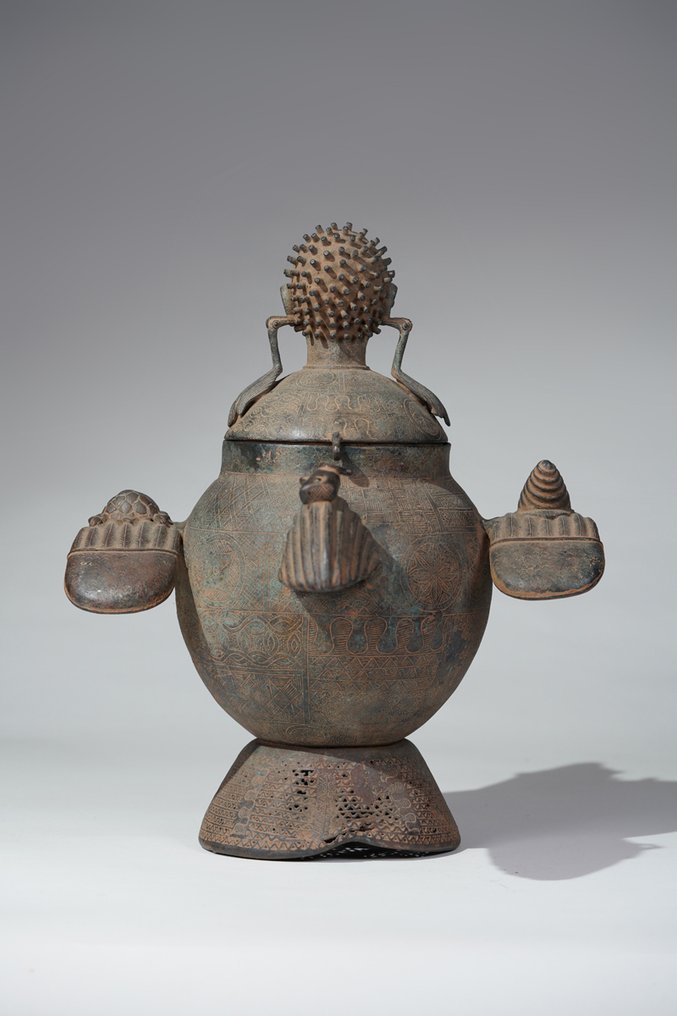
A bronze vessel - Kuduo - Akan - Ghana




05
days
20
hours
35
minutes
24
seconds
Starting bid
€ 1
Reserve price not met

Expert
Selected by Dimitri André
Holds a postgraduate degree in African studies and 15 years experience in African art.
Estimate € 1,400 - € 1,700
No bids placed
Catawiki Buyer Protection
Your payment’s safe with us until you receive your object.View details
Trustpilot 4.4 | 123327 reviews
Rated Excellent on Trustpilot.
A bronze Kuduo vessel from the Akan people of Ghana, titled “A bronze vessel,” 41 cm tall and weighing 4.7 kg, with a lid resembling a human head and in fair condition.
AI-assisted summary
Description from the seller
An Akan Kuduo vessel, in shape of a hen, Ghana, Koumasi region, with the lid of a human head, very beautiful, fine engraving work featuring geometric patterns and good condition.
Akan kuduo are cast copper-alloy vessels produced by Akan-speaking peoples of southern Ghana and southeastern Côte d’Ivoire, probably from the fifteenth to the early twentieth century. They belong to a wider corpus of Akan metalwork executed by adwumfoɔ (goldsmiths and casters) using the lost-wax (cire perdue) process. The vessels are usually cylindrical or spherical in form, fitted with lids and handles, and often feature elaborately cast reliefs, figurative motifs, or symbolic ornament.
Functionally, kuduo served as personal and ritual containers for gold dust, beads, jewelry, or other valuables. They also had ceremonial significance: during life they represented the wealth and status of their owners—chiefs, priests, and other elites—and after death they were sometimes placed in shrines or tombs as receptacles for the soul’s property (kra sika). Some were kept in royal treasuries and used in libation or purification rites.
Stylistic and technical evidence suggests that the oldest known kuduo may date to the fifteenth or sixteenth century, corresponding with the early Akan gold trade and the establishment of Bono-Manso and Begho as major centres of metallurgical production. Later examples, continuing into the nineteenth and early twentieth centuries, exhibit heavier ornamentation and a greater variety of figural motifs. Radiocarbon dating is not applicable to the metal itself, but archaeological contexts and comparisons with dated regalia indicate that the main period of kuduo production spans roughly from 1400 to 1900 CE.
The British Museum, the Metropolitan Museum of Art, and the Musée du quai Branly hold representative specimens. Scholarly studies, including those by Doran H. Ross and Tom Phillips, emphasise the vessels’ dual material and spiritual value within Akan cosmology: they embody both the visible manifestation of wealth and the metaphysical continuity between life, death, and the ancestral world.
References
Ross, Doran H., Royal Arts of the Akan (Los Angeles: Fowler Museum, 1998).
Phillips, Tom, ed., Africa: The Art of a Continent (London: Royal Academy of Arts, 1995).
Garrard, Timothy F., Gold of Africa: Jewellery and Ornaments from Ghana, Côte d’Ivoire and Mali (London: Prestel, 1989).
CAB21751
"I believe that the import of all art objects from Africa—whether copies or originals—should be prohibited to protect Africa." Quote: Prof. Dr. Viola König, former director of the Ethnological Museum of Berlin, now HUMBOLDTFORUM
Legal Framework
Under the 1970 UNESCO Convention in combination with the Kulturgutschutz Gesetz (KGSG) any claim for the restitution of cultural property becomes time-barred three years after the competent authorities of the State of origin obtain knowledge of the object’s location and the identity of its possessor.
All bronzes and terracotta items offered have been publicly exhibited in Wolfgang Jaenicke Gallery since 2001. Organisations such as DIGITAL BENIN and academic institutions such as the Technical University of Berlin, which have been intensively involved in restitution-reseaches (translocation-project) over the past seven years, are aware of our work, have inspected large parts of our collection and have visited us in our dependance in Lomé, Togo, among other places, to learn about the international Art trade on site. Furthermore, the National Commission for Museums and Monuments (NCMM) in Abuja, Nigeria, has been informed about our collection. In no case in the past have there been restitution claims against private institutions such as the Wolfgang Jaenicke Gallery
Our Gallery addresses these structural challenges through a policy of maximum transparency and documentation. Should any questions or uncertainties arise, we invite you to contact us. Each matter will be reviewed diligently using all available resources.
Seller's Story
For over twenty-five years, Wolfgang Jaenicke has been active as a collector and, for the past two decades, as a specialist dealer in African art, with a particular focus on material often subsumed under the term “Tribal Art”. His early engagement with cultural history was shaped by his father’s extensive archive on the former “German Colonies”, a collection of documents, publications and artefacts that introduced him to the evidentiary and historical significance of objects at a young age.
Jaenicke pursued studies in ethnology, art history and comparative law at the Freie Universität Berlin. Motivated by an interest in cultural dynamics beyond the limitations of academic formalism, he left the university to undertake extended research and travel in West and Central Africa. His fieldwork and professional activities took him through Cameroon, Mali, Côte d’Ivoire, Burkina Faso, Togo and Ghana, establishing long-term relationships with artists, collectors, researchers and local institutions.
From 2002 to 2012 he lived primarily in Mali, based in Bamako and Ségou. During this period he directed Tribalartforum, a gallery housed in a historic colonial building overlooking the Ségou harbour. The gallery became a notable site for contemporary and historical cultural production, hosting exhibitions of Bamana sculpture and ceramics, as well as photographic works including those of Malick Sidibé, whose images of the 1970s youth culture in Mali remain internationally influential. The outbreak of the war in Mali in 2012 necessitated the closure of the gallery.
Following his departure from Mali, Jaenicke established his base of operations in Lomé, Togo, where he and his partners maintain a permanent branch. The Jaenicke-Njoya GmbH, founded sixteen years earlier, serves as the organisational and legal framework for these activities. In 2018, the Galerie Wolfgang Jaenicke opened its Berlin location opposite Charlottenburg Palace, operating today with a team of approximately twelve specialists.
A significant focus of the gallery’s curatorial and research work lies in West African bronzes and terracotta. As part of ongoing efforts toward transparency and precise cultural documentation, Jaenicke collaborated with the Technische Universität Berlin’s “Translocation Project”, contributing insight into the circulation of archaeological and ethnographic objects within the international art trade in Lomé. The gallery maintains continuous dialogue with national museums across West Africa and regularly publishes updates on its activities in Lomé and Berlin via its website: wolfgang-jaenicke
Jaenicke’s practice combines long-term field engagement with a commitment to provenance research, museum-level documentation, and the ethical stewardship of cultural heritage. His work continues to bridge local knowledge networks and international scholarly discourse.
An Akan Kuduo vessel, in shape of a hen, Ghana, Koumasi region, with the lid of a human head, very beautiful, fine engraving work featuring geometric patterns and good condition.
Akan kuduo are cast copper-alloy vessels produced by Akan-speaking peoples of southern Ghana and southeastern Côte d’Ivoire, probably from the fifteenth to the early twentieth century. They belong to a wider corpus of Akan metalwork executed by adwumfoɔ (goldsmiths and casters) using the lost-wax (cire perdue) process. The vessels are usually cylindrical or spherical in form, fitted with lids and handles, and often feature elaborately cast reliefs, figurative motifs, or symbolic ornament.
Functionally, kuduo served as personal and ritual containers for gold dust, beads, jewelry, or other valuables. They also had ceremonial significance: during life they represented the wealth and status of their owners—chiefs, priests, and other elites—and after death they were sometimes placed in shrines or tombs as receptacles for the soul’s property (kra sika). Some were kept in royal treasuries and used in libation or purification rites.
Stylistic and technical evidence suggests that the oldest known kuduo may date to the fifteenth or sixteenth century, corresponding with the early Akan gold trade and the establishment of Bono-Manso and Begho as major centres of metallurgical production. Later examples, continuing into the nineteenth and early twentieth centuries, exhibit heavier ornamentation and a greater variety of figural motifs. Radiocarbon dating is not applicable to the metal itself, but archaeological contexts and comparisons with dated regalia indicate that the main period of kuduo production spans roughly from 1400 to 1900 CE.
The British Museum, the Metropolitan Museum of Art, and the Musée du quai Branly hold representative specimens. Scholarly studies, including those by Doran H. Ross and Tom Phillips, emphasise the vessels’ dual material and spiritual value within Akan cosmology: they embody both the visible manifestation of wealth and the metaphysical continuity between life, death, and the ancestral world.
References
Ross, Doran H., Royal Arts of the Akan (Los Angeles: Fowler Museum, 1998).
Phillips, Tom, ed., Africa: The Art of a Continent (London: Royal Academy of Arts, 1995).
Garrard, Timothy F., Gold of Africa: Jewellery and Ornaments from Ghana, Côte d’Ivoire and Mali (London: Prestel, 1989).
CAB21751
"I believe that the import of all art objects from Africa—whether copies or originals—should be prohibited to protect Africa." Quote: Prof. Dr. Viola König, former director of the Ethnological Museum of Berlin, now HUMBOLDTFORUM
Legal Framework
Under the 1970 UNESCO Convention in combination with the Kulturgutschutz Gesetz (KGSG) any claim for the restitution of cultural property becomes time-barred three years after the competent authorities of the State of origin obtain knowledge of the object’s location and the identity of its possessor.
All bronzes and terracotta items offered have been publicly exhibited in Wolfgang Jaenicke Gallery since 2001. Organisations such as DIGITAL BENIN and academic institutions such as the Technical University of Berlin, which have been intensively involved in restitution-reseaches (translocation-project) over the past seven years, are aware of our work, have inspected large parts of our collection and have visited us in our dependance in Lomé, Togo, among other places, to learn about the international Art trade on site. Furthermore, the National Commission for Museums and Monuments (NCMM) in Abuja, Nigeria, has been informed about our collection. In no case in the past have there been restitution claims against private institutions such as the Wolfgang Jaenicke Gallery
Our Gallery addresses these structural challenges through a policy of maximum transparency and documentation. Should any questions or uncertainties arise, we invite you to contact us. Each matter will be reviewed diligently using all available resources.
Seller's Story
For over twenty-five years, Wolfgang Jaenicke has been active as a collector and, for the past two decades, as a specialist dealer in African art, with a particular focus on material often subsumed under the term “Tribal Art”. His early engagement with cultural history was shaped by his father’s extensive archive on the former “German Colonies”, a collection of documents, publications and artefacts that introduced him to the evidentiary and historical significance of objects at a young age.
Jaenicke pursued studies in ethnology, art history and comparative law at the Freie Universität Berlin. Motivated by an interest in cultural dynamics beyond the limitations of academic formalism, he left the university to undertake extended research and travel in West and Central Africa. His fieldwork and professional activities took him through Cameroon, Mali, Côte d’Ivoire, Burkina Faso, Togo and Ghana, establishing long-term relationships with artists, collectors, researchers and local institutions.
From 2002 to 2012 he lived primarily in Mali, based in Bamako and Ségou. During this period he directed Tribalartforum, a gallery housed in a historic colonial building overlooking the Ségou harbour. The gallery became a notable site for contemporary and historical cultural production, hosting exhibitions of Bamana sculpture and ceramics, as well as photographic works including those of Malick Sidibé, whose images of the 1970s youth culture in Mali remain internationally influential. The outbreak of the war in Mali in 2012 necessitated the closure of the gallery.
Following his departure from Mali, Jaenicke established his base of operations in Lomé, Togo, where he and his partners maintain a permanent branch. The Jaenicke-Njoya GmbH, founded sixteen years earlier, serves as the organisational and legal framework for these activities. In 2018, the Galerie Wolfgang Jaenicke opened its Berlin location opposite Charlottenburg Palace, operating today with a team of approximately twelve specialists.
A significant focus of the gallery’s curatorial and research work lies in West African bronzes and terracotta. As part of ongoing efforts toward transparency and precise cultural documentation, Jaenicke collaborated with the Technische Universität Berlin’s “Translocation Project”, contributing insight into the circulation of archaeological and ethnographic objects within the international art trade in Lomé. The gallery maintains continuous dialogue with national museums across West Africa and regularly publishes updates on its activities in Lomé and Berlin via its website: wolfgang-jaenicke
Jaenicke’s practice combines long-term field engagement with a commitment to provenance research, museum-level documentation, and the ethical stewardship of cultural heritage. His work continues to bridge local knowledge networks and international scholarly discourse.
Details
Indigenous object name
Kuduo
Ethnic group/ culture
Akan
Country of Origin
Ghana
Material
Bronze
Sold with stand
No
Condition
Fair condition
Title of artwork
A bronze vessel
Height
41 cm
Weight
4.7 kg
Sold by
GermanyVerified
protop
Rechtliche Informationen des Verkäufers
- Unternehmen:
- Jaenicke Njoya GmbH
- Repräsentant:
- Wolfgang Jaenicke
- Adresse:
- Jaenicke Njoya GmbH
Klausenerplatz 7
14059 Berlin
GERMANY - Telefonnummer:
- +493033951033
- Email:
- w.jaenicke@jaenicke-njoya.com
- USt-IdNr.:
- DE241193499
AGB
AGB des Verkäufers. Mit einem Gebot auf dieses Los akzeptieren Sie ebenfalls die AGB des Verkäufers.
Widerrufsbelehrung
- Frist: 14 Tage sowie gemäß den hier angegebenen Bedingungen
- Rücksendkosten: Käufer trägt die unmittelbaren Kosten der Rücksendung der Ware
- Vollständige Widerrufsbelehrung
