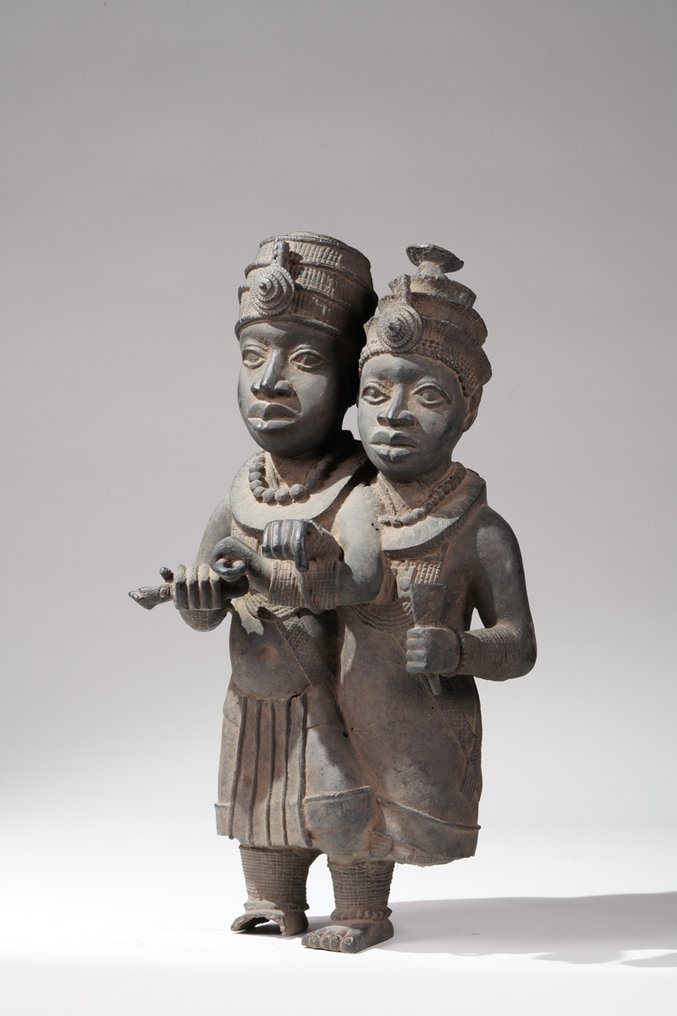
A bronze sculpture - Ife - Nigeria


06
days
10
hours
14
minutes
19
seconds
Current bid
€ 400
Reserve price not met

Expert
Selected by Dimitri André
Holds a postgraduate degree in African studies and 15 years experience in African art.
Estimate € 2,300 - € 2,800
18 other people are watching this object
 Bidder 9543 Bidder 9543 | €400 | |
|---|---|---|
| Bidder 9543 | €340 | |
 Bidder 9308 Bidder 9308 | €320 | |
Catawiki Buyer Protection
Your payment’s safe with us until you receive your object.View details
Trustpilot 4.4 | 123294 reviews
Rated Excellent on Trustpilot.
A bronze sculpture titled 'A bronze sculpture', an Ife couple from Nigeria, weighing 15.9 kg and 53 cm tall, in fair condition and sold without a stand.
AI-assisted summary
Description from the seller
A fragmentary Ife couple, one leg is missing.
Related exemplare, "Ife", Frank Willet, 1957, page 37, plate 10, with a fragmentary, similar exemplare, which was found in Ita Yemoo, 1957, backside, page 75, plate III, text on site 72,
This sculptural pair exemplifies the visual vocabulary of royal authority in Yoruba art.
The elaborate headgear identifies the male figure as the Ooni, spiritual and political leader of Ile Ife, and the female figure as the Queen Mother, a role of significant influence within Yoruba court systems. The Ooni holds a horn, a potent emblem of divine kingship, while the woman carries a stylized hand, a symbol of ritual power found throughout southern Nigerian cosmologies.
Although often interpreted as a married couple, comparative stylistic and iconographic analysis suggests a more institutional reading. Rather than emphasizing conjugal ties, the representation likely depicts the Ooni and the Queen Mother as complementary sources of authority. This interpretation is supported by the figures’ proportional equality, the symmetry in their garments, and the balanced distribution of regalia associated with rulership. Facial features mark gender distinctions, but both figures are rendered with equivalent visual weight, reinforcing the idea of parity rather than hierarchy.
A particularly distinctive motif found in the art of Ile Ife and Benin is the intertwining of limbs. While the linking of arms remains a familiar gesture of union, the interlacing of legs may appear unfamiliar to contemporary viewers. This pose does not signal physical intimacy but instead points to shared obligations and structural interdependence. The left leg of the Ooni wraps around the right leg of the female figure, symbolizing the indivisibility of their respective roles in sustaining the cosmic and political order.
Rather than a literal portrayal of kinship, the work encodes a complex worldview in which leadership is relational, gendered, and ritually balanced. The sculpture thus visualizes a system of dual sovereignty deeply embedded in Yoruba thought and practice.
In Benin art, the depiction of a son in relation to his mother often centers on the role of the Queen Mother, known as the Iyoba. The Iyoba held a prestigious position in the Kingdom of Benin, especially after her son ascended to the throne as Oba (king).
Artworks frequently honor the Iyoba for her role in giving birth to and supporting the Oba. While the son may not always be shown directly alongside the mother, his presence is implied through her elevated status and rich regalia. Bronze heads of the Iyoba, for example, portray her with elaborate coral bead headdresses and royal symbols, emphasizing her power and connection to the king.
In some plaques and carvings, smaller figures may represent the young Oba, attendants, or symbols of royal authority, reflecting the importance of the maternal bond in legitimizing kingship. The mother is not just a biological parent but a source of royal power, and Benin art uses visual language
"The question of fundamental dating - still one of the main questions of Benin research - Wolf approaches, however, always very carefully and with respect. He makes it clear that must remain open, whether his cognition actually" solid clues to the individual by no means completed dating of the Bronzes. "Sylvia Dolz, Treasures of Africa / Benin, the donation Baessler, Museum of Ethnology Dresden, 2006, page 13.
The cited Siegfried Wolf was a scientist and ethnologist, Sylvia Dolz argues according of this point of view that neither a natural sciences (especially TL and metallurgical analysis) nor an art-historical / stylistic method alone lead to useful results in terms of age determination. Only a combination of several reviews can lead to useful results. This is the prevailing opinion in science and literature, one might also call it the opinion of those who prevail. The future will show which opinion will prevail.
Non-binding TL analysis 310 years,+/- 24,3 %
In the last 15 years we have sold two similar exemplares with different stylistic features, one on the Ife and Benin exhibition six years ago, obviously from the same artist. This exemplare was exhibited on our exhibition 2019 (last photo sequence).
Seller's Story
For over twenty-five years, Wolfgang Jaenicke has been active as a collector and, for the past two decades, as a specialist dealer in African art, with a particular focus on material often subsumed under the term “Tribal Art”. His early engagement with cultural history was shaped by his father’s extensive archive on the former “German Colonies”, a collection of documents, publications and artefacts that introduced him to the evidentiary and historical significance of objects at a young age.
Jaenicke pursued studies in ethnology, art history and comparative law at the Freie Universität Berlin. Motivated by an interest in cultural dynamics beyond the limitations of academic formalism, he left the university to undertake extended research and travel in West and Central Africa. His fieldwork and professional activities took him through Cameroon, Mali, Côte d’Ivoire, Burkina Faso, Togo and Ghana, establishing long-term relationships with artists, collectors, researchers and local institutions.
From 2002 to 2012 he lived primarily in Mali, based in Bamako and Ségou. During this period he directed Tribalartforum, a gallery housed in a historic colonial building overlooking the Ségou harbour. The gallery became a notable site for contemporary and historical cultural production, hosting exhibitions of Bamana sculpture and ceramics, as well as photographic works including those of Malick Sidibé, whose images of the 1970s youth culture in Mali remain internationally influential. The outbreak of the war in Mali in 2012 necessitated the closure of the gallery.
Following his departure from Mali, Jaenicke established his base of operations in Lomé, Togo, where he and his partners maintain a permanent branch. The Jaenicke-Njoya GmbH, founded sixteen years earlier, serves as the organisational and legal framework for these activities. In 2018, the Galerie Wolfgang Jaenicke opened its Berlin location opposite Charlottenburg Palace, operating today with a team of approximately twelve specialists.
A significant focus of the gallery’s curatorial and research work lies in West African bronzes and terracotta. As part of ongoing efforts toward transparency and precise cultural documentation, Jaenicke collaborated with the Technische Universität Berlin’s “Translocation Project”, contributing insight into the circulation of archaeological and ethnographic objects within the international art trade in Lomé. The gallery maintains continuous dialogue with national museums across West Africa and regularly publishes updates on its activities in Lomé and Berlin via its website: wolfgang-jaenicke
Jaenicke’s practice combines long-term field engagement with a commitment to provenance research, museum-level documentation, and the ethical stewardship of cultural heritage. His work continues to bridge local knowledge networks and international scholarly discourse.
A fragmentary Ife couple, one leg is missing.
Related exemplare, "Ife", Frank Willet, 1957, page 37, plate 10, with a fragmentary, similar exemplare, which was found in Ita Yemoo, 1957, backside, page 75, plate III, text on site 72,
This sculptural pair exemplifies the visual vocabulary of royal authority in Yoruba art.
The elaborate headgear identifies the male figure as the Ooni, spiritual and political leader of Ile Ife, and the female figure as the Queen Mother, a role of significant influence within Yoruba court systems. The Ooni holds a horn, a potent emblem of divine kingship, while the woman carries a stylized hand, a symbol of ritual power found throughout southern Nigerian cosmologies.
Although often interpreted as a married couple, comparative stylistic and iconographic analysis suggests a more institutional reading. Rather than emphasizing conjugal ties, the representation likely depicts the Ooni and the Queen Mother as complementary sources of authority. This interpretation is supported by the figures’ proportional equality, the symmetry in their garments, and the balanced distribution of regalia associated with rulership. Facial features mark gender distinctions, but both figures are rendered with equivalent visual weight, reinforcing the idea of parity rather than hierarchy.
A particularly distinctive motif found in the art of Ile Ife and Benin is the intertwining of limbs. While the linking of arms remains a familiar gesture of union, the interlacing of legs may appear unfamiliar to contemporary viewers. This pose does not signal physical intimacy but instead points to shared obligations and structural interdependence. The left leg of the Ooni wraps around the right leg of the female figure, symbolizing the indivisibility of their respective roles in sustaining the cosmic and political order.
Rather than a literal portrayal of kinship, the work encodes a complex worldview in which leadership is relational, gendered, and ritually balanced. The sculpture thus visualizes a system of dual sovereignty deeply embedded in Yoruba thought and practice.
In Benin art, the depiction of a son in relation to his mother often centers on the role of the Queen Mother, known as the Iyoba. The Iyoba held a prestigious position in the Kingdom of Benin, especially after her son ascended to the throne as Oba (king).
Artworks frequently honor the Iyoba for her role in giving birth to and supporting the Oba. While the son may not always be shown directly alongside the mother, his presence is implied through her elevated status and rich regalia. Bronze heads of the Iyoba, for example, portray her with elaborate coral bead headdresses and royal symbols, emphasizing her power and connection to the king.
In some plaques and carvings, smaller figures may represent the young Oba, attendants, or symbols of royal authority, reflecting the importance of the maternal bond in legitimizing kingship. The mother is not just a biological parent but a source of royal power, and Benin art uses visual language
"The question of fundamental dating - still one of the main questions of Benin research - Wolf approaches, however, always very carefully and with respect. He makes it clear that must remain open, whether his cognition actually" solid clues to the individual by no means completed dating of the Bronzes. "Sylvia Dolz, Treasures of Africa / Benin, the donation Baessler, Museum of Ethnology Dresden, 2006, page 13.
The cited Siegfried Wolf was a scientist and ethnologist, Sylvia Dolz argues according of this point of view that neither a natural sciences (especially TL and metallurgical analysis) nor an art-historical / stylistic method alone lead to useful results in terms of age determination. Only a combination of several reviews can lead to useful results. This is the prevailing opinion in science and literature, one might also call it the opinion of those who prevail. The future will show which opinion will prevail.
Non-binding TL analysis 310 years,+/- 24,3 %
In the last 15 years we have sold two similar exemplares with different stylistic features, one on the Ife and Benin exhibition six years ago, obviously from the same artist. This exemplare was exhibited on our exhibition 2019 (last photo sequence).
Seller's Story
For over twenty-five years, Wolfgang Jaenicke has been active as a collector and, for the past two decades, as a specialist dealer in African art, with a particular focus on material often subsumed under the term “Tribal Art”. His early engagement with cultural history was shaped by his father’s extensive archive on the former “German Colonies”, a collection of documents, publications and artefacts that introduced him to the evidentiary and historical significance of objects at a young age.
Jaenicke pursued studies in ethnology, art history and comparative law at the Freie Universität Berlin. Motivated by an interest in cultural dynamics beyond the limitations of academic formalism, he left the university to undertake extended research and travel in West and Central Africa. His fieldwork and professional activities took him through Cameroon, Mali, Côte d’Ivoire, Burkina Faso, Togo and Ghana, establishing long-term relationships with artists, collectors, researchers and local institutions.
From 2002 to 2012 he lived primarily in Mali, based in Bamako and Ségou. During this period he directed Tribalartforum, a gallery housed in a historic colonial building overlooking the Ségou harbour. The gallery became a notable site for contemporary and historical cultural production, hosting exhibitions of Bamana sculpture and ceramics, as well as photographic works including those of Malick Sidibé, whose images of the 1970s youth culture in Mali remain internationally influential. The outbreak of the war in Mali in 2012 necessitated the closure of the gallery.
Following his departure from Mali, Jaenicke established his base of operations in Lomé, Togo, where he and his partners maintain a permanent branch. The Jaenicke-Njoya GmbH, founded sixteen years earlier, serves as the organisational and legal framework for these activities. In 2018, the Galerie Wolfgang Jaenicke opened its Berlin location opposite Charlottenburg Palace, operating today with a team of approximately twelve specialists.
A significant focus of the gallery’s curatorial and research work lies in West African bronzes and terracotta. As part of ongoing efforts toward transparency and precise cultural documentation, Jaenicke collaborated with the Technische Universität Berlin’s “Translocation Project”, contributing insight into the circulation of archaeological and ethnographic objects within the international art trade in Lomé. The gallery maintains continuous dialogue with national museums across West Africa and regularly publishes updates on its activities in Lomé and Berlin via its website: wolfgang-jaenicke
Jaenicke’s practice combines long-term field engagement with a commitment to provenance research, museum-level documentation, and the ethical stewardship of cultural heritage. His work continues to bridge local knowledge networks and international scholarly discourse.
Details
Ethnic group/ culture
Ife
Country of Origin
Nigeria
Material
Bronze
Sold with stand
No
Condition
Fair condition
Title of artwork
A bronze sculpture
Height
53 cm
Weight
15.9 kg
Sold by
GermanyVerified
protop
Rechtliche Informationen des Verkäufers
- Unternehmen:
- Jaenicke Njoya GmbH
- Repräsentant:
- Wolfgang Jaenicke
- Adresse:
- Jaenicke Njoya GmbH
Klausenerplatz 7
14059 Berlin
GERMANY - Telefonnummer:
- +493033951033
- Email:
- w.jaenicke@jaenicke-njoya.com
- USt-IdNr.:
- DE241193499
AGB
AGB des Verkäufers. Mit einem Gebot auf dieses Los akzeptieren Sie ebenfalls die AGB des Verkäufers.
Widerrufsbelehrung
- Frist: 14 Tage sowie gemäß den hier angegebenen Bedingungen
- Rücksendkosten: Käufer trägt die unmittelbaren Kosten der Rücksendung der Ware
- Vollständige Widerrufsbelehrung
