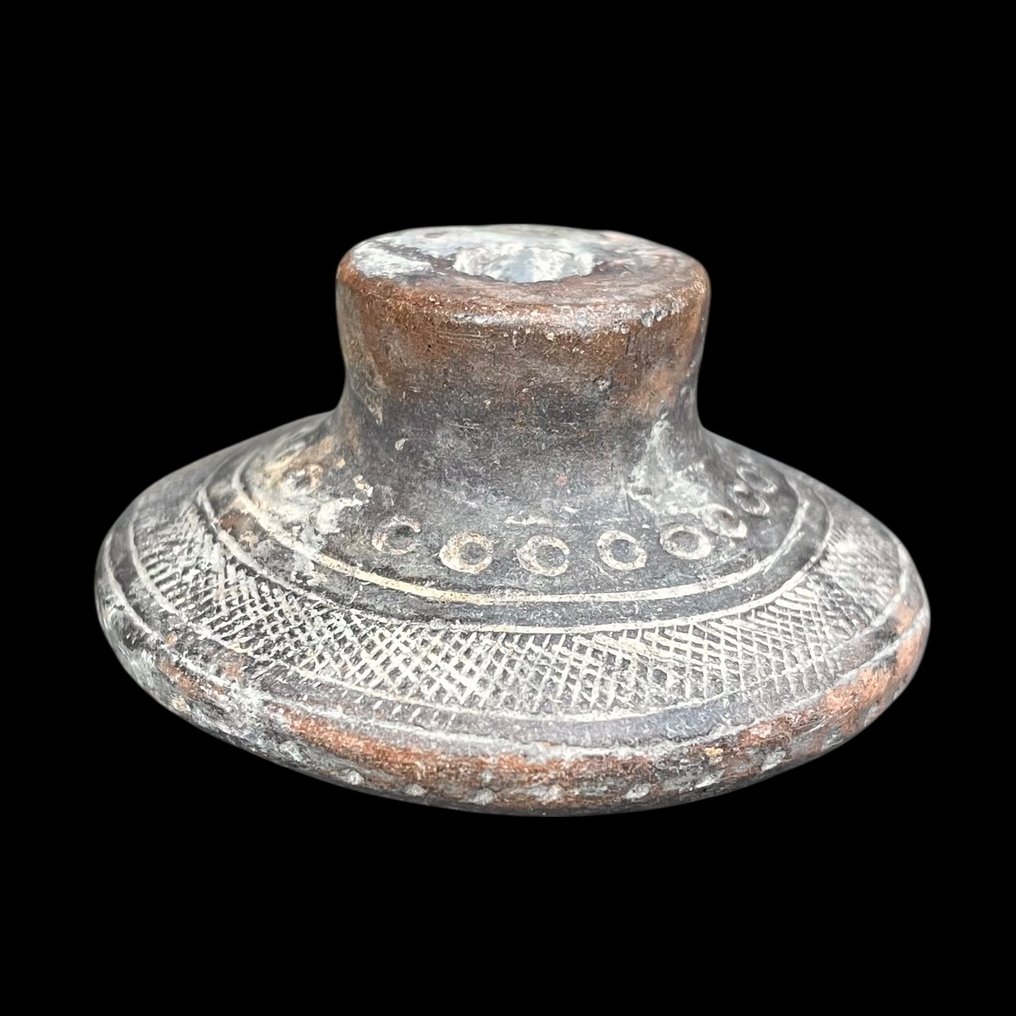
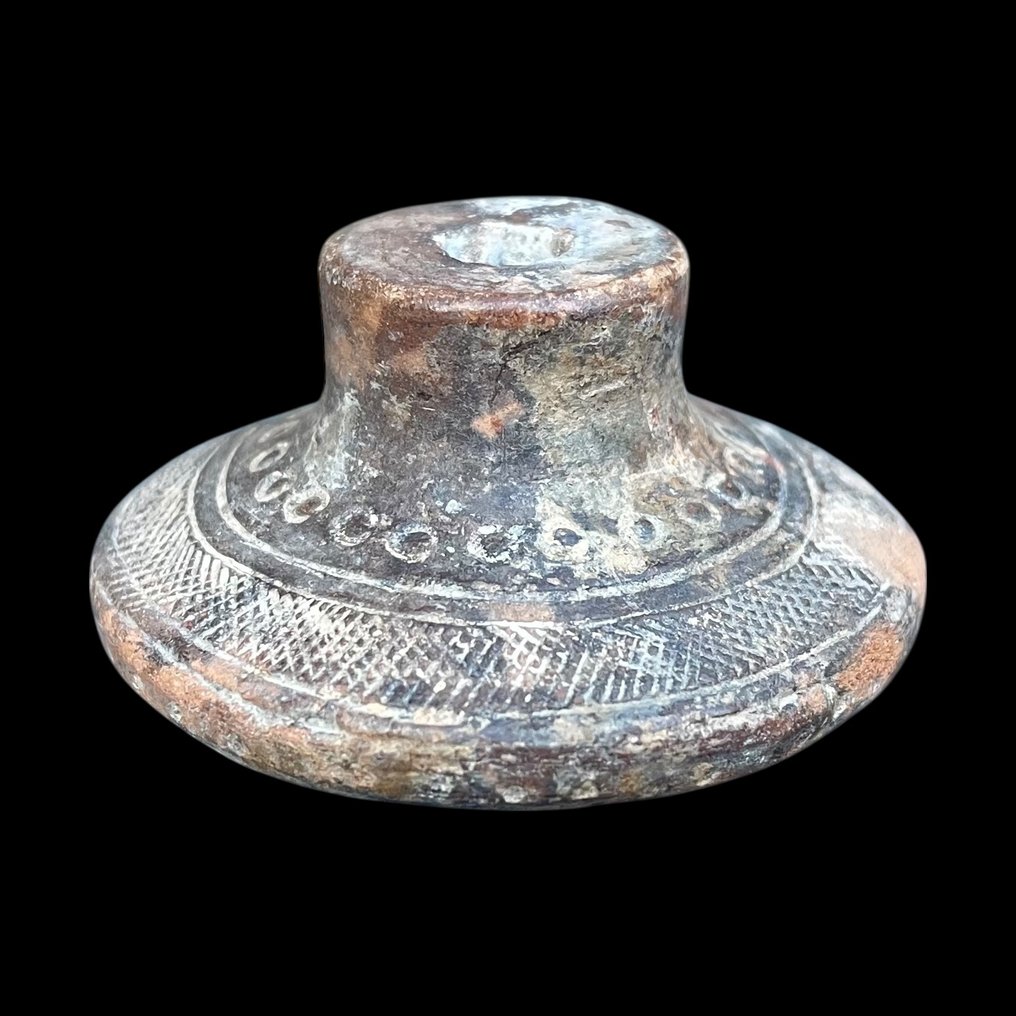
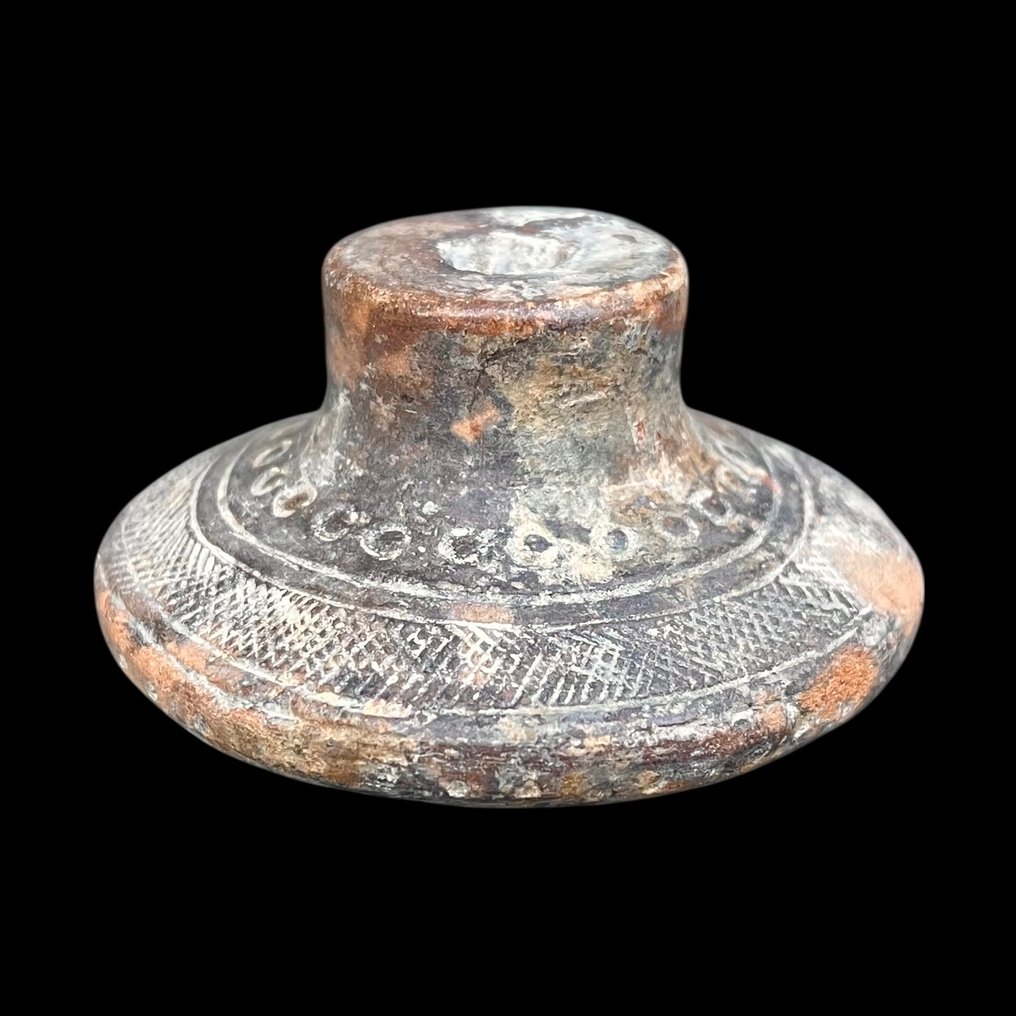
Pre-Columbian Malacate Terracotta Spindle of hoist - 25 mm (No reserve price)


02
days
13
hours
38
minutes
01
second
Current bid
€ 30
No reserve price

Expert
Selected by Ruth Garrido Vila
Directed the Ifergan Collection Museum, specialising in Phoenician and Mediterranean archaeology.
Estimate € 200 - € 250
20 other people are watching this object
 Bidder 9427 Bidder 9427 | €30 | |
|---|---|---|
 Bidder 1567 Bidder 1567 | €21 | |
| Bidder 2572 | €20 | |
Catawiki Buyer Protection
Your payment’s safe with us until you receive your object.View details
Trustpilot 4.4 | 123779 reviews
Rated Excellent on Trustpilot.
Terracotta pre-Columbian spinstone (malacate) dating to the 4th–7th century CE, 25 × 49 mm, in excellent condition, acquired in 2024 from a gallery dealer in the Netherlands and previously owned from 1986, with incised decorative details.
AI-assisted summary
Description from the seller
This object is a precolumbian spindle whorl (also called a spindelkrans or malacate), an archaeological artifact used by indigenous cultures in America for spinning textile fibers before the Europeans arrived.
Dimensions: 39 x 25 mm
Pre-Columbian culture, dating from approximately the 4th to the 7th century CE.
Spinels are frequently found in archaeological excavations in regions such as Mexico (including the Aztecs and Maya) and the Andes (including the Quimbaya and Incas). They are often discovered in graves, indicating the significant status of textile production in these societies, often associated with female identity.
Function and Use
Flywheel: The spinstone served as a weight on the top or bottom of a wooden spinning top.
Rotation: Due to the weight, the spindle kept spinning longer and more evenly, allowing fibers such as cotton, wool (from alpaca or llama), or maguey fibers to be twisted into a strong thread.
Wire gauge: The weight and size of the stone determined the type of wire; light spinning stones were often used for fine fibers like cotton, while heavier specimens were used for stiffer fibers.
Features
Material and style: This particular example is made of terracotta and features detailed, carved decorations. Sometimes, these spindle stones were also made from stone, bone, or wood.
Shape: Often disk-shaped, conical, or spherical with a hole in the middle for the spindle.
Decoration: Many pre-Columbian spinstones are richly decorated with incisions, stamps, or geometric motifs. These decorations sometimes held symbolic meaning or served as marks of ownership.
Cultural significance: Such decorated spinning disks highlight the importance of textile production and craftsmanship in ancient societies.
Shipping method: this lot is excellently packaged and shipped via DHL using Catawiki's smart shipping.
This object is a precolumbian spindle whorl (also called a spindelkrans or malacate), an archaeological artifact used by indigenous cultures in America for spinning textile fibers before the Europeans arrived.
Dimensions: 39 x 25 mm
Pre-Columbian culture, dating from approximately the 4th to the 7th century CE.
Spinels are frequently found in archaeological excavations in regions such as Mexico (including the Aztecs and Maya) and the Andes (including the Quimbaya and Incas). They are often discovered in graves, indicating the significant status of textile production in these societies, often associated with female identity.
Function and Use
Flywheel: The spinstone served as a weight on the top or bottom of a wooden spinning top.
Rotation: Due to the weight, the spindle kept spinning longer and more evenly, allowing fibers such as cotton, wool (from alpaca or llama), or maguey fibers to be twisted into a strong thread.
Wire gauge: The weight and size of the stone determined the type of wire; light spinning stones were often used for fine fibers like cotton, while heavier specimens were used for stiffer fibers.
Features
Material and style: This particular example is made of terracotta and features detailed, carved decorations. Sometimes, these spindle stones were also made from stone, bone, or wood.
Shape: Often disk-shaped, conical, or spherical with a hole in the middle for the spindle.
Decoration: Many pre-Columbian spinstones are richly decorated with incisions, stamps, or geometric motifs. These decorations sometimes held symbolic meaning or served as marks of ownership.
Cultural significance: Such decorated spinning disks highlight the importance of textile production and craftsmanship in ancient societies.
Shipping method: this lot is excellently packaged and shipped via DHL using Catawiki's smart shipping.
Details
Culture
Pre-Columbian Malacate
Century/ Timeframe
4e t/m 7e eeuw
Name of object
Spindle of hoist
Acquired from
Gallery / Antique dealer
Year acquired
2024
Material
Terracotta
Country acquired from
Netherlands
Condition
Excellent
Previous owner acquired from
Inherited
Height
25 mm
Previous owner - year acquired
1986
Width
49 mm
Previous owner - country acquired from
Netherlands
I verify that I have obtained this object legally and that I am allowed to sell it
Yes
Sold by
Disclaimer
The seller was informed by Catawiki about documentation requirements and guarantees the following: - the object was legally obtained, - the seller has the right to sell and/or export the object, as relevant, - the seller will provide the necessary provenance information and arrange required documentation and permits/licenses, as applicable and as per local laws, - the seller will notify the buyer of any delays in obtaining permits/licenses. By bidding, you acknowledge that import documentation may be required depending on your country of residence and that obtaining permits/licenses may cause delays in the delivery of your object.
The seller was informed by Catawiki about documentation requirements and guarantees the following: - the object was legally obtained, - the seller has the right to sell and/or export the object, as relevant, - the seller will provide the necessary provenance information and arrange required documentation and permits/licenses, as applicable and as per local laws, - the seller will notify the buyer of any delays in obtaining permits/licenses. By bidding, you acknowledge that import documentation may be required depending on your country of residence and that obtaining permits/licenses may cause delays in the delivery of your object.
