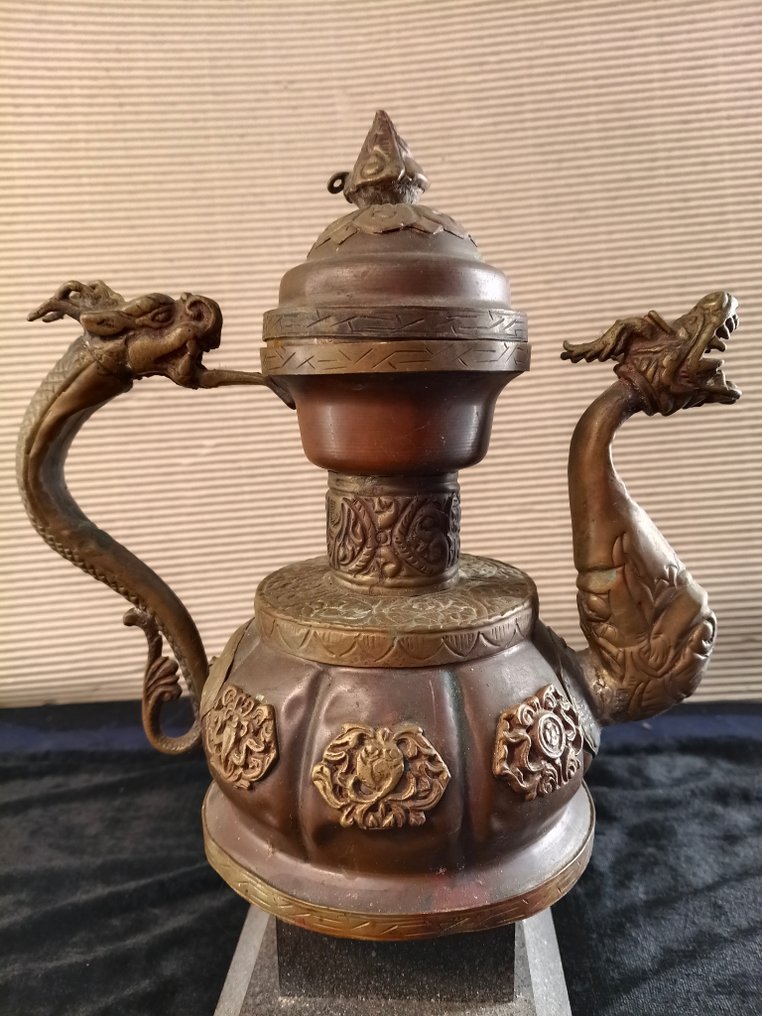
Teapot - Copper, Patinated bronze - Nepal - Kathmandu Valley

Opens Friday
Starting bid
€ 1
Add to your favourites to get an alert when the auction starts.

Expert
Selected by Amy Wassing
Nearly 20 years' experience in Indonesian and Oceanian art with museum expertise.
Estimate € 160 - € 200
Catawiki Buyer Protection
Your payment’s safe with us until you receive your object.View details
Trustpilot 4.4 | 123332 reviews
Rated Excellent on Trustpilot.
Description from the seller
Tibetan Ritual Teapot in Copper, Smashed and Chased with the Eight Auspicious Symbols (Ashtamangala) - second half of the 20th century or earlier.
Refined Tibetan ritual teapot in hammered and hand-engraved copper, crafted according to Himalayan-Buddhist artisanal tradition. (Kathmandu Valley style)
The object represents an excellent example of the fusion of functionality and iconographic meaning, combining traditional craftsmanship mastery with rich religious symbolism.
The spherical shape is completely decorated using repoussé and chasing techniques.
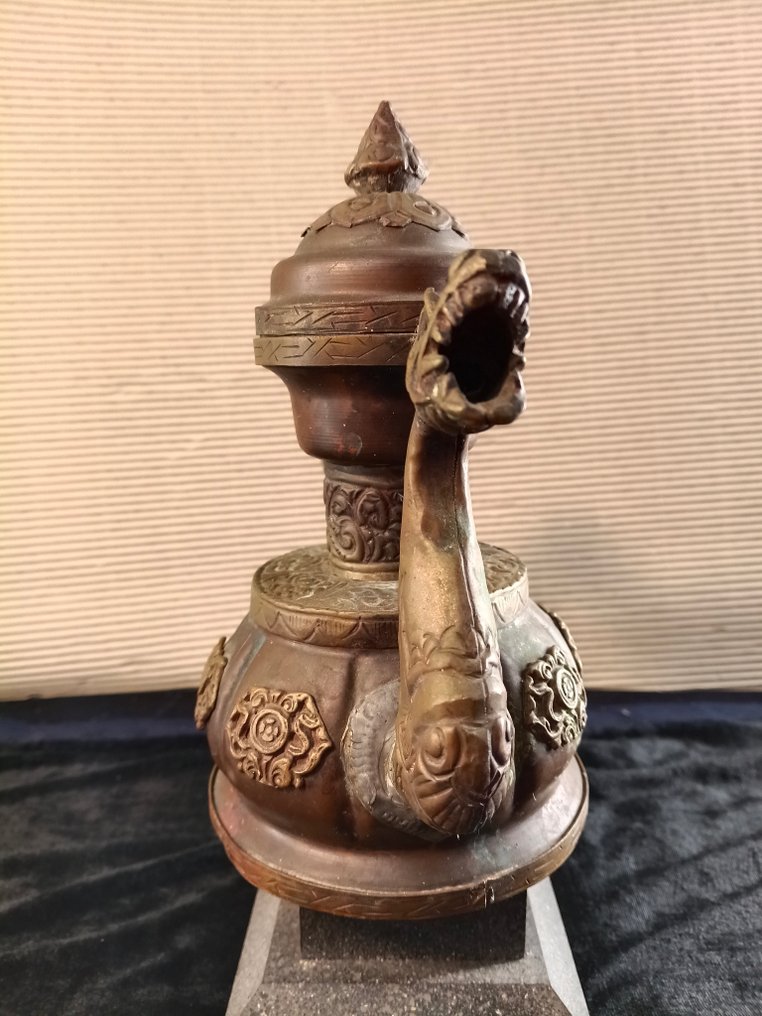
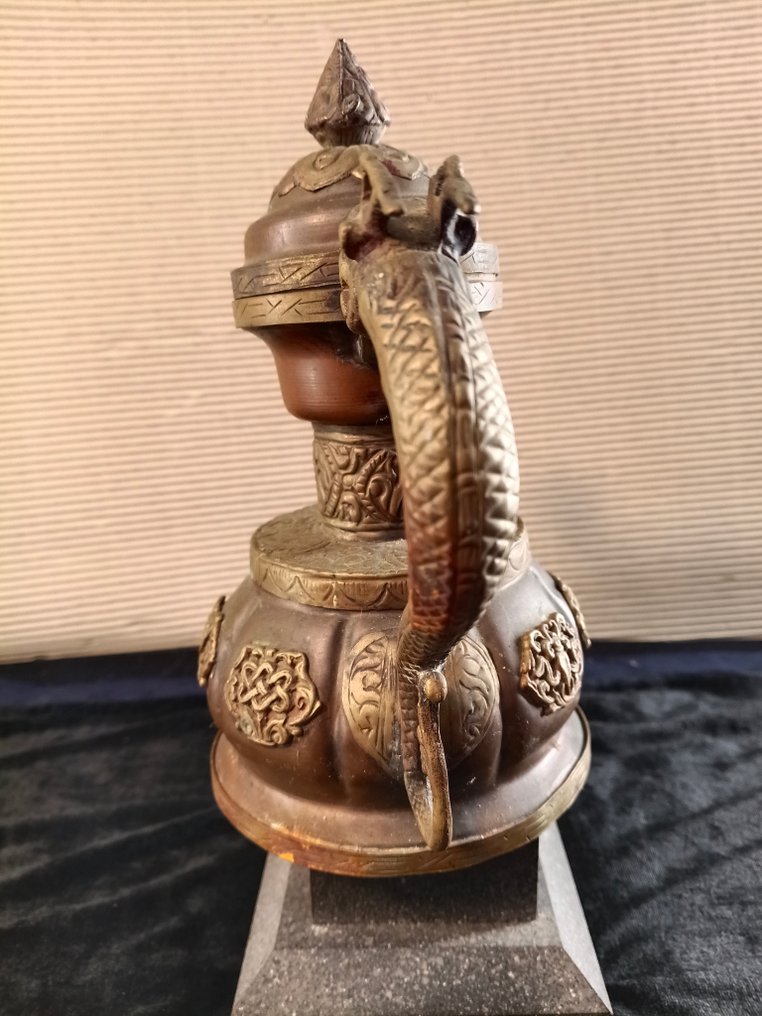
The Eight Auspicious Symbols of Buddhism (Ashtamangala - संस्कृत: अष्टमंगल) are relief applications around the body, created through lost wax casting and then assembled.
These symbols (Canopy, Golden Fish, Treasure Vase, Lotus Flower, White Shell, Infinite Knot) represent fundamental spiritual qualities in Tibetan Buddhist tradition and ensure protection, prosperity, and spiritual enlightenment.
Decorative ornaments present include stylized floral motifs in relief on the lower central area, geometric chevron engravings on the central band, continuous decorative borders with linear patterns, and uniform embossments creating a three-dimensional effect on the surface.
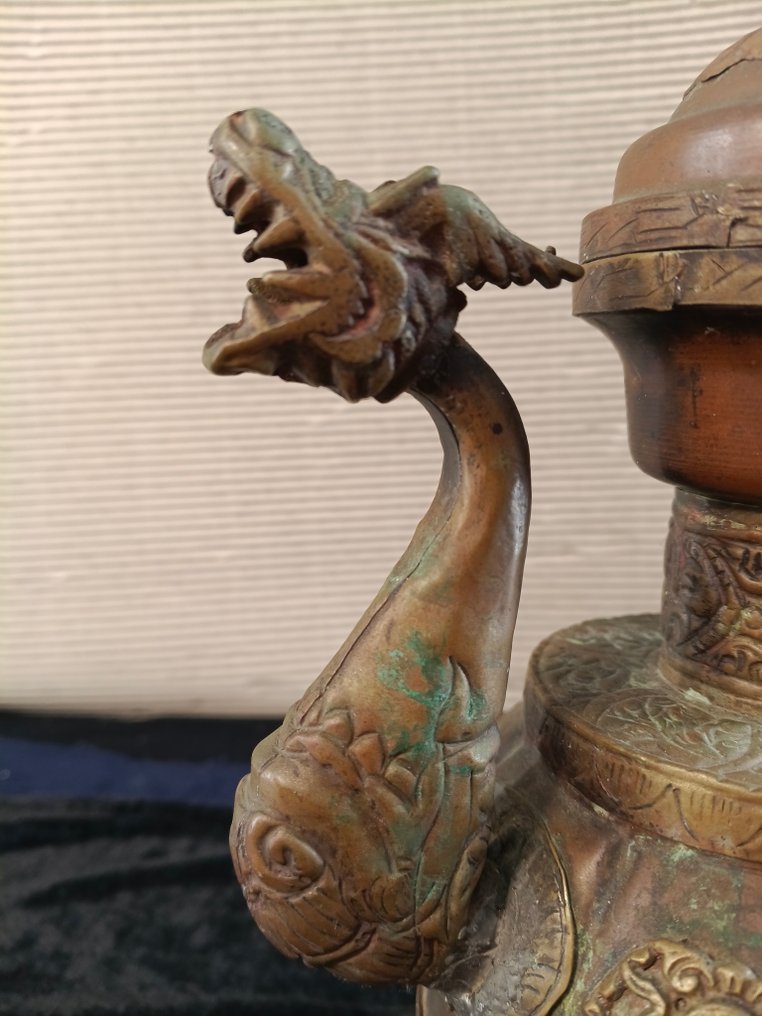
Interesting and highly decorative, the elegant serpent-shaped handle ends with a carved head of a mythological creature (a dragon or a Buddhist lion with characteristics of Makara).
The pouring spout is integrated into the structure with the same artisanal craftsmanship as the handle.
The hemispherical dome lid features a pointed pyramidal terminal, a decorative horizontal band with geometric engravings, and an ornamental connecting ring.
The pedestal has a cylindrical structure richly chiseled with embossed floral motifs.
Circular base with decorative edging. Elegant transition achieved through concentric rings.
Beautiful natural oxidation patina that indicates the authenticity and age of the object.
No invasive restoration. Brownish-copper coloration with golden and greenish hues due to the natural aging process.
In Buddhist iconography, the object incorporates six of the Eight Auspicious Symbols (Ashtamangala):
Parasol (Chattra) - Spiritual protection and royal dignity
Golden Fish (Gaur-matsya) - Freedom in suffering and abundance
Treasure Vase (Kalasha) - Wealth and spiritual prosperity
Lotus Flower (Padma) - Original purity and enlightenment
White Conch (Śaṅkha) - Proclamation of the Dharma
Infinite Node (Śrīvatsa) - Interconnection of wisdom and compassion
This configuration gives the object a significant liturgical and apotropaic value within the context of Tibetan Buddhist practice.
So, the object has been able to serve as:
Recipient for offerings in Buddhist ceremonies
Ceremonial teapot for tea in Tibetan court contexts.
Votive object for ritual worship
Symbols of wealth and status within traditional Tibetan society.
Luxury container for domestic use in high-ranking families.
Summarizing, its craftsmanship and authenticity are evidenced by:
Complete manual processing (embossing, chasing, lost wax casting)
No industrial or mechanical trademark.
Proportions and symmetry are characteristic features of the period.
Genuine natural patina
Handcrafted assembly visible in the craftsmanship details.
Weight and density consistent with pure copper used in the 19th and 20th centuries.
Measurement: Height 22.5 cm. Largest diameter 12.8 cm. Total width including handle and spout 22.5 cm. Total weight 710 g.
Provenance: 'Galleria Fant'Asia' Torino - circa 1980. Private collection of the gallery owner.
Quickly, very well packaged with styrofoam and/or bubble wrap, and shipped with tracking and insurance with the best shipping agencies.
The shipping cost includes shipment tracking, packaging material, and insurance for the artwork.
Due to customs and duties issues, we do not ship to the U.S.A.
Tibetan Ritual Teapot in Copper, Smashed and Chased with the Eight Auspicious Symbols (Ashtamangala) - second half of the 20th century or earlier.
Refined Tibetan ritual teapot in hammered and hand-engraved copper, crafted according to Himalayan-Buddhist artisanal tradition. (Kathmandu Valley style)
The object represents an excellent example of the fusion of functionality and iconographic meaning, combining traditional craftsmanship mastery with rich religious symbolism.
The spherical shape is completely decorated using repoussé and chasing techniques.
The Eight Auspicious Symbols of Buddhism (Ashtamangala - संस्कृत: अष्टमंगल) are relief applications around the body, created through lost wax casting and then assembled.
These symbols (Canopy, Golden Fish, Treasure Vase, Lotus Flower, White Shell, Infinite Knot) represent fundamental spiritual qualities in Tibetan Buddhist tradition and ensure protection, prosperity, and spiritual enlightenment.
Decorative ornaments present include stylized floral motifs in relief on the lower central area, geometric chevron engravings on the central band, continuous decorative borders with linear patterns, and uniform embossments creating a three-dimensional effect on the surface.
Interesting and highly decorative, the elegant serpent-shaped handle ends with a carved head of a mythological creature (a dragon or a Buddhist lion with characteristics of Makara).
The pouring spout is integrated into the structure with the same artisanal craftsmanship as the handle.
The hemispherical dome lid features a pointed pyramidal terminal, a decorative horizontal band with geometric engravings, and an ornamental connecting ring.
The pedestal has a cylindrical structure richly chiseled with embossed floral motifs.
Circular base with decorative edging. Elegant transition achieved through concentric rings.
Beautiful natural oxidation patina that indicates the authenticity and age of the object.
No invasive restoration. Brownish-copper coloration with golden and greenish hues due to the natural aging process.
In Buddhist iconography, the object incorporates six of the Eight Auspicious Symbols (Ashtamangala):
Parasol (Chattra) - Spiritual protection and royal dignity
Golden Fish (Gaur-matsya) - Freedom in suffering and abundance
Treasure Vase (Kalasha) - Wealth and spiritual prosperity
Lotus Flower (Padma) - Original purity and enlightenment
White Conch (Śaṅkha) - Proclamation of the Dharma
Infinite Node (Śrīvatsa) - Interconnection of wisdom and compassion
This configuration gives the object a significant liturgical and apotropaic value within the context of Tibetan Buddhist practice.
So, the object has been able to serve as:
Recipient for offerings in Buddhist ceremonies
Ceremonial teapot for tea in Tibetan court contexts.
Votive object for ritual worship
Symbols of wealth and status within traditional Tibetan society.
Luxury container for domestic use in high-ranking families.
Summarizing, its craftsmanship and authenticity are evidenced by:
Complete manual processing (embossing, chasing, lost wax casting)
No industrial or mechanical trademark.
Proportions and symmetry are characteristic features of the period.
Genuine natural patina
Handcrafted assembly visible in the craftsmanship details.
Weight and density consistent with pure copper used in the 19th and 20th centuries.
Measurement: Height 22.5 cm. Largest diameter 12.8 cm. Total width including handle and spout 22.5 cm. Total weight 710 g.
Provenance: 'Galleria Fant'Asia' Torino - circa 1980. Private collection of the gallery owner.
Quickly, very well packaged with styrofoam and/or bubble wrap, and shipped with tracking and insurance with the best shipping agencies.
The shipping cost includes shipment tracking, packaging material, and insurance for the artwork.
Due to customs and duties issues, we do not ship to the U.S.A.
Details
Dynastic Style/Period
Kathmandu Valley
Country of Origin
Nepal
Attribution
Original
Material
Copper, Patinated bronze
Height
22.5 cm
Width
11.5 cm
Title of artwork
Teapot
Depth
12.8 cm
Condition
Excellent condition
Provenance
Gallery / Antique dealer