Satimbe Mask Dogon - Dogon - Mali



06
days
05
hours
47
minutes
54
seconds
Starting bid
€ 1
Reserve price not met

Expert
Selected by Dimitri André
Holds a postgraduate degree in African studies and 15 years experience in African art.
Estimate € 280 - € 330
No bids placed
Catawiki Buyer Protection
Your payment’s safe with us until you receive your object.View details
Trustpilot 4.4 | 123332 reviews
Rated Excellent on Trustpilot.
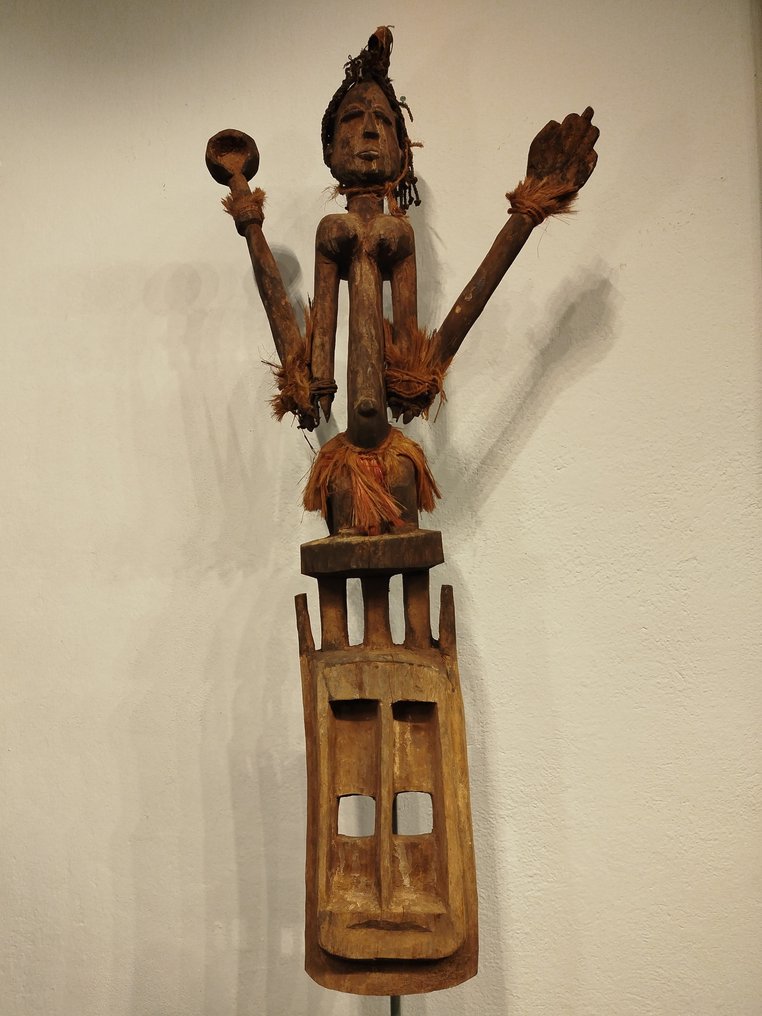
Satimbe Mask of the Dogon people, Mali; from a private collection; carved wood with original vegetal fibre adornments; mid-20th century; 103 × 45 × 15 cm; excellent condition.
AI-assisted summary
Description from the seller
Important Satimbe mask of the Dogon people, from the Bandiagara plateau (Mali), made of hand-carved wood with original applications in plant fibers.
Datable to the mid-20th century, it represents one of the most emblematic types of Dogon ritual art.
The mask is topped by the classic female figure Satimbe, recognizable by her frontal posture and raised arms, one of which holds a ritual cup.
Satimbe is considered the first woman to have discovered and transmitted the language of the masks, a fundamental figure in Dogon cosmogony and in the tradition of ritual dances.
The elongated face below, with rectangular openings for the eyes and a stylized mouth, is typical of the Dogon style and gives the overall piece a strong sculptural presence.
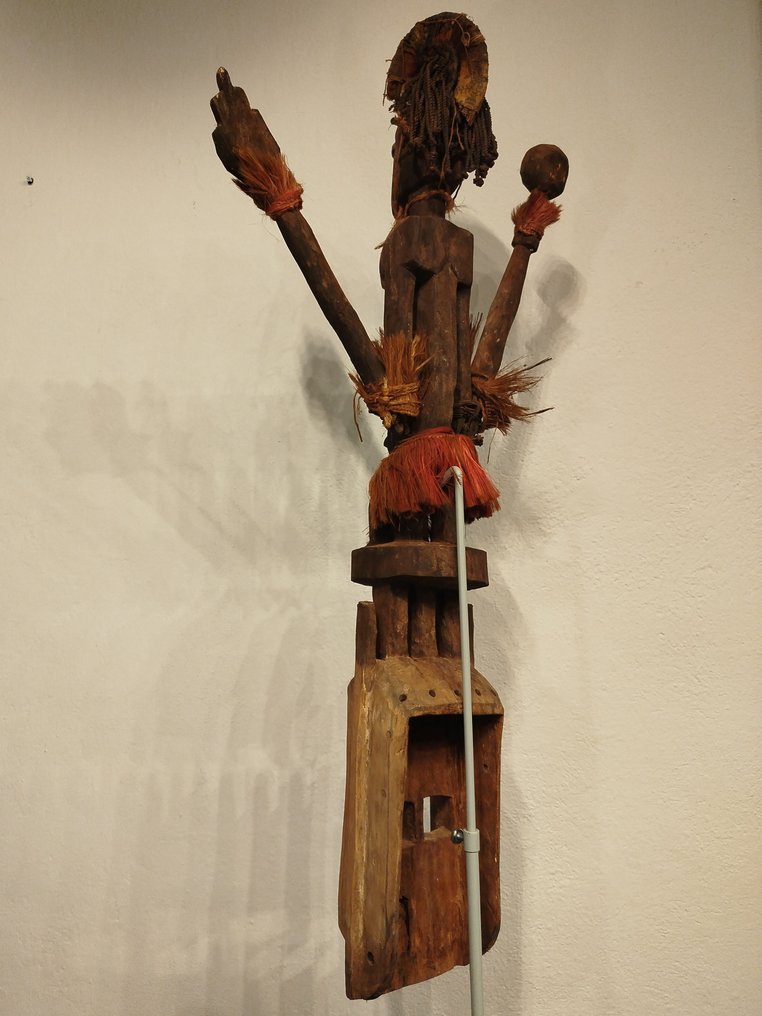
The bindings in natural fiber, visible on the arms and waist, are original and testify to the ceremonial use of the object.
The surface exhibits a warm and uniform patina, with signs of wear consistent with age and ritual use, which enhance its authenticity and historical value.
From a private collection.
Important Satimbe mask of the Dogon people, from the Bandiagara plateau (Mali), made of hand-carved wood with original applications in plant fibers.
Datable to the mid-20th century, it represents one of the most emblematic types of Dogon ritual art.
The mask is topped by the classic female figure Satimbe, recognizable by her frontal posture and raised arms, one of which holds a ritual cup.
Satimbe is considered the first woman to have discovered and transmitted the language of the masks, a fundamental figure in Dogon cosmogony and in the tradition of ritual dances.
The elongated face below, with rectangular openings for the eyes and a stylized mouth, is typical of the Dogon style and gives the overall piece a strong sculptural presence.
The bindings in natural fiber, visible on the arms and waist, are original and testify to the ceremonial use of the object.
The surface exhibits a warm and uniform patina, with signs of wear consistent with age and ritual use, which enhance its authenticity and historical value.
From a private collection.
Details
No. of items
1
Ethnic group/ culture
Dogon
Country of Origin
Mali
Period
Mid 20th century
Condition
Excellent condition
Title of artwork
Satimbe Mask Dogon
Height
103 cm
Width
45 cm
Depth
15 cm
Provenance
Private collection
