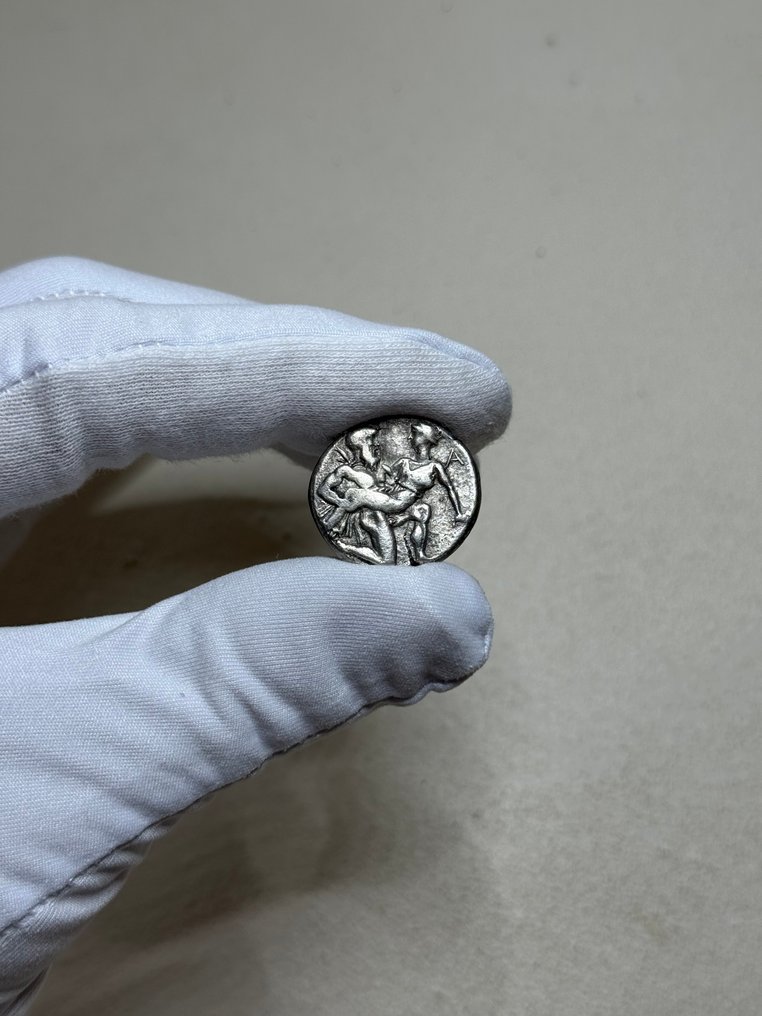
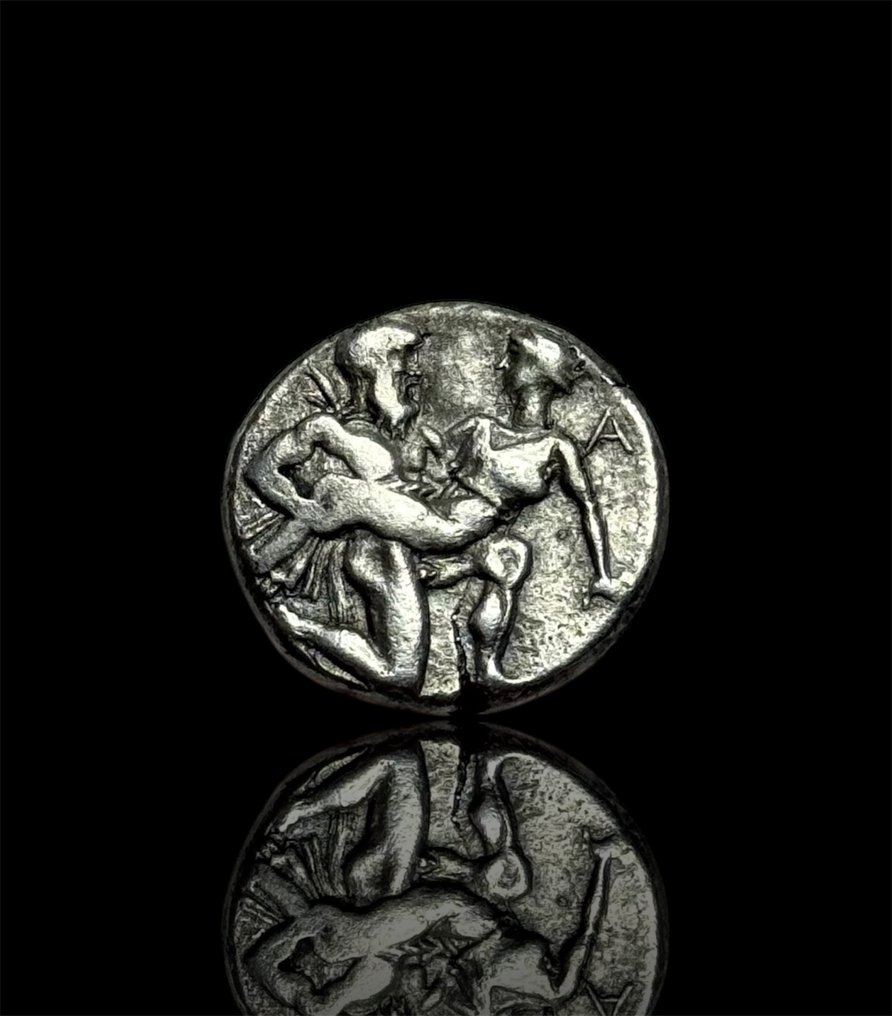
Islands off Thrace, Thasos Stater Circa 480-463 BC
Opens 11:00
Starting bid
€ 1

Add to your favourites to get an alert when the auction starts.

Carmen Vera Gutiérrez
Expert
Selected by Carmen Vera Gutiérrez

Experienced antique appraiser specialising in Spanish coins with deep knowledge of ancient currency.

Estimate  € 1,100 - € 1,300
Catawiki Buyer Protection

Your payment’s safe with us until you receive your object.View details

Trustpilot 4.4 | 123609 reviews

Rated Excellent on Trustpilot.
Description from the seller

Obverse

A nude, ithyphallic (excited) satyr (or silenos, a follower of Dionysus) carries a protesting nymph in his arms as he runs/kneels to the right. The nymph raises her hand in protest. This motif refers to the cult of Dionysus on Thasos, where wine production and orgiastic rituals were central—satyrs and nymphs symbolize fertility and ecstasy. The figures' poses often form a kind of swastika-like pattern (an ancient symbol of good luck in the Greek world).
The A is a control mark or magistrate's mark (mark of a mint master or issue series). Early Thasos staters sometimes feature single Greek letters (such as A, Λ, Θ, Σ) in the incuse squares to identify a specific issue or official. It is not an inscription like a city name, but a practical mark to distinguish series.

Reverse.

A quadripartite incuse square (a four-part indented square, a typical archaic feature without an image).

Very Fine (VF)

Obverse

A nude, ithyphallic (excited) satyr (or silenos, a follower of Dionysus) carries a protesting nymph in his arms as he runs/kneels to the right. The nymph raises her hand in protest. This motif refers to the cult of Dionysus on Thasos, where wine production and orgiastic rituals were central—satyrs and nymphs symbolize fertility and ecstasy. The figures' poses often form a kind of swastika-like pattern (an ancient symbol of good luck in the Greek world).
The A is a control mark or magistrate's mark (mark of a mint master or issue series). Early Thasos staters sometimes feature single Greek letters (such as A, Λ, Θ, Σ) in the incuse squares to identify a specific issue or official. It is not an inscription like a city name, but a practical mark to distinguish series.

Reverse.

A quadripartite incuse square (a four-part indented square, a typical archaic feature without an image).

Very Fine (VF)

Details

Era
Before 1400
Weight
7.91 g
Culture/region
Islands off Thrace, Thasos
Year/Period and Variation
Circa 480-463 BC
Denomination
Stater
Metal
AR
Condition
Ungraded
The NetherlandsVerified
Private

Similar objects

For you in

Ancient Coins