Icon - Quadripartite icon - Wood


05
days
14
hours
02
minutes
07
seconds
Starting bid
€ 1
Reserve price not met

Expert
Selected by Justus Heutink
Holds broad knowledge of religious icons with six years of collecting experience.
Estimate € 150 - € 200
No bids placed
Catawiki Buyer Protection
Your payment’s safe with us until you receive your object.View details
Trustpilot 4.4 | 123332 reviews
Rated Excellent on Trustpilot.
Description from the seller
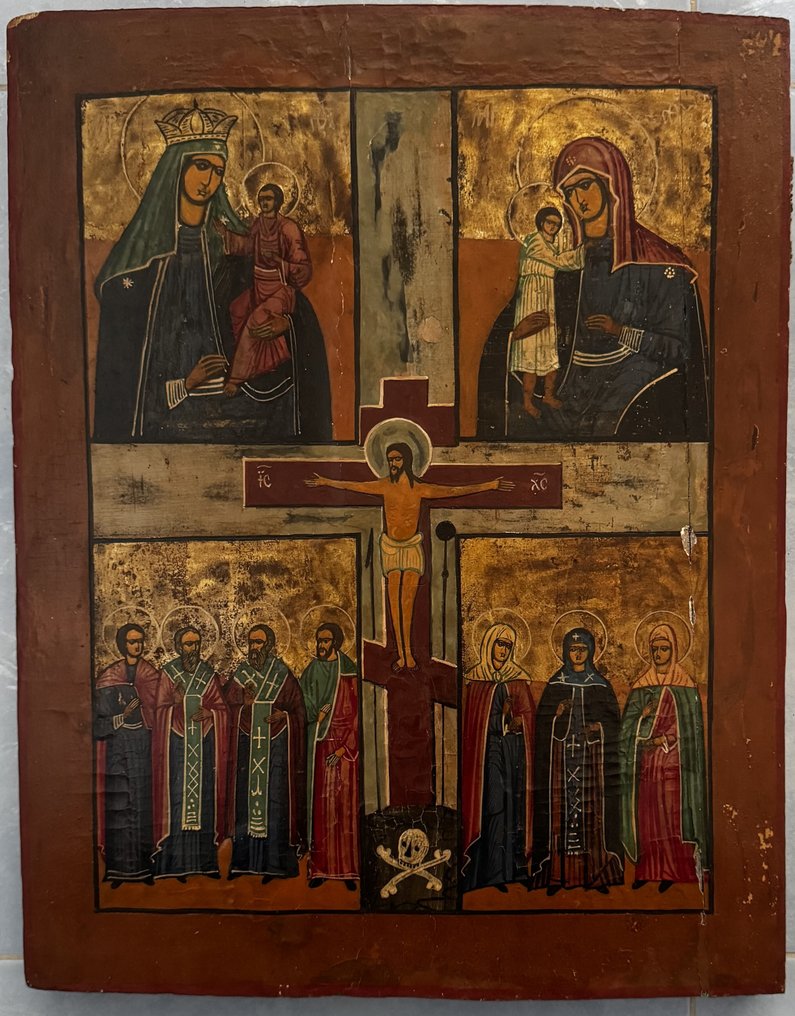
Russian Orthodox icon of the Crucifixion with saints and two Marian icons, a complex theological and liturgical composition, not a simple narrative.
General identification
Central theme:
The Crucifixion of Christ as the axis of salvation history, surrounded by the intercession of the Theotokos and the communion of saints.
Type of icon:
Composite icon (synaxarion-devotional), typical of the Russian sphere between the 18th and 19th centuries.
Technique:
Egg tempera on panel, golden background, marked line drawing.
Iconographic analysis by records
1. Upper register: two icons of the Virgin with the Child.
On the left and right, two different types of marine entities appear, which is very significant.
Left
The enthroned and crowned Virgin Mary, with the Child blessing.
Evokes a Virgin Queen or protector, similar to types like the Hodigitria.
Right
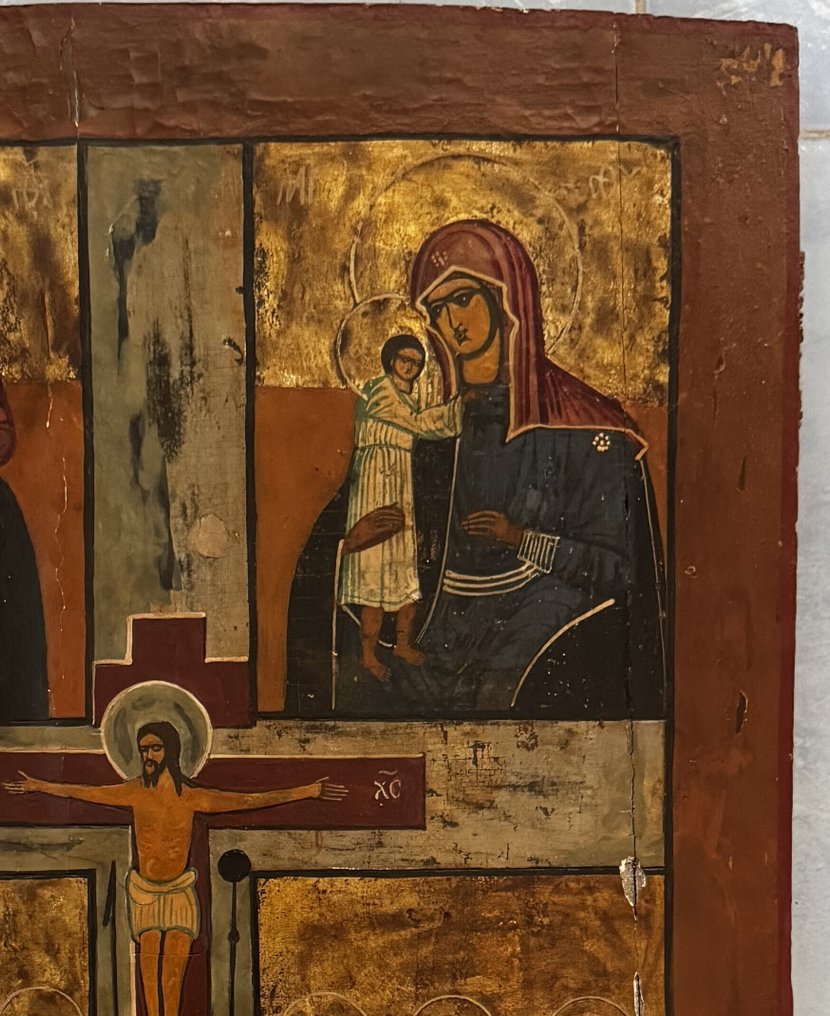
The Virgin of Tenderness (Eleúsa), with the Child supporting the cheek on the Mother.
Highlight compassion and maternal love, in contrast to the drama of the Cross.
Theological reading
Maria is presented before and after the sacrifice, as Mother of the Glorious King and as Mother of Sorrows.
2. Center: the Crucifixion
Central figure: Jesus Christ crucified.
Arms extended in a serene manner, without extreme dramatism — Russian post-Byzantine style.
Inscription IC XC (Jesus Christ).
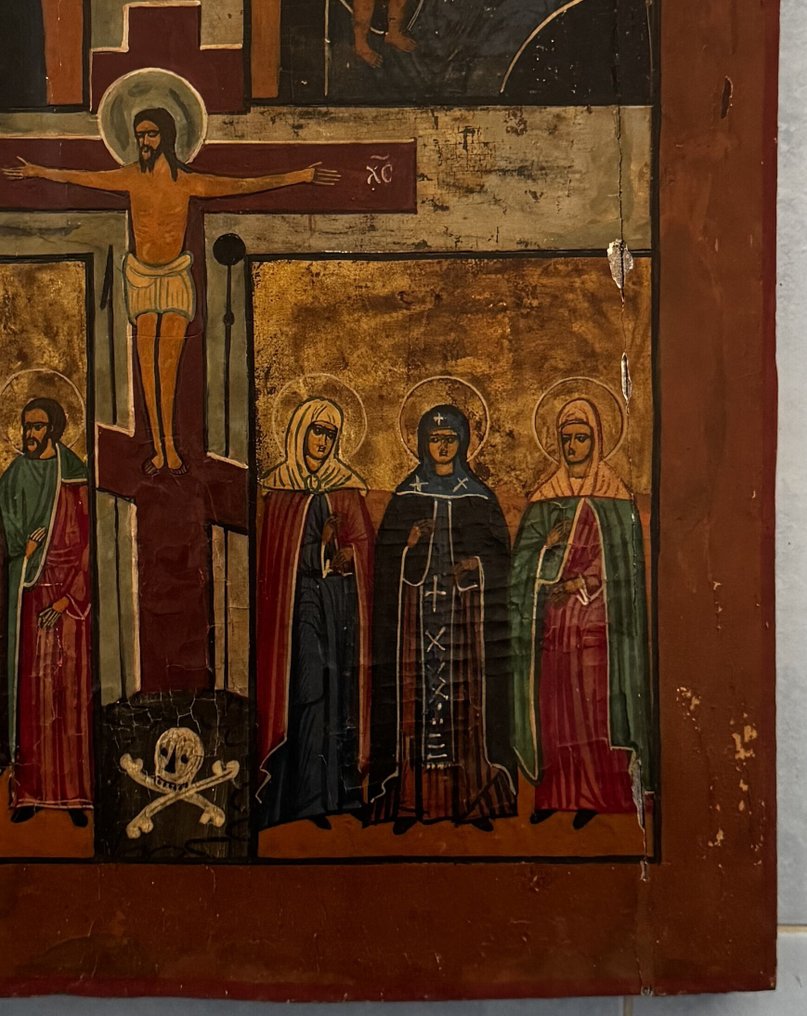
Skull beneath the cross: symbol of Adam, redeemed by the blood of Christ.
The Cross appears as a tree of life, not just an instrument of death.
Lower register: the glorious Church
Two symmetric groups
Left
Saint bishops and Church fathers (with omophorion and Gospels).
Right
Saints, martyrs, and nuns (monastic habit, crosses).
They represent the militant and triumphant Church, united to the sacrifice of Christ.
Global meaning
This icon does not aim to 'tell' the Crucifixion, but to proclaim it.
Christ dies surrounded by the intercession of Mary.
The Cross unites sky, earth, and the Church.
The faithful who pray before the icon are spiritually integrated into that communion.
Dating and origin (estimation)
Origin: Central or Northern Russia
Late 18th century – first half of the 19th century.
Use: private devotion or domestic iconostasis.
Russian Orthodox icon of the Crucifixion with saints and two Marian icons, a complex theological and liturgical composition, not a simple narrative.
General identification
Central theme:
The Crucifixion of Christ as the axis of salvation history, surrounded by the intercession of the Theotokos and the communion of saints.
Type of icon:
Composite icon (synaxarion-devotional), typical of the Russian sphere between the 18th and 19th centuries.
Technique:
Egg tempera on panel, golden background, marked line drawing.
Iconographic analysis by records
1. Upper register: two icons of the Virgin with the Child.
On the left and right, two different types of marine entities appear, which is very significant.
Left
The enthroned and crowned Virgin Mary, with the Child blessing.
Evokes a Virgin Queen or protector, similar to types like the Hodigitria.
Right
The Virgin of Tenderness (Eleúsa), with the Child supporting the cheek on the Mother.
Highlight compassion and maternal love, in contrast to the drama of the Cross.
Theological reading
Maria is presented before and after the sacrifice, as Mother of the Glorious King and as Mother of Sorrows.
2. Center: the Crucifixion
Central figure: Jesus Christ crucified.
Arms extended in a serene manner, without extreme dramatism — Russian post-Byzantine style.
Inscription IC XC (Jesus Christ).
Skull beneath the cross: symbol of Adam, redeemed by the blood of Christ.
The Cross appears as a tree of life, not just an instrument of death.
Lower register: the glorious Church
Two symmetric groups
Left
Saint bishops and Church fathers (with omophorion and Gospels).
Right
Saints, martyrs, and nuns (monastic habit, crosses).
They represent the militant and triumphant Church, united to the sacrifice of Christ.
Global meaning
This icon does not aim to 'tell' the Crucifixion, but to proclaim it.
Christ dies surrounded by the intercession of Mary.
The Cross unites sky, earth, and the Church.
The faithful who pray before the icon are spiritually integrated into that communion.
Dating and origin (estimation)
Origin: Central or Northern Russia
Late 18th century – first half of the 19th century.
Use: private devotion or domestic iconostasis.
Details
Era
1900-2000
Iconography
Quadripartite icon
Weight
1 kg
Material
Wood
Country of Origin
Russia
Height
30 cm
Width
26.3 cm
Depth
2.2 cm
Condition
Good condition - used with small signs of aging & blemishes
Estimated Period
1900-1950
Sold by