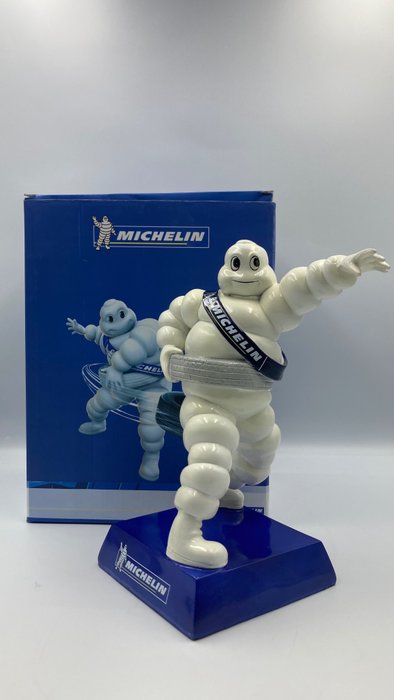
Michelin - Bibendum - Sign - Resin

02
days
23
hours
14
minutes
17
seconds
Current bid
€ 26
No reserve price
Ashley Calvert
Expert
Selected by Ashley Calvert

He has 15 years of experience trading 20th century glass and antiques.

Estimate  € 160 - € 190
39 other people are watching this object
nlBidder 2119 €26
frBidder 8279 €21
itBidder 5120 €16

Catawiki Buyer Protection

Your payment’s safe with us until you receive your object.View details

Trustpilot 4.4 | 123878 reviews

Rated Excellent on Trustpilot.

A resin Bibendum advertising sculpture from France, original/official, in never-used condition, measuring 23 cm high, 11 cm wide and 18 cm deep, weighing 1 kg.

AI-assisted summary

Description from the seller

Michelin Man, advertising object
Michelin resin sculpture
new with packaging

Tracked shipment
accurate packing
with foam rubber protection

Michelin Omino in resin, large size compared to the gadget that was given as a gift with tire purchases.
This was provided to workshops as advertising material.

Historical notes

During the 1894 Universal and Colonial Exposition in Lyon, Édouard and André Michelin noticed a stack of tires that suggested to Édouard the figure of a man without arms. Four years later, in 1898, André met the French cartoonist Marius Rossillon, popularly known as O'Galop, who showed him an image he had created for a Munich brewery that had been rejected. It depicted a large human figure holding a glass of beer and the phrase by Horace, Nunc est bibendum ('Now is the time to drink'). André suggested replacing the man with a figure made of tires, similar to the stack seen years earlier; O'Galop then transformed the original image into what would become the symbol of Michelin.

The first manifesto from 1898 depicted him raising a toast to his humble competitors with the phrase Nunc est bibendum, holding a glass filled with dangerous nails and broken glass, while pronouncing the phrase 'C'est à dire: À votre santé. Le pneu Michelin boit l'obstacle' ('That is to say: To your health. The Michelin tire drinks obstacles'). The implication was that Michelin tires would easily overcome road hazards, unlike other tires.


Modern version of Bibendum, displayed at a fair in Taipei in 2008.
The company has used this type of poster as a basis for many years, adding its latest products to the table in front of the figure. It is not clear when the word 'Bibendum' became the name of the character itself. In 1908, Michelin commissioned Curnonsky to write a newspaper column signed 'Bibendum.' In the 1920s, 'Bibendum' was also the title of a periodical published by the company's Italian branch.

In 1922, Michelin organized a contest to name the Michelin Tyre Man in the United States. [3]

The shape of Bibendum has changed over the years, updating after World War II to better align with new advertising needs. O'Galop's logo was based on bicycle tires, he wore pince-nez glasses with a cord, and smoked a cigar. In the 1970s and 1980s, Bibendum was depicted running, and in 1998, his hundredth anniversary, a simplified version became the company's new logo. He had given up the cigar and pince-nez many years earlier. The logo's simplification reflected the smaller, lower-profile tires of modern cars and gave the character a friendlier, more approachable appearance.

#salvagecollection

Michelin Man, advertising object
Michelin resin sculpture
new with packaging

Tracked shipment
accurate packing
with foam rubber protection

Michelin Omino in resin, large size compared to the gadget that was given as a gift with tire purchases.
This was provided to workshops as advertising material.

Historical notes

During the 1894 Universal and Colonial Exposition in Lyon, Édouard and André Michelin noticed a stack of tires that suggested to Édouard the figure of a man without arms. Four years later, in 1898, André met the French cartoonist Marius Rossillon, popularly known as O'Galop, who showed him an image he had created for a Munich brewery that had been rejected. It depicted a large human figure holding a glass of beer and the phrase by Horace, Nunc est bibendum ('Now is the time to drink'). André suggested replacing the man with a figure made of tires, similar to the stack seen years earlier; O'Galop then transformed the original image into what would become the symbol of Michelin.

The first manifesto from 1898 depicted him raising a toast to his humble competitors with the phrase Nunc est bibendum, holding a glass filled with dangerous nails and broken glass, while pronouncing the phrase 'C'est à dire: À votre santé. Le pneu Michelin boit l'obstacle' ('That is to say: To your health. The Michelin tire drinks obstacles'). The implication was that Michelin tires would easily overcome road hazards, unlike other tires.


Modern version of Bibendum, displayed at a fair in Taipei in 2008.
The company has used this type of poster as a basis for many years, adding its latest products to the table in front of the figure. It is not clear when the word 'Bibendum' became the name of the character itself. In 1908, Michelin commissioned Curnonsky to write a newspaper column signed 'Bibendum.' In the 1920s, 'Bibendum' was also the title of a periodical published by the company's Italian branch.

In 1922, Michelin organized a contest to name the Michelin Tyre Man in the United States. [3]

The shape of Bibendum has changed over the years, updating after World War II to better align with new advertising needs. O'Galop's logo was based on bicycle tires, he wore pince-nez glasses with a cord, and smoked a cigar. In the 1970s and 1980s, Bibendum was depicted running, and in 1998, his hundredth anniversary, a simplified version became the company's new logo. He had given up the cigar and pince-nez many years earlier. The logo's simplification reflected the smaller, lower-profile tires of modern cars and gave the character a friendlier, more approachable appearance.

#salvagecollection

Details

Era
1900-2000
Title
Bibendum
Country of Origin
France
Material
Resin
Manufacturer/ Brand
Michelin
Qualification
Original/official
Style
Industrial
Condition
As new - unused
Height
23 cm
Width
11 cm
Depth
18 cm
Weight
1 kg
Estimated Period
1980-1990
ItalyVerified
703
Objects sold
100%
Private

Similar objects

For you in

Vintage & Industrial Furniture