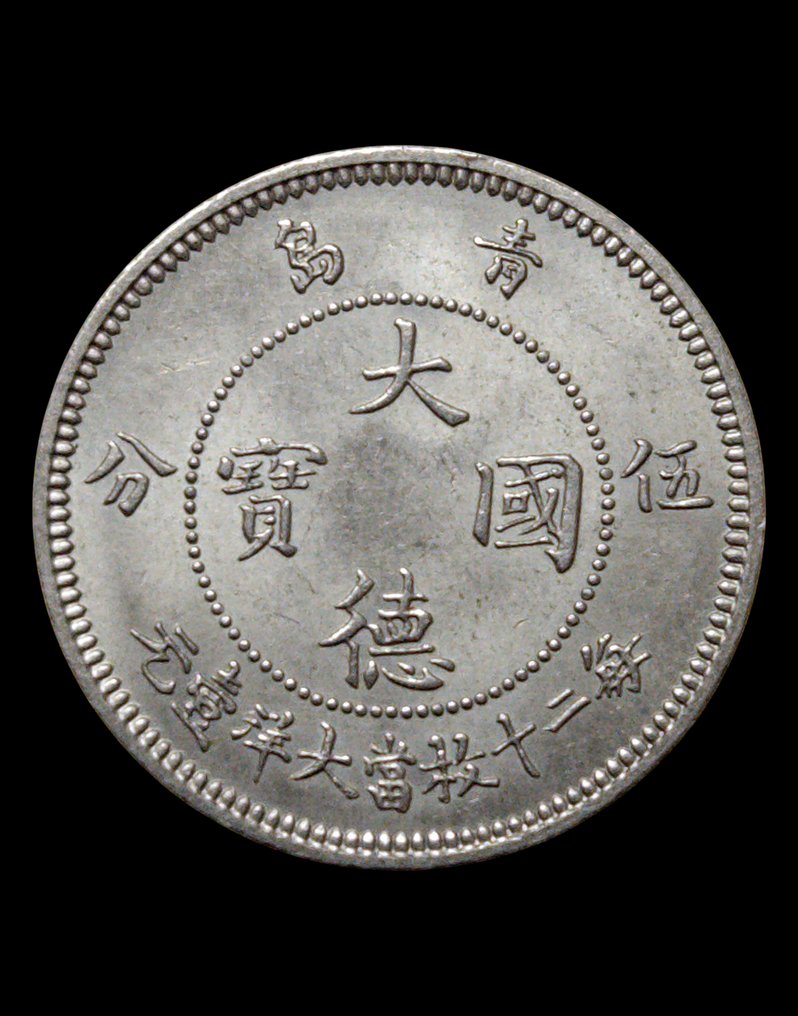
China, Germany Colonies Kiautschou (Kiau Chau) 5 Cents (UNC) Silver, 1909 Emperor Wilhelm II (KM# 1, Schön# 1)


05
days
11
hours
49
minutes
56
seconds
Current bid
€ 120
Reserve price not met

Expert
Selected by Yunheng Deng
Has over 30 years of experience collecting coins, with extensive professional contacts in Asia. Passionate about the stories behind contemporary coins.
Estimate € 380 - € 430
25 other people are watching this object
 Bidder 2646 Bidder 2646 | €120 | |
|---|---|---|
| Bidder 2646 | €110 | |
 Bidder 3486 Bidder 3486 | €100 | |
Catawiki Buyer Protection
Your payment’s safe with us until you receive your object.View details
Trustpilot 4.4 | 123779 reviews
Rated Excellent on Trustpilot.
1909 silver 5 Cents from Kiautschou, issued by Deutsch-Asiatische Bank, UNC (great quality) with diameter 18.5 mm and weight 3 g; obverse shows Chinese inscriptions, reverse features the Imperial German Coat of Arms.
AI-assisted summary
Description from the seller
Obverse: Four Chinese ideograms within a beaded circle, all surrounded by more ideograms.
Lettering:
島青
大
寶國
德
分伍
元壹洋大當枚十二每
Translation:
Tsingtao
Great German Empire's currency
5 Fen
Every 20 pieces is worth 1 Yuan
Engraver: Paul Sturm
Reverse: The Imperial German Coat-of-Arms (including an anchor) separating the value and surrounded by legend.
Script: Latin
Lettering:
DEUTSCH· KIAUTSCHOU GEBIET
5 CENT
1909
Translation: German Kiautschou Territory
Engraver: Otto Schultz
This was issued by the Deutsch-Asiatische Bank in October 1909 to cope with market confusion arising from the currency exchange between the Mexican 8 Reales (which Chinese merchants commonly used) and the Deutsche Mark. By circulating Kiau Chau coins, Chinese merchants were able to exchange at the Deutsch-Asiatische Bank for a Mexican 8 Reales (as 1 Yuan), preventing the exchange problem. It is statutory that local authority had unlimited obligation to exchange all Kiau Chau coins for Mexican 8 Reales, and may not refuse any Kiau Chau coins for transactions within 3 Yuan. When Tsingtao was occupied by Japanese military on November 7, 1914, the Kiau Chau coins ceased to circulate.
Actual dimensions:
diameter: 18,5 mm,
Weigth: 3 gram.
Please take a good look at the photos, they are part of the description.
They provide a clear picture of the quality and condition of the product and they fill in any gaps in the text or correct any errors and are decisive for the description of the product.
ID: 3403"
Please take a good look at the photos, they are part of the description.
They provide a clear picture of the quality and condition of the product and they fill in any gaps in the text or correct any errors and are decisive for the description of the product.
Obverse: Four Chinese ideograms within a beaded circle, all surrounded by more ideograms.
Lettering:
島青
大
寶國
德
分伍
元壹洋大當枚十二每
Translation:
Tsingtao
Great German Empire's currency
5 Fen
Every 20 pieces is worth 1 Yuan
Engraver: Paul Sturm
Reverse: The Imperial German Coat-of-Arms (including an anchor) separating the value and surrounded by legend.
Script: Latin
Lettering:
DEUTSCH· KIAUTSCHOU GEBIET
5 CENT
1909
Translation: German Kiautschou Territory
Engraver: Otto Schultz
This was issued by the Deutsch-Asiatische Bank in October 1909 to cope with market confusion arising from the currency exchange between the Mexican 8 Reales (which Chinese merchants commonly used) and the Deutsche Mark. By circulating Kiau Chau coins, Chinese merchants were able to exchange at the Deutsch-Asiatische Bank for a Mexican 8 Reales (as 1 Yuan), preventing the exchange problem. It is statutory that local authority had unlimited obligation to exchange all Kiau Chau coins for Mexican 8 Reales, and may not refuse any Kiau Chau coins for transactions within 3 Yuan. When Tsingtao was occupied by Japanese military on November 7, 1914, the Kiau Chau coins ceased to circulate.
Actual dimensions:
diameter: 18,5 mm,
Weigth: 3 gram.
Please take a good look at the photos, they are part of the description.
They provide a clear picture of the quality and condition of the product and they fill in any gaps in the text or correct any errors and are decisive for the description of the product.
ID: 3403"
Please take a good look at the photos, they are part of the description.
They provide a clear picture of the quality and condition of the product and they fill in any gaps in the text or correct any errors and are decisive for the description of the product.
Details
Era
1900-2000
Region
China, Germany Colonies Kiautschou (Kiau Chau)
Country/province
China
Year/Period and Variation
(UNC) Silver, 1909 Emperor Wilhelm II (KM# 1, Schön# 1)
Denomination
5 Cents
Precious metal
Silver
Condition
great quality (UNC)
Coin type
World Coins (non Euro coins pre-2000)
Sold by