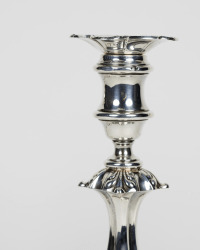
Teapot - Silver


05
days
18
hours
25
minutes
11
seconds
Starting bid
€ 1
Reserve price not met

Expert
Selected by Inés Fernández
Specialised in Spanish and Portuguese silver with over 10 years in galleries and auctions.
Estimate € 2,700 - € 3,000
No bids placed
Catawiki Buyer Protection
Your payment’s safe with us until you receive your object.View details
Trustpilot 4.4 | 124842 reviews
Rated Excellent on Trustpilot.
Silver teapot of European origin dating to the late 18th to early 19th century, featuring a bulbous body with spiral fluting, a hinged lid with an acorn finial, a spout shaped as an animal head, a curved wooden handle, and weighing 1185 g with dimensions 20 cm high by 18 cm wide, in good used condition with minor signs of aging and stains.
AI-assisted summary
Description from the seller
This elegant silver teapot is a fine example of late 18th- to early 19th-century European craftsmanship, likely of Portuguese or broader Iberian origin. Its form is richly decorated with spiral fluting that gracefully wraps around the body and lid, creating a sense of movement and refinement. The bulbous body gently tapers toward the base, which is supported by a short, stepped foot ring.
One of the most striking features is the spout, sculpted in the form of an animal’s head—possibly a hound or dragon—an element typical of the Rococo or early Neoclassical styles, often intended to convey strength and sophistication. This zoomorphic detail adds both a whimsical and noble touch.
The wooden handle, likely made from a fruitwood such as walnut or boxwood, is elegantly curved and ergonomically positioned, providing both aesthetic warmth and practical insulation from heat. Its rich patina contrasts beautifully with the polished silver, underscoring the blend of natural and refined materials.
Although I could not locate the hallmark, a test was carried out in a discreet area using a silver testing reagent, with a positive result.
The lid, fitted with a small acorn-shaped finial, complements the body with matching spiral fluting and is hinged for convenience. The craftsmanship suggests it may have been made for a wealthy household, used in formal tea services or gatherings.
Altogether, this teapot combines functionality with artistic detailing, making it not only a usable object but also a decorative piece, ideal for collectors of antique silverware or period tableware.
Dimensions: 20 cm (height) x 18 cm (width)
Weight: 1185 g
This elegant silver teapot is a fine example of late 18th- to early 19th-century European craftsmanship, likely of Portuguese or broader Iberian origin. Its form is richly decorated with spiral fluting that gracefully wraps around the body and lid, creating a sense of movement and refinement. The bulbous body gently tapers toward the base, which is supported by a short, stepped foot ring.
One of the most striking features is the spout, sculpted in the form of an animal’s head—possibly a hound or dragon—an element typical of the Rococo or early Neoclassical styles, often intended to convey strength and sophistication. This zoomorphic detail adds both a whimsical and noble touch.
The wooden handle, likely made from a fruitwood such as walnut or boxwood, is elegantly curved and ergonomically positioned, providing both aesthetic warmth and practical insulation from heat. Its rich patina contrasts beautifully with the polished silver, underscoring the blend of natural and refined materials.
Although I could not locate the hallmark, a test was carried out in a discreet area using a silver testing reagent, with a positive result.
The lid, fitted with a small acorn-shaped finial, complements the body with matching spiral fluting and is hinged for convenience. The craftsmanship suggests it may have been made for a wealthy household, used in formal tea services or gatherings.
Altogether, this teapot combines functionality with artistic detailing, making it not only a usable object but also a decorative piece, ideal for collectors of antique silverware or period tableware.
Dimensions: 20 cm (height) x 18 cm (width)
Weight: 1185 g
Details
Era
1400-1900
Over 200 years old
No
No. of items
1
Material
Silver
Country of Origin
Europe
Condition
Good condition - used with small signs of aging & blemishes
Height
20 cm
Width
18 cm
Estimated period
unknown
Sold by