Mask - Côte d’Ivoire (No reserve price)



05
days
12
hours
39
minutes
09
seconds

No bids placed
Catawiki Buyer Protection
Your payment’s safe with us until you receive your object.View details
Trustpilot 4.4 | 123609 reviews
Rated Excellent on Trustpilot.
Description from the seller
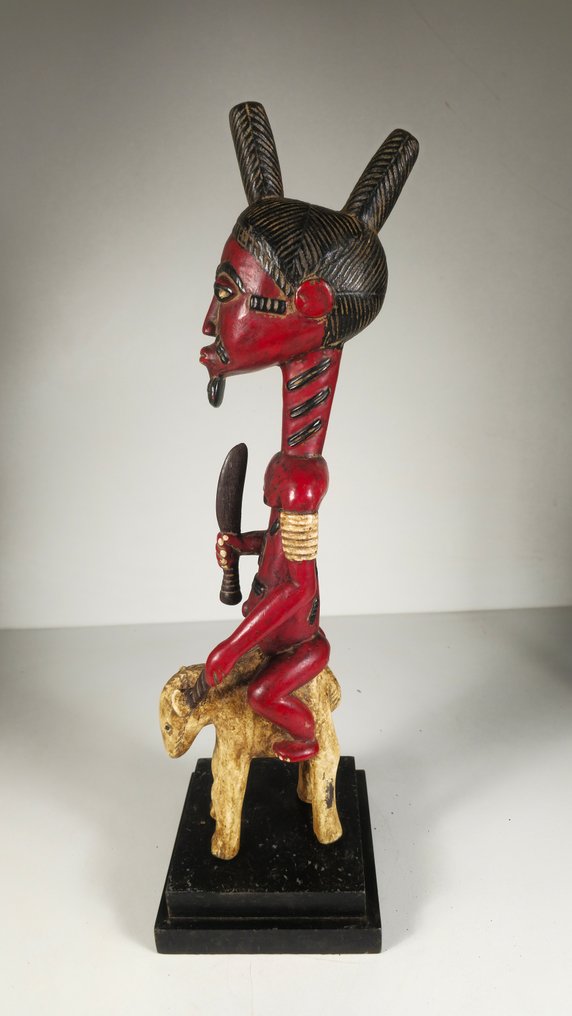
Cavalier Baule
Baoule horseman figure
The mottled coloration of this Baoulé sculpture depicts a nude figure riding its mount bareback. Two types of statues are produced by the Baoulé, within a ritual context: the Waka-Sona statues, meaning 'being of wood' in Baoulé, evoke an 'assié oussou,' meaning 'being of the earth.' They are part of a type of statues used as medium tools by the Kòmien diviners, who are chosen by the asye usu spirits to communicate revelations from the beyond. The second type of statues are the 'spouses' of the afterlife, masculine, the Blolo Bian, or feminine, the Blolo Bia, which represent a quest for fulfillment through seeking homage to an idealized opposite sex. About sixty ethnic groups inhabit Ivory Coast, including the Baoulé in the center, the Akans from Ghana, a savannah people practicing hunting and agriculture, similar to the Gouro, from whom they have borrowed ritual practices and sculpted masks.
Cavalier Baule
Baoule horseman figure
The mottled coloration of this Baoulé sculpture depicts a nude figure riding its mount bareback. Two types of statues are produced by the Baoulé, within a ritual context: the Waka-Sona statues, meaning 'being of wood' in Baoulé, evoke an 'assié oussou,' meaning 'being of the earth.' They are part of a type of statues used as medium tools by the Kòmien diviners, who are chosen by the asye usu spirits to communicate revelations from the beyond. The second type of statues are the 'spouses' of the afterlife, masculine, the Blolo Bian, or feminine, the Blolo Bia, which represent a quest for fulfillment through seeking homage to an idealized opposite sex. About sixty ethnic groups inhabit Ivory Coast, including the Baoulé in the center, the Akans from Ghana, a savannah people practicing hunting and agriculture, similar to the Gouro, from whom they have borrowed ritual practices and sculpted masks.
Details
Era
After 2000
No. of items
1
Material
Wood
Country of Origin
Côte d’Ivoire
Condition
Good condition - used with small signs of aging & blemishes
Height
54 cm
Width
10 cm
