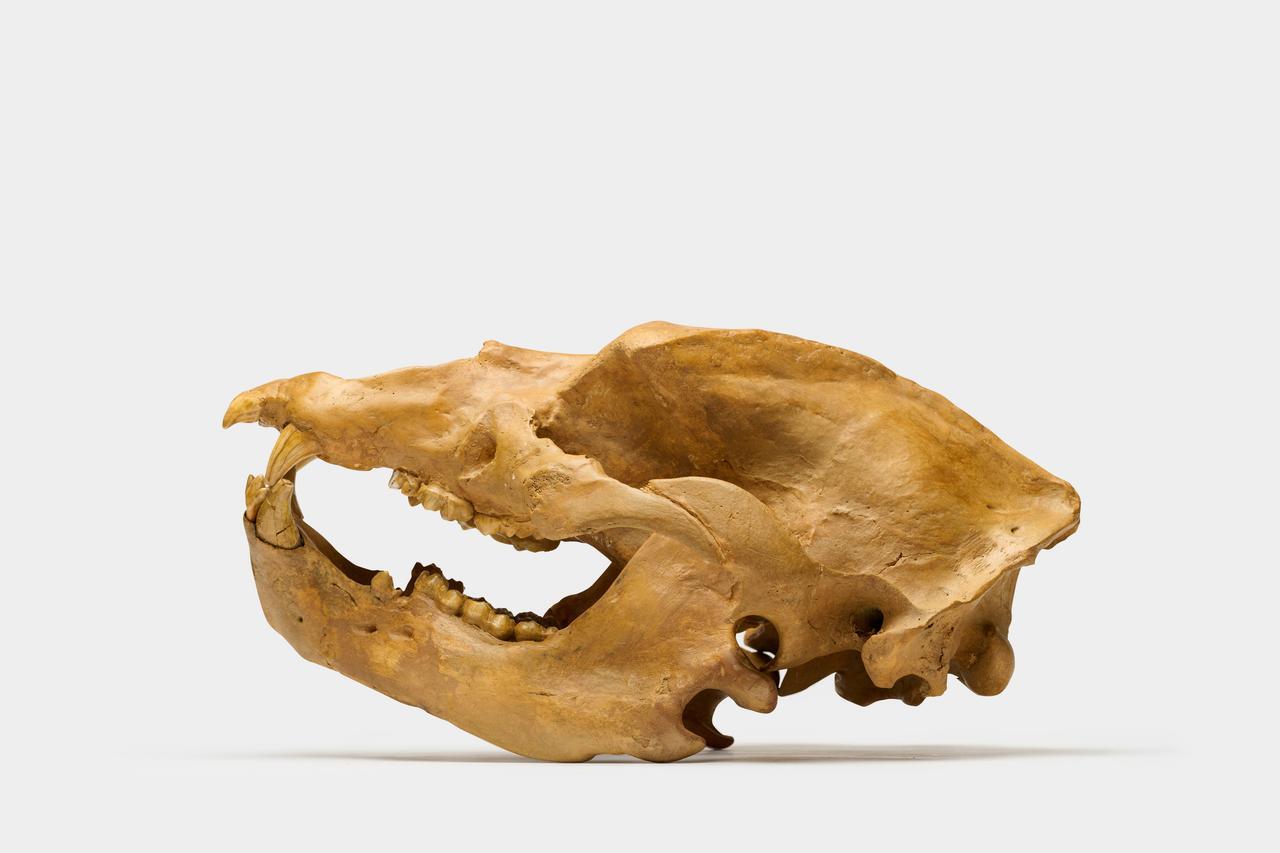
Basilosaurus - Fossil bone


05
days
11
hours
11
minutes
39
seconds

No bids placed
Catawiki Buyer Protection
Your payment’s safe with us until you receive your object.View details
Trustpilot 4.4 | 123418 reviews
Rated Excellent on Trustpilot.
Scientific name Basilosaurus; specimen Basilosaurus from Morocco, Paleogene (Eocene), conserved and natural in condition, weight 132 g.
AI-assisted summary
Description from the seller
Key metrics
Specimen Weight : 132 grams
specimen length :12 cm
specimen width : 7.8 cm
Front incisor height: 4.5 cm
2nd from front incisor height: 4 cm
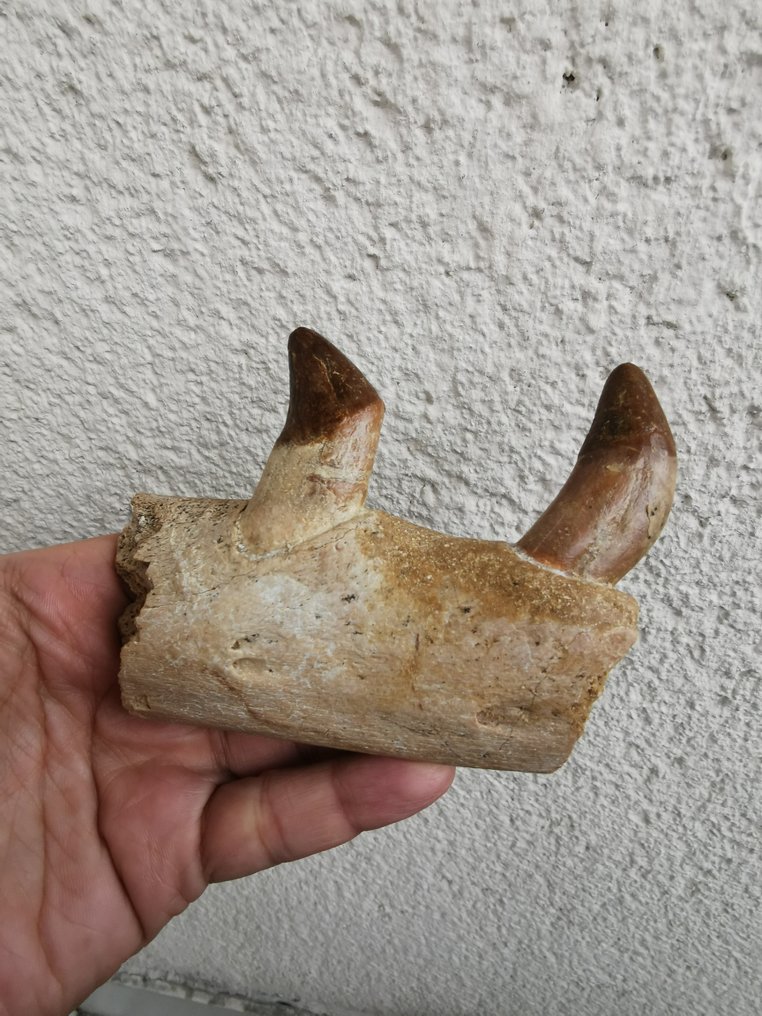
It is beautiful lower jaw fragment of Basilosaurus featuring the characteristic front incisors.
Basilosaurus was an amazing mammal of late Eocene, approximately 41.3 to 33.9 million years ago and a lot can be said about it. Amongst its amazing features were the teeth of Basilosaurus which showed hetero denitations meaning variation of teeth shape along the jaw as as teeth or group of teeth were meant for specific function. The premolars and molars were double rooted and distinct triangular structure with cutting ridges whereas the canines had long roots and had shorter crowns. The canines were meant to firmly hold onto prey while delivering fatal puncture wounds where as molar & premolars where meant for cutting, shearing and ripping off the flesh.
The very front of the jaw features the incisors which were meant to deliver the bite to the prey as well as go deep into the prey so that it cant escape. The incisors has very interesting and different shape in its own. The first incisor is curved outward while the second incisor is more of a boomerang shape. A diagram have been provided in the photos which shows the distinct nature of the Basilosaurus teeth.
The presented jaw fragment not only feature the exciting incisors but also very interestingly, it has mandibular foramen which are the holes in the jaw bone under the teeth. These holes carry the important nerves and blood vessels of the whole mouth region.
Another interesting feature of the fossil is the presence of mesh like structure which is basically the inside of a bone. This is called spongy bone. That structure has also beautifully fossilized as well and seems like it has somewhat "melted" during the fossilization. The underside and backside features nice mix of fossilization, mineralization. As usual with such specimens, there is no feeling of bone but rather purely a feeling of rock when person hold the fossil in hand as the fossilization process have completely turned the biological specimen into a rock.
Overall this is a compact yet a simple specimen with lots of interesting features of the iconic Basilosaurus. The specimen have been professionally conserved to make it long lasting. There is a possibility of some minor or hard to see repair is done on the specimen but effectively its in natural state.
Please refer to more photos for reference
Key metrics
Specimen Weight : 132 grams
specimen length :12 cm
specimen width : 7.8 cm
Front incisor height: 4.5 cm
2nd from front incisor height: 4 cm
It is beautiful lower jaw fragment of Basilosaurus featuring the characteristic front incisors.
Basilosaurus was an amazing mammal of late Eocene, approximately 41.3 to 33.9 million years ago and a lot can be said about it. Amongst its amazing features were the teeth of Basilosaurus which showed hetero denitations meaning variation of teeth shape along the jaw as as teeth or group of teeth were meant for specific function. The premolars and molars were double rooted and distinct triangular structure with cutting ridges whereas the canines had long roots and had shorter crowns. The canines were meant to firmly hold onto prey while delivering fatal puncture wounds where as molar & premolars where meant for cutting, shearing and ripping off the flesh.
The very front of the jaw features the incisors which were meant to deliver the bite to the prey as well as go deep into the prey so that it cant escape. The incisors has very interesting and different shape in its own. The first incisor is curved outward while the second incisor is more of a boomerang shape. A diagram have been provided in the photos which shows the distinct nature of the Basilosaurus teeth.
The presented jaw fragment not only feature the exciting incisors but also very interestingly, it has mandibular foramen which are the holes in the jaw bone under the teeth. These holes carry the important nerves and blood vessels of the whole mouth region.
Another interesting feature of the fossil is the presence of mesh like structure which is basically the inside of a bone. This is called spongy bone. That structure has also beautifully fossilized as well and seems like it has somewhat "melted" during the fossilization. The underside and backside features nice mix of fossilization, mineralization. As usual with such specimens, there is no feeling of bone but rather purely a feeling of rock when person hold the fossil in hand as the fossilization process have completely turned the biological specimen into a rock.
Overall this is a compact yet a simple specimen with lots of interesting features of the iconic Basilosaurus. The specimen have been professionally conserved to make it long lasting. There is a possibility of some minor or hard to see repair is done on the specimen but effectively its in natural state.
Please refer to more photos for reference
Details
Number of items
1
Specimen
Basilosaurus
Country of Origin
Morocco
Geological Period
Paleogene, Eocene (56 - 33.9 million years)
Condition
Natural
Treatment
Conserved
Weight
132 g
Sold by