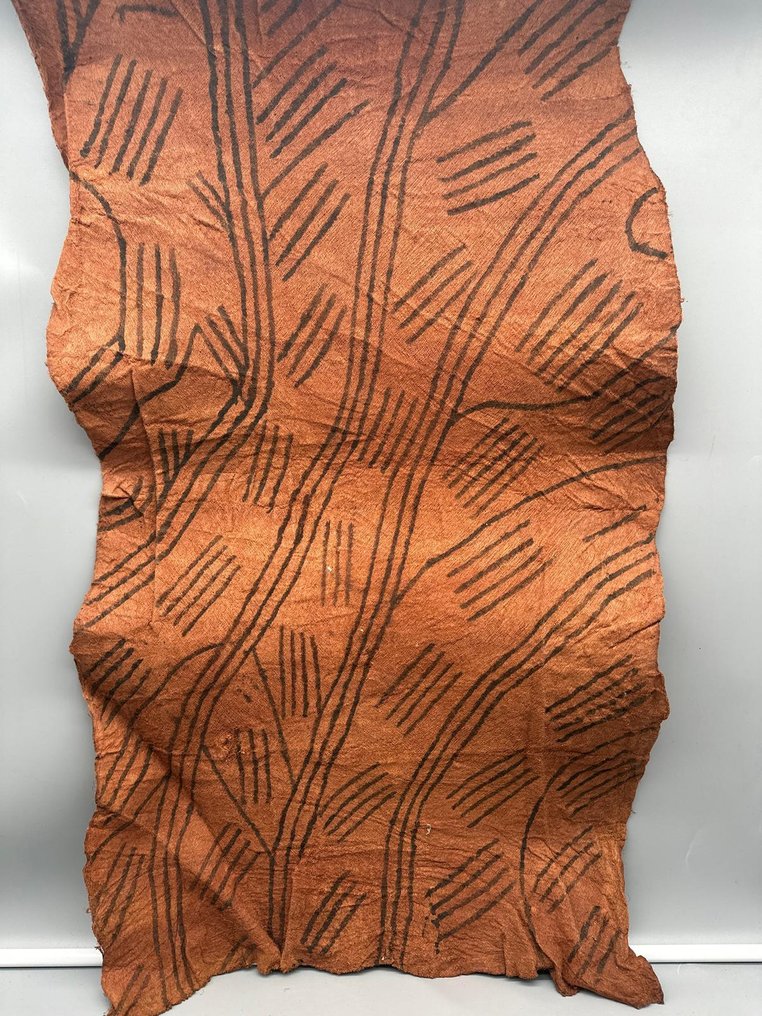
Carpet - 86 cm - 47 cm - Ficus fibres



04
days
05
hours
51
minutes
55
seconds

No bids placed
Catawiki Buyer Protection
Your payment’s safe with us until you receive your object.View details
Trustpilot 4.4 | 123609 reviews
Rated Excellent on Trustpilot.
Fibres de ficus wall hanging by the Mbuti Pygmies of Ituri in the Democratic Republic of the Congo, dating to the 21st century; overall condition with signs of age and wear, measurements 86 by 47 cm, weight 0.13 kg.
AI-assisted summary
Description from the seller
Mbuti bark cloth - Pygmies - Ituri - DRC Zaire - Fabrics
These magnificent objects are made from tree bark, specifically the fibrous substance found beneath the hardest outer layer of the trunk (Liber). These bark fibers are beaten until they become thin and flexible.
If it is the Pygmy women of the Ituri forests who determine the tree from which the bark will be taken, it is the men who will beat it and prepare it using mallets.
Symbolic motifs are then painted by the women, using charcoal mixed with latex.
The finished product is called murumba, pongo, or lengbe.
The use of various types of wood, especially ficus, explains the colors ranging from white to orange through to brown.
It is a very accomplished art, as highlighted by J. Cornet.
Carried or used in the context of ritual ceremonies, these works are the supports of a spiritual necessity.
These fabrics are not very fragile and can be lightly ironed by dampening them with a damp cloth.
The ideal presentation is to display them under glass, which results in a stunning appearance. A beautiful gift to give or to keep for yourself, or for your collection.
Mbuti bark cloth - Pygmies - Ituri - DRC Zaire - Fabrics
These magnificent objects are made from tree bark, specifically the fibrous substance found beneath the hardest outer layer of the trunk (Liber). These bark fibers are beaten until they become thin and flexible.
If it is the Pygmy women of the Ituri forests who determine the tree from which the bark will be taken, it is the men who will beat it and prepare it using mallets.
Symbolic motifs are then painted by the women, using charcoal mixed with latex.
The finished product is called murumba, pongo, or lengbe.
The use of various types of wood, especially ficus, explains the colors ranging from white to orange through to brown.
It is a very accomplished art, as highlighted by J. Cornet.
Carried or used in the context of ritual ceremonies, these works are the supports of a spiritual necessity.
These fabrics are not very fragile and can be lightly ironed by dampening them with a damp cloth.
The ideal presentation is to display them under glass, which results in a stunning appearance. A beautiful gift to give or to keep for yourself, or for your collection.
Details
Era
1900-2000
Title additional information
Ficus fibres
Nr of items
1
Length
86 cm
Width
47 cm
Material
Ficus fibres
Country of Origin
Democratic Republic of the Congo
Condition
Overall in fair condition with traces of ageing and usage
Professionally Cleaned
No
Manufacturing period
21st century
Weight
0.13 kg
Sold by
