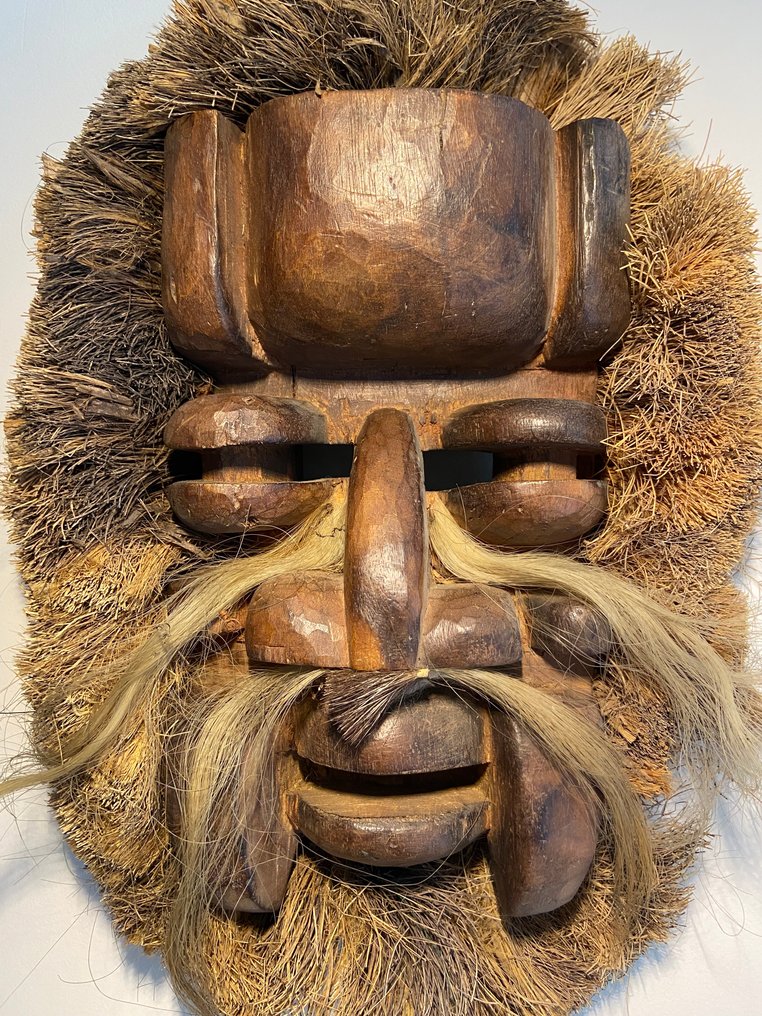
Mask N'guéré-Wobé - N'Guéré-Wobé - Côte d'Ivoire



04
days
20
hours
28
minutes
24
seconds
Starting bid
€ 1
Reserve price not met

Expert
Selected by Dimitri André
Holds a postgraduate degree in African studies and 15 years experience in African art.
Estimate € 280 - € 330
No bids placed
Catawiki Buyer Protection
Your payment’s safe with us until you receive your object.View details
Trustpilot 4.4 | 123718 reviews
Rated Excellent on Trustpilot.
Máscara N'guéré-Wobé, a 38 cm high wooden and raffia mask from the N'Guéré-Wobé people of Ivory Coast (Costa de Marfil), with provenance from Mundo Africano and Argiles Collection, Barcelona.
AI-assisted summary
Description from the seller
The N'Guéré-Wobé, also called Wé, which means 'men who forgive easily,' inhabit the forests along the western border of Ivory Coast. They are divided into two different tribes, the N'Guéré, also known as Guéré, and the Wobé, who share many customs and beliefs. Confederations govern these tribes; they are led by a chief who is also a civil authority. The family unit plays an important role among the Wé. Each family is under the authority of an elder, revered for his wisdom and wealth, who organizes family life, marriages, conflicts, and religious life. Masks are part of the attributes of the Gla social control society. This institution is very similar to that of the Dan mask society. The members, who belong to certain lineages, meet far from the village in a sacred enclosure marked by a raffia curtain hanging at the entrance. This entrance leads to a courtyard where the Kpan is located, which houses the masks and objects needed for the ritual. The Wé use them to represent the powerful forest demon with a deformed face, exuberant and aggressive in form, conveying great dynamism. The masks, in which zoomorphic elements merge with human elements in an exasperating naturalism, have very prominent foreheads and eyebrows, swollen lips, a fleshy, flattened nose, and tubular or almond-shaped eyes. Some have iron or horn fangs attached, while others sometimes feature stylized cones or cylinders, arches, or half-spheres. The masks belonging to the so-called Grebo style—in the inner Cavally region, in Liberia, and in Ivory Coast—are influenced by the cubist style of the N'Guéré.
Provenance: Mundo Africano, Barcelona
Argiles Collection, Barcelona
The N'Guéré-Wobé, also called Wé, which means 'men who forgive easily,' inhabit the forests along the western border of Ivory Coast. They are divided into two different tribes, the N'Guéré, also known as Guéré, and the Wobé, who share many customs and beliefs. Confederations govern these tribes; they are led by a chief who is also a civil authority. The family unit plays an important role among the Wé. Each family is under the authority of an elder, revered for his wisdom and wealth, who organizes family life, marriages, conflicts, and religious life. Masks are part of the attributes of the Gla social control society. This institution is very similar to that of the Dan mask society. The members, who belong to certain lineages, meet far from the village in a sacred enclosure marked by a raffia curtain hanging at the entrance. This entrance leads to a courtyard where the Kpan is located, which houses the masks and objects needed for the ritual. The Wé use them to represent the powerful forest demon with a deformed face, exuberant and aggressive in form, conveying great dynamism. The masks, in which zoomorphic elements merge with human elements in an exasperating naturalism, have very prominent foreheads and eyebrows, swollen lips, a fleshy, flattened nose, and tubular or almond-shaped eyes. Some have iron or horn fangs attached, while others sometimes feature stylized cones or cylinders, arches, or half-spheres. The masks belonging to the so-called Grebo style—in the inner Cavally region, in Liberia, and in Ivory Coast—are influenced by the cubist style of the N'Guéré.
Provenance: Mundo Africano, Barcelona
Argiles Collection, Barcelona
Details
No. of items
1
Ethnic group/ culture
N'Guéré-Wobé
Country of Origin
Côte d'Ivoire
Period
Mid 20th century
Material
Rafia, Wood
Sold with stand
No
Condition
Good condition
Title of artwork
Mask N'guéré-Wobé
Height
38 cm
Provenance
Private collection
