Pwoom Itok Mask - Kuba - DR Congo



06
days
03
hours
36
minutes
48
seconds
Starting bid
€ 1
Reserve price not met

Expert
Selected by Dimitri André
Holds a postgraduate degree in African studies and 15 years experience in African art.
Estimate € 350 - € 400
No bids placed
Catawiki Buyer Protection
Your payment’s safe with us until you receive your object.View details
Trustpilot 4.4 | 123641 reviews
Rated Excellent on Trustpilot.
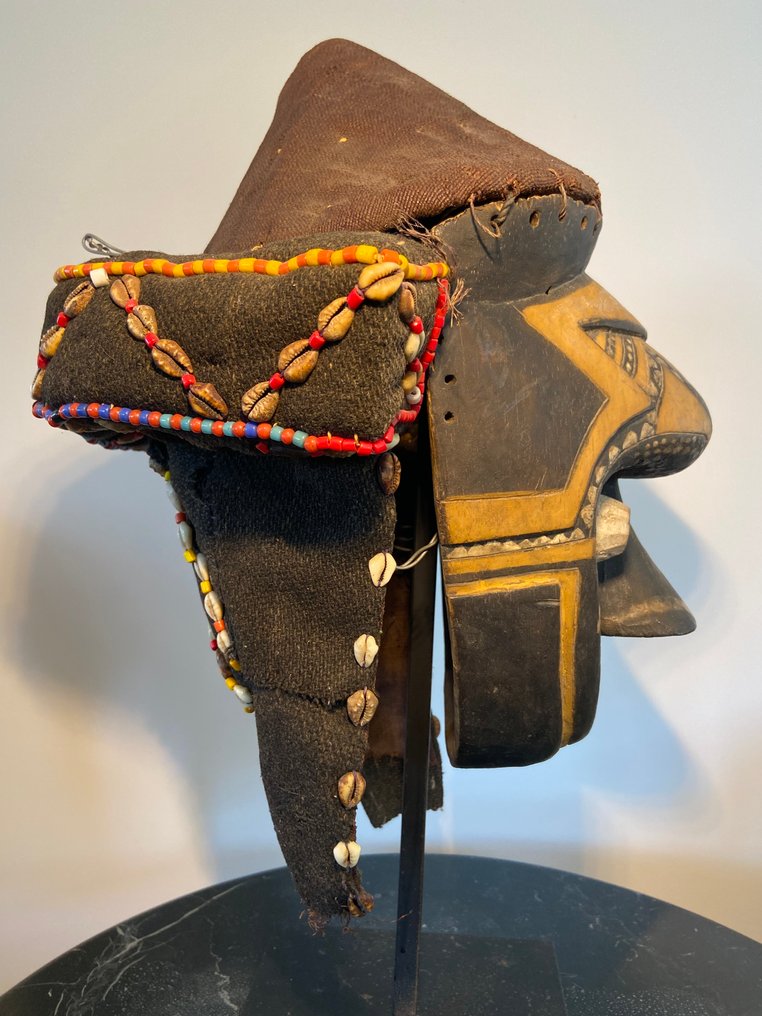
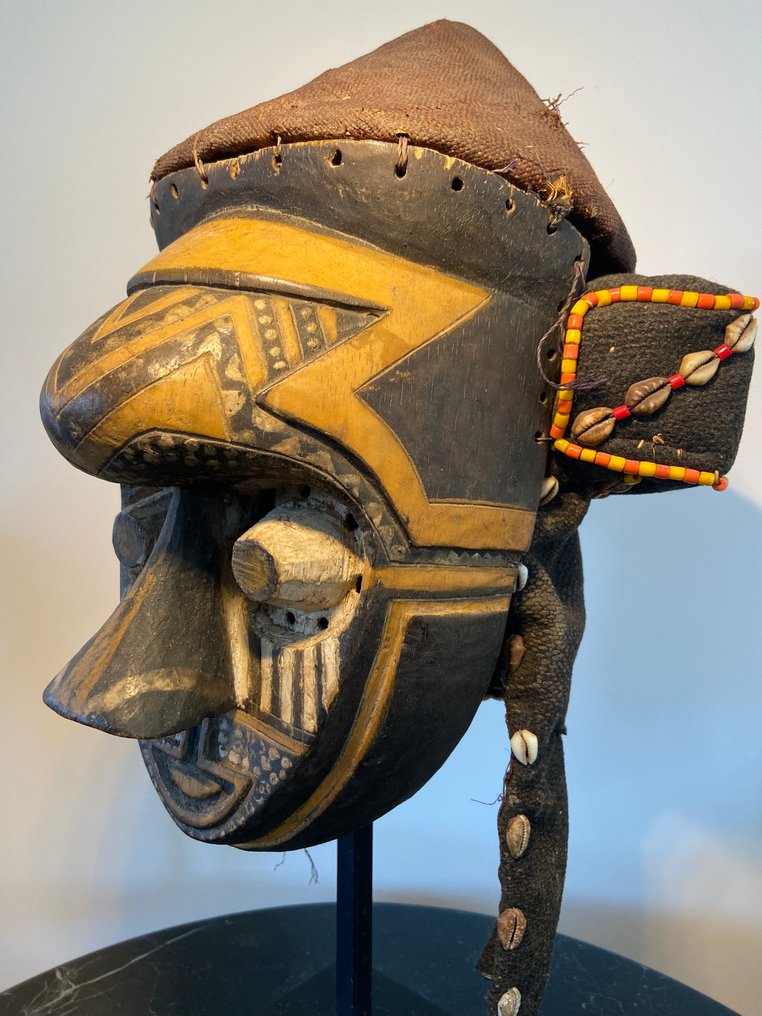
Pwoom Itok mask from the Kuba culture in the D.R. Congo, dating to the early 20th century, carved in wood with textiles and shell, measuring 35 cm in height, in good condition and coming from a private collection.
AI-assisted summary
Description from the seller
Masks like this one are often called Pwoom Itok. Other names given to them are Ishieenmaal or Ishendemale. Cornet (1993) stated that the structure is typical of the Ngeende. In 1908, Torday and Joyce, who lived for a time with the Ngongo, found identical examples. All these masks have trilobed hairstyles, made from rota fiber or raffia. The eyes are very prominent, cylindrical in shape and markedly protruding, and, according to Cornet, are inspired by the chameleon. The area around the iris has peepholes, and the pupils are very emphasized. Other notable features are the sharp, voluminous nose and the semi-elliptical mouth joined to the nose by the columella. Cornet argued that these masks were used in the context of boys' initiations. The Ngongo Torday and Joyce were led to believe by the Ngongo that masks of this type were worn by the Babende, members of a “powerful secret society” of that ethnic group, which held an official position in each village and whose function was to combat crime. Today, it is more likely that this was an elite within the organization rather than a secret society. The Shene Malula mask (pronunciation by Torday and Joyce) performed in the villages along with two others, the Bungu and the Gore Moashi. A Ngongo legend attributes the creation of the mask to a woman from the time of Samba Milepe, who later became the founder of the Babende.
Provenance: Medicus Mundi missionaries
Argiles collection, Barcelona
Masks like this one are often called Pwoom Itok. Other names given to them are Ishieenmaal or Ishendemale. Cornet (1993) stated that the structure is typical of the Ngeende. In 1908, Torday and Joyce, who lived for a time with the Ngongo, found identical examples. All these masks have trilobed hairstyles, made from rota fiber or raffia. The eyes are very prominent, cylindrical in shape and markedly protruding, and, according to Cornet, are inspired by the chameleon. The area around the iris has peepholes, and the pupils are very emphasized. Other notable features are the sharp, voluminous nose and the semi-elliptical mouth joined to the nose by the columella. Cornet argued that these masks were used in the context of boys' initiations. The Ngongo Torday and Joyce were led to believe by the Ngongo that masks of this type were worn by the Babende, members of a “powerful secret society” of that ethnic group, which held an official position in each village and whose function was to combat crime. Today, it is more likely that this was an elite within the organization rather than a secret society. The Shene Malula mask (pronunciation by Torday and Joyce) performed in the villages along with two others, the Bungu and the Gore Moashi. A Ngongo legend attributes the creation of the mask to a woman from the time of Samba Milepe, who later became the founder of the Babende.
Provenance: Medicus Mundi missionaries
Argiles collection, Barcelona
Details
No. of items
1
Ethnic group/ culture
Kuba
Country of Origin
DR Congo
Period
Early 20th century
Material
Shell, Textiles, Wood
Sold with stand
No
Condition
Good condition
Title of artwork
Pwoom Itok Mask
Height
35 cm
Provenance
Private collection
