Ancient Greek, Magna Graecia Terracotta Figurative Oenochoe. 38 cm H. TL tested. 4th century BC.


04
days
21
hours
15
minutes
06
seconds
Current bid
€ 65
Reserve price not met

Expert
Selected by Ruth Garrido Vila
Directed the Ifergan Collection Museum, specialising in Phoenician and Mediterranean archaeology.
Estimate € 7,200 - € 8,000
9 other people are watching this object
 Bidder 9355 Bidder 9355 | €65 | |
|---|---|---|
 Bidder 9589 Bidder 9589 | €60 | |
 Bidder 3735 Bidder 3735 | €55 | |
Catawiki Buyer Protection
Your payment’s safe with us until you receive your object.View details
Trustpilot 4.4 | 123779 reviews
Rated Excellent on Trustpilot.
Figurative oenochoe in terracotta from Magna Graecia (Canosa), 4th century BC, 38 cm high, in good condition with some restoration of the polychromy and TL testing.
AI-assisted summary
Description from the seller
Figurative Oenochoe
Ancient Greek, Magna Graecia, Canosa, 4th century BC
Height: 38 cm
Pottery
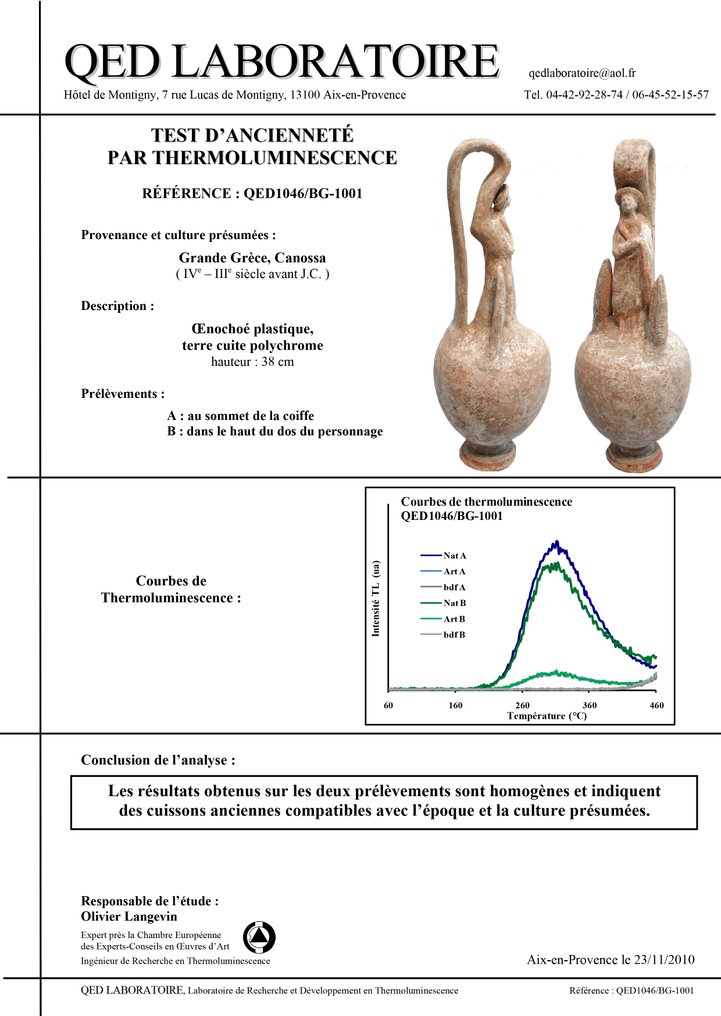
Attached thermoluminescence test
CONDITION: Good overall condition, with some areas of restoration to the polychromy, see photos.
PROVENANCE: Private collection, París, before 1970.
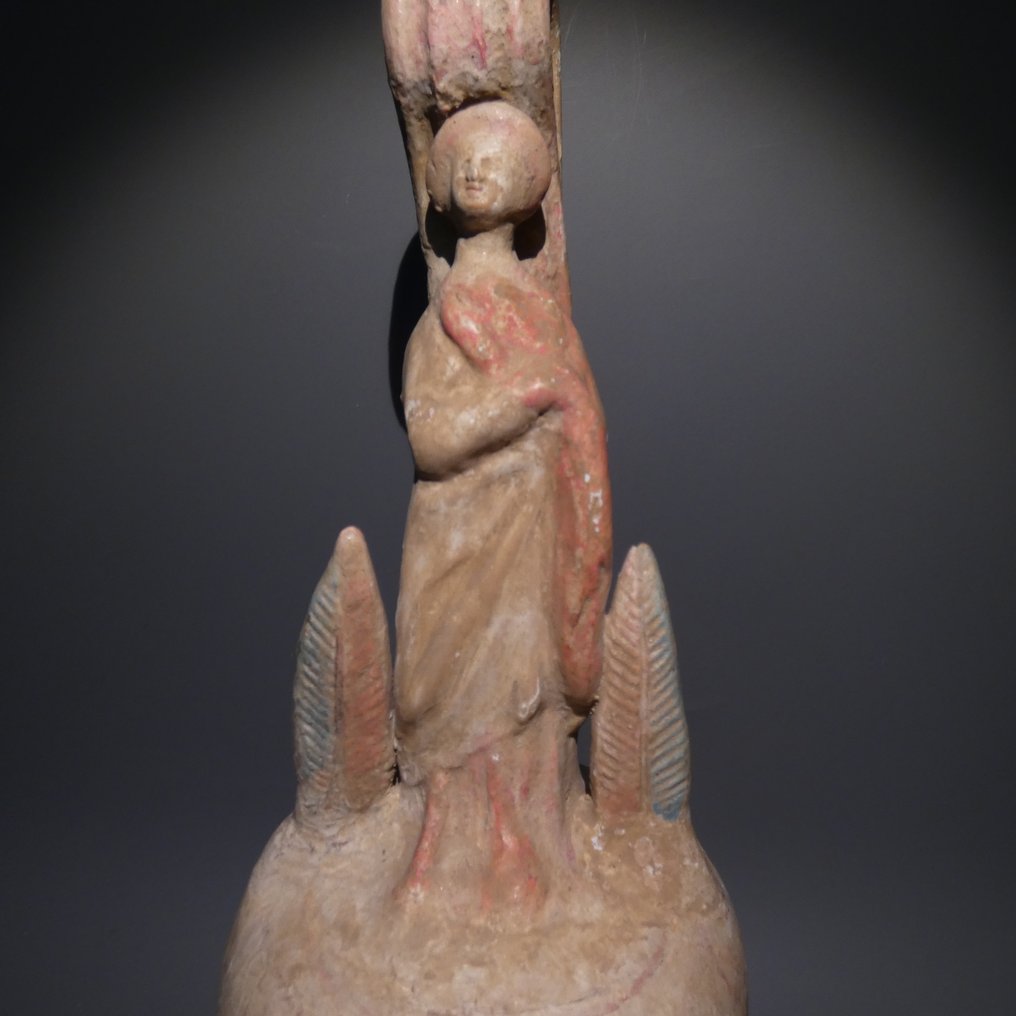
In the shape of a plastic-style oenochoe in polychrome terracotta. On the shoulder, two palmettes surround a young woman standing upright, dressed in a long peplum and a coat, leaning against a curved handle.
Magna Graecia was a region in southern Italy colonized by the Greeks between the 8th and 5th centuries BC. Canosa, known in ancient times as Canusium, although not a direct Greek colony, was strongly influenced by Hellenic culture due to its proximity to important Greek cities such as Taranto. This influence is reflected in its art, architecture, religion, and ceramics. Numerous funerary objects decorated with Greek motifs, such as craters and amphorae, have been found in Canosa, evidence of a strong presence of Greek beliefs and customs. The city was an important cultural and commercial center, where Greek, Roman, and local elements mixed, creating a unique identity. It also stood out for its production of painted pottery and for maintaining religious practices linked to Greek cults. Overall, Canosa represents a remarkable example of the cultural syncretism that characterized Magna Graecia in ancient times.
The oinochoe is a type of ceramic vessel from ancient Greece used mainly for serving wine. Its name comes from the Greek words “oinos” (wine) and “cheo” (to pour). It is characterized by a single vertical handle and a clover-shaped or rounded mouth, which made it easier to pour the liquid without spilling it. It was generally part of the set used in symposia, social gatherings where wine was drunk and various topics were discussed. Oinochoai were made of ceramic and often decorated with mythological scenes, rituals, or scenes from everyday life, especially in the black-figure and red-figure styles. In addition to their functional use, some oinochoai were placed in funerary contexts as offerings. Their shape and decoration vary according to period and region, allowing archaeologists to identify specific styles. These vessels are a valuable source of information about the life and culture of ancient Greece.
Seller's Story
IMPORTANT NOTES:
-We are a professional seller.
- All items sold will come with their professional invoice.
- All items sold will come with their own Certificate of Authenticity (warranty document), including the description, image and provenance of the item.
- All items will be shipped via private courier with insurance (DHL express, CORREOS of Spain, or other similar with tracking number).
- All items when shipped (if required) will be declared as antiques over 100 years old and their price valued.
- For shipping outside of EU: Delivery time subject to customs clearance. Liability and Customs Regulations or Import Requirements applicable in the destination country are the sole responsibility of the buyer. We are not responsible for delays caused by customs procedures. Import taxes and vat are not included in the shipping costs. The import tax or VAT payable depends on the country of destination. Payments of any taxes or any disputes with the Customs Authorities are the sole responsibility of the buyer.
- For some of the items offered, for shipment outside the European Union it is necessary to obtain an Export Permit which will detail the payment by the buyer of Export Fees according to Spanish legislation. If it is necessary it will be mentioned in the description of the article, BECAUSE NOT IN ALL THE CASES IT IS LIKE THAT. These fees will be added to the invoice, at the buyer's expense. These export fees are fixed on the final auction price and the tax rate is not applied directly on the total value of the item to be exported, but rather the different percentages by sections are applied to it: Up to 6,000 euros: 5%. From 6,001 to 60,000 euros: 10%.
This export permit application process can take between 1-2 months maximum.
- We guarantee that he acquired this piece according to all national and international laws related to the ownership of cultural property.
Translated by Google TranslateFigurative Oenochoe
Ancient Greek, Magna Graecia, Canosa, 4th century BC
Height: 38 cm
Pottery
Attached thermoluminescence test
CONDITION: Good overall condition, with some areas of restoration to the polychromy, see photos.
PROVENANCE: Private collection, París, before 1970.
In the shape of a plastic-style oenochoe in polychrome terracotta. On the shoulder, two palmettes surround a young woman standing upright, dressed in a long peplum and a coat, leaning against a curved handle.
Magna Graecia was a region in southern Italy colonized by the Greeks between the 8th and 5th centuries BC. Canosa, known in ancient times as Canusium, although not a direct Greek colony, was strongly influenced by Hellenic culture due to its proximity to important Greek cities such as Taranto. This influence is reflected in its art, architecture, religion, and ceramics. Numerous funerary objects decorated with Greek motifs, such as craters and amphorae, have been found in Canosa, evidence of a strong presence of Greek beliefs and customs. The city was an important cultural and commercial center, where Greek, Roman, and local elements mixed, creating a unique identity. It also stood out for its production of painted pottery and for maintaining religious practices linked to Greek cults. Overall, Canosa represents a remarkable example of the cultural syncretism that characterized Magna Graecia in ancient times.
The oinochoe is a type of ceramic vessel from ancient Greece used mainly for serving wine. Its name comes from the Greek words “oinos” (wine) and “cheo” (to pour). It is characterized by a single vertical handle and a clover-shaped or rounded mouth, which made it easier to pour the liquid without spilling it. It was generally part of the set used in symposia, social gatherings where wine was drunk and various topics were discussed. Oinochoai were made of ceramic and often decorated with mythological scenes, rituals, or scenes from everyday life, especially in the black-figure and red-figure styles. In addition to their functional use, some oinochoai were placed in funerary contexts as offerings. Their shape and decoration vary according to period and region, allowing archaeologists to identify specific styles. These vessels are a valuable source of information about the life and culture of ancient Greece.
Seller's Story
IMPORTANT NOTES:
-We are a professional seller.
- All items sold will come with their professional invoice.
- All items sold will come with their own Certificate of Authenticity (warranty document), including the description, image and provenance of the item.
- All items will be shipped via private courier with insurance (DHL express, CORREOS of Spain, or other similar with tracking number).
- All items when shipped (if required) will be declared as antiques over 100 years old and their price valued.
- For shipping outside of EU: Delivery time subject to customs clearance. Liability and Customs Regulations or Import Requirements applicable in the destination country are the sole responsibility of the buyer. We are not responsible for delays caused by customs procedures. Import taxes and vat are not included in the shipping costs. The import tax or VAT payable depends on the country of destination. Payments of any taxes or any disputes with the Customs Authorities are the sole responsibility of the buyer.
- For some of the items offered, for shipment outside the European Union it is necessary to obtain an Export Permit which will detail the payment by the buyer of Export Fees according to Spanish legislation. If it is necessary it will be mentioned in the description of the article, BECAUSE NOT IN ALL THE CASES IT IS LIKE THAT. These fees will be added to the invoice, at the buyer's expense. These export fees are fixed on the final auction price and the tax rate is not applied directly on the total value of the item to be exported, but rather the different percentages by sections are applied to it: Up to 6,000 euros: 5%. From 6,001 to 60,000 euros: 10%.
This export permit application process can take between 1-2 months maximum.
- We guarantee that he acquired this piece according to all national and international laws related to the ownership of cultural property.
Translated by Google TranslateDetails
Culture
Ancient Greek, Magna Graecia
Century/ Timeframe
Canosa, 4th century BC.
Name of object
Figurative Oenochoe. 38 cm H. TL tested. 4th century BC.
Acquired from
Private collection
Year acquired
2025
Material
Terracotta
Country acquired from
France
Condition
Good
Previous owner acquired from
Private collection
Previous owner - year acquired
1970
Previous owner - country acquired from
France
I verify that I have obtained this object legally and that I am allowed to sell it
Yes
Disclaimer
The seller was informed by Catawiki about documentation requirements and guarantees the following: - the object was legally obtained, - the seller has the right to sell and/or export the object, as relevant, - the seller will provide the necessary provenance information and arrange required documentation and permits/licenses, as applicable and as per local laws, - the seller will notify the buyer of any delays in obtaining permits/licenses. By bidding, you acknowledge that import documentation may be required depending on your country of residence and that obtaining permits/licenses may cause delays in the delivery of your object.
The seller was informed by Catawiki about documentation requirements and guarantees the following: - the object was legally obtained, - the seller has the right to sell and/or export the object, as relevant, - the seller will provide the necessary provenance information and arrange required documentation and permits/licenses, as applicable and as per local laws, - the seller will notify the buyer of any delays in obtaining permits/licenses. By bidding, you acknowledge that import documentation may be required depending on your country of residence and that obtaining permits/licenses may cause delays in the delivery of your object.
