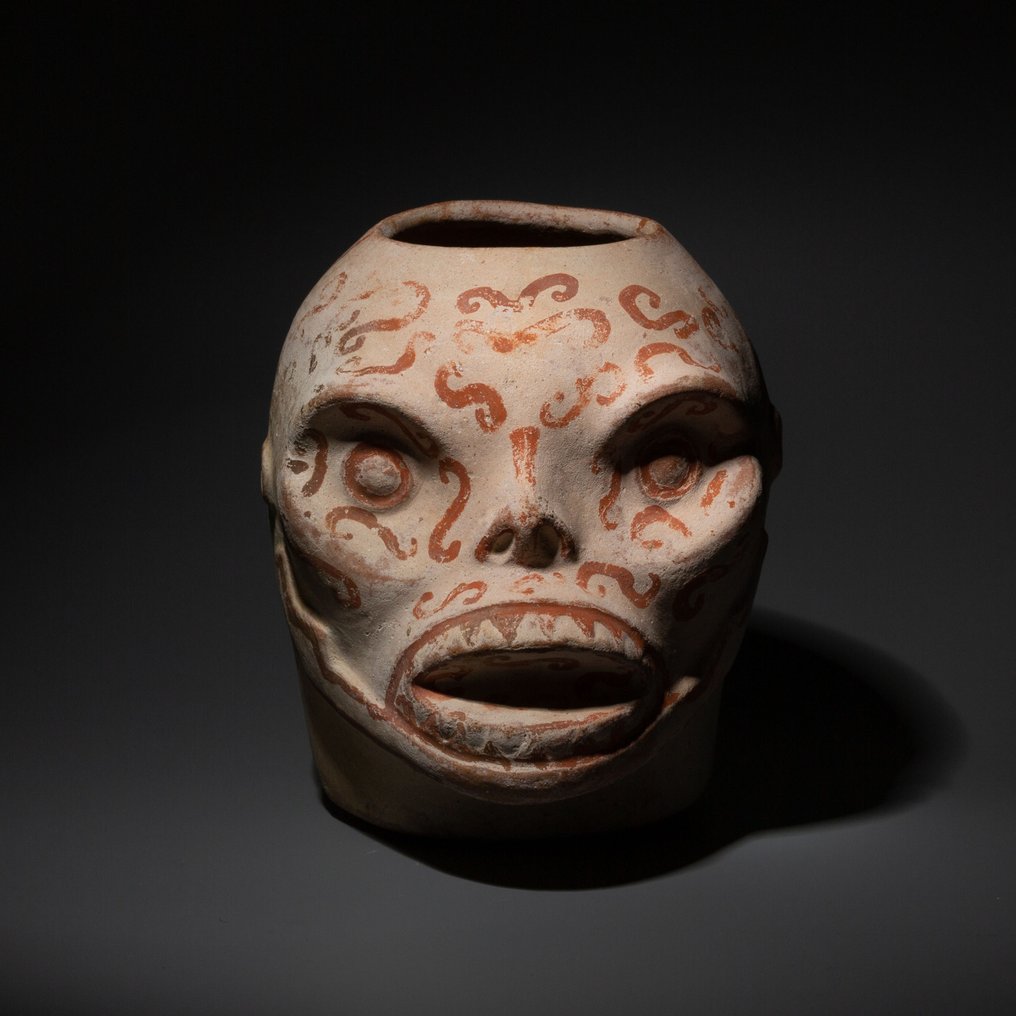
Moche, Perú Terracotta Skull shaped bowl. 200 - 600 AD. 13 cm Height. TL Tested. Spanish Import License.


06
days
00
hours
18
minutes
25
seconds
Current bid
€ 50
Reserve price not met

Expert
Selected by Ruth Garrido Vila
Directed the Ifergan Collection Museum, specialising in Phoenician and Mediterranean archaeology.
Estimate € 5,000 - € 5,500
10 other people are watching this object
 Bidder 2709 Bidder 2709 | €50 |
|---|
Catawiki Buyer Protection
Your payment’s safe with us until you receive your object.View details
Trustpilot 4.4 | 123779 reviews
Rated Excellent on Trustpilot.
A terracotta skull-shaped bowl from the Moche culture of Peru, dating to 200–600 AD and measuring 13 cm high, in very good condition with some superficial polychrome wear and accompanied by a Spanish Import License and an authenticity certificate.
AI-assisted summary
Description from the seller
Huaco with bat-shaped deity.
Moche, Perú, 200 - 600 AD.
Terracotta.
Height 13 cm.
CONDITION: Good condition. Without restorations, it presents superficial wear in part of the polychrome.
PROVENANCE: Private collection, Paris, France. 1960 – 1970.
DOCUMENTATION: Spanish Import license included.
DESCRIPTION:
Bowl made of clay in the shape of a human skull, probably representing a supernatural character given the expressiveness of the face. The large eye sockets are not empty, but house two round eyes that protrude with a slight relief; also the nose, although thin and flat, brings a certain aspect of life to the representation. The rest of the features reveal the advance of death: the mouth, very open and with well differentiated teeth, projects towards the front, and the ears are two simple orifices, worked in relief. The jaw has also been highlighted by reproducing the shape of the bone, with a stepped profile. The result is a representation halfway between the world of the living and the dead, whose supernatural character is accentuated by the polychrome, with motifs brushed in an orange-red pigment on the white engobe base. In addition to the outlines of the facial features, there are S-shaped brackets arranged in an orderly fashion around the face, even occupying the inside of the mouth and the eye sockets. The back of the head, on the other hand, is decorated with two bands of vertical bands, differentiating the nape of the neck from the crown.
Within Mochica ceramics, this type of representation of skeletal characters is common, whose symbolic meaning alludes to the interrelationship between life and death, to their complementary nature. It has also been suggested that these animated figures of the dead could represent a state of transition between life and death; in fact, on numerous occasions these skeletal figures are represented in everyday scenes, even having sexual relations. These images could also be related to the various types of ritual death of the Mochica culture, which included the fleshing and subsequent exposure of the remains of sacrificial victims or ritual punishment. In fact, such practices are often illustrated in detail on Mochica ceramics.
Settled on the northern coast of Peru, the Moche culture developed in the valleys of Lambayeque, Chicama, Moche and Viru, between the first and eighth centuries AD. At its peak, the culture was organized into two independent states, which controlled the northern and southern regions and shared the same highly hierarchical social structure, dominated by a warrior caste. At the base of the social pyramid were slaves, prisoners of war who were often sacrificed in honor of the deities.
Within the Mochica art, their exquisite pottery was especially outstanding, which evidences a very high technical and artistic mastery. There were several specialized ceramic workshops that worked with molds to obtain a serial production. The Mochica vases show a wide variety of typologies, among which the plastic vases worked as round sculptures stand out, representing all kinds of scenes and characters from daily life, the supernatural world and the ritual context, and even offer portraits of prominent figures of the society.
BIBLIOGRAPHY:
- CASTILLO, L.J. La ceremonia del sacrificio, batallas y muerte en el arte mochica. Museo Arqueológico Rafael Larco Herrera. 2000.
- DONNAN, C. Moche Art of Peru. Pre-Columbian Symbolic Communication. University of California Press. 1978.
- SAWYER, A.R. Ancient Peruvian Ceramics: the Nathan Cummings Collection. The Metropolitan Museum of Art. 1966.
PARALLELS: Fig. 1 Stirrup huaco in the shape of a skull. Moche, north coast of Peru, s. II-V AD, polychrome ceramic. Chicago Art Institute (USA), inv. 1958.566.
Notes:
- The piece includes authenticity certificate.
- The piece includes Spanish Export License (Passport for European Union) - If the piece is destined outside the European Union a substitution of the export permit should be requested, can take between 1-2 weeks maximum.
- The seller guarantees that he acquired this piece according to all national and international laws related to the ownership of cultural property. Provenance statement seen by Catawiki.
Seller's Story
Gallery of Ancient Art - Archeology based in Barcelona with more than fifteen years of experience. Specialized in classical art, Egyptian art, Asian art and pre-Columbian art. It guarantees the authenticity of all its pieces. It participates in the most important art fairs in Spain, such as Feriarte, as well as in fairs abroad, BRAFA, Parcours des Mondes, Cultures Brussels.
All the pieces are sent with an Export Permit issued by the Spanish Ministry of Culture.
We are quick to ship via DHL Express or Direct Art Transport.
Translated by Google TranslateHuaco with bat-shaped deity.
Moche, Perú, 200 - 600 AD.
Terracotta.
Height 13 cm.
CONDITION: Good condition. Without restorations, it presents superficial wear in part of the polychrome.
PROVENANCE: Private collection, Paris, France. 1960 – 1970.
DOCUMENTATION: Spanish Import license included.
DESCRIPTION:
Bowl made of clay in the shape of a human skull, probably representing a supernatural character given the expressiveness of the face. The large eye sockets are not empty, but house two round eyes that protrude with a slight relief; also the nose, although thin and flat, brings a certain aspect of life to the representation. The rest of the features reveal the advance of death: the mouth, very open and with well differentiated teeth, projects towards the front, and the ears are two simple orifices, worked in relief. The jaw has also been highlighted by reproducing the shape of the bone, with a stepped profile. The result is a representation halfway between the world of the living and the dead, whose supernatural character is accentuated by the polychrome, with motifs brushed in an orange-red pigment on the white engobe base. In addition to the outlines of the facial features, there are S-shaped brackets arranged in an orderly fashion around the face, even occupying the inside of the mouth and the eye sockets. The back of the head, on the other hand, is decorated with two bands of vertical bands, differentiating the nape of the neck from the crown.
Within Mochica ceramics, this type of representation of skeletal characters is common, whose symbolic meaning alludes to the interrelationship between life and death, to their complementary nature. It has also been suggested that these animated figures of the dead could represent a state of transition between life and death; in fact, on numerous occasions these skeletal figures are represented in everyday scenes, even having sexual relations. These images could also be related to the various types of ritual death of the Mochica culture, which included the fleshing and subsequent exposure of the remains of sacrificial victims or ritual punishment. In fact, such practices are often illustrated in detail on Mochica ceramics.
Settled on the northern coast of Peru, the Moche culture developed in the valleys of Lambayeque, Chicama, Moche and Viru, between the first and eighth centuries AD. At its peak, the culture was organized into two independent states, which controlled the northern and southern regions and shared the same highly hierarchical social structure, dominated by a warrior caste. At the base of the social pyramid were slaves, prisoners of war who were often sacrificed in honor of the deities.
Within the Mochica art, their exquisite pottery was especially outstanding, which evidences a very high technical and artistic mastery. There were several specialized ceramic workshops that worked with molds to obtain a serial production. The Mochica vases show a wide variety of typologies, among which the plastic vases worked as round sculptures stand out, representing all kinds of scenes and characters from daily life, the supernatural world and the ritual context, and even offer portraits of prominent figures of the society.
BIBLIOGRAPHY:
- CASTILLO, L.J. La ceremonia del sacrificio, batallas y muerte en el arte mochica. Museo Arqueológico Rafael Larco Herrera. 2000.
- DONNAN, C. Moche Art of Peru. Pre-Columbian Symbolic Communication. University of California Press. 1978.
- SAWYER, A.R. Ancient Peruvian Ceramics: the Nathan Cummings Collection. The Metropolitan Museum of Art. 1966.
PARALLELS: Fig. 1 Stirrup huaco in the shape of a skull. Moche, north coast of Peru, s. II-V AD, polychrome ceramic. Chicago Art Institute (USA), inv. 1958.566.
Notes:
- The piece includes authenticity certificate.
- The piece includes Spanish Export License (Passport for European Union) - If the piece is destined outside the European Union a substitution of the export permit should be requested, can take between 1-2 weeks maximum.
- The seller guarantees that he acquired this piece according to all national and international laws related to the ownership of cultural property. Provenance statement seen by Catawiki.
Seller's Story
Gallery of Ancient Art - Archeology based in Barcelona with more than fifteen years of experience. Specialized in classical art, Egyptian art, Asian art and pre-Columbian art. It guarantees the authenticity of all its pieces. It participates in the most important art fairs in Spain, such as Feriarte, as well as in fairs abroad, BRAFA, Parcours des Mondes, Cultures Brussels.
All the pieces are sent with an Export Permit issued by the Spanish Ministry of Culture.
We are quick to ship via DHL Express or Direct Art Transport.
Translated by Google TranslateDetails
Culture
Moche, Perú
Century/ Timeframe
200 - 600 AD
Name of object
Skull shaped bowl. 200 - 600 AD. 13 cm Height. TL Tested. Spanish Import License.
Acquired from
Private collection
Material
Terracotta
Condition
Very good
Disclaimer
The seller was informed by Catawiki about documentation requirements and guarantees the following: - the object was legally obtained, - the seller has the right to sell and/or export the object, as relevant, - the seller will provide the necessary provenance information and arrange required documentation and permits/licenses, as applicable and as per local laws, - the seller will notify the buyer of any delays in obtaining permits/licenses. By bidding, you acknowledge that import documentation may be required depending on your country of residence and that obtaining permits/licenses may cause delays in the delivery of your object.
The seller was informed by Catawiki about documentation requirements and guarantees the following: - the object was legally obtained, - the seller has the right to sell and/or export the object, as relevant, - the seller will provide the necessary provenance information and arrange required documentation and permits/licenses, as applicable and as per local laws, - the seller will notify the buyer of any delays in obtaining permits/licenses. By bidding, you acknowledge that import documentation may be required depending on your country of residence and that obtaining permits/licenses may cause delays in the delivery of your object.
