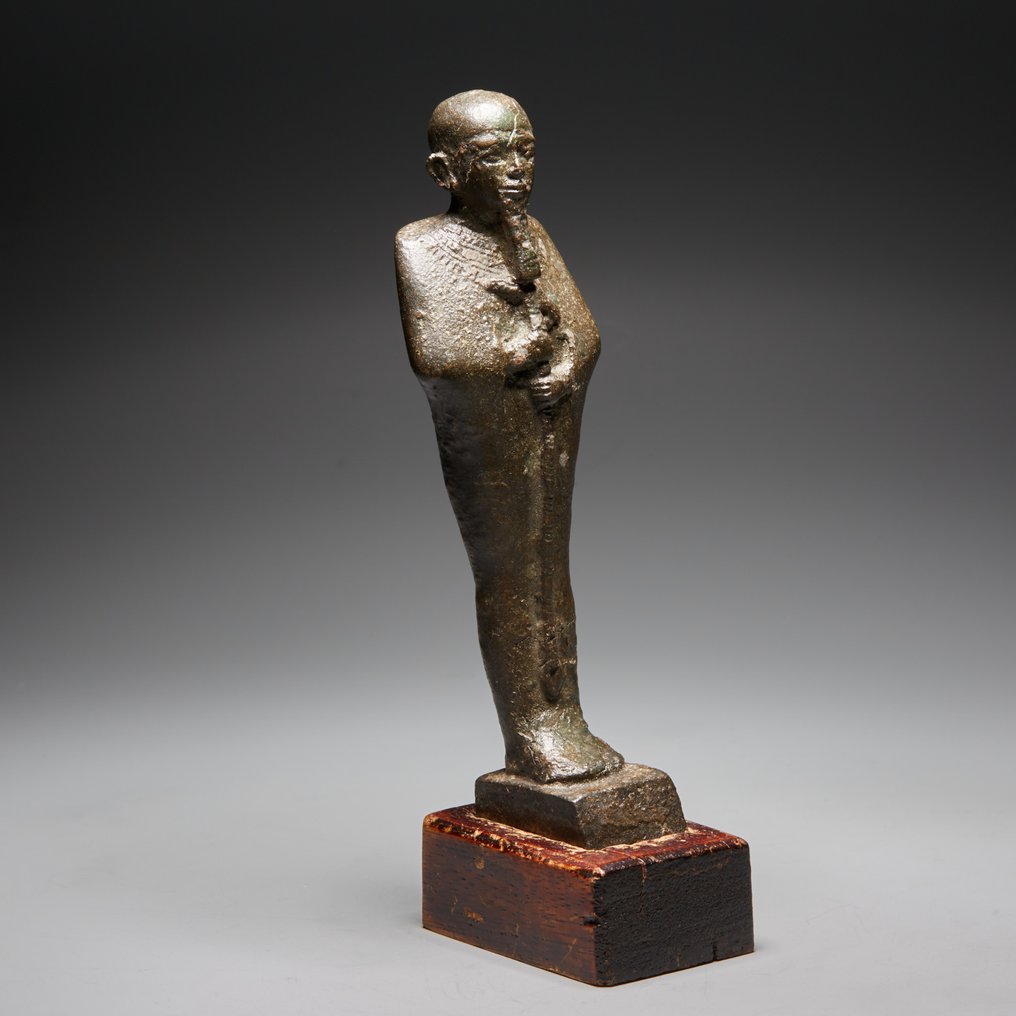
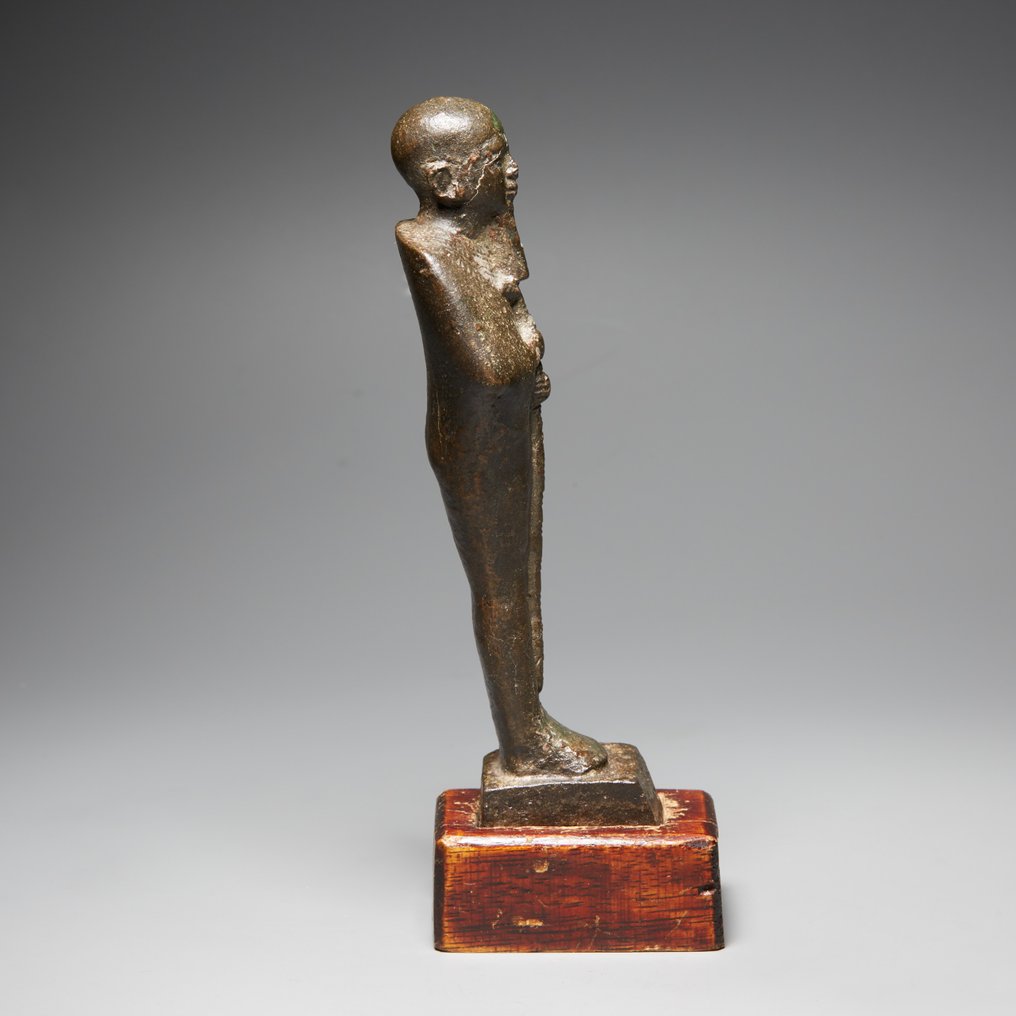
Ancient Egyptian Bronze God Ptah. Late Period, 664 - 332 BC. 12 cm height.



07
days
06
hours
26
minutes
29
seconds
Current bid
€ 100
Reserve price not met

Expert
Selected by Ruth Garrido Vila
Directed the Ifergan Collection Museum, specialising in Phoenician and Mediterranean archaeology.
Estimate € 8,000 - € 8,800
18 other people are watching this object
 Bidder 0167 Bidder 0167 | €100 |
|---|
Catawiki Buyer Protection
Your payment’s safe with us until you receive your object.View details
Trustpilot 4.4 | 123759 reviews
Rated Excellent on Trustpilot.
Ancient Egyptian bronze sculpture of Ptah from the Late Period (664–332 BC), about 12 cm high (14 cm with stand), in good condition, from a private French collection.
AI-assisted summary
Description from the seller
God Ptah.
Ancient Egypt, Late Period, 664 - 332 BC.
Bronze.
12 cm height and 14 cm with the stand.
CONDITION: Good condition.
PROVENANCE: Private collection, France. Acquired before the 1970's.
DESCRIPTION:
A solid bronze sculpture representing the Egyptian deity Ptah. He is wearing a shroud from head to foot which closely hugs his body. The arms are outlined but the hands alone are visible. An usekh, or wide collar, circles his neck. Usekhs are typical accessories of Egyptian deities and nobility. The most commonly used typology is made up of various rows of beads. The head is totally covered by a smooth, tightly-fitting helmet, characteristic of this god, and also used by priests. He is the only god, moreover, who has a straight beard, as the one normally seen is curved upward at the end. These two attributes are those associated with Ptah.
The hands of the god, holding a was sceptre, the symbol of authority and power, project from two vertical openings in the shroud. The sceptre is a straight rod with the lower end in the form of a hook and the upper end showing some sort of fabulous animal which cannot for the moment be identified.
Although Ptah is not one of the most famous gods, he is one of the most important in the Egyptian pantheon. His name may mean “the Creator”. He was the sovereign of all the gods as he created the universe through “Thought”. He is also known by other epithets such as the “Lord of Magic”, the “Lord of Darkness” and the “Lord of Truth”. He was originally associated with Memphis, the capital of the Old Kingdom. From the time of the New Kingdom, he formed part of a triad with his wife, Sekhmet, and his son, Nefertem. He was also a funerary god: in pictorial depictions he appears with a green face, a sign that he is a god of the Afterlife, just like Osiris.
One of the most important functions of Ptah was as the patron of craftsmen, above all, of sculptors and metal craftsmen. He was considered to be the inventor of manual practices and techniques, and was worshipped in the town well-known for its craftsmen, Deir el-Medina. The working of jewellery was usually done by dwarfs, and these were under the protection of Ptah and his sons, the Pataikos.
This statuette of Ptah was made using the lost wax technique, a technique in sculpture where a mould is first made from a prototype traditionally sculpted in beeswax. This is covered by a thick layer of soft material, usually clay, which solidifies. Once this is done it is fired in an oven where the wax melts and comes out of the mould through specially made perforations. Molten metal is then injected into the mould and takes on its exact form. To release the final piece the mould must be removed.
PARALLELS:
- Figure of the god Ptah. Bronze. Dynasty XXVI 664–525 BC. Dallas Museum of Art. University of Pennsylvania Museum (USA). E14294.
BIBLIOGRAPHY:
- SILVERMAN, D. Searching for Ancient Egypt: Art, Architecture and Artefacts from the University of Pennsylvania Museum. Pennsylvania University Press. 1997. Fig. 3.
- WILKINSON H. R. The Complete Gods and Goddesses of Ancient Egypt. London. 2003.
Notes:
- The piece includes authenticity certificate.
- The piece includes Spanish Export License.
- The seller guarantees that he acquired this piece according to all national and international laws related to the ownership of cultural property. Provenance statement seen by Catawiki.
#ExclusiveCabinetofCuriosities
Seller's Story
Gallery of Ancient Art - Archeology based in Barcelona with more than fifteen years of experience. Specialized in classical art, Egyptian art, Asian art and pre-Columbian art. It guarantees the authenticity of all its pieces. It participates in the most important art fairs in Spain, such as Feriarte, as well as in fairs abroad, BRAFA, Parcours des Mondes, Cultures Brussels.
All the pieces are sent with an Export Permit issued by the Spanish Ministry of Culture.
We are quick to ship via DHL Express or Direct Art Transport.
Translated by Google TranslateGod Ptah.
Ancient Egypt, Late Period, 664 - 332 BC.
Bronze.
12 cm height and 14 cm with the stand.
CONDITION: Good condition.
PROVENANCE: Private collection, France. Acquired before the 1970's.
DESCRIPTION:
A solid bronze sculpture representing the Egyptian deity Ptah. He is wearing a shroud from head to foot which closely hugs his body. The arms are outlined but the hands alone are visible. An usekh, or wide collar, circles his neck. Usekhs are typical accessories of Egyptian deities and nobility. The most commonly used typology is made up of various rows of beads. The head is totally covered by a smooth, tightly-fitting helmet, characteristic of this god, and also used by priests. He is the only god, moreover, who has a straight beard, as the one normally seen is curved upward at the end. These two attributes are those associated with Ptah.
The hands of the god, holding a was sceptre, the symbol of authority and power, project from two vertical openings in the shroud. The sceptre is a straight rod with the lower end in the form of a hook and the upper end showing some sort of fabulous animal which cannot for the moment be identified.
Although Ptah is not one of the most famous gods, he is one of the most important in the Egyptian pantheon. His name may mean “the Creator”. He was the sovereign of all the gods as he created the universe through “Thought”. He is also known by other epithets such as the “Lord of Magic”, the “Lord of Darkness” and the “Lord of Truth”. He was originally associated with Memphis, the capital of the Old Kingdom. From the time of the New Kingdom, he formed part of a triad with his wife, Sekhmet, and his son, Nefertem. He was also a funerary god: in pictorial depictions he appears with a green face, a sign that he is a god of the Afterlife, just like Osiris.
One of the most important functions of Ptah was as the patron of craftsmen, above all, of sculptors and metal craftsmen. He was considered to be the inventor of manual practices and techniques, and was worshipped in the town well-known for its craftsmen, Deir el-Medina. The working of jewellery was usually done by dwarfs, and these were under the protection of Ptah and his sons, the Pataikos.
This statuette of Ptah was made using the lost wax technique, a technique in sculpture where a mould is first made from a prototype traditionally sculpted in beeswax. This is covered by a thick layer of soft material, usually clay, which solidifies. Once this is done it is fired in an oven where the wax melts and comes out of the mould through specially made perforations. Molten metal is then injected into the mould and takes on its exact form. To release the final piece the mould must be removed.
PARALLELS:
- Figure of the god Ptah. Bronze. Dynasty XXVI 664–525 BC. Dallas Museum of Art. University of Pennsylvania Museum (USA). E14294.
BIBLIOGRAPHY:
- SILVERMAN, D. Searching for Ancient Egypt: Art, Architecture and Artefacts from the University of Pennsylvania Museum. Pennsylvania University Press. 1997. Fig. 3.
- WILKINSON H. R. The Complete Gods and Goddesses of Ancient Egypt. London. 2003.
Notes:
- The piece includes authenticity certificate.
- The piece includes Spanish Export License.
- The seller guarantees that he acquired this piece according to all national and international laws related to the ownership of cultural property. Provenance statement seen by Catawiki.
#ExclusiveCabinetofCuriosities
Seller's Story
Gallery of Ancient Art - Archeology based in Barcelona with more than fifteen years of experience. Specialized in classical art, Egyptian art, Asian art and pre-Columbian art. It guarantees the authenticity of all its pieces. It participates in the most important art fairs in Spain, such as Feriarte, as well as in fairs abroad, BRAFA, Parcours des Mondes, Cultures Brussels.
All the pieces are sent with an Export Permit issued by the Spanish Ministry of Culture.
We are quick to ship via DHL Express or Direct Art Transport.
Translated by Google TranslateDetails
Culture
Ancient Egyptian
Century/ Timeframe
Late Period, 664 - 332 BC
Name of object
God Ptah. Late Period, 664 - 332 BC. 12 cm height.
Acquired from
Auction house
Year acquired
2025
Material
Bronze
Country acquired from
France
Condition
Good
Previous owner acquired from
Private collection
Previous owner - year acquired
1970
Previous owner - country acquired from
France
I verify that I have obtained this object legally and that I am allowed to sell it
Yes
Disclaimer
The seller was informed by Catawiki about documentation requirements and guarantees the following: - the object was legally obtained, - the seller has the right to sell and/or export the object, as relevant, - the seller will provide the necessary provenance information and arrange required documentation and permits/licenses, as applicable and as per local laws, - the seller will notify the buyer of any delays in obtaining permits/licenses. By bidding, you acknowledge that import documentation may be required depending on your country of residence and that obtaining permits/licenses may cause delays in the delivery of your object.
The seller was informed by Catawiki about documentation requirements and guarantees the following: - the object was legally obtained, - the seller has the right to sell and/or export the object, as relevant, - the seller will provide the necessary provenance information and arrange required documentation and permits/licenses, as applicable and as per local laws, - the seller will notify the buyer of any delays in obtaining permits/licenses. By bidding, you acknowledge that import documentation may be required depending on your country of residence and that obtaining permits/licenses may cause delays in the delivery of your object.
