Megalodon - Fossil tooth - 7.3 cm (No reserve price)




01
day
09
hours
14
minutes
06
seconds

19 other people are watching this object
 Bidder 4192 Bidder 4192 | €25 | |
|---|---|---|
 Bidder 1189 Bidder 1189 | €4 | |
 Bidder 2894 Bidder 2894 | €3 |
Catawiki Buyer Protection
Your payment’s safe with us until you receive your object.View details
Trustpilot 4.4 | 123759 reviews
Rated Excellent on Trustpilot.
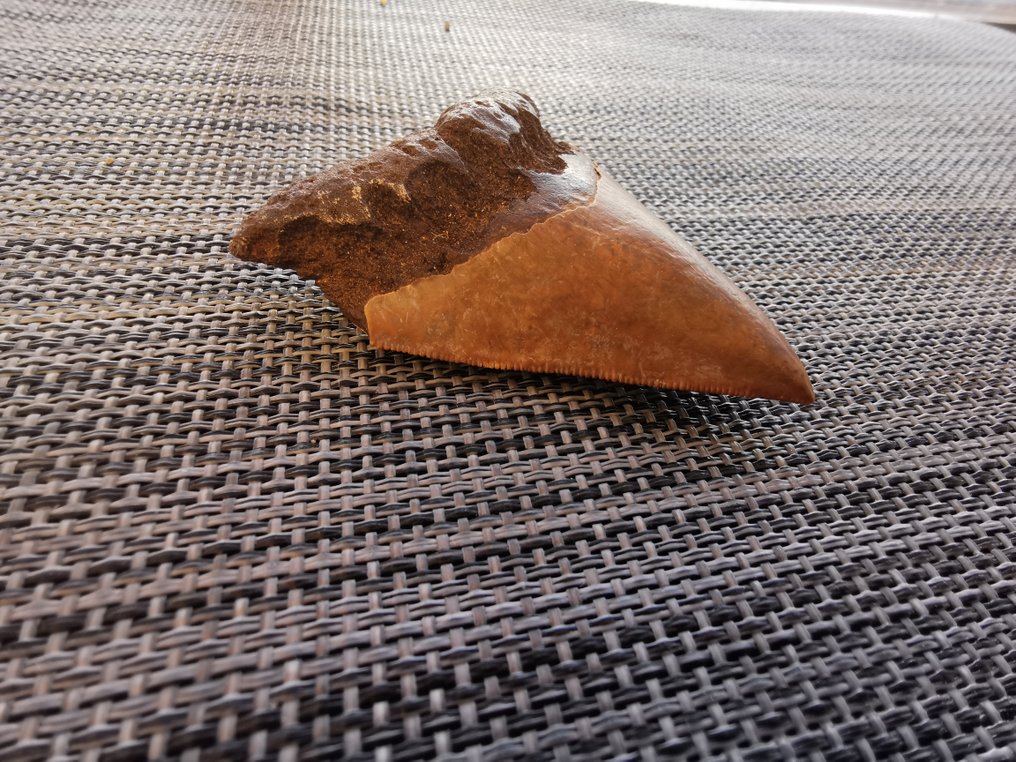
Specimen Megalodon from Indonesia, dating to the Neogene Miocene, in natural condition, 7.3 cm long and 6.1 cm wide.
AI-assisted summary
Description from the seller
→ 7.3 cm long x 6.1 cm wide Otudus Megalodon teeth
It is medium-small profile Megolodon teeth whose looks and features are very different than most of other Indonesian teeth. This can be clearly seen in the root region as well in the color of the teeth which is black-dark brownish-maroon and compex mix of colors. The reason for this is due to presence of different fossilization conditions like mineral, moistures, pressure and the overall chemistry of the surrounding region of the teeth during its prolonged fossilization process which spanned somewhere between for 23 to 3.6 million years (Mya), from the Early Miocene to the Early Pliocene epochs.
The root region has big and small pits and is eroded during the process while the body of the teeth is intact with nice serrations. The bourlette can also be seen although it has blended into root color. The tooth seem to be that at the back of the mouth which are smaller in size compared to those in front. The teeth is roughly square in shape with roughly same legth and width.
Overall its a very nice, unique and rare teeth. The teeth is in natural state as well.
Please refer to detail photos for reference.
→ 7.3 cm long x 6.1 cm wide Otudus Megalodon teeth
It is medium-small profile Megolodon teeth whose looks and features are very different than most of other Indonesian teeth. This can be clearly seen in the root region as well in the color of the teeth which is black-dark brownish-maroon and compex mix of colors. The reason for this is due to presence of different fossilization conditions like mineral, moistures, pressure and the overall chemistry of the surrounding region of the teeth during its prolonged fossilization process which spanned somewhere between for 23 to 3.6 million years (Mya), from the Early Miocene to the Early Pliocene epochs.
The root region has big and small pits and is eroded during the process while the body of the teeth is intact with nice serrations. The bourlette can also be seen although it has blended into root color. The tooth seem to be that at the back of the mouth which are smaller in size compared to those in front. The teeth is roughly square in shape with roughly same legth and width.
Overall its a very nice, unique and rare teeth. The teeth is in natural state as well.
Please refer to detail photos for reference.
Details
Number of items
1
Specimen
Megalodon
Country of Origin
Indonesia
Geological Period
Neogene, Miocene (23.03 - 5.33 million years)
Condition
Natural
Height
7.3 cm
Depth
6.1 cm
Sold by
