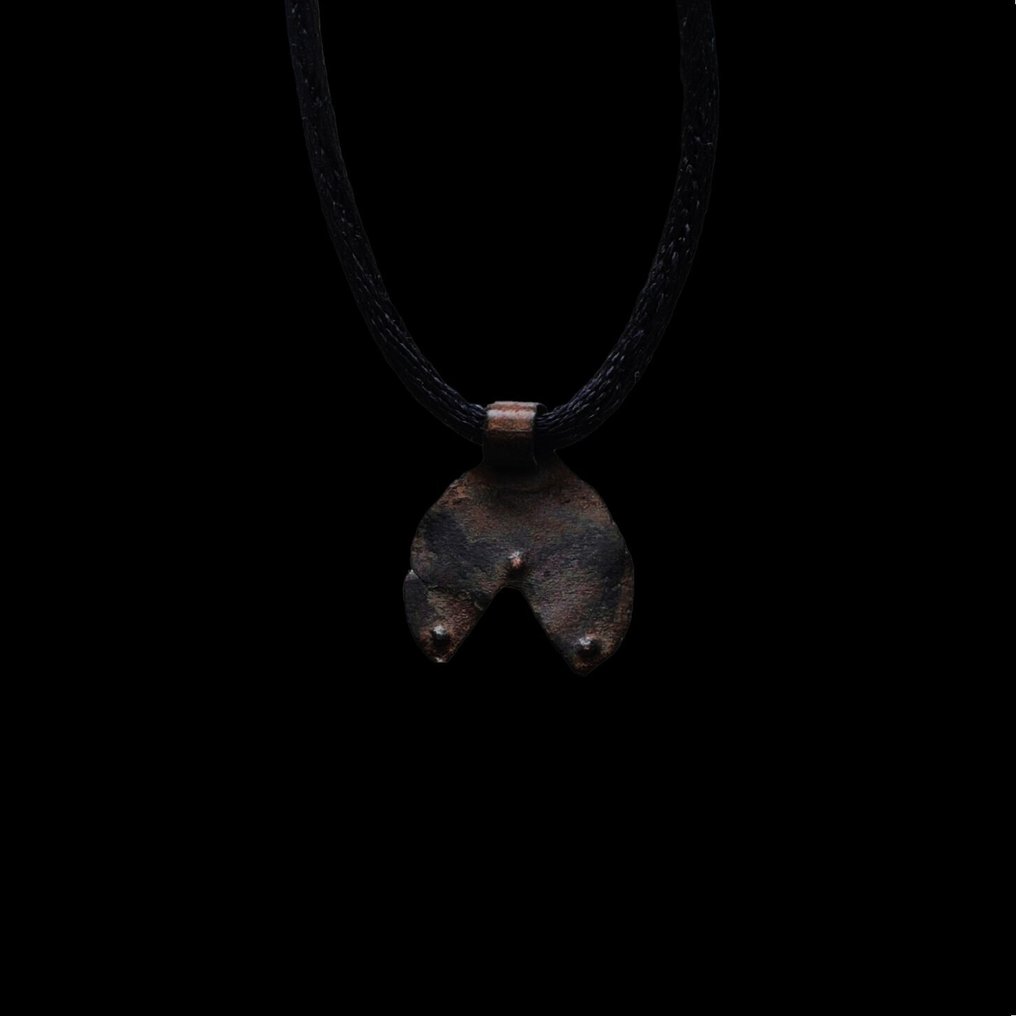
Early medieval Bronze Beautiful and Rare Lucky Amulet (No reserve price)


01
day
03
hours
51
minutes
32
seconds
Current bid
€ 25
No reserve price

Expert
Selected by Ruth Garrido Vila
Directed the Ifergan Collection Museum, specialising in Phoenician and Mediterranean archaeology.
Estimate € 150 - € 200
10 other people are watching this object
 Bidder 2314 Bidder 2314 | €25 | |
|---|---|---|
| Bidder 8890 | €20 | |
| Bidder 2314 | €20 | |
Catawiki Buyer Protection
Your payment’s safe with us until you receive your object.View details
Trustpilot 4.4 | 123951 reviews
Rated Excellent on Trustpilot.
Beautiful and Rare Lucky Amulet, a bronze Early Medieval pendant from circa 6th–10th century, in excellent condition, acquired from an auction house in the Netherlands in 2025, previously owned from a private collection since 1998 with origins in Germany, featuring a front with three raised bosses and a suspension loop and a plain reverse.
AI-assisted summary
Description from the seller
Material: Bronze (copper alloy)
Period: Early Medieval period (circa 6th–10th century AD)
Condition: Good archaeological condition with natural patina and wear consistent with age
This rare early medieval bronze amulet features a distinctive stylized insect form, visually reminiscent of a ladybird (ladybug) seen from above. The pendant is symmetrical, with two rounded lobes suggesting wings, three raised bosses on the front, and a suspension loop at the top for wearing.
Such abstract insect-shaped amulets are well known in early medieval folk cultures and are commonly interpreted as lucky or protective charms, associated with:
good fortune
fertility and renewal
protection against misfortune
The ladybird, in particular, has long been regarded in European folklore as a symbol of luck and blessing, making this amulet especially appealing as a “lucky charm”.
The reverse is plain, while the front displays carefully placed raised dots, possibly symbolic rather than decorative. The surface shows a beautiful, undisturbed patina, indicating genuine age and long burial.
A fine and evocative piece of early medieval folk jewelry, suitable for collectors of ancient amulets, medieval artifacts, or symbolic jewelry with positive associations.
A rare and meaningful lucky amulet with strong visual presence and historical charm.
Material: Bronze (copper alloy)
Period: Early Medieval period (circa 6th–10th century AD)
Condition: Good archaeological condition with natural patina and wear consistent with age
This rare early medieval bronze amulet features a distinctive stylized insect form, visually reminiscent of a ladybird (ladybug) seen from above. The pendant is symmetrical, with two rounded lobes suggesting wings, three raised bosses on the front, and a suspension loop at the top for wearing.
Such abstract insect-shaped amulets are well known in early medieval folk cultures and are commonly interpreted as lucky or protective charms, associated with:
good fortune
fertility and renewal
protection against misfortune
The ladybird, in particular, has long been regarded in European folklore as a symbol of luck and blessing, making this amulet especially appealing as a “lucky charm”.
The reverse is plain, while the front displays carefully placed raised dots, possibly symbolic rather than decorative. The surface shows a beautiful, undisturbed patina, indicating genuine age and long burial.
A fine and evocative piece of early medieval folk jewelry, suitable for collectors of ancient amulets, medieval artifacts, or symbolic jewelry with positive associations.
A rare and meaningful lucky amulet with strong visual presence and historical charm.
Details
Culture
Early medieval
Century/ Timeframe
Circa, 6th–10th century
Name of object
Beautiful and Rare Lucky Amulet
Acquired from
Auction house
Year acquired
2025
Material
Bronze
Country acquired from
Netherlands
Condition
Excellent
Previous owner acquired from
Private collection
Previous owner - year acquired
1998
Previous owner - country acquired from
Germany
I verify that I have obtained this object legally and that I am allowed to sell it
Yes
Sold by
