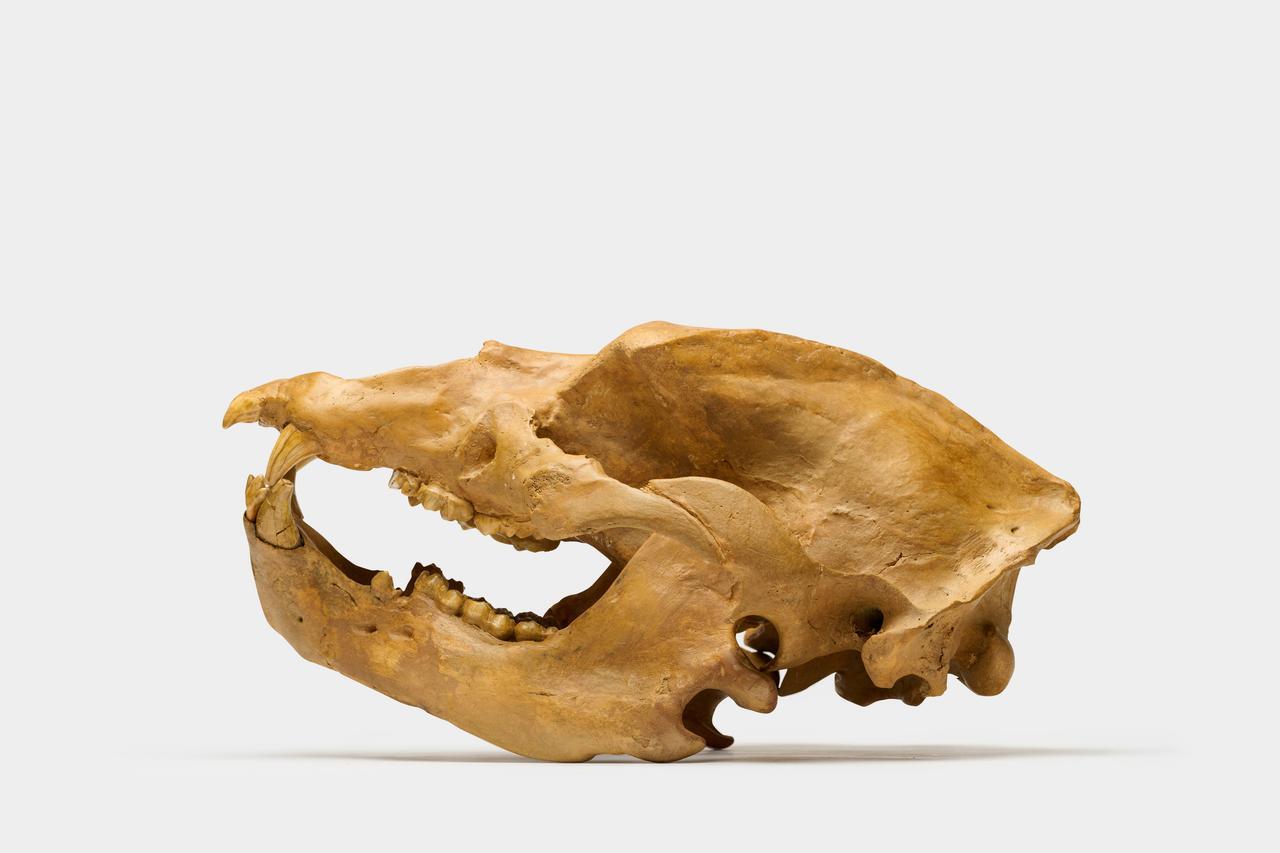
Whale - Fossil tooth - Basilosaurus - 8.8 cm (No reserve price)


04
days
22
hours
07
minutes
17
seconds

11 other people are watching this object
 Bidder 2385 Bidder 2385 | €2 | |
|---|---|---|
 Bidder 4269 Bidder 4269 | €1 |
Catawiki Buyer Protection
Your payment’s safe with us until you receive your object.View details
Trustpilot 4.4 | 123718 reviews
Rated Excellent on Trustpilot.
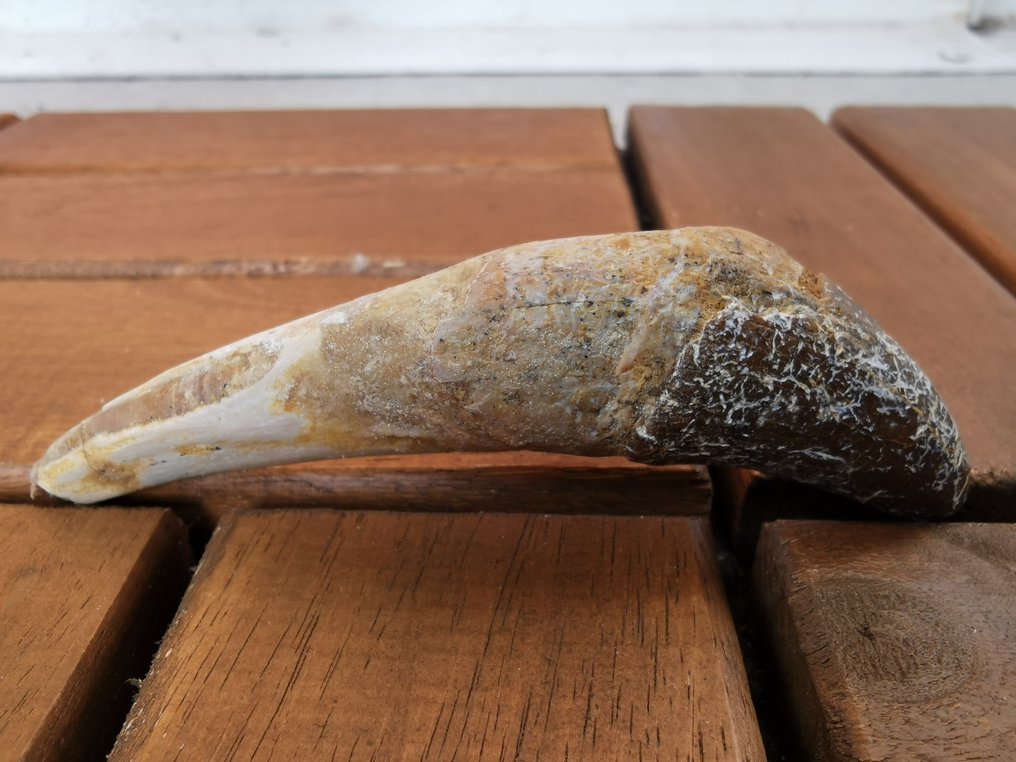
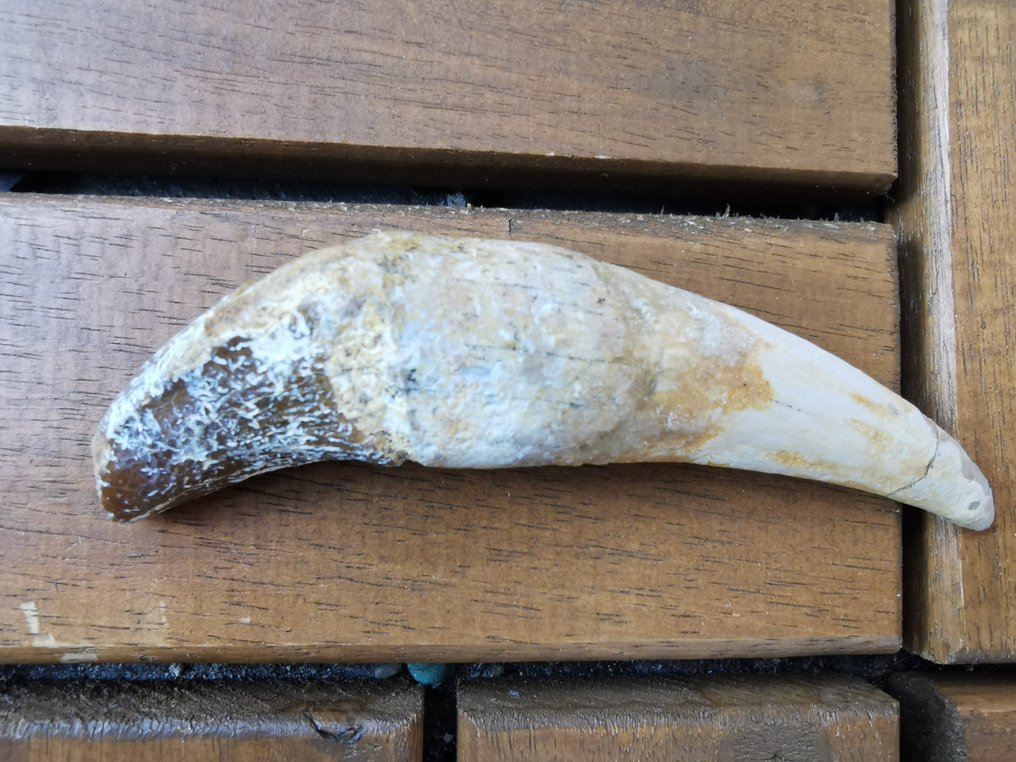
Basilosaurus canine tooth fossil from Morocco, dating to the Paleogene Eocene (56–33.9 million years ago), a whale specimen, restored and conserved, height 8.8 cm.
AI-assisted summary
Description from the seller
→ 8.8 cm Basilosaurus canine teeth
It is a beautiful and nicely curved canine teeth of Basilosaurus which on average 35 million year old when Basilosaurus lived during the Late Eocene Epoch, as one of the first fully aquatic, predatory whales, thriving in warm, shallow seas.
It is a very interesting fossil revealing the unique curve of the front canine of Basilosaurus. The front incisors were more curved and less thicker than canines. The canines have less curvature & more thicker and have shorter teeth crowns than the canines. The reason being the fact that canines should more firmly hold onto to prey while delivering fatal puncture wounds.
The presented fossil because of its small size points to juvenile Basilosaurus. The enamel of the teeth has turned into brown with distinctive white marks due to fossilization process while the rest of the teeth & the root are in light color with marks of yellow color as well at some points probably due to presence of Iron during fossilization process which makes fossil somewhat yellow. The white lines on fossil is due to presence of Calcium and Silicate minerals during the fossilization process.
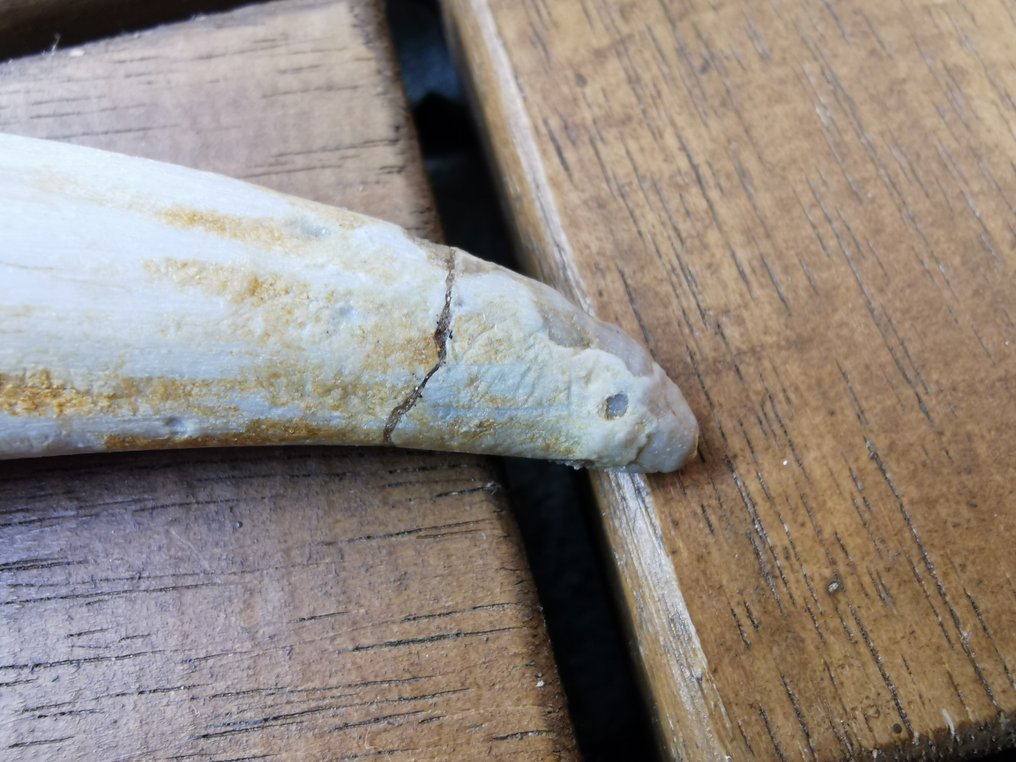
The tip is warn off at one side probably may be due to prolonged fossilization conditions or fossil retrieval or its natural wear & tear of teeth when this Basilosaurus was alive. Basically its a mix of all these three reasons.
The teeth looks like jumping whale as well making it very cool specimen.
Minor restoration work is performed at the end of the root region to make the canine long lasting. The teeth is professionally conserved as well.
Basilosaurus was a formidable hunter reaching length upto 20 meters (66 feet) and capable of taking down large prey with enormous bite force. One of the favourite prey of Basilosaurus was Durodon as well. Basilosaurus was the largest member of Basilosauridae family which included Durodon.
There is possibility that the teeth belong to some other Basilosauridae family member like Durodon or Zygorhiza as the difference is hard to tell.
Please refer to photos for reference. Different photos have been provided to give an idea about the shape, size, color and other features of the fossil.
→ 8.8 cm Basilosaurus canine teeth
It is a beautiful and nicely curved canine teeth of Basilosaurus which on average 35 million year old when Basilosaurus lived during the Late Eocene Epoch, as one of the first fully aquatic, predatory whales, thriving in warm, shallow seas.
It is a very interesting fossil revealing the unique curve of the front canine of Basilosaurus. The front incisors were more curved and less thicker than canines. The canines have less curvature & more thicker and have shorter teeth crowns than the canines. The reason being the fact that canines should more firmly hold onto to prey while delivering fatal puncture wounds.
The presented fossil because of its small size points to juvenile Basilosaurus. The enamel of the teeth has turned into brown with distinctive white marks due to fossilization process while the rest of the teeth & the root are in light color with marks of yellow color as well at some points probably due to presence of Iron during fossilization process which makes fossil somewhat yellow. The white lines on fossil is due to presence of Calcium and Silicate minerals during the fossilization process.
The tip is warn off at one side probably may be due to prolonged fossilization conditions or fossil retrieval or its natural wear & tear of teeth when this Basilosaurus was alive. Basically its a mix of all these three reasons.
The teeth looks like jumping whale as well making it very cool specimen.
Minor restoration work is performed at the end of the root region to make the canine long lasting. The teeth is professionally conserved as well.
Basilosaurus was a formidable hunter reaching length upto 20 meters (66 feet) and capable of taking down large prey with enormous bite force. One of the favourite prey of Basilosaurus was Durodon as well. Basilosaurus was the largest member of Basilosauridae family which included Durodon.
There is possibility that the teeth belong to some other Basilosauridae family member like Durodon or Zygorhiza as the difference is hard to tell.
Please refer to photos for reference. Different photos have been provided to give an idea about the shape, size, color and other features of the fossil.
Details
Number of items
1
Specimen
Whale
Scientific name
Basilosaurus
Country of Origin
Morocco
Geological Period
Paleogene, Eocene (56 - 33.9 million years)
Condition
Restored
Treatment
Conserved
Height
8.8 cm
Sold by